
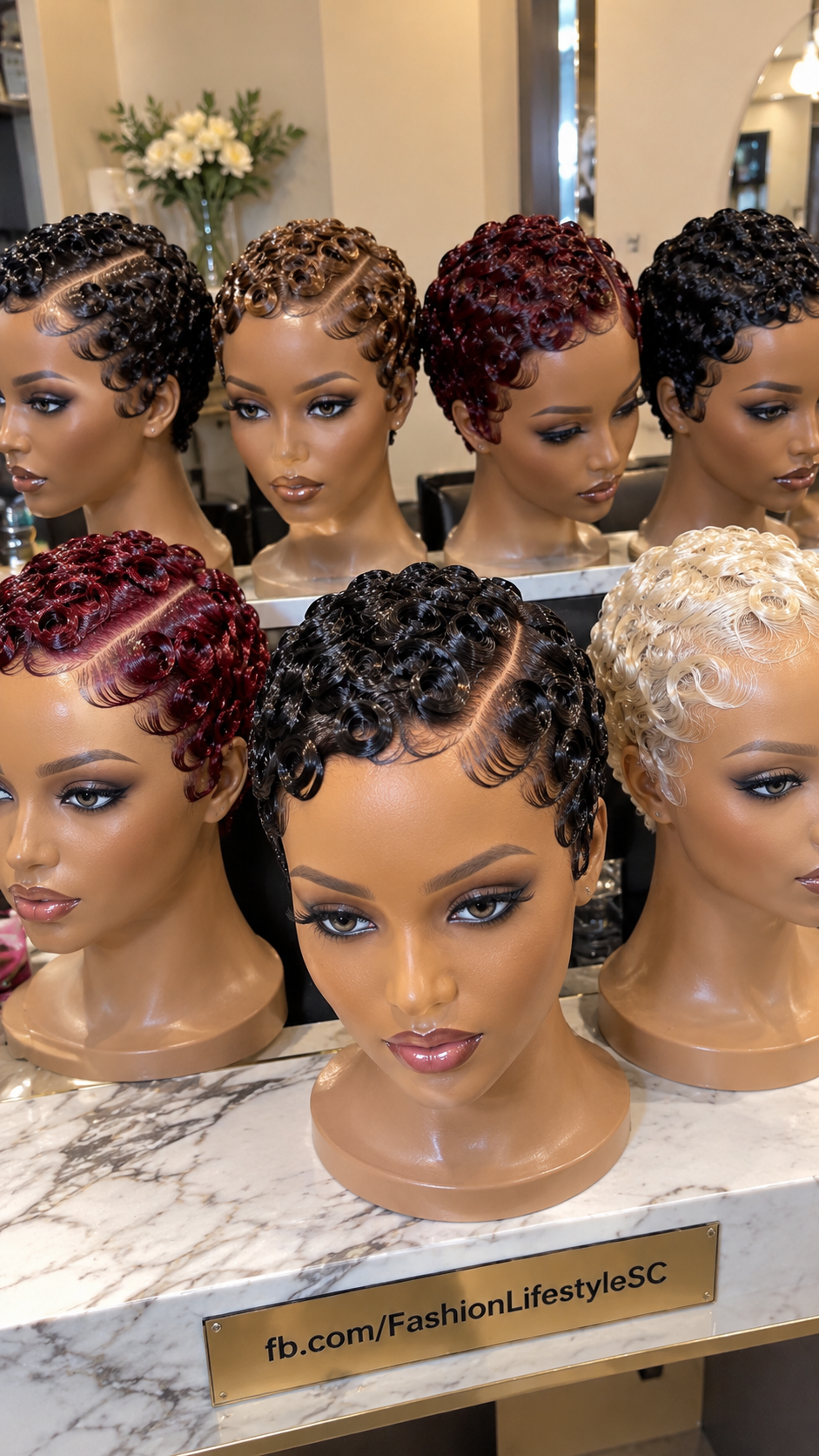
When several sculpted finger-coil wigs are displayed together, color is the easiest difference to notice, but it is not necessarily the most important one. This salon collection includes glossy black, deep burgundy, bronze-brown and pale blonde options, yet the mannequins also reveal meaningful differences in curl scale, crown distribution, diagonal parting and the direction of the fine strands around the forehead and temples. Those construction choices determine how each wig frames the face and can matter more than simply choosing between black, red, brown or blonde.
The foreground black unit makes this especially clear. Large circular coils occupy much of the upper crown, while a pronounced diagonal part creates an open path toward the front. Along that path, finer strands have been arranged into elongated finger-wave curves. Other wigs in the display use related ideas but distribute their coils differently. The burgundy units concentrate wine-red rings across the crown, the bronze-brown mannequin combines warm loops with a directional division, and the pale blonde version creates a softer visual contrast because both the curls and perimeter strands are light.
These wigs are photographed already arranged on mannequin heads. Their underside construction is not visible, so the image does not provide enough evidence to identify a specific lace type or cap system. In particular, HD lace should not be assumed. Buyers interested in one of these units should ask the seller for photographs of the actual wig removed from the mannequin and obtain verified construction details before purchasing.
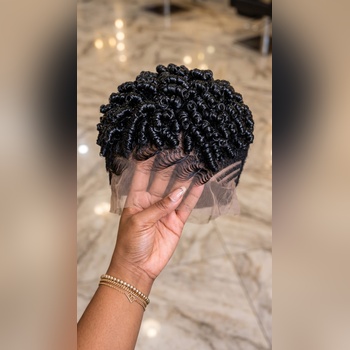
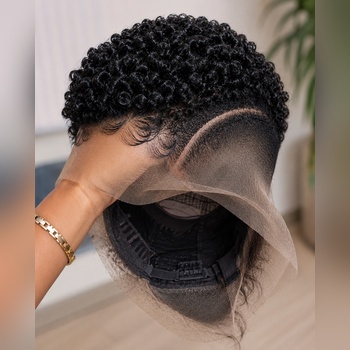
Begin With the Parting Because It Organizes Everything Around It
The diagonal part is one of the most influential elements visible across this collection. It does more than expose a narrow scalp-toned pathway. It establishes where the major coil field begins, where flatter hair is positioned and which direction the front styling follows.
On the central black wig, the division starts toward the front and travels diagonally through the crown. Large circular coils are concentrated on one side, while finer directional strands follow the exposed route on the other. This produces intentional asymmetry without requiring extreme volume.
A similar principle appears on the burgundy and bronze-brown wigs, although the parting interacts differently with their color. On burgundy, the exposed pathway interrupts a dense field of wine-red curls and becomes highly noticeable. On bronze-brown, the lighter reflections surrounding the part make the transition between crown and flatter strands easier to read.
For a custom order, the part should be specified before discussing minor curl adjustments. Moving it even a small distance can redistribute the entire crown and change the face-framing effect.
Large Ring Coils Give the Center Black Wig Its Character
The foreground black wig uses some of the clearest circular formations in the collection. Individual coils have visible centers and sit close enough together to create a substantial crown without dissolving into one continuous curl mass. The black color makes the interior of every ring appear deep, while salon light reflects across the upper surfaces.
This arrangement works because the rings are not all identical. Some are slightly larger and more open, while others occupy smaller spaces near the part and side. The variation allows the curl field to adapt to the shape of the head.
A custom maker should therefore not be instructed simply to produce identical circular curls across the entire cap. The reference depends on controlled irregularity. Large rings can establish the focal area, while smaller formations fill transitions without making the crown appear mechanically repeated.
The Front Waves Create a Second Styling Language
The crown may attract attention first, but the fine strands near the forehead are equally important. They do not form the same compact rings found above. Instead, they stretch into longer curved sections that follow the diagonal part and then turn toward the temple.
This creates two scales of movement within one wig. The crown uses compact rotation, while the front uses elongated arcs. The contrast prevents the styling from becoming visually crowded and helps direct the eye toward the face.
During maintenance, these flatter sections should not automatically be rolled into new coils. Their different direction is intentional. A stylist refreshing the wig should identify where the ring-curl zone ends and the finger-wave-inspired perimeter begins.
Burgundy Creates Depth Through Wine and Cherry Reflections
The burgundy wigs demonstrate how a dark red palette can reveal sculpted curls without needing a separate highlight color. Deep areas appear close to wine or merlot, while raised loops catch brighter cherry-red reflections. Each coil therefore carries its own tonal variation.
The front-left burgundy unit has a particularly strong relationship between the diagonal part and the circular crown. The exposed path remains clearly visible against the dark red hair, while curved front strands follow its direction toward the face.
Another burgundy mannequin farther back shows how the same broad color family can appear different when curl placement changes. This is why customers should identify the exact unit they prefer rather than ordering “the burgundy one” from a group display.
For remote orders, request a neutral-light photograph before confirming the shade. Burgundy is especially sensitive to lighting and camera processing. A color that appears bright red under salon lamps may look considerably deeper in daylight.
Bronze Brown Makes the Circular Construction More Visible
The bronze-brown unit in the upper row provides a warmer alternative. Light catches the outer surface of its loops, creating golden-brown reflections while the interiors remain deeper. The contrast makes the circular construction immediately readable.
This color can work well for someone who wants noticeable warmth without moving into very pale blonde territory. It still retains enough depth to create shadow between neighboring curls.
Color naming deserves caution when ordering. One supplier may call this family bronze brown, while another may use caramel, golden brown, chestnut or copper. Instead of depending on a name, send the reference and request photographs of the available hair or fiber.
Pale Blonde Exposes Every Change in Direction
The pale blonde wig has a very different visual balance. Dark shadow is reduced, so the viewer notices the physical shape of the coils and perimeter strands more directly. The crown appears airy and highly sculpted because light reaches nearly every visible section.
That visibility can make precision particularly important. A displaced curl or uneven front transition may stand out more clearly than it would on deep black hair. The perimeter also becomes part of the focal area rather than disappearing into shadow.
Maintenance depends heavily on material. If the pale wig is human hair, the customer should ask how the color was achieved and what care limitations apply. If it is synthetic, the fiber type and heat tolerance should be confirmed. The display photograph does not establish either answer.
Black Remains the Best Reference for Studying Curl Architecture
Several black wigs appear in the collection, allowing customers to compare construction without being distracted by color differences. One may use larger rings concentrated near the front, while another distributes smaller coils more evenly around the crown.
This is useful during a consultation. A customer can select the preferred black crown pattern first and then ask whether the salon can reproduce that construction in burgundy, bronze or blonde. This is often more reliable than selecting a color first and assuming its existing curl arrangement is the only option.
Black also makes the relationship between glossy surfaces and recessed spaces especially obvious. If the coils are properly separated, reflected light outlines them naturally. Heavy product is not necessary to manufacture that contrast and may actually cause neighboring curls to stick together.
Curl Diameter Can Change the Perceived Density
Two wigs can contain a similar amount of hair and still appear dramatically different because of coil diameter. Larger circular sections expose more visible openings and create broader points of movement. Smaller coils pack more individual shapes into the same area and make the crown appear busier.
The collection contains both approaches. Some mannequins emphasize large rolled circles near the forward crown, while others use tighter formations around the sides and rear. Mixing sizes also allows the stylist to adapt the curls to the changing contour of the head.
When commissioning a custom wig, include curl scale in the brief. A reference photograph from slightly above is particularly helpful because it shows both the diameter and distribution of the rings.
Color and Curl Pattern Should Be Ordered as Separate Variables
A customer may love the bronze shade but prefer the crown construction of the central black wig. Another may want burgundy with the less elaborate perimeter of a different mannequin. Those requests are easier to communicate when color and structure are treated independently.
Ask the wig maker which combinations are realistically available. If the wigs are pre-manufactured, customization may be limited. If the salon builds units individually, there may be more freedom to combine a particular crown pattern with another color.
This approach also prevents an easy misunderstanding in online sales. A seller may show several finished inspiration pieces while offering only a limited set of actual stock configurations. Confirm the exact combination before paying.
Inspect the Exact Unit Away From the Mannequin
Once a customer has chosen a favorite wig, the group display has completed its job. The next step should be individual inspection. Ask for front, side, rear and elevated crown photographs of that specific unit.
If lace or another perimeter construction is advertised, request an off-mannequin photograph showing the underside. This gives the buyer a chance to examine the cap and ask about material, shade, sizing and whether the perimeter has already been cut.
A finished mannequin photograph alone cannot reliably answer those questions. It shows styling exceptionally well, but many structural details are concealed once the wig is positioned on a display head.
Salon Ordering Works Better With a Reference Code for Each Wig
For wig businesses, collections like this can become difficult to manage through social-media messages if customers describe products only as “the black one” or “the red one.” Several units may fit those descriptions.
Assigning each wig a simple product reference allows customers to identify the exact crown and parting they want. Color variants can then be listed beneath that construction. This reduces mistakes and makes it easier to confirm whether the requested combination is ready-made or requires customization.
The same system can be used for appointment booking. The salon knows in advance which wig the customer is bringing or collecting and can reserve enough time for the appropriate fitting or styling work.
Custom Labor Can Matter More Than Hair Length
These compact wigs use far less visible length than long straight or curly units, but that does not automatically make them inexpensive. Their value may be concentrated in labor: repeated coil formation, directional parting, fine perimeter work, color processing and individualized crown arrangement.
| Category | Estimated Price Range | What Can Account for the Cost |
|---|---|---|
| Premium Custom | $315–$565+ | Higher-grade hair, personalized sizing, individually positioned ring coils, custom color work, planned parting and detailed front styling. |
| Standard Custom | $190–$335 | Selected color, prepared finger-coil crown and directional parting with more standardized sizing and finishing. |
| Basic Human Hair | $115–$205 | A human-hair foundation requiring additional professional setting, perimeter styling or color adjustment. |
| Premium Synthetic | $75–$145 | A pre-set option designed to retain its circular coil arrangement with less frequent reshaping. |
| Basic Synthetic | $35–$80 | A budget interpretation where coil placement, parting precision or individualized color work may be simpler. |
These are general comparison ranges, not verified prices for the wigs pictured. Hair source, fiber type, seller location, cap construction, color processing, customization and shipping can move the final price considerably. Salon fitting may also be charged separately.
When comparing two sellers, ask each one to explain what is included. A low-priced foundation requiring a separate coil-setting appointment can ultimately cost more than a higher-priced unit that arrives fully prepared.
Maintenance Economics Depend on Material and Color
A buyer should consider not only purchase price but also the cost of keeping the wig close to its original appearance. A pre-set synthetic coil crown may require relatively little professional rebuilding, while a human-hair version offers greater flexibility but may occasionally need a stylist to reconstruct sections.
Color can introduce additional maintenance. Burgundy and bronze human-hair units may need tonal refreshing over time. Pale blonde hair can require particularly careful handling if it has been heavily processed. Black may be simpler from a color perspective, although the ring construction still needs protection.
Asking about maintenance before ordering helps establish a realistic long-term budget instead of focusing entirely on the initial purchase.
Wash According to the Coil Map
Before cleaning one of these wigs for the first time, photograph the crown from above. That image records where the largest rings sit, how the part travels and where the flatter front work begins.
During washing, avoid aggressive circular rubbing through the crown. Such movement can combine several carefully separated coils. Handle the hair according to its confirmed material and keep the perimeter work as undisturbed as possible.
After drying, rebuild only the sections that require attention. The objective is to return the wig to its established curl map rather than creating an entirely new arrangement after every wash.
Protect the Perimeter From Unnecessary Cutting
The fine strands around the forehead and temples can be vulnerable to repeated alteration. Because wig hair does not grow back, a stylist should avoid trimming these areas automatically at every appointment.
If the curves lose their original position, try resetting their direction first. A photograph taken when the wig was new can guide the stylist. Cutting should be reserved for situations where it is actually necessary.
This is particularly important on wigs with elaborate front arcs because gradually reducing those strands can change the balance between the face-framing area and circular crown.
Storage Should Preserve the Open Centers of the Rings
The circular coils depend on retaining space inside their centers. Compressing the crown can flatten those openings and turn individual rings into a less organized curl mass.
Store the wig on an appropriate stand or mannequin head with enough clearance around the crown. Do not stack other wigs or objects on top. Make sure the hair and any underlying construction are fully dry before storage.
Pale units should be kept away from surfaces that may transfer pigment, while colored wigs should be protected from unnecessary prolonged exposure to conditions that may affect their shade.
Book the Appointment Around the Wig’s Actual Condition
A finished display unit and an unfinished base require very different appointment lengths. Before booking, tell the salon whether the wig already has its finger coils and perimeter work or whether those elements still need to be created.
If the unit was purchased online, inspect it before allowing any irreversible changes. Confirm that the color, parting and coil arrangement match the agreed product. Contact the seller first if there is a major discrepancy.
For a custom commission, a consultation followed by an approval stage can be more efficient than trying to make every decision during the final fitting. Color and crown construction can be approved before the appointment is used for wearer-specific adjustments.
A Good Collection Helps Customers Design Instead of Merely Choose
The real strength of this seven-wig display is the ability to compare individual styling decisions side by side. Burgundy shows how dark red changes the appearance of circular coils. Bronze demonstrates warm reflective depth. Pale blonde emphasizes physical curl shape, while several black versions make differences in parting and ring placement easy to study.
A customer can use those comparisons to build a precise request: the coil scale from one unit, diagonal parting from another and color from a third. If the salon cannot combine those elements, the customer can then decide which characteristic matters most rather than discovering the limitation after ordering.
For wig businesses, this is also an effective way to present customization without making unsupported claims. Show each construction clearly, provide verified information about the material and cap when requested, state which combinations can actually be ordered and explain the price of additional work. The result is a catalog that helps customers make informed choices instead of relying only on color names or generic hairstyle labels.
Search Terms
black ring coil part wig · burgundy sculpted finger coil wig · bronze diagonal coil wig · pale blonde finger curl wig · glossy circular crown wig · side parted ring curl wig · curved temple finger wave wig · compact salon coil wig