
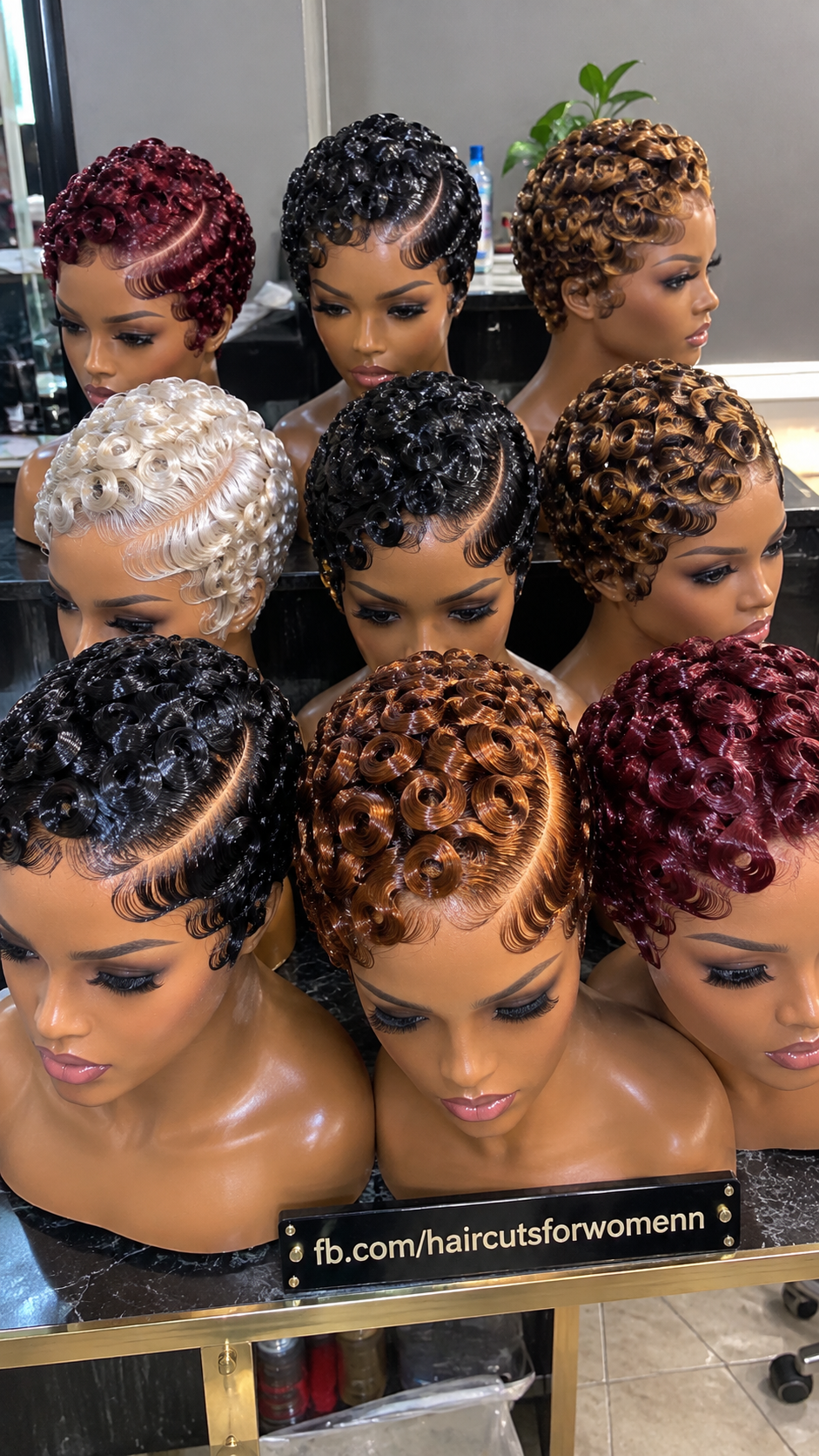
A salon display containing several closely related wigs creates a different buying experience from viewing one isolated unit. Here, the customer can compare how the same general finger-coil language changes when color, part direction, curl diameter and perimeter styling are adjusted. Deep burgundy, glossy black, pale platinum and warm bronze-brown all appear in the collection, yet the wigs are not simple color copies. Some crowns concentrate tightly rolled circles toward the top, others spread larger loops toward the front, and several use diagonal exposed parting paths to organize the curl placement.
This makes the display useful as a customization reference. A customer may prefer the bronze palette of one mannequin but the diagonal parting and temple movement of another. A salon can use those preferences to identify an existing unit or develop a custom order. What should not happen is assuming that every visible characteristic automatically belongs to every color option. Crown arrangement, part placement, side treatment and color need to be discussed independently.
The photograph shows the wigs installed on mannequin heads rather than exposing their underside construction. For that reason, it is not possible to verify a particular lace category, cap system or attachment method for every unit from this image. Those details should be confirmed individually with the seller before purchase.
A Gallery View Reveals Four Distinct Color Behaviors
The black wigs create the strongest light-and-shadow effect. Their raised coils reflect narrow bands of light while the interiors of the loops remain almost completely dark. This makes every circular opening visible despite the monochromatic palette. Black also provides strong contrast against the exposed parting areas and the fine directional strands around the temple.
Burgundy behaves differently. The deepest portions read as wine or dark cherry, while raised sections become brighter under direct light. The color therefore outlines the coils naturally. Instead of depending only on shadow to distinguish one loop from another, burgundy produces tonal variation across each bend.
Bronze-brown introduces another type of dimension. Warm reflections appear on the upper surfaces, while deeper brown remains inside the curls and near the roots. This gives the crown a metallic-looking richness under salon lighting without requiring pale blonde sections.
The platinum unit has the opposite visual effect from black. Shadow plays a smaller role because the hair is extremely light. Curl geometry itself becomes immediately visible, and the pale tone draws attention to every change in direction around the crown and front perimeter.
The Foreground Black Wig Uses a Strong Diagonal Route
The black unit at the front left provides a clear example of directional styling. A pronounced diagonal part begins near the forward crown and travels backward, dividing the circular coils from the flatter side work. The crown contains glossy ring formations of several sizes, while long combed arcs follow the exposed parting toward the temple.
This directional contrast gives the wig its identity. The circular crown creates rotational movement, but the side strands move in long sweeps. Those two patterns meet along the diagonal division rather than blending randomly.
A customer ordering this construction should specify that the parting is integral to the style. Simply requesting black finger curls may result in an all-over coil arrangement without the strong diagonal architecture visible here.
Bronze Rings Create a Different Focal Point
The central foreground bronze-brown wig places its warm ring curls prominently across the crown. Circular openings are clearly visible, and several coils sit almost like small rolled ribbons. A diagonal division remains important, but the brighter brown color causes the crown to attract attention before the side detail.
This makes the bronze option particularly suitable for customers who want the sculpted curl construction to be immediately noticeable. Light travels around each ring and produces several brown intensities within a relatively compact area.
When ordering this shade, photographs are more useful than color terminology alone. Depending on the supplier, similar tones might be marketed as bronze, caramel brown, warm chestnut or copper brown. The exact visual target should therefore accompany the order.
Burgundy Changes With Every Viewing Angle
The burgundy wigs demonstrate why a single color swatch cannot fully describe sculpted hair. Areas facing the light appear brighter and redder, while deeper portions of the crown become dark wine. When the head is turned, different loops catch the light and the apparent color balance changes.
A customer considering this shade should ask for images under both salon lighting and more neutral light whenever possible. Phone cameras can intensify red tones, and highly reflective styling products can also make the surface appear brighter.
The underlying curl construction should be checked separately from the shade. If a customer wants the exact crown pattern of one burgundy mannequin, that mannequin should be identified specifically rather than assuming every burgundy unit uses identical curl placement.
Platinum Makes Precision Easy to See
The platinum wig stands apart because its pale strands expose the construction immediately. Individual loops, sweeping front sections and smaller perimeter curls can all be seen without relying heavily on reflected highlights.
This visibility makes precision particularly important. A displaced coil or uneven transition may be easier to notice on very pale hair. At the same time, the light color gives the wig a bright decorative quality that differs considerably from the dramatic depth of black or burgundy.
Maintenance requirements may also differ depending on the material. If the platinum unit is human hair, the customer should ask how the color was achieved and what heat or cleansing routine is recommended. If it is synthetic, fiber specifications should be confirmed before using heated tools. The photograph alone cannot establish the material.
Curl Diameter Is an Ordering Decision
Not every ring in this collection has the same diameter. Some crowns contain smaller compact circles packed closely together, while others use larger loops that leave more visible space in their centers. This seemingly minor difference changes the overall density of the hairstyle.
Smaller coils create a busier crown with many individual points of movement. Larger rings produce broader shapes and allow each loop to become a more obvious visual element. A mixture of both can create a gradual transition from one area to another.
Customers commissioning a wig should therefore discuss curl scale rather than asking only for “finger curls.” Providing a reference image of the preferred crown is the simplest way to communicate the desired proportion.
Parting Placement Determines Where the Eye Travels
Several wigs in the collection use diagonal parting rather than a centered division. The exposed path creates a strong visual direction and gives the stylist a boundary from which the coils and flatter strands can move.
A part placed farther toward the side can create a larger uninterrupted curl field on the opposite side of the crown. Moving the same line toward the center would redistribute that visual weight and change the entire appearance even if the curl pattern remained similar.
For online ordering, an elevated photograph is essential. A direct front image may show only the beginning of the part, while a higher angle reveals its full trajectory and the amount of hair positioned on either side.
Perimeter Styling Separates One Wig From Another
The fine strands around the forehead and temple are not identical throughout the display. Some units use long curved sweeps following the parting. Others create smaller loops around the side, while a few maintain a more restrained transition into the crown.
These differences matter because perimeter styling sits close to the face when the wig is worn. A small change in direction can have more visual impact than changing several curls at the back of the crown.
When discussing customization with a wig stylist, show both the preferred crown and the preferred side treatment. If they come from different reference units, say so explicitly. This avoids the assumption that choosing one crown automatically includes its original perimeter arrangement.
Use the Display as a Mix-and-Match Consultation Tool
A salon can turn a gallery like this into a useful ordering system by separating each wig into four decisions: color, crown construction, part direction and perimeter treatment. Customers can then identify what they like in each category.
For example, someone might select the bronze-brown color, the compact ring density of a black unit, the diagonal parting from another mannequin and a restrained temple treatment. The stylist can explain whether those elements can realistically be combined and what additional custom labor would be required.
This approach is particularly useful for clients who arrive with several inspiration photographs. Instead of attempting to copy all of them simultaneously, the consultation identifies which visible elements are actually priorities.
Individual Photos Should Replace the Group Shot at the Ordering Stage
The gallery photograph is excellent for discovery, but once a customer selects a wig, that unit should be documented individually. Ask for a front photograph, both side profiles, an elevated crown view and a rear view.
If the wig uses lace, request a photograph of the actual unit off the mannequin so the lace and cap can be inspected. The seller should also state whether the lace is trimmed or untrimmed and provide the available shade information. This is far more reliable than inferring construction from a finished mannequin display.
For a custom order, approval photographs should show the actual commissioned wig before shipping. They allow the buyer to check the color, parting and coil arrangement before any additional alteration occurs.
A Salon Can Price Existing Stock and Custom Work Differently
A ready-made display unit and a made-to-order recreation do not necessarily belong in the same price category. An existing wig may already have its crown and perimeter styling completed, while a custom piece can require color selection, cap preparation, individualized curl placement and additional fitting work.
| Category | Estimated Price Range | Typical Reason for the Price Level |
|---|---|---|
| Premium Custom | $320–$575+ | Higher-grade hair, individualized sizing, custom color placement, hand-arranged ring curls, personalized parting and detailed perimeter work. |
| Standard Custom | $195–$340 | Selected color and planned coil arrangement with standardized cap sizing and fewer individualized finishing services. |
| Basic Human Hair | $120–$215 | A human-hair foundation that can be taken to a stylist for additional crown setting, parting and perimeter work. |
| Premium Synthetic | $75–$150 | A quality pre-set option that may retain circular curl placement with less frequent professional resetting. |
| Basic Synthetic | $35–$85 | A budget option where coil arrangement, color depth, parting work or cap construction may be simpler. |
These figures are broad planning ranges rather than prices for the exact wigs pictured. Seller location, hair or fiber quality, coloring, cap construction, customization labor, shipping and installation can all affect the final amount.
Ask for an itemized quotation when ordering a custom version. Knowing whether the price includes crown setting, color work, part customization and salon fitting makes it possible to compare offers fairly.
Color Choice Can Change the Maintenance Budget
Black is generally forgiving when minor tonal changes occur, although the glossy coil arrangement still requires careful shape maintenance. Burgundy and bronze may need more attention if the customer wants their original richness preserved over a long period, particularly on processed human hair.
Platinum can demand the most cautious color care if it is made from highly lightened human hair. The buyer should ask which products and heat limits the maker recommends. Synthetic platinum avoids some human-hair color concerns but introduces its own fiber-specific restrictions.
Maintenance cost should therefore be considered at the ordering stage. A color that requires professional refreshing may still be the preferred choice, but the customer should know that before purchasing rather than discovering it later.
Ring Curls Need Shape Memory More Than Daily Brushing
The circular crown should be maintained as a collection of individual formations. Conventional brushing through the entire top can dismantle the rings and combine them into a completely different curl mass.
When one coil becomes displaced, isolate that section and restore its original direction. Photographing the crown before the first full wash creates a useful reference for later maintenance. This is especially helpful for the bronze and burgundy units where color reflections can make the original loop placement easy to identify.
Heavy product application should be avoided. Excess residue can collect inside the rings, make neighboring sections adhere together and reduce their visible openings. Use only products suitable for the confirmed hair or fiber type.
Side Styling Should Be Refreshed Conservatively
The fine directional strands around the temples are delicate visual elements. Repeated aggressive trimming can gradually alter their shape, particularly on a wig where removed hair does not grow back.
If the side begins to look less precise, first determine whether the strands simply need repositioning. A stylist can often recover the original direction without removing additional hair. When cutting is genuinely required, a photograph of the new wig should be used as the reference.
This preservation approach keeps the side proportional to the crown and extends the useful life of the original design.
Salon Storage Should Give Every Crown Its Own Space
A collection of tightly arranged coils should not be stored with the crowns pressed against one another. Compression can flatten loops on one side and make the display inconsistent even before a customer tries a unit.
Individual mannequin heads or suitable stands provide enough room for the circular formations to remain open. At home, the same principle applies. Avoid placing the wig beneath clothing, boxes or other hairpieces.
After cleaning, make sure the unit is completely dry before storage. Pale and warm-colored wigs should also be protected from surfaces that might transfer pigment.
Book the Service According to Whether the Wig Is Ready or Custom
A customer buying a finished display wig may only require fitting, perimeter preparation and minor adjustments. Someone ordering a basic human-hair unit with the intention of reproducing one of these crowns may need a longer appointment or several sessions.
Before booking, tell the salon whether the wig arrives pre-styled. Ask whether the same professional handles curl setting, perimeter work and fitting or whether separate specialists are involved. Coordinating those services in advance prevents the customer from arriving for installation with a unit that still needs extensive construction.
For online purchases, inspect the delivered wig before any irreversible salon work. Compare it with the approval photographs and contact the seller first if the color or construction differs significantly from the order.
The Collection Is Strongest When Customers Shop by Components
The nine visible mannequins demonstrate how much variety can exist inside one compact finger-coil family. Glossy black emphasizes shadow and precision. Burgundy creates wine-red tonal shifts. Bronze-brown turns reflected light into warm contrast, while platinum exposes every curve with a pale, high-visibility finish. Diagonal partings and different temple arrangements further separate one unit from another.
For buyers, that means the most useful question is not simply “Which color do I want?” First choose the crown density and ring size. Then examine the parting. Decide how much side styling is desirable. Only after those construction choices are clear should color complete the specification.
For wig businesses, presenting the collection this way can make ordering clearer and reduce misunderstandings. Give every unit its own reference photographs, state verified material and cap information, explain which custom changes are available and quote those changes transparently. A well-organized gallery can then function as both inspiration and a practical ordering catalog rather than merely a row of attractive mannequins.
Search Terms
glossy finger coil wig gallery · burgundy ring curl wig · black diagonal part wig · bronze spiral crown wig · platinum finger curl wig · sculpted temple curl wig · compact circular coil wig · side swept coil crown wig