
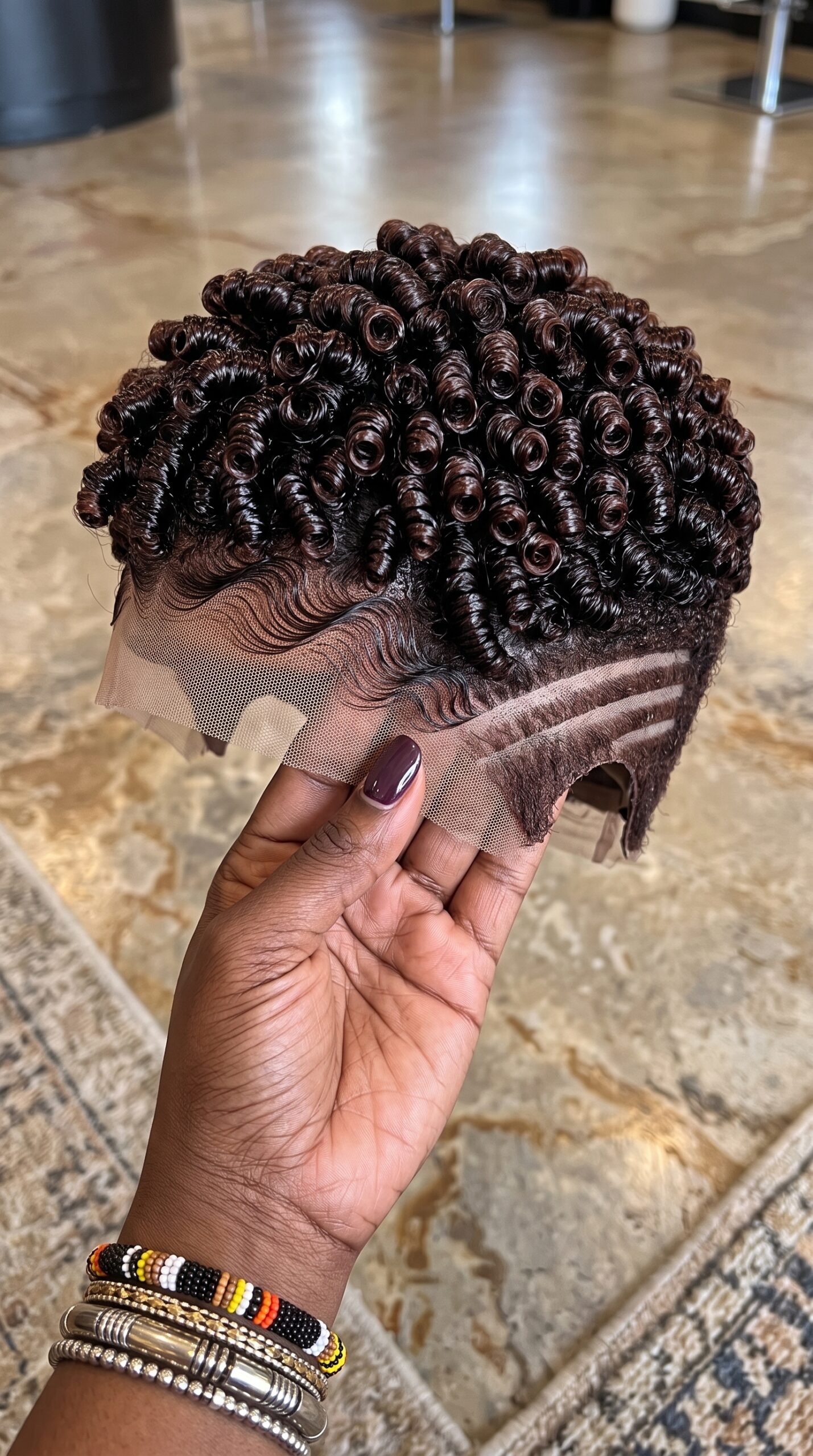
A short curly pixie can look extremely full without using unusually high density. This chocolate-brown unit is a good example. Many of the ringlets do not lie flat against the crown. They rise away from the cap, hold a cylindrical shape, and project outward before curling back toward themselves.
That extra distance creates volume. It also changes how the wig moves, how much space it occupies around the head, how easily the curls can snag, and how compact the silhouette looks from the side. Two pixies with the same curl diameter and the same number of hairs can appear completely different if one keeps its curls close to the cap and the other lets them stand several millimeters farther out.
Before ordering a sculpted ringlet pixie like this, do not ask only about curl size. Ask how far the ringlets project away from the crown once the wig is fully styled.
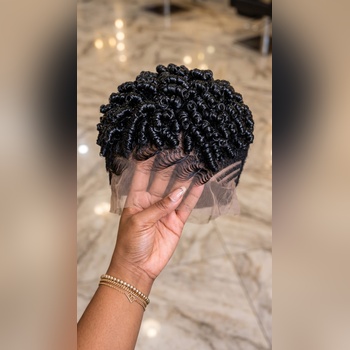
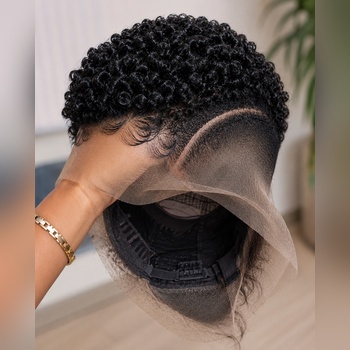
Where To Buy A Projected Ringlet Pixie Wig
Custom wig makers. A custom maker is usually the best option when you want this exact stand-off height. Send a side-profile reference and explain that the curls should remain visibly raised from the crown instead of being molded close to the cap.
Instagram and TikTok sellers. Ask for a slow side video at eye level. Top-down photos can make projecting curls look compact, while a low camera angle can exaggerate them. A true side profile tells you how far the hair actually stands away from the head.
Etsy. Independent makers may let you control curl diameter, curl length, crown density, cap size, colour, and the amount of lift between the root and the finished ringlet.
Marketplaces like Amazon, AliExpress, and Temu. Product photos may show a very sculpted high-projection sample while delivered units arrive flatter from packaging. Compare customer videos after unpacking and light refreshing.
Local beauty supply shops and salons. Local buying gives you the easiest test. View the wig from the side and gently press one curl toward the cap. If it springs back to its intended position, the projection is part of the set rather than only temporary fluffing for the photo.
Vendors and wholesalers direct. Ask whether the crown is factory-set, hand-rod-set, finger-coiled, or heat-shaped. The method affects how strongly the curls hold their outward projection after shipping and washing.
Regionally. Wig makers in Lagos, Accra, Atlanta, London, and major South African hair markets may describe this look as raised ringlets, sculpted coils, barrel coils, spiral pixie, or rod-set curls. A side reference is more reliable than the name.
Vet the seller. Favor sellers who show side, top, and rear three-quarter views. You want to see whether the projection is consistent around the crown or concentrated only in the front where it photographs best.
Red flags. Be cautious if the curls look extremely raised only under heavy product, if the roots lie flat but the ends are artificially pulled outward, or if the seller cannot explain what happens after the first wash.
When you order, send. Provide your cap size, desired crown height, curl diameter, approximate curl projection, colour reference, and at least one true side-profile image.
Contact / order inquiries: WhatsApp [WhatsApp: +XX XXX XXX XX XX]
How Much It Costs
Premium custom human hair. A carefully styled human-hair ringlet pixie with lace, carved side work, colour, and controlled crown projection can commonly range from around $240–$460 depending on the hair quality and styling labour.
Standard custom human hair. Around $180–$320 can cover many strong short units. At this level, ask whether the crown keeps its projection naturally or requires repeated heavy setting.
Basic human hair. Around $150–$240 may buy a simpler version with less consistent lift, more generic curl placement, heavier lace, or a flatter crown after washing.
Good synthetic. Around $60–$150 can work especially well for raised sculpted curls because quality synthetic fibre may hold a preset stand-off shape longer than untreated human hair.
Basic synthetic. Around $25–$70 is common for budget pieces. Watch for rigid plastic-looking curls that project outward but do not move naturally.
What the price may exclude. Custom cap sizing, lace tinting, knot work, colour correction, carved side design, crown resetting, and professional first fitting may all cost extra.
Shipping and duty. International shipping, customs charges, and local taxes can increase the final cost significantly. Compare the full delivered amount rather than only the listing price.
Ongoing costs. Raised ringlets may need light mousse, setting products, and occasional reshaping to preserve their stand-off distance after compression or washing.
First-year total. Include curl products, lace care, colour-safe washing, and professional resetting if you cannot reproduce the lifted crown yourself.
Cost per wear. A slightly more expensive wig that naturally returns to its projected shape may offer better value than a cheaper unit that collapses flat after every wash.
What a very low price may signal. It may indicate a look created mainly by product, aggressive fluffing, or temporary photography styling rather than a repeatable curl structure.
Deposit structure. Custom makers commonly request around 30–50% upfront and the remaining balance before shipping. Keep the desired side silhouette and projection reference in writing.
Shipping, Delivery, And What To Expect After Ordering
When the wig arrives, do not judge the crown immediately after removing it from tight packaging. Raised ringlets can be temporarily compressed during transit.
Place the unit on a mannequin or suitable form and allow the curls to recover. Use your fingers to separate obvious compression points without pulling the ringlets apart.
Then view the wig from the side. The key question is whether the curls recover their intended stand-off height without needing excessive product or teasing.
Curl Diameter And Curl Projection Are Not The Same Measurement
This distinction is essential.
Curl diameter describes how wide the circular opening or spiral is.
Curl projection describes how far that curl sits away from the cap.
A wide curl can lie nearly flat against the head. A smaller curl can project strongly outward.
That means two wigs with the same curl diameter can still create completely different silhouettes.
This is why “small curls” or “large curls” does not fully describe a sculpted pixie.
Projection Creates Volume Without Extra Density
Think of the crown as three-dimensional space.
If every curl sits close to the cap, most of the hair occupies a narrow layer around the head.
Lift those same curls outward and the hair now fills a larger volume of space.
The eye reads that extra space as fullness.
No extra strands had to be added.
This can be especially useful on short wigs because over-densifying the crown can make the unit heavy and helmet-like.
Too Much Projection Can Make The Wig Look Larger Than Expected
There is a practical limit.
If the ringlets stand too far away from the cap across the entire crown, the head silhouette can become noticeably wider and taller.
That may be ideal for a dramatic sculpted pixie.
But if you prefer a close-cut, compact look, the same amount of outward projection can feel excessive.
This is why seller side views matter. A top photo tells you curl pattern. A side photo tells you how much physical space the style occupies.
Projection Changes How The Side Fade Looks
This unit uses a short faded side with carved lines beneath a much fuller ringlet crown.
The farther the curls project, the stronger the contrast becomes between the compact side and the upper section.
A low-projection crown would create a softer transition.
A high-projection crown makes the side look even more shaved by comparison.
The fade itself may be identical, but the perceived contrast changes because of what sits above it.
Front Projection Affects Face Framing
The curls closest to the forehead deserve separate attention.
If front ringlets project strongly outward, they can visually extend over the forehead even without physically hanging down like a fringe.
That creates a fuller frame around the face.
If those front curls sit close to the cap, the forehead feels more open.
This means projection can influence face framing independently from hair length.
Side Projection Can Interfere With Glasses
Raised curls near the temple occupy more lateral space.
If you regularly wear glasses or sunglasses, strongly projecting ringlets can sit directly above the path of the frame arms.
That can create repeated contact, flatten selected curls, or make the frame feel crowded.
Check the side profile with your eyewear if that is part of your everyday routine.
A beautiful projected crown should still work with the things you actually wear.
High Projection Increases Snag Exposure
Curls that sit farther from the head are more exposed to the environment.
They can brush against hands, door frames, headrests, scarves, and other objects more easily than curls sitting close to the cap.
This does not make the style impractical, but it does increase the amount of contact the outermost ringlets receive.
For human hair, repeated snagging can loosen the set.
For synthetic fibre, repeated friction can create fuzz or deformation.
Projection Changes How The Wig Behaves Against Headrests
This matters during driving, office work, and travel.
A compact pixie allows the back of the head to sit closer to a chair or car headrest.
A strongly projecting rear crown contacts the surface sooner.
That repeated pressure can gradually flatten the back more than the front.
If you spend long periods sitting against a headrest, inspect how far the rear ringlets stand out before choosing an extremely sculpted version.
The Rear Should Not Project More Than The Front Without A Reason
Projection should be mapped around the crown.
It does not need to be identical everywhere, but the silhouette should feel intentional.
If the front is compact while the rear suddenly balloons outward, the wig can look back-heavy.
If the front projects dramatically while the back lies completely flat, the crown can feel disconnected.
A good pixie controls how projection changes from zone to zone.
Projection Is Often Created At The Root
The visible ringlet receives most of the attention, but the stand-off distance begins lower down.
If the root exits the cap with lift before entering the curl, the finished ringlet naturally sits farther away.
If the root is molded flat against the cap and only the end is curled, the projection remains much lower.
This is why root direction matters even on a style where the decorative focus is the spiral itself.
Heavy Product Can Create False Projection
A stylist can temporarily push curls outward and lock them in place with strong gel or spray.
That can produce an impressive product photo.
But once the product softens, the root may collapse and the crown may sit much closer to the head.
Ask to see a refreshed or previously worn unit.
You want to know whether the projection comes from the actual set or from a temporary hardened shell.
Compression During Shipping Is Not Always A Defect
Raised ringlets are vulnerable to packing pressure.
A delivered wig may therefore look flatter than the listing immediately out of the box.
Before assuming the seller sent the wrong unit, give the hair a chance to recover.
Human hair may need light misting and finger reshaping.
Synthetic curls may spring back on their own if the fibre has a strong preset memory.
The real defect is when the projection cannot be restored without completely rebuilding the style.
Human Hair Gives You More Control Over Projection
Human hair allows a stylist to change how far the ringlets stand away from the crown.
You can flatten them slightly for a closer silhouette or reset them with more root lift for greater volume.
That flexibility is valuable if you enjoy changing the shape.
The tradeoff is maintenance.
The exact projected salon set may not survive every wash automatically.
Synthetic Fibre Can Preserve Projection Longer
Quality synthetic fibre can hold a preset cylindrical ringlet and root lift very consistently.
For a highly sculpted pixie, that can reduce the amount of resetting required.
The downside is repairability.
If a synthetic ringlet becomes crushed or permanently bent, recreating the original projection may be difficult unless the fibre is heat-safe.
Ask before attempting heated correction.
The Brown Colour Makes Projection Easier To Read
This unit uses a dark chocolate-brown tone with warm reflections.
Those lighter reflections appear along the outer curves of the raised ringlets.
That makes it easier to see which curls sit forward and which disappear deeper into the crown.
The colour is not creating the projection.
It is revealing the three-dimensional shape more clearly than solid flat black might under the same lighting.
Shine Can Exaggerate Projection In Photos
High-gloss ringlets catch bright highlights along their outer edges.
Those reflections can make the curls appear more separated and farther from the crown than they seem under ordinary lighting.
That is why neutral-light video is useful.
A highly polished salon photograph tells you what the wig can look like at its best.
It does not always tell you how dramatic the projection will feel in everyday conditions.
Projection Should Be Consistent Across Similar Curls
Not every ringlet needs to sit at exactly the same distance.
Natural variation gives the crown dimension.
But major random differences can make the set look uneven.
If several curls lie completely flat while neighbouring ringlets stand far out from the cap, the crown may appear patchy rather than layered.
Look for controlled variation rather than identical repetition or random extremes.
Longer Cylindrical Ringlets Need More Support
Some curls on this wig form elongated tubes rather than short circular loops.
The longer the cylindrical section becomes, the more weight it carries away from the root.
Human hair may gradually sag under that weight, especially with humidity or heavy product.
A shorter projected ringlet usually has less leverage pulling it downward.
That is another reason curl length and projection need to be considered together.
Projection Can Change After Washing Even If The Curl Survives
This is an easy issue to misdiagnose.
After washing, a ringlet may still be perfectly curled but sit much closer to the cap.
The wearer thinks the curl pattern has failed.
In reality, the curl survived while the root lift disappeared.
Restoring projection may therefore require resetting the base rather than rebuilding the entire ringlet.
Do Not Tease The Roots Aggressively To Create Height
Backcombing can temporarily increase stand-off distance, but it is a poor long-term solution for many lace wigs.
Teasing creates tangles near the root, increases friction, and makes later detangling harder.
For curly units, those root tangles can quickly become matting.
Use controlled setting techniques instead of forcing volume through knotting.
Storage Should Preserve The Outer Shape
A projected pixie should not be stored under heavy pressure.
Placing the crown face-down, stuffing it tightly into a drawer, or stacking items on top can gradually train the ringlets closer to the cap.
Use a form or storage method that allows the curls to keep their three-dimensional shape.
The goal is not only preserving curl pattern.
It is preserving the distance between the curl and the crown.
Before You Pay
- Can you show a true side-profile photo so I can judge how far the ringlets stand away from the crown?
- Is the projection created by root lift and setting, or mainly by heavy gel and spray?
- What happens to the stand-off height after the first full wash?
- Can the crown be reset closer to the head if I decide the projection is too dramatic?
- Can you show another finished unit with approximately the same curl projection?
Trimming The Lace
Set the wig in its true wearing position before trimming the lace. A strongly projected crown can tempt you to pull the cap backward because the front feels visually fuller than expected.
Do not use cap position to solve a crown-volume preference.
Align the hairline, temples, ear area, and nape first. Once the wig sits correctly, trim the excess lace gradually.
If you want a lower-profile crown, adjust the curl projection itself rather than wearing the cap in the wrong position.
Search Terms
projected ringlet pixie wig · raised curl pixie wig · cylindrical curl pixie wig · chocolate brown ringlet wig · sculpted coil pixie wig · high projection curly pixie wig · short barrel coil lace wig · lifted crown ringlet pixie
Final Thoughts
The dramatic fullness of this chocolate-brown pixie is not only about curl size or density. A major part of the effect comes from how far the cylindrical ringlets stand away from the cap.
That projection creates volume without requiring unnecessary hair, but it also changes snag exposure, storage needs, headrest contact, and the overall size of the silhouette.
When buying a sculpted ringlet pixie, judge the curls in three dimensions. Diameter tells you how wide they are. Length tells you how long they are. Projection tells you how much space they occupy away from the head.
That third measurement is easy to miss, but it can completely change how the wig looks and feels in real wear.