
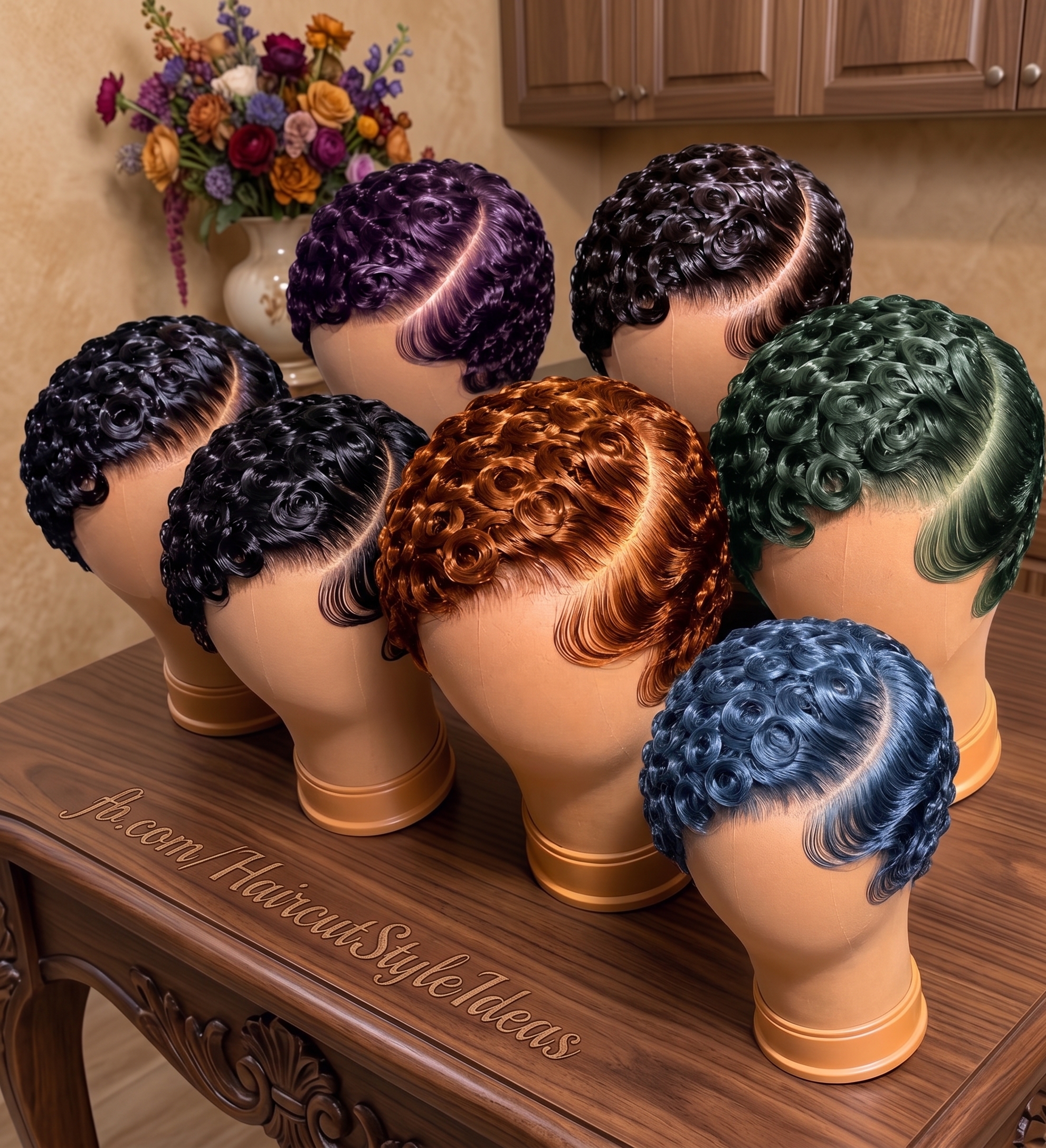
Purple, forest green, steel blue, copper, burgundy, and jet black can all work on the same short curly pixie shape, but they do not behave the same way where the colour meets the scalp. The most important area is often not the bright crown at all. It is the first few millimeters of hair beside the part.
That root zone controls how abruptly the fashion colour appears to begin. If vivid colour starts at maximum brightness directly beside a scalp-like part, the result can look extremely graphic. If the roots are left slightly deeper, the transition can feel more dimensional and the part may appear more believable.
This is why buyers should not order a fantasy pixie by colour name alone. Ask how dark the roots will be, how far that root depth extends, and whether the darker base follows the part and hairline consistently.
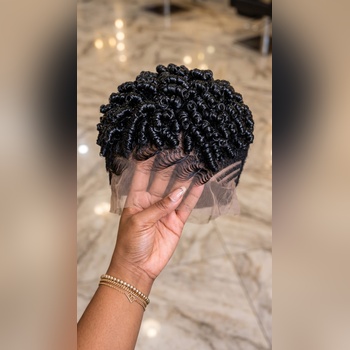
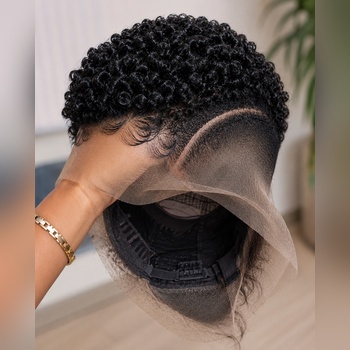
Where To Buy A Fantasy Pixie Wig With Good Root Depth
Custom wig makers. A custom maker is usually the strongest option when you want a precise relationship between the vivid colour and the roots. Send a close reference of the part as well as the overall colour. Tell the maker whether you want completely coloured roots, a subtle shadow root, or a clearly darker root zone.
Instagram and TikTok sellers. Ask for close video of the part and temple under neutral lighting. A bright ring light can make dark roots disappear visually and make the whole unit appear more uniformly coloured than it really is.
Etsy. Independent makers may allow you to specify root depth, base colour, fantasy tone, cap size, and part direction. Use actual colour references because phrases such as dark root or shadow root can describe very different amounts of darkness.
Marketplaces like Amazon, AliExpress, and Temu. Colour-menu photographs often emphasize the crown. Look at customer images of the exact colourway and zoom in on the part. Some units have dark rooting only at the front while the crown begins at full colour immediately.
Local beauty supply shops and salons. Local shopping gives you a useful comparison. Place two vivid-colour pixies beside each other, one with deeper roots and one with colour running directly to the scalp line. The difference around the part becomes much easier to understand in person.
Vendors and wholesalers direct. Ask whether the darker root is part of the fibre colour, hand-dyed after construction, or created mainly by leaving the original dark hair unprocessed near the base.
Regionally. Wig makers in Lagos, Accra, Atlanta, London, and major South African hair markets may describe this as rooted colour, dark roots, shadow root, black root, or colour melt. Send the reference rather than depending on terminology alone.
Vet the seller. Favor sellers who show the same colour from above. A front photo can hide the root transition beneath curls, but the top view reveals exactly how the dark base surrounds the part.
Red flags. Be cautious if the root depth changes randomly from one section to another, if the front is dark-rooted but the crown suddenly becomes bright at the scalp, or if the seller uses heavy part concealer that prevents you from seeing the real colour transition.
When you order, send. Provide your cap size, fantasy colour reference, preferred root shade, approximate root depth, part placement, and whether you want the root effect around the hairline as well as the part.
Contact / order inquiries: WhatsApp [WhatsApp: +XX XXX XXX XX XX]
How Much It Costs
Premium custom human hair. A carefully coloured short human-hair pixie with vivid fashion colour, controlled root depth, refined lace, sculpted ringlets, and custom styling can commonly range around $250–$480 depending on the hair and colouring work.
Standard custom human hair. Around $190–$340 can cover many good fantasy-colour human-hair units. Rooting should be intentional at this level rather than simply the result of unfinished colouring near the base.
Basic human hair. Around $150–$250 may buy a simpler version with more generic root placement, heavier lace, or less refined colour transitions.
Good synthetic. Around $60–$160 can work especially well for vivid shades because synthetic fibre can be manufactured with a dark root already built into the colour pattern.
Basic synthetic. Around $25–$75 is common for budget units. Inspect whether the root transition looks graduated or like a hard black stripe painted beneath the colour.
Colour premium. Human-hair purple, blue, green, copper, burgundy, and similar fashion shades can cost more because selected hair may need lifting before the final pigment is deposited.
Rooting premium. A carefully blended shadow root may add additional colour labour because the stylist has to control exactly where the dark base ends and the vivid colour begins.
What the price may exclude. Custom cap sizing, lace tinting, knot work, colour refreshing, root retouching, professional curl resetting, and first fitting may all cost extra.
Shipping and duty. International shipping, customs charges, and local taxes can significantly increase the real purchase cost. Compare the full delivered price rather than only the listing amount.
Ongoing costs. Fantasy colour may require colour-depositing products, while the darker root usually needs much less maintenance. That difference can actually make a rooted unit easier to refresh selectively.
First-year total. Include colour-safe shampoo, conditioner, pigment-refresh products, lace care, and any professional re-colouring needed if the bright section fades faster than the roots.
Cost per wear. A slightly more expensive unit with well-designed root depth may age better visually than an all-over vivid colour where fading becomes obvious directly beside the scalp line.
What a very low price may signal. It can indicate generic mixed-colour fibre, abrupt rooting, inconsistent placement, or a factory colour effect designed mainly to photograph well from the front.
Deposit structure. Custom makers commonly request around 30–50% upfront and the balance before shipping. Keep the exact root and colour reference with the written order.
Shipping, Delivery, And What To Expect After Ordering
When the wig arrives, inspect the roots before trimming the lace or applying makeup through the part.
Look directly down at the crown. Follow both sides of the part from the front toward the back and check whether the root depth remains intentional.
Then inspect the hairline and temple. If you ordered a rooted effect, decide whether you expected the darker colour to continue there or only along the internal part.
A Shadow Root Is Not The Same As Leaving The Dye Job Unfinished
This distinction matters.
A good shadow root is placed intentionally. The darker zone follows a controlled depth and blends gradually into the fashion colour.
An unfinished colour job can also leave dark roots, but the transition may be patchy, irregular, or much deeper in some areas than others.
Both can technically produce dark hair near the scalp.
Only one looks designed.
The Part Is Where Root Depth Becomes Most Visible
On a dense curly crown, neighbouring ringlets can hide much of the root.
A part removes that cover.
The hair is deliberately separated, exposing where the strands leave the scalp-like base. That makes the part the easiest place to judge whether the root colour was planned properly.
If you are buying a purple, green, blue, or copper side-part pixie, inspect the part before being distracted by the brighter curls around it.
Dark Roots Can Make Fantasy Colour Look More Dimensional
Vivid colour used from root to tip can create an intense, saturated appearance.
That may be exactly what some buyers want.
But when every visible layer uses the same brightness, individual curls can sometimes merge into one colour field.
A deeper base creates shadow underneath the curls. The brighter sections then move forward visually.
This can give the crown more depth without changing the curl density at all.
Dark Roots Can Also Make The Scalp Transition Feel Less Abrupt
A scalp-like part is usually a relatively neutral skin tone.
Place extremely bright emerald green or electric blue directly beside that line and the contrast can become dramatic.
A deeper root acts as a buffer between the scalp and vivid colour.
The eye moves from scalp tone to dark root and then into fashion colour rather than jumping directly from skin to maximum saturation.
That softer sequence can make the part easier to wear even when the crown colour remains bold.
But A Root That Is Too Dark Can Look Like A Stripe
More root depth is not automatically better.
If the dark section extends too far, especially on a very short pixie, it can occupy a large percentage of the visible hair.
The result may look like a black wig with coloured tips rather than a fantasy-colour pixie with natural root depth.
This is particularly important because pixie curls are short. One inch of root on a long wig may be subtle. One inch on a two-inch curl can dominate the entire strand.
Short Hair Makes Root Measurements More Important
Root depth has to be judged in proportion to total strand length.
A five-millimeter dark root on a short sculpted curl may already be clearly visible.
A two-centimeter root can completely change the colour balance.
This is why simply telling a stylist “give it dark roots” is not enough for a pixie.
Show exactly how much dark area you want to see.
Purple Can Carry A Softer Root Transition
Deep plum and violet already contain considerable darkness.
Because of that, a black or very deep-purple root can blend relatively smoothly into the brighter sections.
The transition may remain visible without looking extremely striped.
This makes purple one of the easier fantasy families for subtle dark rooting.
Green Makes Root Temperature More Noticeable
Forest or emerald green creates a different relationship.
If the root is warm black-brown and the green is very cool, the transition can sometimes reveal unwanted warmth between them.
A cooler deep base may preserve a cleaner green effect.
This is one reason colour references matter more than generic terms like black root.
Not every dark colour has the same undertone.
Blue Can Benefit From A Blue-Black Root
A cool blue pixie often works beautifully with a blue-black or very deep navy root.
That lets the brightness increase gradually while keeping the entire palette cool.
A warm brown-black root can still work, but under strong lighting its warmer undertones may become easier to see beside icy or steel blue.
If you want an especially cool final result, specify the root tone as well as the blue.
Copper Needs A Different Kind Of Root Decision
Copper and ginger are warm enough that a very cool jet-black root can create extremely strong contrast.
Some buyers love that dramatic effect.
Others prefer espresso, deep auburn, or warm dark brown at the roots because the transition feels more continuous.
The correct root shade therefore depends on whether you want contrast or colour harmony.
“Dark root” alone does not answer that question.
Black Is The Control Colour In A Collection Like This
The solid black units give you a useful visual baseline.
Because there is no colour transition, you can focus on the curl pattern, part width, shine, and silhouette without the root itself becoming another design feature.
Compare the fantasy units against the black version.
If they suddenly appear flatter or more artificial around the part, the issue may not be the construction. It may be the way colour was brought all the way to the root.
The Root Should Follow The Curl Distribution
A shadow root should not end at the same perfectly straight horizontal line across every strand.
Hair grows and curls in different directions.
A slightly irregular but controlled blend can therefore look more natural than a ruler-straight colour boundary.
The goal is not randomness.
It is avoiding the appearance that every strand was dipped into colour to exactly the same depth.
Root Depth Should Be Consistent Around The Part
Controlled variation is useful, but major inconsistency is not.
If the left side of the part has a tiny dark base and the right side has a much deeper one, the scalp line can begin looking uneven even when the actual part construction is symmetrical.
That is especially noticeable on these polished short ringlet styles because both sides of the part remain highly visible.
Judge the root placement as a pair.
The Hairline May Need Less Root Than The Crown
A seller may choose to keep the internal crown more deeply rooted while allowing slightly more fashion colour near the front.
That can work when the wearer wants the vivid shade to remain visible from the front.
Another approach is to preserve darker hair around the temple and hairline for a more grounded perimeter.
Neither approach is automatically correct.
The important thing is that you know which design you are ordering.
Root Colour Can Help Hide Future Fading
Fantasy shades rarely remain at maximum saturation forever on human hair.
As the bright sections fade, a deeper root often stays visually stronger because it received less lifting and less vivid pigment.
That creates a useful advantage.
The wig can lose some brightness while still keeping deliberate depth near the part.
An all-over vivid unit may show fading directly from the scalp line onward, making the colour change feel more obvious.
Rooted Human Hair Can Reduce Processing Near The Base
On dark human hair, vivid fashion shades generally require lifting.
If the stylist deliberately preserves a darker root, the hair closest to the lace may avoid the heaviest lightening process.
That can be useful because the base area is already structurally important.
It does not make the whole unit unprocessed, and it does not guarantee stronger hair everywhere.
But it can reduce unnecessary chemical work on the sections deliberately left dark.
Synthetic Rooting Works Differently
A rooted synthetic pixie does not need dark natural pigment to be chemically preserved.
The fibre can simply be manufactured or coloured with a darker base and brighter lengths.
That can create very stable root placement and reduce the fading differences seen in dyed human hair.
The tradeoff is flexibility. Changing the root depth later may be much harder than recolouring human hair.
Do Not Try To Fix Root Depth With Part Makeup
Concealer and powder can adjust the apparent scalp tone.
They cannot redesign a colour transition.
If the bright colour begins too close to the scalp for your preference, painting the part darker does not solve the root placement and may simply make the lace look dirty.
Likewise, brightening the scalp line cannot repair an excessively deep black root.
Keep lace correction and hair-colour correction as separate jobs.
A Rooted Wig Should Be Judged From Above
This is one of the most useful seller requests for a style like this.
Ask for the camera to look directly down at the crown.
That view reveals the entire root map around the part and between the curls.
You can see whether the deeper base is distributed evenly, whether it extends too far, and whether some coloured sections begin abruptly at the scalp.
A front-facing beauty shot cannot provide the same information.
Compare Root Depth Across Different Colours
A collection like this is particularly useful because you can compare several colour families on nearly the same haircut.
The purple version may need only a subtle dark transition.
The green version may benefit from a cooler deep root.
The blue version may look strongest with blue-black depth.
The copper version may work better with warm brown or auburn roots.
Uniform rooting across every colour is convenient for production but not always visually optimal.
Before You Pay
- Can you show the exact colour from directly above so I can see the roots around the full part?
- How deep is the darker root compared with the total length of these short curls?
- Is the root jet black, blue-black, dark brown, deep auburn, or a darker version of the fantasy shade?
- Does the same root depth continue around the hairline and temples, or is it limited to the crown?
- Can you show another finished unit with the same root-to-colour transition?
Trimming The Lace
Place the wig in its true wearing position before trimming the lace. The root pattern and side part establish a strong direction, and rotating the cap changes where both appear relative to the face.
Check the part, hairline, temples, root depth, and crown balance first.
Once everything aligns correctly, trim the excess lace gradually.
Do not reposition the wig simply to hide a root transition you dislike. Root placement belongs to the colour design, while cap placement belongs to fit.
Search Terms
shadow root pixie wig · rooted fantasy pixie wig · purple dark root pixie wig · green rooted curly pixie wig · blue black root pixie wig · copper shadow root pixie wig · short curly wig root depth · side part fantasy pixie wig
Final Thoughts
The strongest decision in a fantasy pixie is not always which colour sits on the curls. It can be how that colour begins.
Root depth controls the transition between the scalp-like part and the vivid crown. Too little depth can make some bright shades feel abrupt. Too much can overpower a short curl and turn the entire colour balance into dark roots with coloured ends.
Because pixie hair is so short, a few millimeters matter. Choose the root shade, root depth, and placement with the same care you give the green, blue, purple, copper, or burgundy itself.
A colour name tells the seller what shade you want. Root depth tells them how you want that shade to live on the wig.