
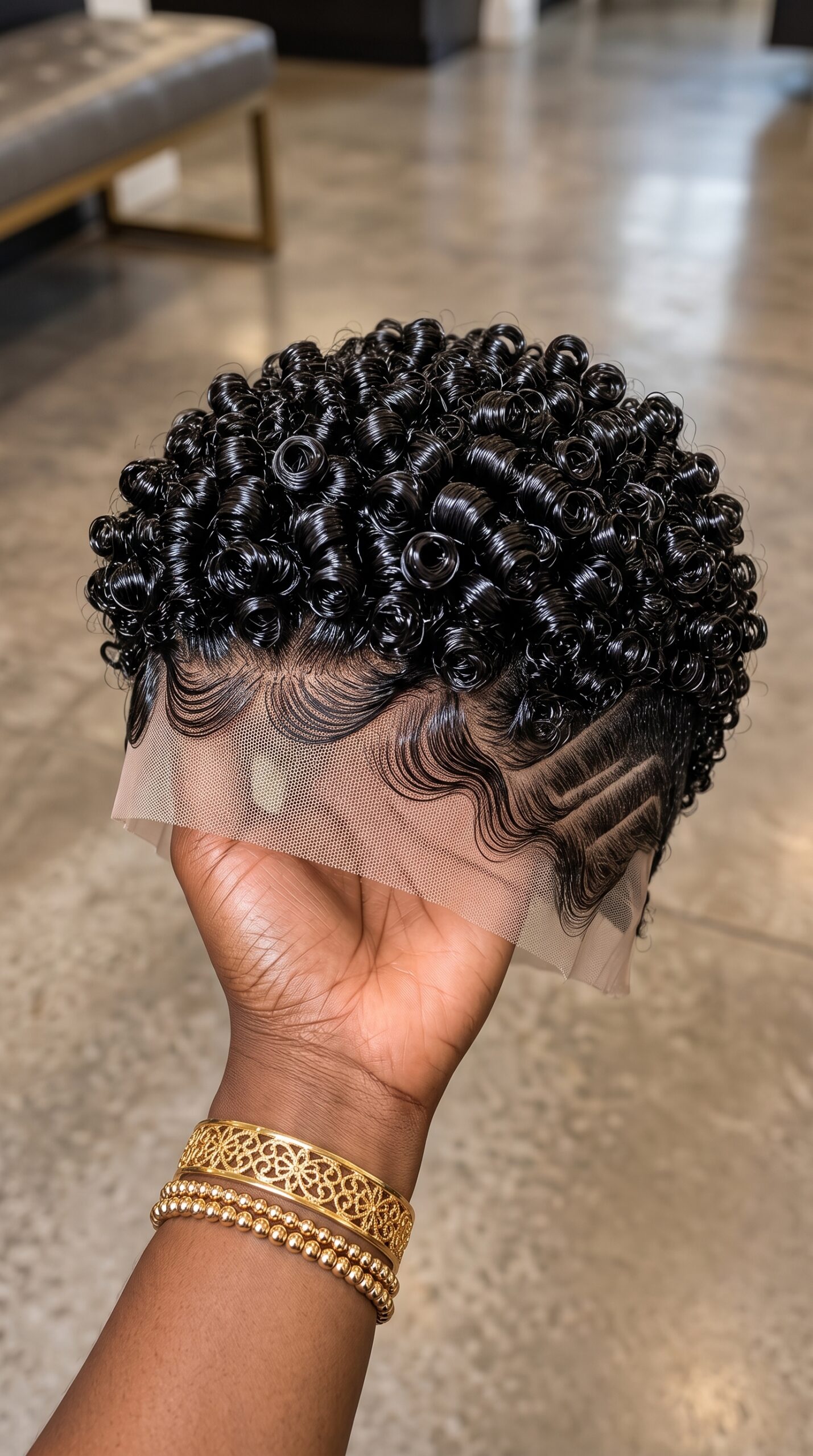
Baby hairs are supposed to soften a lace hairline, but more styling does not automatically create more realism. On this black ringlet pixie, the front edge is shaped into several large repeating swoops that curve down across the lace before rising back toward the dense crown.
Those curves are visually impressive, but they also reveal an important buying detail: the size, spacing, and repetition of the edge swoops can completely change how the frontal reads. A few carefully placed curves can soften the transition between lace and hair. Too many identical curves can begin looking stamped, drawn, or mechanically repeated.
Before buying a highly sculpted pixie like this, do not ask only whether the baby hairs are laid. Ask how many swoops there are, how deep they sit on the forehead, and whether the spacing looks intentionally varied rather than copied in one repeating pattern.
Where To Buy A Pixie Wig With Well-Placed Edge Swoops
Custom wig makers. A custom maker is usually the best option when you want control over the frontal design. Send a close reference and explain whether you want large dramatic swoops, smaller soft curves, or only minimal baby hairs around selected areas.
Instagram and TikTok sellers. Ask for the frontal to be shown before and after the edges are styled. This tells you whether the underlying hairline is strong on its own or whether the swoops are doing most of the visual work.
Etsy. Independent makers may allow you to specify edge density, swoop size, part placement, cap size, and whether the frontal should arrive pre-styled or left more natural for you to customize.
Marketplaces like Amazon, AliExpress, and Temu. Product photographs often show extremely polished edges that may not survive shipping or washing. Customer photos are useful for seeing what the actual frontal looks like after the original gel set relaxes.
Local beauty supply shops and salons. If you can inspect the unit in person, look at the frontal both with the baby hairs laid and gently lifted. The wig should not depend on one frozen edge design to hide poor lace placement underneath.
Vendors and wholesalers direct. Ask whether the edge hairs are separately ventilated at lower density or simply cut from the normal frontal hair and molded downward with product.
Regionally. Wig makers in Lagos, Accra, Atlanta, London, and major South African hair markets may use terms such as baby hair, laid edges, swoops, finger-wave edges, or molded frontal differently. A close photograph communicates the target more clearly than the terminology alone.
Vet the seller. Favor sellers who can show the frontal without heavy edge product. A beautifully laid edge is a styling result; a good lace hairline should still make sense underneath it.
Red flags. Be cautious if every swoop is exactly the same width and depth, if the edge hairs form a thick solid strip, if the frontal looks empty when the swoops are lifted, or if the seller refuses to show the lace before styling.
When you order, send. Provide your cap size, desired edge density, approximate swoop size, preferred amount of forehead coverage, and whether you want dramatic sculpted edges or a softer irregular hairline.
Contact / order inquiries: WhatsApp [WhatsApp: +XX XXX XXX XX XX]
How Much It Costs
Premium custom human hair. A carefully built human-hair pixie with refined lace, separately ventilated edge hairs, sculpted ringlets, and hand-shaped frontal work can commonly range from around $240–$460 depending on hair quality and construction.
Standard custom human hair. Around $180–$320 can cover many strong short units. At this level, inspect whether the edge design comes from properly placed fine hairs or simply from cutting thicker crown hair short and forcing it into curves.
Basic human hair. Around $150–$240 may buy a simpler frontal with more uniform density, heavier edge hairs, or a less refined transition into the crown.
Good synthetic. Around $60–$150 can produce attractive preset swoops, especially when the fibre holds its molded shape well. Check whether the edges still look natural at close range.
Basic synthetic. Around $25–$70 is common for budget pieces. At this price, the baby hairs may be unusually thick, shiny, long, or permanently molded into repetitive curves.
What the price may exclude. Custom edge ventilation, lace tinting, knot work, cap sizing, frontal customization, and professional first installation may all cost extra.
Shipping and duty. International shipping, customs fees, and local taxes can increase the real purchase cost considerably. Compare the full delivered amount rather than only the listed wig price.
Ongoing costs. Highly sculpted swoops need edge-control products, foam, or gel and may require frequent resetting after washing, sweating, or prolonged wear.
First-year total. Include lace care, edge products, curl products, and possible professional frontal maintenance if delicate edge hairs begin shedding.
Cost per wear. A frontal that still looks convincing when the edges are worn more softly can give better value than one that only looks finished after every swoop has been rebuilt perfectly.
What a very low price may signal. It can indicate a dense generic hairline disguised with dramatic baby-hair styling rather than a genuinely refined frontal.
Deposit structure. Custom makers commonly request around 30–50% upfront and the balance before shipping. Keep your edge reference with the written order because “baby hairs included” does not describe the design accurately enough.
Shipping, Delivery, And What To Expect After Ordering
When the wig arrives, inspect the frontal before adding more gel. Shipping may flatten or disturb some swoops, and that is not necessarily a construction defect.
First look at the underlying edge density. Then examine how much hair has been allocated to each swoop and whether the individual curves can be separated without exposing large unnatural gaps.
Do not trim the lace or cut additional baby hairs until you understand how the existing frontal was designed.
A Swoop Has Three Measurements
Buyers often think of an edge swoop only as a curve, but three measurements change the result dramatically.
Width is how much hairline distance one swoop occupies.
Depth is how far the curve travels downward onto the forehead before turning back.
Spacing is the amount of visual separation between one swoop and the next.
Change any one of these and the whole frontal begins looking different.
Large Swoops Cover More Lace
A deep curve pulls a section of edge hair farther down over the frontal mesh.
That can help visually break up the straight boundary between lace and skin.
It can be especially useful on short wigs because there is no long fringe available to soften the hairline.
But coverage and realism are not the same thing.
If every inch of the frontal is covered by large swoops, the viewer may stop seeing a natural hairline and start seeing an edge design placed on top of it.
Too Many Identical Swoops Create A Stamp Effect
Natural hairlines contain irregularity.
One section may curve slightly, another may contain only a few fine hairs, and another may sit almost straight.
When a wig uses five or six nearly identical swoops with the same depth, width, and spacing, repetition becomes obvious.
The edge begins behaving like a decorative border.
That may be desirable for a highly stylized pixie, but it should not automatically be confused with natural realism.
Variation Makes A Sculpted Hairline Look Less Mechanical
A strong frontal can still use dramatic swoops without making every curve identical.
One may be broader near the center. Another may be smaller around the temple. A third may dissolve into only a few fine hairs.
That controlled variation keeps the design polished while reducing the repeated-template effect.
The goal is not randomness.
It is rhythm without cloning.
The Center Does Not Need The Same Edge Design As The Temple
Different frontal zones perform different jobs.
The central forehead often benefits from lighter, softer edge work because it is highly visible.
The temple can tolerate a longer or more directional swoop because hair naturally changes direction there.
Using exactly the same curve across both zones ignores the geometry of the face.
A better edge design adapts as it travels from the center toward the side.
Swoop Depth Changes The Apparent Hairline Position
This is easy to overlook.
A very deep swoop may extend several millimeters below the actual ventilated hairline.
Visually, the viewer begins reading the bottom of the swoop as part of the hairline.
That can make the wig appear to sit lower on the forehead than the lace itself actually does.
Small shallow swoops keep the original hairline more visible.
Large deep swoops effectively redraw it.
Deep Swoops Can Shorten The Visible Forehead
Because they travel downward, large edge curves occupy forehead space.
On someone who already has a shorter forehead, several deep swoops can make the area feel even smaller.
On someone who prefers more frontal coverage, the same styling may be useful.
This is why pre-styled baby hairs do not automatically fit every wearer equally well.
The design was created on a mannequin or another head shape before it met yours.
Small Swoops Create A Softer Transition
Smaller curves do less to redraw the frontal.
Instead, they mainly interrupt the straight lace boundary and add small pieces of texture around the edge.
This can be more versatile for everyday wear because the hairline remains the primary shape and the baby hairs stay secondary.
The tradeoff is that the lace and knot work underneath need to be stronger because less styling is available to hide them.
Edge Density Determines Whether A Swoop Looks Like Hair Or A Stripe
A swoop formed from a small number of fine hairs tends to show visible separation between strands.
A swoop formed from a thick chunk of hair can look like a painted dark ribbon.
The stronger version usually becomes slightly more transparent toward its outer edge.
You should be able to see the skin or lace subtly between some of the hairs instead of seeing one opaque band.
This is especially important on jet-black units where thick hair creates maximum contrast.
The Roots Should Not Form A Hard Wall
Look at where the edge hairs leave the frontal.
If they emerge from an extremely dense straight row and then curve downward, the swoop may be beautiful while the root still looks artificial.
A more convincing design gradually increases in density as it moves into the crown.
The styling should complement that gradient, not replace it.
Good baby hairs cannot permanently rescue a badly built root line.
Gel Makes Swoop Spacing Look Cleaner Than It Really Is
Edge product separates and organizes individual sections.
That means a freshly styled frontal can make spacing look extremely precise.
Wash the product away and those same hairs may blend together, overlap, or fall in completely different directions.
This is why a washed or unstyled frontal photo is valuable.
You need to know whether the underlying edge placement supports the pattern or whether the entire architecture exists only because of gel.
The First Wash Resets The Edge Rhythm
On human hair, the large swoops shown in product photographs are not permanent shapes.
Once thoroughly washed, the hairs generally loosen and the neat repeating curves disappear.
The edge hairs remain, but the rhythm has to be rebuilt.
If you love the exact frontal shown in the listing, photograph it closely before the first wash.
Those images become your styling map.
Do Not Cut More Edge Hairs Just Because The Swoops Collapse
A collapsed swoop does not necessarily mean you need more baby hair.
The existing hairs may simply need to be redirected and reset.
Cutting additional frontal hairs shorter every time the styling loses shape gradually increases the amount of hair committed to the edge zone.
Over time, the front can become too thick or too short to blend naturally back into the crown.
Restyle before cutting.
Swoop Spacing Affects Lace Visibility
The gaps between curves expose more of the original hairline and lace.
Wide gaps therefore demand cleaner lace work.
Tight spacing covers more of the boundary but also makes the edge design visually heavier.
This creates a tradeoff.
If the lace is excellent, the stylist can afford to leave more natural empty space.
If the frontal depends on dense baby-hair coverage everywhere, ask what the lace looks like underneath.
Front Ringlets And Edge Swoops Need Different Scale
This wig already contains a very busy crown of cylindrical ringlets.
The frontal therefore has two competing sources of detail: curls above and swoops below.
If the edges become just as large and numerous as the ringlets, the front can feel overcrowded.
A balanced design usually lets one element dominate.
The crown may provide the major texture while the edges frame it, or the frontal may become highly graphic while the crown remains simpler.
Scale relationships matter.
The Swoops Should Lead Into The Crown
Each frontal curve should feel connected to the direction of the hair behind it.
If a swoop curves strongly to the left while the dense hair immediately above it grows visually to the right, the transition can look forced.
A well-planned edge follows or complements the root direction of the surrounding style.
This makes the swoop feel like a small extension of the haircut rather than a decoration pasted onto the forehead.
Side Designs Increase The Need For Frontal Restraint
This unit also contains geometric carved lines on the short side.
That gives the wig another strong visual element.
When a pixie already combines glossy ringlets, repeated frontal swoops, and carved side graphics, every design element is competing for attention.
The stronger result usually comes from hierarchy.
If the side carving is bold, slightly softer frontal styling may keep the whole unit easier to read.
Perfect Symmetry Is Not Necessary
A natural hairline is rarely a mirror image from left to right.
One temple may need a slightly longer curve. The opposite side may look better with less baby hair.
Forcing identical swoops onto both sides can create unnecessary artificial symmetry.
Judge the overall balance rather than expecting every curve to have a matching twin.
Photographs Can Make Deep Swoops Look Smaller
Camera angle matters.
From above, the forehead is visually shortened and the swoops can appear compact.
At eye level, their actual depth becomes easier to see.
This matters when buying because a frontal that looks subtle in a top-down product photograph may sit much farther down the forehead during real wear.
Ask for a straight-on view whenever the baby-hair design is a major feature.
Thick Black Edges Show Every Mistake
Jet-black edge hairs create very high contrast against lace and skin.
That makes the curves visually strong but unforgiving.
Uneven spacing, stray product flakes, hairs crossing in the wrong direction, and abrupt ends all become easier to notice.
A dramatic black frontal therefore requires cleaner execution than a softer brown or lower-contrast edge.
Edge Product Buildup Changes The Shape Over Time
Repeatedly layering gel over the old set can make individual swoops thicker.
Hairs that once separated cleanly begin sticking together.
The curves become darker, heavier, and eventually less flexible.
At that point, adding more product does not restore definition.
The frontal needs cleaning and a fresh reset.
Flaking Is More Visible Inside Large Curves
Large swoops create broad glossy surfaces.
That means dried white gel, lint, powder, and makeup residue have plenty of room to show.
Use compatible products and avoid repeatedly layering different formulas without cleaning the edge.
A crisp dark curve can go from polished to dusty very quickly when product begins flaking.
Sleeping In Sculpted Edges Changes Their Spacing
Pressure does not affect every swoop equally.
One side of the frontal may be pushed inward while another stays intact.
By morning, the original spacing can become uneven even though the edge hairs themselves are undamaged.
If the unit is removable, taking it off before sleep helps preserve both the lace and the styling.
If it stays installed, protect the frontal carefully rather than pressing the sculpted hairline directly into bedding.
Do Not Judge A Wig Only With The Edges Already Laid
This is one of the strongest seller tests for a style like this.
Ask for a close photograph with the edge hairs combed gently away from the forehead.
You want to see the real frontal boundary, lace, density gradient, and knot placement underneath.
Then look at the styled version.
A good unit should improve with baby-hair styling, not depend on it for basic realism.
Before You Pay
- Can you show the frontal before the baby hairs are molded into these large swoops?
- Are the edge hairs separately ventilated at lower density or cut from the main frontal hair?
- How many large swoops are normally used across the front, and can I request fewer or smaller ones?
- What happens to this exact edge pattern after the first full wash?
- Can you show a straight-on view so I can judge how far the swoops actually extend onto the forehead?
Trimming The Lace
Do not use the lowest point of a baby-hair swoop as your lace-cut guide.
The swoop is styled hair sitting over the frontal; it is not necessarily the actual ventilated hairline.
Place the wig correctly, identify the real lace hairline underneath the sculpted edges, and trim the excess mesh gradually around that boundary.
After the lace is cut and the unit is positioned correctly, rebuild the swoops according to the amount of forehead coverage you actually want.
If the pre-styled edges sit too low, change the edge styling rather than wearing the whole wig farther backward.
Search Terms
scalloped edge curly pixie wig · baby hair swoop pixie wig · sculpted edge lace pixie wig · large swoop curly wig · finger wave edge pixie wig · jet black ringlet pixie wig · laid edge short curly wig · scallop hairline pixie wig
Final Thoughts
The edge design on this black ringlet pixie is almost a hairstyle of its own. Several broad swoops run across the frontal, creating a repeating scalloped border beneath the dense cylindrical curls.
That can look striking, but the quality of the result depends on proportion. Swoop width, depth, spacing, density, and variation all matter. Too little structure and the edges look unfinished. Too much repetition and the hairline begins looking stamped rather than naturally irregular.
When shopping for a heavily laid pixie, inspect what the baby hairs are doing and what they are hiding. A good swoop should support a strong frontal, not substitute for one.