
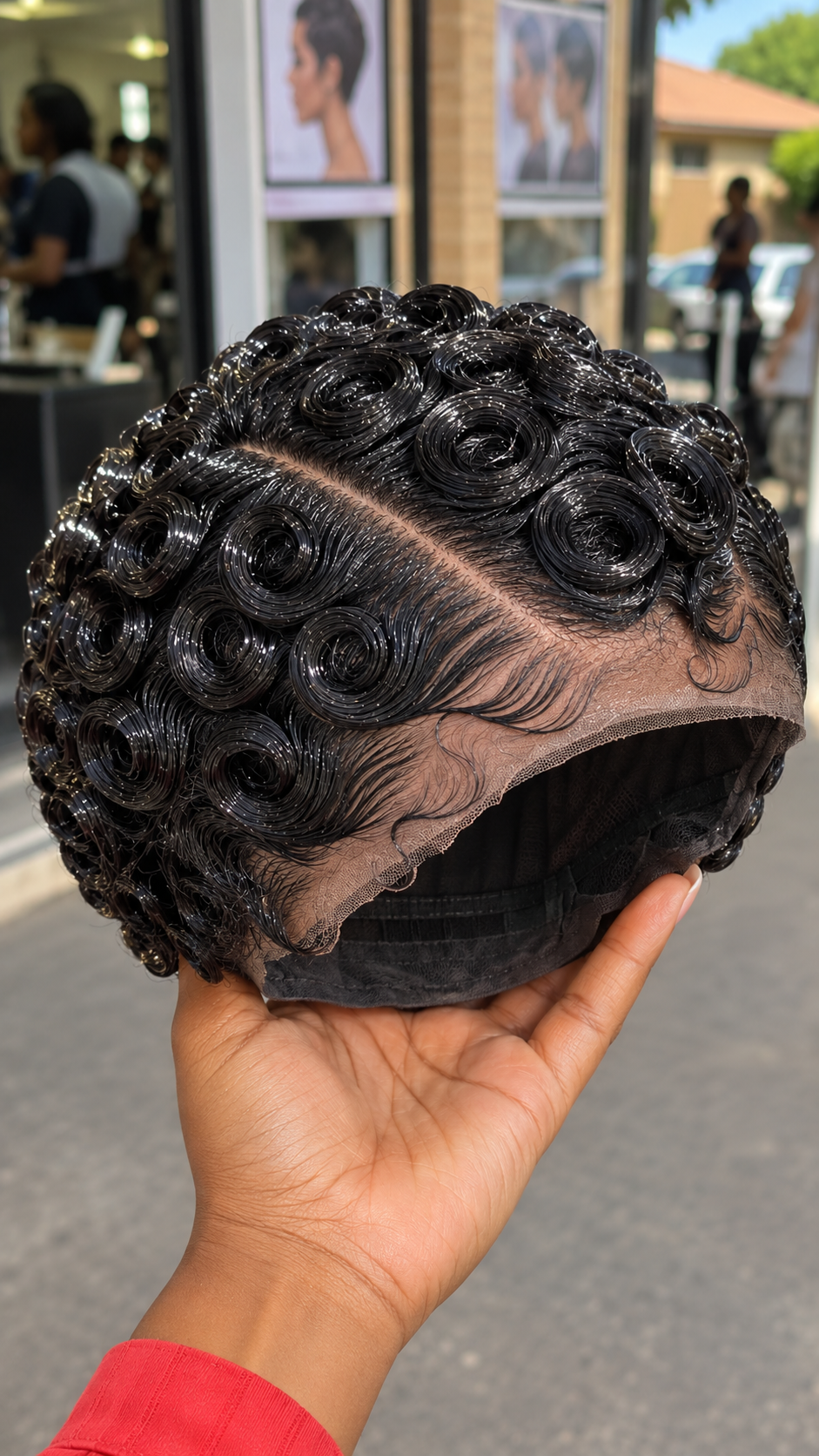
A beautifully crafted short wig can create an unforgettable impression through the arrangement of its curls alone. The black hairstyle pictured here combines glossy circular pinwheel curls, a sweeping diagonal part, and delicate finger-wave details across the front. Its compact silhouette allows the individual curls to remain the main attraction, while the carefully arranged hairline adds a graceful finishing touch. The result is a distinctive pixie-length wig that draws inspiration from vintage salon styling without relying on colorful highlights, shaved patterns, or excessive height.
The photograph shows the wig being supported in one hand outside a neighborhood beauty salon. The upper crown contains numerous circular formations resembling small spiraling rosettes. Several curls have wide visible openings, while others are more tightly rolled. A pronounced diagonal part travels across the upper hair, separating sections of the circular crown from the flatter strands near the forehead. The front hairline contains elongated black waves that sweep toward the sides before narrowing into delicate curled accents.
The wig is presented before installation, with beige-toned lace extending beyond the front hair-bearing area. The dark interior foundation is visible beneath the mesh, including several fabric sections. Although the photograph provides a detailed view of the curl arrangement and parting, it does not establish whether the hair is human or synthetic, the precise commercial lace grade, or the complete attachment system. Those specifications should be confirmed directly with the seller.


What makes this hairstyle especially interesting is the relationship between its tightly controlled circular curls and the softer directional strands near the hairline. The crown creates texture and visual fullness, while the front waves provide movement and help frame the forehead. Together, these details produce a polished short hairstyle that can appeal to women who enjoy elaborate curls in a relatively compact wig.
The Circular Pinwheel Curls Create a Distinctive Crown
The most noticeable feature of the hairstyle is its collection of rounded pinwheel curls. These formations resemble tightly rolled circles with individual strands following a continuous spiral path toward their centers.
Unlike loose curls that hang downward, the pinwheel formations are positioned close to the head. This arrangement creates a rounded crown with impressive detail without requiring long hair.
Several curls have open centers that reveal darker strands beneath their glossy surfaces. Other formations are more tightly wound, producing smaller circles that fill the spaces between the larger ones.
This variation gives the hairstyle a layered appearance. A professional wig maker should preserve the mixture of curl sizes rather than creating identical spirals across every section.
The result should be a full crown with clearly recognizable circular formations, not a dense mass in which the individual curls become indistinguishable.
Glossy Obsidian Black Creates Beautiful Reflections
The hair appears predominantly deep obsidian black, with narrow charcoal and dark-gray reflections across the raised curls. No clearly separate blonde, copper, burgundy, or other colored highlights are visible.
This monochromatic palette makes the direction and shape of the strands particularly important.
When light reaches a rolled curl, the outer surface reflects more strongly, while the recessed center remains darker. These variations give the crown dimension without additional coloring.
For a custom wig, buyers should request a rich black shade rather than introducing contrasting colors that would alter the reference.
It is also useful to request a photograph of the actual available hair under neutral lighting, since natural black and blue-black may appear similar under salon lights.
The Crown Uses a Mixture of Large and Small Spirals
The pinwheel curls are not perfectly uniform. Some circles are relatively broad, with noticeable openings, while others form smaller and tighter spirals.
The larger curls occupy prominent positions across the upper crown and visible side. Smaller curls continue around them, maintaining coverage and contributing to the rounded shape.
These differences prevent the hairstyle from appearing excessively repetitive.
A custom stylist should consider curl diameter during the initial setting process. Using only one size throughout the wig could create a more mechanical appearance than the photographed hairstyle.
Balanced variation helps the crown maintain fullness while allowing individual curls to stand out.
The Spiral Openings Give the Hair Extra Depth
Several curls have clearly visible circular centers. These openings are important because they allow the viewer to recognize the rolled construction of the hair.
When neighboring curls overlap, dark areas appear beneath their reflective surfaces, creating natural-looking shadows.
Increasing hair density indiscriminately could obscure these openings and make the crown appear less detailed.
For custom production, the objective should be sufficient coverage without eliminating the separation between individual circles.
Buyers should examine close-up crown photographs before approving a custom wig, especially if the circular pattern is the main reason they selected the hairstyle.
The Upper Hair Forms a Compact Rounded Silhouette
Although the crown contains numerous curls, the overall hairstyle remains relatively short. The rolled sections follow the rounded contour of the wig rather than extending into an exaggerated upright shape.
This is an important difference from tall curly pompadours or longer pixie hairstyles with hanging ringlets.
The curls create fullness through their arrangement rather than excessive length.
A custom maker should preserve the compact proportions and avoid raising every curl unnecessarily.
The crown should remain rounded, with a gradual transition toward the shorter lower perimeter.
The Diagonal Part Creates a Graceful Asymmetric Design
A clearly visible diagonal part travels through the upper hairstyle, separating groups of circular curls from the flatter front section.
This scalp-toned division establishes the direction of the surrounding hair and creates an asymmetric appearance.
Its angle is particularly noticeable because the black curls sit on both sides, emphasizing the exposed pathway.
The parting should not be interpreted as a decorative shaved stripe. It functions as a structural division within the hairstyle.
For a faithful recreation, the stylist should establish the part before completing the pinwheel curls and front waves.
The Parting Adds Structure Without Excessive Exposure
The diagonal division remains relatively narrow, allowing dark strands to provide coverage along both edges.
A wider part could change the arrangement of the curls and reduce the amount of hair available for the neighboring sections.
The visible pathway should remain consistent with the reference rather than becoming a prominent shaved channel.
If fine strands move across the division during wear, careful repositioning may restore its appearance.
Permanent cutting should be approached conservatively because hair removed from a wig cannot naturally grow back.
The Sweeping Front Hairline Softens the Circular Crown
Beneath the raised pinwheel curls, fine black strands follow elongated curves across the front hairline.
These strands are arranged differently from the circular crown. Rather than forming complete rounded spirals, they travel in flowing S-shaped movements.
The contrast creates an attractive transition between the fuller upper hair and the lace perimeter.
The sweeping front also gives the hairstyle an elegant appearance inspired by traditional finger-wave techniques.
A custom stylist should preserve these directional strands instead of replacing the entire front with additional circular curls.
The Fine Hairline Strands Create Natural-Looking Movement
The hair near the lace is less densely arranged than the upper crown. Individual strands are visible as they travel toward the surrounding curls.
This gradual transition prevents the hairstyle from appearing to begin abruptly with heavy ringlets directly along the forehead.
Several fine sections bend into small curls, providing additional detail around the front.
During installation, these strands should be examined before trimming or thinning.
Removing them automatically could change the carefully constructed hairline and reduce the resemblance to the photographed wig.
The Side Curls Continue the Pinwheel Pattern
Numerous circular curls continue along the visible side of the wig. Some resemble the larger formations on the crown, while smaller spirals fill the lower sections.
This creates consistent curl coverage without making the side excessively bulky.
The individual circles remain distinguishable because their outer strands reflect light against darker recessed areas.
A professional should maintain the gradual variation in curl size rather than extending the largest curls throughout the entire lower side.
The side should complement the rounded crown while retaining a compact silhouette.
The Hairstyle Does Not Depend on Razor-Carved Artwork
Unlike certain pixie wigs with multiple exposed barber lines or geometric side patterns, this design relies primarily on the arrangement of its curls and front waves.
The visible diagonal part provides the main separation.
No elaborate zigzag, spiral carving, or double-crescent temple design is clearly present.
Adding such elements might produce a different attractive hairstyle, but it would not faithfully reproduce the reference.
For custom orders, buyers should emphasize the circular pinwheel crown and sweeping hairline rather than requesting unrelated side cutting.
The Lower Curls Create a Neat Short Finish
As the hairstyle continues toward the lower perimeter, the circular curls become more compact.
This gradual reduction in size helps maintain the short pixie silhouette.
The lower sections still contain visible curls rather than transitioning into an entirely shaved undercut.
This is important for buyers who want full curly coverage around the sides and back.
A custom stylist should preserve the compact lower curls without removing excessive hair or extending them into longer hanging spirals.
The Rear Should Maintain Consistent Curl Coverage
The photograph shows much of the crown and side but does not provide a complete direct rear view.
Before approving a custom unit, buyers should request additional photographs showing how the pinwheel curls continue toward the nape.
The back should retain balanced coverage while gradually becoming more compact near the lower perimeter.
An unexpectedly sparse rear could make the wig look unfinished, while excessive bulk could change the rounded silhouette.
A rear photograph is therefore a useful quality check before purchasing.
The Compact Length Offers a Practical Alternative
Short pixie wigs can provide noticeable styling detail without long strands falling around the shoulders.
The circular curls create fullness across the head, while the compact lower sections keep the overall shape manageable.
This can appeal to women who prefer shorter hairstyles but still enjoy decorative curls.
However, the sculpted pattern may require more careful maintenance than a conventional loose-curly wig.
Customers should consider whether they prefer preserving a set hairstyle or frequently changing the curl arrangement.
The Lace Perimeter Remains Untrimmed
Beige-toned mesh extends beyond the front hair-bearing area, indicating that the wig has not yet been fitted to an individual wearer.
The extra lace gives the installer flexibility when positioning the unit and determining the final hairline boundary.
Because the front contains fine sweeping strands, trimming should be approached carefully.
The photograph does not verify HD lace or another specialized commercial grade.
Buyers should request the actual lace type and available shade options directly from the supplier.
The Dark Interior Cap Is Partially Visible
The open underside reveals a dark cap foundation with fabric sections and visible stitching.
This confirms the presence of an interior wig structure, although the photograph does not establish the complete securing arrangement.
Before purchasing, customers should request a full underside photograph showing any adjustable straps, elastic components, combs, or other attachments.
These details are important when choosing an installation method.
A visible lace perimeter does not automatically guarantee adhesive-free suitability.
Choosing the Correct Cap Size
The diagonal part, circular curls, and sweeping hairline are fixed to the wig foundation.
If the cap sits too far forward or backward, the decorative sections may appear in unintended positions.
Correct sizing therefore affects both comfort and styling accuracy.
For custom orders, follow the manufacturer’s measurement instructions. Head circumference, front-to-nape, and ear-to-ear measurements may be required depending on the construction.
A professional wig installer can help establish the appropriate size before permanent lace trimming.
Understanding Different Wig Cap Options
Comparable hairstyles may be produced on lace-front, frontal, closure, or full-lace foundations.
A lace-front wig typically includes lace along the front hairline, while a closure wig generally has a smaller lace area.
Frontal and full-lace constructions may allow additional styling flexibility depending on their design.
For a hairstyle with a visible diagonal part and decorative front waves, the chosen construction should support the intended placement.
The photograph does not establish the exact foundation used in this particular unit, so buyers should confirm the specifications before ordering.
Can This Hairstyle Be Worn Glueless?
Some wigs are designed for adhesive-free wear using an appropriately fitted cap and suitable securing components.
However, the presence of lace or a constructed interior does not automatically establish that a particular wig is glueless.
Customers who prefer adhesive-free installation should ask the supplier to confirm whether the actual unit supports that method.
The correct choice depends on cap fit, attachment components, comfort, and the manufacturer’s instructions.
A qualified wig stylist can help evaluate the installation options.
Choosing the Right Hair Density
This hairstyle requires enough hair to create a full pinwheel crown, but excessive density can conceal the individual circular openings.
The most suitable density depends on curl size, fiber type, and cap construction.
Some suppliers offer density percentages, but identical figures do not always create the same appearance across different manufacturers.
For this hairstyle, completed product photographs are more useful than density numbers alone.
Customers should prioritize balanced curl coverage and visible separation between the rosettes.
Human Hair and Synthetic Versions Have Different Benefits
The photograph cannot confirm whether the wig contains human hair, synthetic fibers, or a blend.
Human-hair versions may offer greater flexibility for professional curl resetting and hairline restoration, depending on quality and condition.
Some synthetic wigs can preserve pre-set circular curls with relatively limited daily styling.
However, synthetic fibers vary in heat tolerance, and conventional permanent coloring should not be assumed suitable.
Buyers should choose the material according to their budget, expected maintenance routine, and desired styling flexibility.
Where To Buy Similar Black Pinwheel Curl Wigs
Custom lace-wig studios, specialist wig makers, beauty supply retailers, and salons experienced with pin-curl styling are practical places to begin searching.
Ready-made short curly wigs may be suitable when their curl diameter, crown shape, and hairline arrangement already match the desired style.
Custom production offers greater control over the diagonal part, circular curl placement, and sweeping front waves.
Before purchasing, confirm whether the seller supplies a completed sculpted wig or an unfinished foundation requiring additional styling.
Also request the actual product specifications and information about the seller’s return policy.
Finding a Stylist Experienced With Spiral Pin Curls
The hairstyle requires experience with rolled circular curls and carefully arranged finger-wave hairlines.
These techniques involve different forms of strand control.
A stylist experienced only with ordinary loose curls may not automatically reproduce the compact pinwheel crown and delicate front waves.
When evaluating a portfolio, look for close-up photographs showing circular curl openings and neatly arranged directional strands.
A consultation using the reference photograph can help establish whether the stylist has the appropriate experience.
Booking a Professional Wig Appointment
The appointment required depends on whether the wig arrives fully styled.
A completed unit may require fitting, lace trimming, and minor restoration of curls displaced during transportation.
An unfinished foundation may require extensive pin-curl setting, diagonal part preparation, finger-wave styling, and installation.
When contacting a salon, provide the photograph and explain that the hairstyle uses glossy black pinwheel curls with a sweeping front hairline.
Ask whether the salon provides both customization and installation or whether separate appointments are necessary.
Preparing a Custom Production Brief
The crown should contain glossy black circular pinwheel curls with varied diameters and visible open centers.
A pronounced diagonal part should separate the major styling sections.
The front should contain fine backward-directed strands arranged into elongated finger waves and smaller curled accents.
The sides should maintain compact circular curls without additional shaved artwork.
The overall silhouette should remain short, rounded, and proportionate.
Finally, confirm the hair material, cap dimensions, lace specifications, and installation preferences.
Request Approval Photographs Before Delivery
An elevated crown photograph should reveal the circular curl openings and the diagonal part.
A frontal image should document the sweeping hairline and fine decorative strands.
Side photographs should show how the larger curls transition into smaller formations.
A rear image should confirm complete curl coverage and the compact lower silhouette.
An underside photograph should establish the actual cap construction and attachment components.
What Determines the Price of This Hairstyle?
Although the wig has a compact length and a single black color, the individual circular curls and carefully arranged front waves may require substantial professional labor.
Hair material, cap construction, lace preparation, and fitting services can also influence the cost.
Custom production may be more expensive than purchasing a basic ready-made short curly wig because the curl placement requires additional precision.
Estimated Pricing for Black Pinwheel Curl Wigs
| Category | Illustrative Price Range | Potential Scope |
|---|---|---|
| Premium Custom | $330–$610+ | Higher-grade hair, personalized cap sizing, individually arranged circular curls, precision diagonal parting, decorative front waves, and professional lace preparation. |
| Standard Custom | $200–$365 | Prepared black pinwheel crown, sweeping hairline styling, and standard cap options. |
| Basic Human Hair | $115–$220 | A human-hair foundation requiring curl setting, parting preparation, and professional fitting. |
| Premium Synthetic | $80–$160 | A quality pre-set alternative that may preserve the circular curl pattern with relatively limited routine styling. |
| Basic Synthetic | $40–$95 | A budget interpretation where curl separation, hairline precision, or cap construction may be simpler. |
These figures are illustrative budgeting estimates rather than verified retail prices for the photographed wig. Actual quotations depend on materials, supplier, location, customization labor, shipping, and installation.
Buyers should compare completed-unit prices rather than assuming every inexpensive black curly wig includes the full pinwheel crown and decorative hairline.
Human Hair May Allow Professional Curl Restoration
A human-hair version may allow selected circular curls to be reset when they lose their original shapes, depending on the condition of the strands.
The sweeping front waves may also be restored separately from the crown.
However, repeated heat can affect the hair, particularly if it has undergone chemical processing.
A professional should assess the material before selecting restoration techniques.
Synthetic Hair May Retain Its Pre-Set Spirals
Some quality synthetic fibers can maintain circular curls with comparatively limited daily manipulation.
This may appeal to women who prefer wearing a consistent set hairstyle.
However, synthetic fibers differ in heat resistance and coloring compatibility.
Conventional permanent hair dye should not be assumed suitable, and any use of heated tools should follow the manufacturer’s instructions.
Daily Care for the Circular Curls
The pinwheel curls should be handled gently to preserve their rolled shapes.
Avoid repeatedly brushing through the crown or aggressively separating neighboring ringlets.
If a curl becomes displaced, targeted restoration may be preferable to resetting the entire hairstyle.
The appropriate method depends on the material and the original setting technique.
Washing Without Disturbing the Pinwheel Pattern
Before washing, photograph the crown from above to record the original curl arrangement.
Use cleansing products suitable for the confirmed hair or fiber.
Avoid aggressive rubbing that could intertwine neighboring curls and obscure their circular openings.
Allow the wig to dry without compressing the crown.
Restore displaced sections individually using suitable techniques when necessary.
The Sweeping Hairline Requires Separate Maintenance
The elongated front strands should retain their flowing direction rather than being rolled into additional circular curls.
If the waves become displaced, a professional may be able to restore their original curves using material-appropriate methods.
Heavy styling products can cause the fine strands to merge and reduce the detailed appearance.
The goal should be preserving the original direction and separation of the hairline waves.
Protecting the Diagonal Part
The exposed parting is a significant structural detail and should not be widened unnecessarily.
If fine strands shift across the division, careful repositioning may restore the original appearance.
Permanent cutting should be conservative because removed wig hair cannot naturally regrow.
The original photograph can serve as a reference for maintaining the angle and width of the part.
Avoid Excessive Styling Product
The glossy black curls already reflect light strongly.
Heavy oils or waxes may cause neighboring circular formations to adhere together and lose their individual outlines.
Product buildup can also obscure the fine front waves.
Use styling products appropriate for the confirmed fiber and apply them conservatively.
Maintaining the Deep Black Color
The hairstyle’s monochromatic appearance places emphasis on the shine and structure of the curls.
If a human-hair version requires color maintenance, a professional should assess the condition of the strands before applying additional processing.
Synthetic wigs should not be recolored using conventional permanent dye unless the manufacturer confirms compatibility.
Appropriate cleansing and storage can help preserve the intended appearance.
Installation Should Protect the Decorative Front
Before trimming the lace, the installer should establish the correct wearing position and evaluate the front waves.
The diagonal part should fall in its intended location, and the circular crown should retain its rounded shape.
Delicate strands should not be removed automatically during hairline preparation.
Only after the fit is approved should excess lace be trimmed and optional adjustments considered.
Storage Should Preserve the Rounded Crown
A suitable wig stand or mannequin head can help maintain the circular curls between wears.
Avoid stacking the wig beneath other hairpieces or pressing the crown against hard surfaces.
The sweeping front waves should remain free from compression.
Make sure the hair and cap are completely dry before storage.
For transportation, choose packaging with sufficient clearance around the styled curls.
Advantages of This Compact Curly Wig
The hairstyle offers substantial curl detail without long hanging strands.
The rounded pinwheel crown creates fullness, while the diagonal part and sweeping hairline provide elegant directional movement.
The deep black color keeps the appearance cohesive and emphasizes the craftsmanship of the individual curls.
These qualities can appeal to women who enjoy short hairstyles with a polished salon finish.
Potential Limitations to Consider
The intricate circular curls may require more careful handling than ordinary loose-curly wigs.
Individual pinwheel formations can lose their shape through compression, aggressive brushing, or unsuitable styling methods.
The sweeping hairline may also require occasional professional restoration.
Buyers should consider the maintenance routine and potential styling expenses before purchasing a heavily sculpted wig.
Why This Black Pinwheel Pixie Makes a Lasting Impression
This hairstyle combines a rounded crown of glossy black circular curls, a prominent diagonal part, and fine sweeping waves along the front. Its compact shape allows each curl to contribute to the finished appearance without relying on contrasting colors or extensive shaved artwork.
For buyers, the most important quality checks are curl diameter, visible circular centers, crown density, diagonal part placement, front-wave direction, cap fit, and verified material specifications.
For wig businesses, detailed crown and frontal photographs can communicate the craftsmanship more accurately than a generic description of a black curly wig. Clear product specifications and accurate customization information also support informed purchasing decisions.
A faithful custom recreation should preserve the circular pinwheel curls and sweeping front hairline without introducing unnecessary highlights, excessive crown height, or unrelated geometric patterns. The strongest result comes from maintaining the careful balance between the rounded crown and decorative directional strands.
Search Terms
obsidian black pinwheel curl wig · sweeping hairline pixie · black circular rosette curls · diagonal part short lace wig · sculpted spiral crown wig · glossy black pin curl hairpiece · finger wave front pixie · compact black rolled curls