
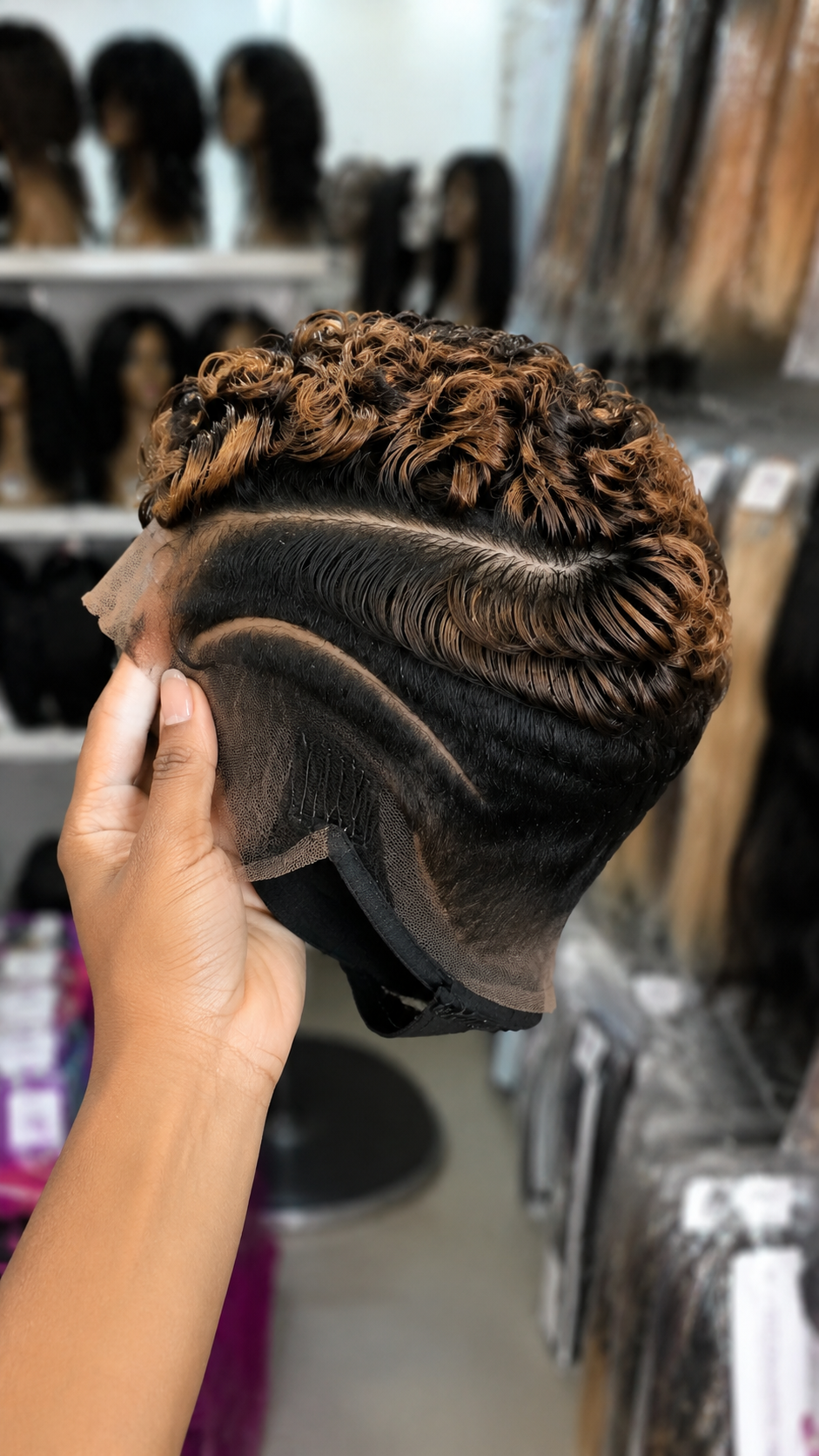
Look at the top and side of this pixie wig separately and they almost behave like two different hairstyles. The crown is filled with loose, lifted curls carrying warm caramel-brown highlights, while the side is pressed into sleek sculpted ridges that sit extremely close to the cap.
That difference creates the character of the style, but it also creates a maintenance problem many buyers do not think about. The crown and the molded side should not automatically receive the same products, the same amount of moisture, or the same styling technique. Treating the entire wig as one texture can flatten the curls above or soften the precise wave pattern below.
Before ordering a mixed-finish pixie like this, find out whether you are comfortable maintaining two styling zones instead of one.
Where To Buy A Mixed-Finish Curly Pixie Wig
Custom wig makers. A custom maker is useful for a style this specific because you can ask how the crown curls and the molded side were created separately. Ask which products were used in each area and request maintenance instructions for both zones.
Instagram and TikTok sellers. Social sellers often show the finished result without explaining how it was built. Ask for a short video showing the crown being separated with the fingers and the side being lightly touched or brushed. You want to understand whether both areas are flexible or heavily set.
Etsy. Independent makers may offer custom colour, cap size, curl placement, and side styling. Send the reference image and specify that you want a loose highlighted crown combined with a close molded side rather than simply asking for a curly pixie.
Marketplaces like Amazon, AliExpress, and Temu. Similar-looking units may arrive with one uniform texture instead of the two-zone finish shown in promotional photos. Compare customer images closely, especially the transition between the upper curls and the flatter side.
Local beauty supply shops and salons. Buying locally gives you the chance to touch both areas. The crown should not feel coated with the same amount of hard-setting product as the molded side unless that is intentionally how the unit was designed.
Vendors and wholesalers direct. Ask whether the crown and side are made from the same fibre, whether the highlights are processed human hair or coloured synthetic fibre, and whether the molded side can be refreshed after washing.
Regionally. Wig makers in Lagos, Accra, Atlanta, London, and major South African hair markets often produce short sculpted pixies, but product names vary. Use the image itself to describe the two zones rather than depending on labels such as curly pixie or finger-wave wig.
Vet the seller. Look for photographs after washing or refreshing, not only the original salon-finished version. A mixed-finish pixie is only valuable if both sections can be maintained after the first few wears.
Red flags. Be cautious if the seller cannot explain how to refresh the side waves, recommends one heavy gel for the whole unit, or refuses to show the hair after the original styling products have been removed.
When you order, send. Provide your cap size, preferred colour, crown curl reference, side-wave reference, and whether you want a softer everyday finish or a highly sculpted salon-set appearance.
Contact / order inquiries: WhatsApp [WhatsApp: +XX XXX XXX XX XX]
How Much It Costs
Premium custom human hair. A carefully made highlighted human-hair pixie with separate crown and molded-side styling can commonly range from around $240–$450 depending on hair quality, lace, colouring, ventilation, cap construction, and styling labour.
Standard custom human hair. Around $180–$320 can cover many good short human-hair units. The price should reflect real hair quality and construction, not merely the amount of styling product used to create the photograph.
Basic human hair. Around $150–$240 may buy a simpler version with more processed hair, basic lace, or less refined separation between the crown and side.
Good synthetic. Around $60–$150 can work well for highly sculpted styles because quality synthetic fibre may preserve preset waves and curls with less daily styling.
Basic synthetic. Around $25–$70 is common for lower-cost units. Check whether the side waves are actually formed into the fibre or simply held in place with a heavy coating of product.
Colour work. Warm caramel or honey-brown highlighted human hair may add roughly $50–$120 depending on the starting colour, placement, and amount of lightening required.
What the price may exclude. Custom cap sizing, lace tinting, bleached knots, colour maintenance, side-wave resets, and professional restyling may all cost extra.
Shipping and duty. International delivery, customs charges, and local taxes can increase the real price considerably. Compare the delivered total rather than only the seller’s listed amount.
Ongoing costs. This style can require two kinds of products: lightweight curl care for the crown and stronger setting products for the molded side. That does not make it extremely expensive, but it does make the routine more specific.
First-year total. Include curl products, setting gel or foam, lace care, colour-safe shampoo, conditioner, and occasional professional resetting if you cannot recreate the side waves yourself.
Cost per wear. A mixed-finish pixie that you can maintain yourself may offer excellent value. A cheaper unit that requires a salon visit every time the side loses its shape can become expensive quickly.
What a very low price may signal. It may mean the apparent two-texture finish exists mainly because of styling product rather than careful construction or quality fibre.
Deposit structure. Custom makers may request about 30–50% upfront and the remaining balance before shipping. Keep your colour, curl, and side-finish instructions in writing.
Shipping, Delivery, And What To Expect After Ordering
When the wig arrives, examine the two styling zones before adding any product. Look at the highlighted crown first. Separate a few curls gently and see whether they move independently or feel glued together by finishing spray.
Then inspect the molded side. The ridges should follow a deliberate direction and sit close to the cap without feeling excessively crusted.
Do not immediately spray the entire wig with water. If the side is product-set, soaking it can soften the wave pattern before you have even evaluated the original construction.
The Crown Wants Movement
The upper section of this wig gets much of its appeal from separation. Individual highlighted curls bend, overlap, and lift away from the head.
That movement creates visible depth because the lighter caramel strands catch the light at different points. If you coat the crown in heavy gel, the curls begin sticking together and the dimension disappears.
A lightweight leave-in, curl foam, or small amount of curl cream is usually more appropriate for a human-hair crown like this than the amount of hard gel used for a molded side.
The goal is to restore the curl without turning every strand into one solid shape.
The Molded Side Wants Control
The side section has almost the opposite requirement. Its beauty comes from control rather than freedom.
The hairs are aligned closely together to form long, repeated ridges. If that area becomes fluffy, excessively moisturized, or individually separated, the pattern loses its definition.
This section may need setting foam, mousse, gel, or another holding method depending on the fibre.
The important point is that a product appropriate for the side may be too heavy for the crown.
One Product Across The Whole Wig Can Ruin The Contrast
This is where mixed-finish pixies often go wrong at home.
A buyer sees curls and reaches for curl cream. She applies it everywhere. The crown responds well, but the sculpted side becomes too soft and begins losing its ridges.
Another buyer loves how sharp the side looks and uses a strong gel across the entire wig. The side stays precise, but the highlighted crown becomes heavy, sticky, and visually smaller.
Neither product is necessarily bad. The mistake is assuming every section of the wig needs the same thing.
Think Of The Wig As Two Maintenance Zones
A practical way to care for this style is to mentally divide the unit at the transition line.
Zone one: the raised highlighted crown. Maintain curl separation, softness, movement, and moisture.
Zone two: the close sculpted side. Maintain direction, hold, ridge definition, and a flatter profile.
You do not need a complicated collection of products. You simply need to stop applying every product everywhere.
That small change can preserve the original contrast much longer.
The Transition Between The Two Zones Matters
The most difficult section is not necessarily the crown or the side. It is where they meet.
The upper curls should gradually emerge from the flatter section rather than looking like a curly piece was placed on top of a separate wave panel.
During maintenance, avoid aggressively combing across this boundary. Doing so can pull side hairs upward into the crown or press crown hairs downward into the molded section.
Work with the existing direction instead of fighting it.
The Highlighted Crown Shows Product Buildup Faster
The warm caramel-brown pieces make the top more dimensional, but they can also make buildup easier to notice.
Heavy wax, gel residue, lint, or dried product can collect between separated strands and become particularly obvious where the lighter colour catches strong light.
That means the highlighted crown benefits from using the minimum product necessary.
More product does not automatically mean more definition. Sometimes it simply means less movement and faster buildup.
The Dark Side Can Hide Buildup Until It Becomes Heavy
The darker molded side creates the opposite problem. Product residue may be less obvious at first because the hair is already compact and dark.
That can tempt the wearer to keep layering new gel over old gel.
Eventually the side becomes stiff, dull, flaky, or difficult to reshape. At that point, adding another layer will not restore the original finish.
The section needs to be cleaned and reset rather than continuously coated.
Wash The Two Zones With The Final Restyle In Mind
Eventually the wig will need a proper wash. At that point, both styling zones may relax.
The critical question is what happens afterward.
If the underlying hair has a natural curl pattern, the crown may return fairly easily with moisture and light styling. The molded side may require significantly more technique because those precise ridges were arranged by hand.
Before washing for the first time, ask yourself whether you know how to recreate both sections.
If not, photograph the wig carefully from several angles before washing or ask the seller for a reset tutorial.
Human Hair Gives Flexibility But Requires Skill
Human hair offers the advantage of restyling. You can refresh the crown, change the amount of curl definition, and rebuild the side with the correct tools and products.
The downside is that none of those sculpted details are permanently guaranteed.
Once the original set is washed away, the finished appearance depends partly on your styling ability.
That makes human hair flexible, but not automatically maintenance-free.
Synthetic Fibre Can Preserve The Design Longer
With a quality synthetic unit, some of the curl and wave geometry may be built into the fibre more permanently.
That can make a mixed-finish pixie easier to maintain because the side may retain its direction with less resetting.
The tradeoff is flexibility. If a synthetic section becomes badly deformed, changing or repairing it may be more difficult than restyling human hair.
Ask whether the fibre is heat-safe before attempting any heated correction.
Do Not Confuse Shine With The Same Finish
Both sections of this wig reflect light, but they do not need to reflect it in exactly the same way.
The crown can have softer, broken highlights across individual curls. The molded side naturally creates longer continuous reflections because the hairs are aligned together.
Trying to make both sections equally glossy can remove the contrast that makes the design interesting.
The finish should follow the texture instead of forcing every part of the wig to look identical.
Before You Pay
- Can you tell me which products were used on the highlighted crown and which were used on the molded side?
- What happens to each section after the first full wash?
- Can you show the wig after it has been washed and restyled once?
- Is the side wave built into the fibre or created mainly with gel, foam, or heat?
- Can you provide instructions for refreshing the crown without disturbing the sculpted side?
Trimming The Lace
Place the wig in its intended position before trimming because the sculpted side establishes a very specific direction across the head.
Check the parting, temple, and transition between the raised crown and flatter side. Once everything sits correctly, trim the lace gradually rather than removing a large section at once.
Avoid pulling the wig excessively tight to make the molded side appear flatter. The side should lie correctly because of the styling and cap fit, not because the front lace is under unnecessary tension.
Search Terms
caramel highlight curly pixie wig · molded wave curly pixie wig · mixed texture pixie wig · highlighted crown finger wave wig · black and caramel short pixie wig · sculpted side curly lace wig · two texture curly pixie wig · caramel brown molded pixie
Final Thoughts
This black-and-caramel pixie works because its two sections are intentionally different. The highlighted crown is lifted, separated, and mobile. The darker molded side is compressed, directional, and highly controlled.
Maintaining the style successfully means preserving that difference instead of trying to make both areas behave the same way. Use lighter curl care where movement matters and stronger setting techniques only where control is actually required.
A mixed-finish pixie is not necessarily difficult to own. But it rewards a wearer who understands that one wig can contain two completely different maintenance jobs.