
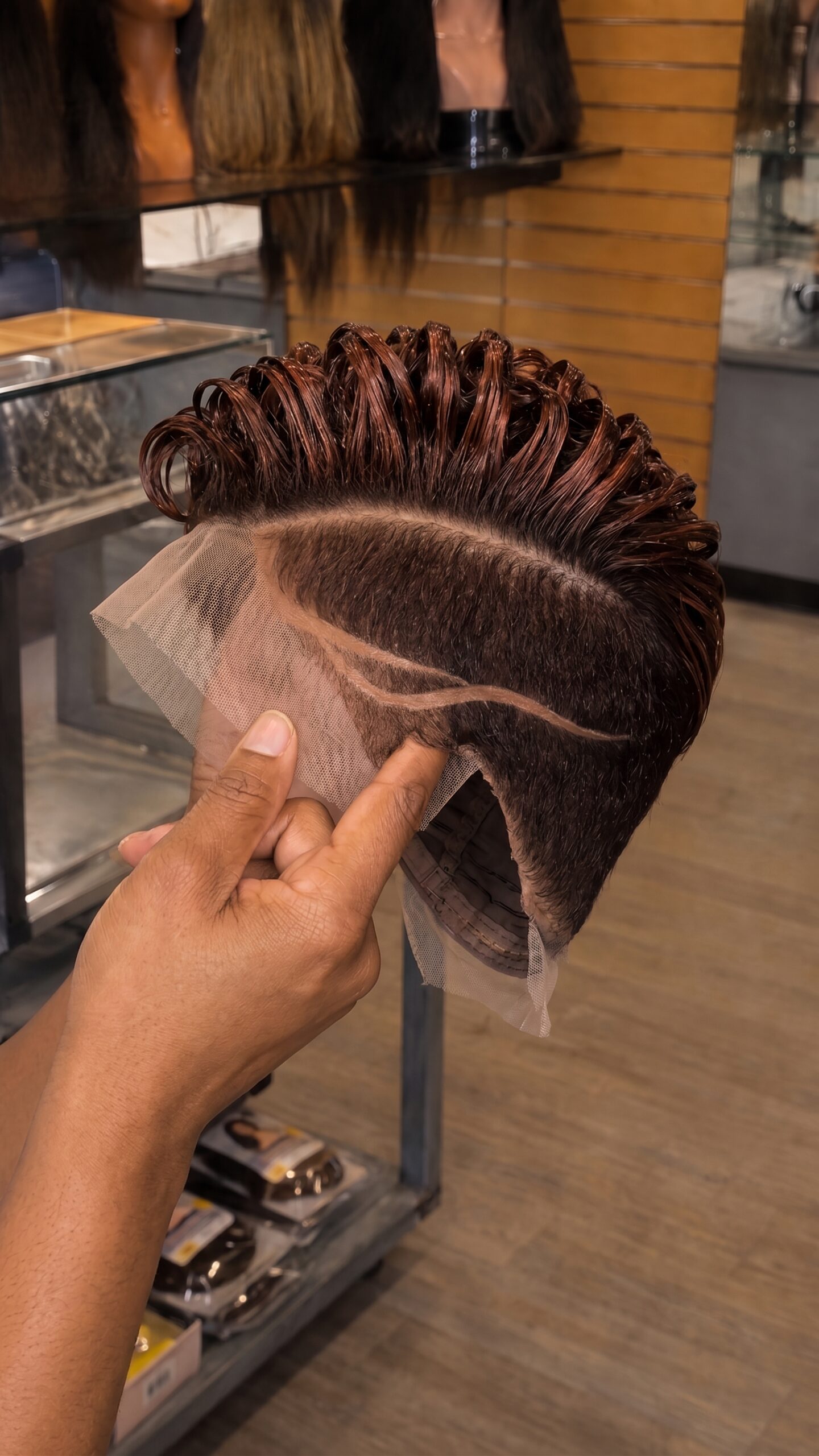
A short pixie wig can look surprisingly tall without carrying a huge amount of hair. This chocolate-brown unit shows exactly how. The top is built from long sculpted loops that rise away from the cap before curving back toward the crown, while the side stays extremely short and close to the head.
That contrast creates height. But the important buying lesson is that the height is not necessarily coming from higher density. It is coming from the direction in which each loop leaves the root. If those same strands were pressed flat or curled horizontally, the entire silhouette would become lower even though the wig contained exactly the same amount of hair.
Before paying extra for a “fuller” pixie, learn to separate actual hair density from styling geometry.
Where To Buy A Sculpted Loop Curl Pixie Wig
Custom wig makers. A custom maker is the strongest option when you want this exact loop height and direction. Ask for the crown to be shown from the side, not only from above, because the side profile reveals whether the loops genuinely rise from the root.
Instagram and TikTok sellers. Ask for a slow video rotating the unit from front to side and then toward the back. Still photos can make loops look taller than they really are if the camera is positioned low.
Etsy. Independent makers may be able to adjust the loop size, crown height, fade depth, colour, and side design. Send a reference image and describe the top as elongated sculpted loops rather than simply asking for “curly pixie hair.”
Marketplaces like Amazon, AliExpress, and Temu. Similar-looking units may use completely different construction. Compare customer photographs carefully because a listing can show tall sculpted loops while delivered units arrive with ordinary compact curls.
Local beauty supply shops and salons. Buying locally gives you a major advantage with this style. View the wig from eye level and from the side. If the crown only looks full from above, the loop orientation may not be giving the silhouette you expect.
Vendors and wholesalers direct. Ask whether the loops are permanently set in synthetic fibre, heat-shaped human hair, or formed mainly with styling product. That answer tells you a lot about how much maintenance the crown will require.
Regionally. Wig makers in Lagos, Accra, Atlanta, London, and major South African hair markets often produce sculpted short styles, but naming varies widely. Use the reference photograph instead of relying only on words such as loop curl, barrel curl, or pixie curl.
Vet the seller. Look for photographs showing the same unit from side profile, top, front, and underside. The most important view for this particular style is the side because it exposes the actual height of the loops.
Red flags. Be cautious if every image is shot from one low angle, if the crown shape changes dramatically between photos, or if the seller cannot explain how the loops are maintained after washing.
When you order, send. Provide your cap size, preferred crown height, loop size, colour reference, side-profile reference, and whether you want the top to stand upright or lie closer to the head.
Contact / order inquiries: WhatsApp [WhatsApp: +XX XXX XXX XX XX]
How Much It Costs
Premium custom human hair. A carefully styled human-hair loop pixie can commonly range from about $220–$430 depending on hair quality, lace, cap construction, colouring, fade work, and the amount of hand styling required.
Standard custom human hair. Around $170–$300 can cover many good short human-hair units. If the sculpted top requires extensive hand-setting, the styling labour may account for part of the price.
Basic human hair. Around $150–$230 may buy a simpler version. At this level, check whether the loops are truly shaped throughout the crown or whether only the most visible front section has been carefully styled.
Good synthetic. Around $60–$150 can be very competitive for this particular look because a quality synthetic fibre can preserve a preset loop shape with less daily restyling.
Basic synthetic. Around $25–$70 is common for budget pieces. Check for plastic-looking shine, stiff loops, weak root direction, and inconsistent loop size.
What the price may exclude. Custom colouring, lace tinting, individual cap sizing, carved side work, professional fitting, and later restyling may be separate charges.
Shipping and duty. International delivery, customs charges, and local taxes can add significantly to the final cost. Compare the landed price rather than only the listing amount.
Ongoing costs. Human-hair sculpted loops may need setting products and occasional reforming. Synthetic loops can require less styling but may be harder to reshape once the fibre itself is damaged.
First-year total. Include curl products, possible professional resets, lace care, and any maintenance needed to preserve the upright crown silhouette.
Cost per wear. A slightly more expensive unit that holds its loop orientation between wears may be cheaper in practice than a lower-priced wig that needs professional restyling every few weeks.
What a very low price may signal. It may mean ordinary curls have simply been arranged to imitate a sculpted loop crown for the product photo rather than the style being built consistently throughout the unit.
Deposit structure. Custom makers often request around 30–50% upfront with the balance before shipping. Keep the requested crown height and loop direction in writing because those details are difficult to explain after the unit has already been made.
Shipping, Delivery, And What To Expect After Ordering
When the wig arrives, inspect the crown before touching the loops. Shipping pressure can flatten sculpted styles, so first determine whether the shape is temporarily compressed or genuinely different from what you ordered.
Look at the wig from the side at eye level. Check where the loops begin rising, how high the crown sits, and whether the height continues naturally from front to back.
Do not judge only the individual curl shape. On this kind of pixie, the relationship between all of the loops is what creates the silhouette.
Loop Direction Creates Height Before Density Does
The easiest way to understand this style is to imagine one strand leaving the cap.
If that strand travels almost horizontally and then curls, most of its visual mass stays close to the head. If the same strand rises vertically first and only then bends into a loop, it occupies more vertical space.
Repeat that geometry across the crown and the wig suddenly looks taller.
No extra hair had to be added. The strands simply use space differently.
This matters because shoppers frequently mistake height for density. A tall pixie may look as though it contains more hair, when in reality its loops are simply standing farther away from the cap.
Root Direction Matters More Than The Tip Of The Curl
Buyers naturally stare at the visible loop because that is the decorative part of the style. But the more revealing section is lower down, where the hair leaves the cap.
Look at whether the strands initially rise, sweep forward, lean backward, or spread sideways. That first centimeter of direction helps determine where the entire curl eventually lands.
A strong sculpted crown needs intentional root direction. If every strand grows straight upward with no plan, the wig can become spiky. If everything lies flat before curling, the loops may look beautiful individually but the silhouette loses height.
The best result uses controlled lift rather than random lift.
Loop Size And Loop Orientation Are Two Different Decisions
A large curl does not automatically create a high crown. A large loop can still lie flat against the head.
Likewise, a smaller loop can create surprising height if it is anchored vertically.
That is why buyers should separate curl size from curl orientation. Size describes how wide the loop is. Orientation describes how that loop occupies space relative to the cap.
This unit uses both relatively large loops and strong upward orientation, producing a much more architectural crown than the compact ringlet pixies shown in many standard listings.
The Short Side Makes The Crown Look Even Taller
The extremely short side panel creates another optical effect. Because the hair drops rapidly from tall loops to a close-cut fade, the difference between the two zones becomes dramatic.
That makes the crown appear even higher.
If the same loop crown were paired with fuller sides, the height difference would feel softer. Here, the short faded side acts almost like a visual baseline, making every centimeter of crown lift easier to notice.
This is why you cannot judge top volume independently from the side length. The two proportions work together.
The Crown Should Rise Gradually, Not Like A Shelf
A badly constructed high-loop pixie can create a hard horizontal line where the tall crown suddenly starts above the short side. That makes the top look attached rather than integrated.
Look for gradual elevation. The hair should become longer and more lifted as it moves away from the faded side and toward the upper crown.
The transition does not need to be perfectly smooth because the style is intentionally sculptural, but it should still feel like one haircut.
If the entire loop crown appears to sit on top of the side like a separate cap, the height has not been blended successfully.
Large Loops Need Space Between Them
One of the easiest mistakes with sculpted loop styles is overcrowding.
If the maker places too many large loops in a small crown area, they begin pressing against one another. The loops lose their individual openings, the silhouette becomes heavy, and the top starts looking like one solid mass.
A successful loop crown needs controlled negative space. You should be able to read individual bends and openings without seeing obvious bald gaps beneath them.
That balance is different from simply increasing density.
Compression Is The Main Enemy Of A Tall Loop Crown
A pixie built around vertical loops is sensitive to pressure. Packing the wig tightly, placing heavy objects on it, or storing it flattened can push those loops toward the cap.
The hair may still technically be curled afterward, but the silhouette changes because the root direction has collapsed.
That is an important distinction. Sometimes buyers think their curls have “fallen” when the curl itself still exists. What disappeared was the orientation that created the height.
Store a style like this on a form or mannequin head whenever possible so the crown is not constantly being compressed.
Human Hair And Synthetic Fibre Behave Differently Here
Human hair gives you the advantage of restyling. If the crown collapses, a skilled stylist can usually reshape and redirect the loops with appropriate setting methods.
The tradeoff is maintenance. Humidity, washing, sleeping, and handling can gradually change a sculpted human-hair set.
Synthetic fibre can hold a factory-set loop orientation for longer when the fibre is designed for it. But once a non-heat-safe synthetic loop bends or deforms badly, restoring the exact original shape may be difficult.
Ask which type you are buying based on how much restyling you are comfortable doing.
The Brown Colour Makes The Loop Geometry Easier To Read
This unit uses a rich chocolate-to-auburn brown rather than solid jet black. The warmer tone catches highlights along the long curved surfaces of each loop.
That makes the loop direction easier to see because the raised sections reflect more light than the deeper folds.
Colour is not the main construction issue here, but it does help reveal the geometry. On an extremely dark black unit photographed in low light, some of those individual loops could visually merge together.
The Carved Side Should Support The Silhouette, Not Compete With It
The side of this wig includes two flowing carved lines. They add movement to an otherwise very short faded panel.
Because the crown is already visually dramatic, the side design works best when it stays secondary. If the carved pattern becomes too elaborate, the eye has to process two competing focal points: the sculpted crown and the graphic side.
Here, the larger design story should remain the crown height and the long loop direction.
Before You Pay
- Can you show the wig from a true side profile so I can judge the actual crown height?
- Do the loops rise from the root, or are they ordinary curls arranged upward only for the photograph?
- What happens to the loop orientation after the first wash?
- Is the fibre human hair, heat-safe synthetic, or non-heat-safe synthetic?
- Can you show how the crown looks after the wig has been unpacked and lightly refreshed?
Trimming The Lace
Set the wig in its final wearing position before trimming the lace. A tall sculpted crown can change how you instinctively position the unit because the visual weight sits higher than on a compact pixie.
Check the front, temples, and side profile first. Once the cap position is correct, trim the lace gradually along the intended hairline.
Do not pull the wig excessively backward just because the crown feels tall. That changes the hairline position instead of solving the silhouette. If the crown height is too much for you, the loops need styling adjustment rather than a different cap position.
Search Terms
sculpted loop curl pixie wig · chocolate brown loop pixie wig · tall crown curly pixie wig · upright loop curl short wig · brown sculpted pixie wig · loop curl lace pixie wig · shaved side loop curl wig · auburn brown sculpted pixie
Final Thoughts
The dramatic height on this chocolate-brown pixie is not simply a matter of adding more hair. It comes from a styling decision: long loops are directed upward from the crown before they curve back toward the head.
Once you understand that, you can judge this style much more accurately. Look past the total volume and inspect the root direction, loop spacing, side-to-crown proportion, and how well the shape survives movement and storage.
A good sculpted loop pixie uses geometry to create volume. The best one gives you height without needing unnecessary density.