
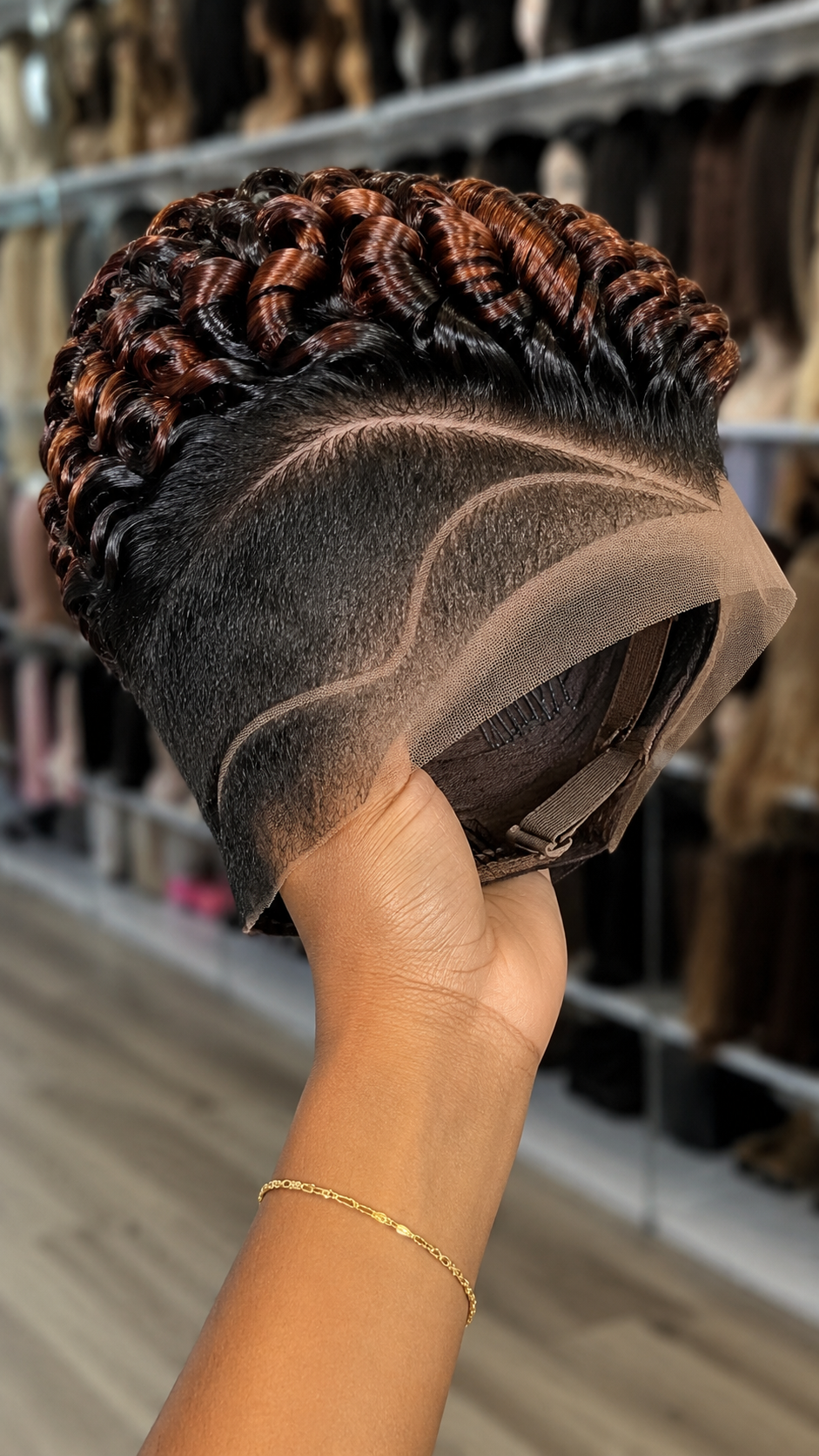
A two-colour pixie wig can look dimensional for several completely different reasons. Sometimes lighter strands are scattered randomly through the hair. Sometimes the roots stay dark while the ends gradually become lighter. But this black-and-copper pixie uses another approach: the warm colour appears repeatedly across the visible bends of the sculpted loop curls.
That repetition is what makes the colour pattern feel intentional. Instead of simply placing copper somewhere on the crown, the colour works with the geometry of each loop. As the curl rotates, black disappears underneath and copper catches the eye across the raised section. The result is a repeated dark-light-dark rhythm across the top of the wig.
Before ordering a pixie like this, do not ask only whether the colour is black and copper. Ask where the copper sits on each curl and whether that placement repeats consistently across the crown.
Where To Buy A Black And Copper Loop Curl Pixie Wig
Custom wig makers. A custom maker is the strongest option when you want this exact colour placement. Send a close reference and explain that the copper should follow the visible sections of the sculpted loops rather than appear as ordinary scattered highlights.
Instagram and TikTok sellers. Ask for a rotating video of the unit. A still image can make strategically positioned colour look consistent even when the back of the wig is very different. Rotation reveals whether the pattern continues around the crown.
Etsy. Independent makers may offer enough customization to control both curl shape and colour placement. Confirm that the maker understands you want repeated colour placement on the loops rather than a general brown-highlighted pixie.
Marketplaces like Amazon, AliExpress, and Temu. Similar listings may use broad terms such as highlighted, two-tone, brown-black, or copper mix. Those labels do not tell you how the colour is arranged. Compare buyer photos carefully before assuming the delivered wig will have the same repeated pattern.
Local beauty supply shops and salons. Buying locally makes this colour technique much easier to judge. Turn the wig slowly and watch whether the copper continues appearing across similar sections of the curls or disappears after the most visible front area.
Vendors and wholesalers direct. Ask whether the colour is created strand by strand, section by section, or by colouring a finished curl set. The method can affect consistency and how easy the effect is to reproduce across multiple units.
Regionally. Wig makers in Lagos, Accra, Atlanta, London, and major South African hair markets may use different names for this style. A photograph is more useful than trying to describe it with one colour term.
Vet the seller. Look for multiple units made with the same technique. If every wig has completely different colour placement, the effect may depend heavily on chance rather than a repeatable method.
Red flags. Be cautious if the front has attractive copper bands but the crown becomes random, if some loops are completely orange while others remain entirely black, or if the seller refuses to show the back and opposite side.
When you order, send. Provide your cap size, base colour, copper tone, desired loop size, crown height, and several reference angles showing how much copper you want visible.
Contact / order inquiries: WhatsApp [WhatsApp: +XX XXX XXX XX XX]
How Much It Costs
Premium custom human hair. A carefully coloured human-hair pixie with sculpted loops and repeated black-to-copper placement can commonly range from around $250–$470 depending on hair quality, lace, hand work, colour processing, cap construction, and the time required to set the crown.
Standard custom human hair. Around $190–$330 can cover many good short human-hair units. The important question is whether the colour placement is genuinely repeated throughout the crown or carefully staged only near the front.
Basic human hair. Around $150–$240 may buy a simpler version with more generic highlighting or less consistent loop placement.
Good synthetic. Around $60–$160 can work particularly well for patterned colour because synthetic fibre can be manufactured in stable pre-coloured combinations without the chemical lifting required on dark human hair.
Basic synthetic. Around $25–$75 is common for budget pieces. Inspect whether the copper appears painted-looking, excessively bright, or inconsistent between curls.
Colour premium. On human hair, black-to-copper work may add approximately $60–$140 depending on how much hair needs lifting and how precisely the colour has to be positioned.
What the price may exclude. Lace tinting, bleached knots, custom cap sizing, carved side work, colour refreshes, and professional loop resetting may be separate charges.
Shipping and duty. International shipping, customs fees, and local taxes can increase the final purchase cost substantially. Compare the full delivered price rather than only the listing amount.
Ongoing costs. Copper usually needs more colour maintenance than black. Human-hair sections may require colour-safe washing and occasional pigment refreshing to keep the contrast strong.
First-year total. Include colour products, curl-setting products, lace care, possible professional resets, and any colour refresh required as the copper begins losing intensity.
Cost per wear. A more expensive unit with consistent colour placement may provide better value than a cheaper version where the copper pattern looks uneven every time the crown moves.
What a very low price may signal. It may mean generic mixed-colour fibre has been arranged to imitate the effect rather than the colour being intentionally mapped to the loop pattern.
Deposit structure. Custom makers often request around 30–50% upfront and the remaining balance before shipping. Keep the colour-placement reference in writing because “black and copper” alone is not specific enough for this design.
Shipping, Delivery, And What To Expect After Ordering
When the wig arrives, inspect the colour before cutting the lace or disturbing the loop set. Look at the crown from the front, side, top, and back.
Count how often the copper appears on similar portions of the curls. It does not need to be mathematically identical, but the pattern should feel deliberately repeated rather than random.
Also inspect the darkest areas between the curls. Those black sections are important because they create the contrast that makes the copper visible.
This Is Not Ordinary Highlight Placement
Traditional highlights usually work by selecting strands and making those strands lighter from root toward the ends. The primary design decision is which strands receive colour.
This pixie behaves differently visually. The important feature is not simply which hair is copper. It is where the copper becomes visible after the strand has been curled into a loop.
A curl turns through several angles. One section faces upward, another turns inward, and another disappears beneath the loop. When the lighter colour appears repeatedly on the outward-facing bends, the colour begins emphasizing the curl shape itself.
The geometry and the colouring become one design instead of two unrelated features.
The Black Sections Create The Shadow
The dark base is doing more work than it may seem.
If every part of these loops were the same bright copper, you would still see the curl pattern, but the dramatic depth would decrease. Black sections disappear visually into the deeper portions of the curl while copper sections move forward.
That creates a built-in shadow effect.
Instead of relying only on salon lighting to create depth, the colour pattern produces some of that depth on its own.
The Copper Sections Show The Bend
The lighter colour performs the opposite job. Copper catches light and makes the raised sections easier to see.
On a loop curl, that is particularly useful because the curved structure can otherwise merge into neighbouring curls when the entire crown is jet black.
By placing warm colour on the most visible bend, the maker effectively outlines part of the loop without drawing a literal line around it.
This is why this colouring technique can make the crown appear more detailed without adding more hair.
Consistency Matters More Than Perfect Symmetry
The goal should not be to make every loop identical. Hair that repeats with machine-like precision can begin looking artificial.
What you want is a consistent visual rule.
For example, most loops may contain a dark base, a visible copper middle section, and darker material again where the curl turns underneath. Individual curls can vary while still following that broader rhythm.
That is different from random colour, where one curl may be completely copper, another entirely black, and another mixed without any repeating logic.
The Colour Must Be Judged After The Hair Is Curled
This is an important detail for custom orders.
A strand that looks perfectly coloured while straight may behave very differently once it is wrapped into a loop. The copper may disappear underneath the curl or concentrate in the wrong place.
For this kind of pixie, the colour result has to be judged in the finished curl geometry.
That makes the maker’s ability to coordinate colouring and styling especially important. Colouring first without considering the eventual curl direction can produce unpredictable placement.
Curl Rotation Changes Which Colour You See
Every loop has a direction. Some rotate forward, others outward, and others slightly backward.
If the colour placement is not adjusted for that rotation, the copper may appear prominently on one curl and almost disappear on the next.
This is where an experienced maker earns the premium. The goal is not just to colour strands consistently on a table. It is to make the final visible result feel consistent after those strands have been shaped.
Ask to see the finished crown rather than relying on colour swatches alone.
Fading Can Change The Pattern Before It Changes The Style
Copper and warm reddish-brown pigments can gradually lose intensity through washing, UV exposure, heat, and ordinary wear.
On a solid copper wig, that simply makes the whole unit softer in colour. On a patterned black-and-copper pixie, something else happens: the contrast between the two sections weakens.
The loops may still hold perfectly while the visual pattern becomes less dramatic.
That means colour maintenance is partly structural to the appearance of this wig. Refreshing the copper does not only restore the shade; it restores the dark-light rhythm across the curls.
Refresh Only The Copper Where Possible
If this is human hair, avoid repeatedly colouring the black sections just because the copper needs refreshing.
The dark base usually requires less maintenance. Reprocessing it unnecessarily adds stress without improving the design.
Use colour-depositing products targeted toward the lighter portions when possible, or let a stylist refresh the copper selectively.
The maintenance goal is to preserve contrast without repeatedly processing the entire unit.
The Carved Side Gives The Crown A Second Graphic Element
The side of this wig contains a sharp leaf-like carved pattern within a very short faded section. That geometry is visually strong, but it works differently from the colour pattern above.
The carved side uses negative space and short hair to create lines. The crown uses dark and copper sections to reveal the curves of the loops.
Because both are graphic, the wig already contains a lot of visual information. Keeping the colour placement controlled is important. Completely random colour on top could make the overall design feel too busy.
Do Not Judge This Colour From One Photo
A front-side photograph can make the copper placement look perfect because the visible surfaces of the curls happen to face the camera.
Turn the wig and those same curls show different surfaces.
That is why a rotating video is essential for patterned loop colour. You want the design to remain coherent as the viewing angle changes.
A good unit should not have one “colour side” and one forgotten side unless that asymmetry was intentionally requested.
Before You Pay
- Can you show the entire crown rotating slowly so I can see whether the copper placement continues around the wig?
- Is the colour applied according to the final loop position or simply placed on random strands before styling?
- Will the copper still appear in the same general areas after the loops are reset?
- What products should I use to refresh the copper without changing the black base?
- Can you show another unit made with the same colour-placement technique to prove the effect is repeatable?
Trimming The Lace
Place the wig in its final wearing position before trimming the lace. The carved side and directional loop crown make the intended orientation of the unit very obvious.
Check the side design, front hairline, crown direction, and nape before removing excess mesh.
Trim gradually around the hairline and avoid pulling the wig into a different position merely to make one side appear more balanced. If the colour or loop placement feels uneven, that needs styling adjustment rather than changing the cap position.
Search Terms
black and copper loop curl pixie wig · banded colour loop pixie wig · copper tipped loop curl wig · black copper sculpted pixie wig · two tone loop curl lace wig · copper ribbon curl pixie wig · black brown carved pixie wig · patterned colour curly pixie wig
Final Thoughts
The strongest colour detail on this black-and-copper pixie is not simply that two shades were used. It is that the lighter shade repeatedly appears on similar visible sections of the sculpted loops.
That placement lets colour explain the curl. Black creates depth in the lower and hidden sections while copper draws attention to the outward bends. When the pattern repeats consistently, the crown gains dimension without needing excessive density or random highlights.
If you want this exact effect, order the colour pattern rather than merely ordering the colours. “Black and copper” describes the palette. The placement is what creates the design.