
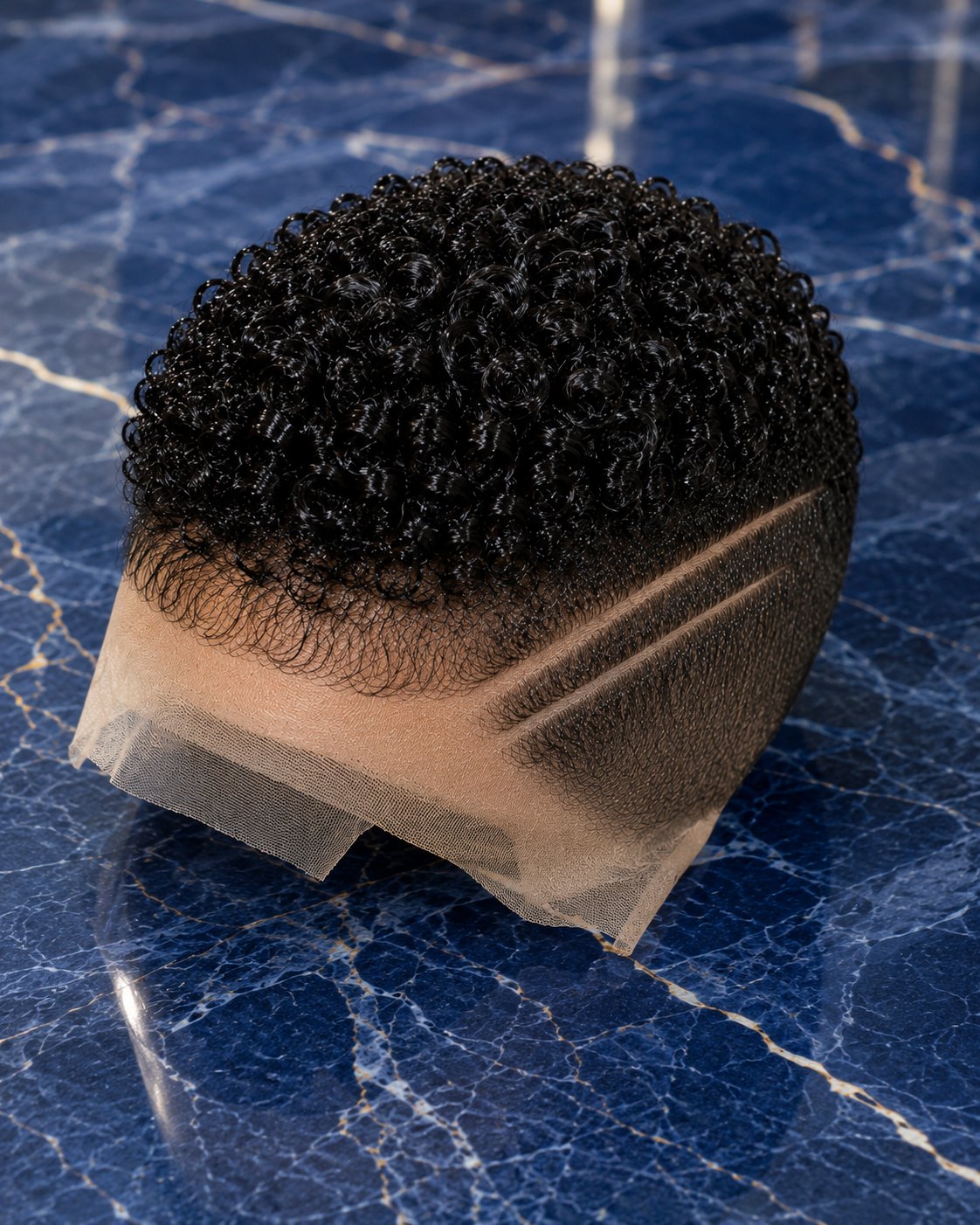
Set down on a blue marble surface with the lace still completely untrimmed, this unit gives buyers the sort of clear structural view that polished install photos often hide. The crown is crowded with short, glossy finger coils in a deep black shade. The side has been cut down close and crossed by two long parallel temple lines. Along the front edge, fine baby hairs soften the perimeter, while the lace extends well past the hairline and sideburn area.
There is no mannequin face, no dramatic pose, and no cap interior shown here. That makes the image more useful, not less. Without those distractions, the important questions become easier to ask. Is the crown proportioned well? Does the side density drop enough to support the temple design? Are the two lines clean and evenly spaced? Is the front perimeter light enough to help the lace disappear once installed? Those are the details that decide whether a short wig reads as a believable haircut or a generic curly cap.
The appeal of this piece comes from how controlled it is. The top stays compact instead of spreading outward. The side is reduced enough for the design work to show clearly. And the pair of lines gives the wig a sharper, more barber-finished identity than a plain pixie would have on its own. Short wigs do not forgive much. If the crown is too bulky, the style loses balance. If the side remains too full, the haircut illusion weakens. If the front gets heavy, the lace becomes harder to hide. Almost every one of those choices is visible in this frame.
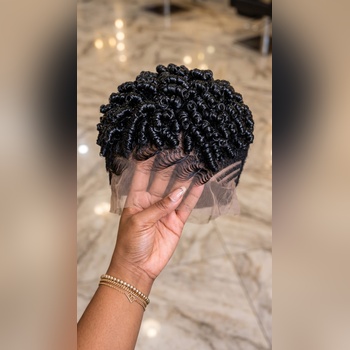
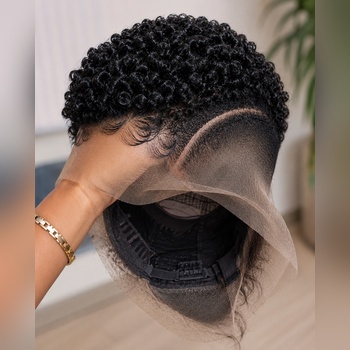
Where To Buy A Wig Like This
A unit like this is better sourced from custom wig makers, lace studios, and short-style specialists than from broad catalogue sellers. Plenty of shops can supply a “short curly pixie wig.” Far fewer can actually deliver a compact coiled crown, a close taper, and two long parallel temple lines that still look clean once the wig is worn.
Instagram and TikTok are usually the strongest places to search because short-wig specialists tend to show the angles that matter: the side profile, the lace before trimming, the hairline close-up, and the crown under movement. That matters more than a polished front glamour shot. A pretty front image tells you almost nothing about whether the side really sits close enough to the head for twin lines to stay visible.
Look for sellers who regularly show:
- short finger-coil pixie units
- temple-line or fade-style work
- lace fronts before installation
- natural-light hairline close-ups
- several side angles
- short videos where the crown is touched or lifted lightly
Etsy can work for made-to-order pieces, but it requires more caution. Check buyer-uploaded photographs and written reviews, not just the listing image. A seller may advertise a detailed sample photo and then ship a much simpler short curly unit with little real shaping through the side.
Useful search terms include:
- “finger coil pixie wig with double lines”
- “short lace pixie with temple design”
- “jet black coily wig with tapered side”
- “custom pixie wig with parallel side lines”
- “HD lace finger coil pixie human hair”
- “glueless curly pixie with twin temple lines”
If a seller never shows side design work anywhere in their portfolio, assume it is not one of their strengths. That matters here, because the side is not a minor extra. It is one of the main reasons this wig stands out.
Contact / Order Inquiries
WhatsApp is often the standard channel once a serious custom-order conversation begins.
[WhatsApp: +XX XXX XXX XX XX]
Send the full reference image and ask directly:
“Can you replicate this exact short pixie with the dense finger-coil crown, close tapered side, twin temple lines, soft front baby hairs, and untrimmed lace?”
That wording matters. If you ask only for a “short curly wig,” you leave too much room for interpretation. A vague request usually produces a vague result.
Also ask the maker to send:
- a true side profile
- the opposite side view
- a back view
- a close-up of the front hairline
- a lace close-up in daylight
- a short video of the curls moving
- an inside-cap photograph
- cap measurement options
It is also worth asking whether the exact line layout can be copied as shown. “Double lines” is still broader than the specific angle, length, and spacing visible in this image.
How Much It Costs
The colour here is uncomplicated. There is no lifting, toning, or multi-step dye work adding to the price. What you are paying for instead is construction: crown control, side tapering, lace preparation, and the labour required to place two clean parallel lines into a very short section.
Typical ranges may look like this:
- 100% human hair, fine lace, dense finger-coil crown, tapered side, twin temple lines, softened front perimeter, and custom finishing: generally $210–$440
- 100% human hair with a similar coiled top but a simpler side and no line design: typically $150–$320
- 100% human hair, short curly pixie with a standard factory hairline and limited side shaping: typically $85–$200
- Higher-quality synthetic with a similar silhouette and side work: usually $65–$150
- Basic synthetic short curly pixie: often $20–$65
The real price jump is in the side. Two lines do not add cost only because of the lines themselves. The maker also has to reduce the surrounding density, keep the short section even, and leave enough contrast so the pattern reads clearly without turning the temple into an empty patch. That is the arithmetic buyers should understand. A carefully finished pixie is often priced far above a plain one with the same colour because the labour sits in the shaping, not the shade.
Ask whether the quoted price includes:
- lace customisation
- cap sizing
- pre-styled hairline work
- full styling before shipment
- shipping fees
- a final approval video
Lower starting prices can rise quickly once those extras are added.
Shipping, Delivery, And What To Expect After Ordering
A piece like this is usually made to order or at least heavily customised before shipping. That means it is not something to expect in a few days unless the seller is offering the exact sample unit.
A realistic production window is often two to four weeks, though some makers may take longer if they are building to head measurements or handling all styling by hand. Twin side lines and a short tapered perimeter are not instant details.
The lace will normally arrive untrimmed, as shown. That should be seen as a good sign. It gives the installer enough room to place the unit properly at the front and around the sideburn area before cutting.
Before paying, confirm:
- processing time
- tracked shipping
- whether customs fees may apply
- whether the wig is shipped fully styled
- whether the curls are protected during packing
- whether a final approval video is available
- whether custom orders can be altered or returned
Custom returns are often limited, especially once the seller has followed a specific design reference. Get the specifications in writing before payment.
The Finger-Coil Crown
The crown is built from many short, glossy coils packed closely together into a rounded top. The coils are tighter than loose ringlets but not so tiny that the crown turns fuzzy or woolly. That balance is important. It keeps the wig looking polished while preserving the cropped pixie shape.
Because the top carries most of the volume, the coil size matters more than it would on a longer unit. If the curls were looser, the crown would spread too wide and the side design would lose some impact. If they were drier and smaller, the surface could start to look rough instead of refined.
What to judge:
- similar coil size across the crown
- enough separation for individual spirals to stay visible
- no large open gaps
- a rounded top rather than a flat shelf
- movement rather than stiffness from heavy product
Ask the maker how the pattern is achieved. Is it the natural hair texture, finger coiling, rod setting, or texture processing? A still image cannot tell you how the unit behaves after washing, and that is where many buyers are disappointed.
A useful direct question is: “When I wash the wig, will the same coils return, and what is the best way to refresh them?”
The Twin Temple Lines
The double-line design is the feature that gives this wig its sharpest identity. Two long parallel lines sweep backward through the tapered side, giving the unit a barbershop influence without making it overly busy.
Parallel lines are harder than they first appear. Both lines need even width, consistent spacing, and a surrounding area that stays short enough for the pattern to remain visible. If one line widens too much or the gap between them shifts, the whole effect starts to look careless.
How to judge them:
- equal width through most of the length
- steady spacing between both lines
- strong contrast against the surrounding short hair
- no broken patches along the line
- an angle that follows the side contour naturally
The seller should be able to show previous work with similar patterns. Ask for side-profile examples and not just front-facing shots. A maker who says they “can do lines” is not automatically someone who can reproduce this exact layout.
The Tapered Side
The area under the crown has been brought down close, both in length and in apparent density. That reduction is what allows the twin lines to work. Without it, the style would read as a plain curly pixie with decoration added on top. With it, the whole unit moves closer to the look of an actual haircut.
This is where many short wigs fail. The seller trims the side shorter but leaves too much density, creating a dark block under the crown. A convincing taper requires both shorter fibres and less bulk. That is what keeps the side close to the head instead of pushing outward.
This image suggests a disciplined side transition, but it is still only one angle. Before ordering, ask for:
- the opposite profile
- the nape view
- a closer shot of the temple transition
- the back perimeter under bright light
A strong visible side does not automatically mean the rest of the perimeter matches it.
The Hairline And Lace
The lace is broad, visible, and untrimmed across the front and side. That makes it easier to judge how much working room the buyer will receive. The baby hairs at the front are light and wispy, which is the right direction for a short pixie. A heavier front would make the lace much more obvious.
Still, the photo cannot prove every lace detail. It suggests a fine lace front, but it does not confirm the exact lace type or knot work.
Ask directly:
- Is the lace HD, Swiss, or another type?
- Are the knots bleached?
- Is the front pre-plucked?
- What lace shades are available?
- Can the seller show the lace against skin in natural light?
Short wigs expose the hairline constantly. A beautiful crown cannot rescue a weak front edge.
What The Photo Does Not Show
The image gives a strong exterior view, but it does not show the cap interior. That means you should not assume:
- the number of combs
- whether the unit is glueless
- whether an adjustable strap is included
- whether there is an elastic band
- how the nape is constructed
- how secure the wig feels during wear
Always ask for the inside-cap photograph. Fit matters as much as styling on a short unit. If the wig shifts, the front hairline position changes and the angle of the twin lines changes with it.
Before You Pay
Before sending payment, ask the maker to confirm:
- whether the wig is human hair, synthetic, or a blend
- the exact curl size
- whether the coils return after washing
- whether the twin lines can be matched exactly
- the lace type and tone
- whether the knots are bleached
- whether the hairline is pre-plucked
- the cap circumference
- whether the cap can be made to your measurements
- how many combs or straps are inside
- whether the wig arrives fully styled
- whether a final video is provided before shipping
- the return or alteration policy
A clear written confirmation is worth much more than enthusiastic but vague replies.
Trimming The Lace
Cut slowly. Position the wig first, then trim with short staggered snips rather than one long straight cut.
On a short wig like this, the front hairs and the lace have to work together. The wispy hairline helps disguise the edge, but only if the lace has been cut carefully and not taken back too far. If you are new to short lace pixies, the first trim is often worth paying a stylist to do properly.
Search Terms
finger coil pixie wig with double lines · short lace pixie with temple design · jet black coily wig with tapered side · custom pixie wig with parallel razor lines · HD lace finger coil pixie · where to buy a short curly wig with twin temple lines
Final Thoughts
Study this piece if you want to understand how much of a short wig’s value is tied to small, visible decisions. The black colour is simple. The length is short. But the work is not simple. The crown has to stay compact, the side has to be lowered enough to support the design, the twin lines have to stay clean, and the front perimeter has to remain light enough for the lace to blend.
Take away the parallel lines and it becomes a more ordinary coiled pixie. Leave the side too full and the haircut illusion softens. Make the front heavier and the lace becomes more obvious. The strength of the unit is the way all those choices support one another.
That is why careful ordering matters. A seller who can reproduce the curls but not the side structure is not making the same wig. A seller who can imitate the lines but ignores lace quality is also missing the point. Ask for all angles, get the details in writing, and insist on a final video before shipment.