
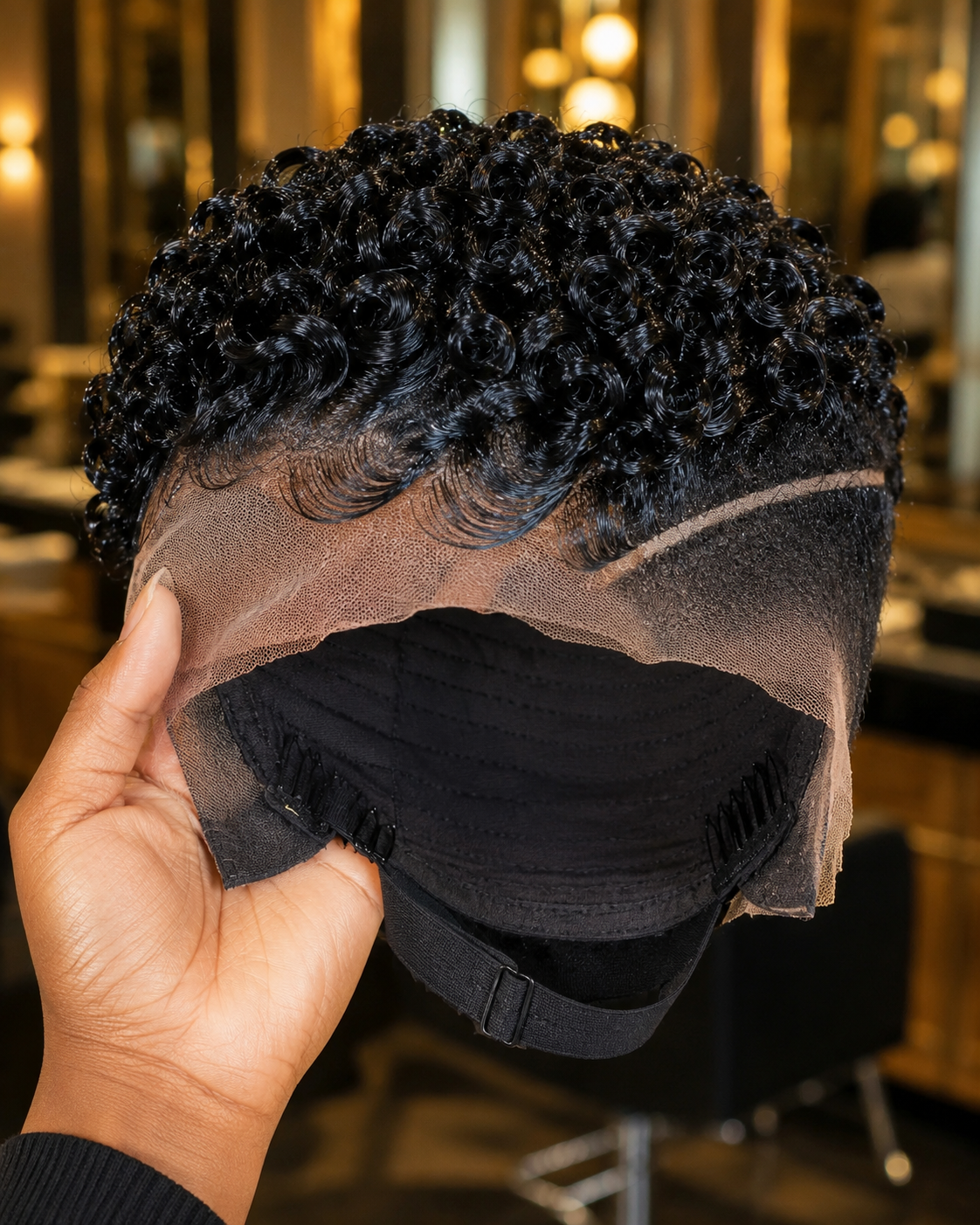
Held open in a salon, this short jet-black unit reveals nearly every feature that determines whether a pixie wig will look convincing once installed. The crown is filled with glossy spiral finger coils. The front perimeter carries a sequence of sculpted S-wave edges. A single curved line passes through the closely tapered temple, while the untrimmed lace extends beyond the hairline and sideburn area.
The interior is just as informative. Two side combs are visible inside the dark cap, along with a broad adjustable strap and buckle at the back. This is clearly intended to function as a secure glueless-style unit rather than depending entirely on adhesive.
What makes the frame valuable is the amount of construction left exposed. The curls have not been hidden beneath elaborate styling, the lace has not been cut, and the cap has not been covered by a mannequin head. You can judge the crown density, perimeter work, temple transition, lace width, comb placement, and fastening system in one photograph.
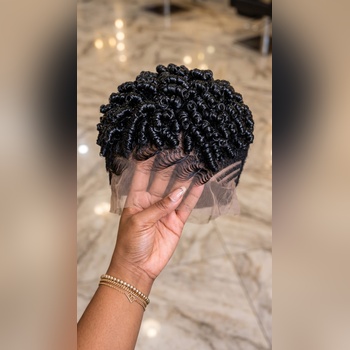
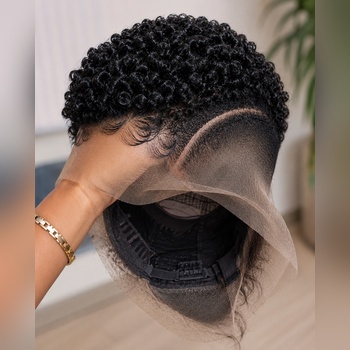
The design relies on contrast. The crown is full and highly curled, while the side is short and close to the cap. The front waves are decorative but also help blur the lace boundary. The curved temple line gives the piece the appearance of a fresh barber detail without making the side overly busy.
Where To Buy A Wig Like This
A ready-made short curly wig may give you the general crown shape, but the combination of sculpted edges, a tapered side, and a curved temple line usually requires a custom or semi-custom order.
Independent wig makers and lace studios are the best starting point. Search for sellers who specialise in short human-hair pixie units, finger coils, tapered lace wigs, and barber-inspired side work. Their portfolios should include more than polished model photographs. Look for untrimmed lace, cap interiors, close-up hairlines, and side-profile videos.
Instagram and TikTok are especially useful for this category because short-wig specialists often post the actual styling process. Watch for videos showing the unit before installation, while the edges are being shaped, and after the crown has been touched or lightly lifted. A movement clip can reveal whether the curls are flexible or being held in place by a heavy layer of product.
Etsy can also work for made-to-order purchases. Read the full listing and check buyer-uploaded photographs. A seller’s display image may show a carefully customised sample, while customer photos reveal the real lace quality, curl size, side density, and cap construction.
Useful search phrases include:
- “jet black finger coil pixie wig”
- “glueless pixie wig with sculpted edges”
- “short curly lace wig with curved side line”
- “human hair coily pixie with tapered sides”
- “custom lace pixie with combs and strap”
- “finger coil wig with S-wave baby hairs”
Do not search only for a “curly pixie wig.” That phrase is too broad and will return many one-length units without the front or side work shown here.
Contact / Order Inquiries
WhatsApp is commonly used by independent wig makers for custom consultations.
[WhatsApp: +XX XXX XXX XX XX]
Send the full reference image and a cropped view of the temple. A clear opening message could be:
“Can you recreate this jet-black finger-coil pixie with the same sculpted S-wave hairline, one curved temple line, short tapered side, untrimmed lace, internal combs, and adjustable strap?”
Mentioning every major element reduces the risk of receiving a basic curly unit that only resembles the crown.
Ask the maker to provide:
- Front hairline close-ups
- A true side profile
- The opposite side and back
- A photograph of the complete cap interior
- A short video showing the curls in motion
- Available lace tones
- Cap measurement options
- Production and shipping estimates
Also ask whether the curls, front waves, and temple line will arrive fully styled. Some sellers ship the unit in its finished shape, while others provide a lightly set base that needs further work after delivery.
How Much It Costs
The solid black colour avoids the cost of lifting, toning, and colour correction. Most of the price comes from the hair quality, lace, hand-finishing, side construction, and glueless hardware.
Realistic ranges may look like this:
- 100% human hair, fine lace, bleached knots, compact finger coils, full S-wave perimeter, curved temple line, hand-finished taper, two combs, and adjustable strap: generally $210–$450
- 100% human hair with a similar crown but simpler baby hairs and no carved side detail: typically $155–$330
- Human-hair short curly wig with a standard cap, basic lace, and little custom side work: approximately $80–$195
- Higher-quality synthetic fibre with comparable shaping and cap support: usually $65–$150
- Basic synthetic curly pixie with a factory hairline: often $20–$60
The front and side work explain much of the difference. A maker producing this version must arrange many small coils, reduce the side density, form a gradual taper, shape multiple front waves, and place the curved line at an angle that follows the head.
A cheaper version may still look attractive, but something will usually be simplified. It may have a thicker hairline, fewer hand-knotted areas, a plain side, a less structured cap, or curls that depend heavily on styling product.
Before paying, request a complete quote that includes:
- Hair and lace choice
- Cap sizing
- Knot treatment
- Hairline customisation
- Edge and line work
- Full styling
- Shipping charges
This prevents a low starting price from becoming unexpectedly expensive after custom options are added.
Shipping, Delivery, And What To Expect After Ordering
A custom version will generally take longer than a standard warehouse wig. The crown can be styled relatively quickly, but the tapered side, curved line, lace preparation, and wave edges require more careful finishing.
A realistic production window is often two to four weeks, depending on the maker’s queue and construction method. A fully hand-ventilated side or made-to-measure cap may take longer.
The lace should normally arrive untrimmed, as shown. The excess material gives the wearer or installer room to position the unit according to the actual hairline before making the final cut.
Before sending payment, confirm:
- When production officially begins
- Whether shipping includes tracking
- Whether international customs fees may apply
- Whether the wig is shipped fully styled
- How the curls are protected inside the package
- Whether a final approval video is supplied
- Whether customised orders can be returned or altered
Custom wig returns are often limited. Keep the seller’s written confirmation of the curl pattern, temple line, cap size, lace tone, and internal hardware.
The Finger-Coil Crown
The crown is covered with compact spiral curls that create a rounded pixie silhouette. The coils are larger and more open than tiny kinky coils, but they remain short enough to keep the top controlled.
Their glossy surface makes each spiral easy to see. That also means weak areas would be difficult to hide. Large gaps, inconsistent curl sizes, or a collapsed crown would become obvious under salon lighting.
A well-made crown should have:
- Similar curl diameter across the top
- Enough separation for each spiral to remain visible
- No large empty spaces
- A rounded profile rather than a flat centre
- Flexibility when touched
Ask how the coils are created. They may come from the natural texture of the hair, finger coiling, rod setting, texturising, or a combination of methods.
The most important question is what happens after washing. A styled photograph cannot tell you whether the same curls will return naturally or require complete resetting.
Ask directly:
“Will the crown return to this curl pattern after washing, and what products should I use to recreate it?”
A careful maker should be able to explain the refresh process clearly.
The Sculpted S-Wave Edges
The front perimeter carries a series of broad S-shaped waves rather than a few thin strands brushed forward. Each curve has been formed deliberately, creating a decorative border between the coiled crown and the lace.
This is more demanding than ordinary baby-hair styling. The maker has to control the direction, width, spacing, and hold of every wave. The entire sequence must flow across the front without becoming too stiff or too dark.
How to judge the work:
- Each curve should relate to the next
- The wave band should remain reasonably even
- The hairs should taper near the outer edge
- There should be no large gaps in the pattern
- The product should not leave the lace heavily coated
The waves also serve a practical purpose. Once the lace has been trimmed and blended, they help break up the visible edge between the material and the skin.
They will not remain untouched forever. Humidity, washing, sleep, and regular handling will loosen the pattern. Before ordering, ask the maker which edge product they use and whether they can provide a short re-laying video.
If you do not plan to recreate the waves after washing, consider requesting a simpler perimeter. Elaborate edge work only remains valuable when it can be maintained.
The Curved Temple Line
A single curved line travels backward through the right temple. Its position follows the contour of the side and separates the shorter lower section from the taper above it.
Using one line is a sensible choice here. The front waves and crown already carry a great deal of visual detail. Several additional lines could make the side feel crowded.
A convincing curved line needs:
- Consistent width from front to back
- A continuous path without breaks
- Enough surrounding density for contrast
- Placement that follows the side shape
- A clean ending rather than a fading patch
Curves are harder to replicate than straight lines because the maker cannot rely on one fixed angle. The spacing and direction have to be controlled by eye.
Send a close crop of the temple when ordering. Otherwise, a seller may reproduce a generic straight line or place the design too high beneath the curls.
The Tapered Side
The side transitions from the full coiled crown into a closely cropped section. That reduction is essential to the haircut illusion.
A common mistake is to take a dense wig and simply trim the lower side shorter. The result remains thick and dark, creating a heavy block beneath the curls. A better taper reduces both the fibre length and the amount of hair placed in that section.
The visible side here appears close to the cap, leaving enough contrast for the curved line to remain readable. The transition beneath the crown also avoids an obvious shelf.
Still, one side view cannot confirm the whole perimeter. Ask for the opposite profile, back, and nape. A maker may complete the photographed side carefully while leaving the other side much fuller.
The Lace And Knots
The lace is fine, broad, and still untrimmed. It extends beyond the front and around the sideburn area, providing a generous installation margin.
The material appears translucent in the photograph, but an image alone cannot confirm whether it is HD lace, Swiss lace, or another type. Warm salon lighting can also affect how the colour appears.
Ask the seller:
- What exact lace type is used?
- Which lace tones are available?
- Are the knots bleached across the full front?
- Is the hairline pre-plucked?
- Can the lace be shown against skin in daylight?
The knots around the hairline appear discreet, but confirmation is still necessary. Blonde or light-brown lace against the wrong complexion can leave an ashy cast, even when the lace itself is fine.
Inside The Cap
The open interior is one of the most useful parts of this image. Two combs are visible near the lower sides, and a broad adjustable strap runs across the back with a buckle for tightening.
This configuration is designed to provide mechanical security without requiring adhesive across the entire hairline. The combs anchor the unit, while the strap helps control the circumference.
That does not mean the wig will fit every head automatically. Glueless wear depends heavily on sizing. A cap that is too large can lift at the front or bunch at the crown. A cap that is too small can pull the hairline backward and distort the placement of the waves and curved line.
Measure the head before ordering:
- Start at the centre of the natural front hairline.
- Pass the tape above the ears.
- Continue around the nape.
- Return to the starting point without pulling tightly.
Also provide front-to-nape and ear-to-ear measurements if the maker accepts full custom sizing.
The combs may offer useful hold, but buyers with weak natural edges or a sensitive scalp should use them carefully. A wig grip or properly adjusted strap may reduce the need to press the combs deeply into the hair.
Before You Pay
Ask the maker to confirm:
- Is the hair human hair, synthetic fibre, or a blend?
- Can the same finger-coil size be recreated?
- Will the curls return after washing?
- Can the full S-wave perimeter be replicated?
- Can the curved temple line be matched in the same position?
- What lace type and tone will be used?
- Are the knots bleached?
- Is the hairline pre-plucked?
- How many combs are inside the cap?
- Is the adjustable strap included?
- Can the cap be built to your measurements?
- Will the unit arrive fully styled?
- Can a final video be sent before shipping?
- What is the return or alteration policy?
Do not accept only a general promise that the seller can make “the same style.” Ask them to repeat the main specifications in writing.
Trimming The Lace
Position and secure the unit before making any cuts. The front waves and curved side line must sit at the correct angle, so placement should be finalised first.
Separate the sculpted edge hairs from the lace and move them backward. Cut the excess with small staggered snips rather than one straight line. Leave a narrow margin during the first pass.
Avoid cutting too close to the knots. Fine lace can tear if it is pulled tightly while trimming. If this is your first short lace installation, professional help may be worthwhile. A long hairstyle can hide small errors; a pixie exposes them immediately.
Maintaining The Coils, Edges, And Temple Detail
Do not drag a fine-tooth comb through the crown. That will separate the spirals and make the shape much wider.
For routine care:
- Mist the curls lightly with water
- Apply a small amount of curl foam
- Re-form loose sections around a finger
- Allow the wig to dry on a compact stand
- Separate only the coils that have joined together
- Keep heavy oil away from the lace
Re-lay the front waves in small sections using an edge brush. Trying to recreate the full perimeter in one motion usually produces uneven curves.
Keep product out of the carved temple line. Residue can reduce the contrast and make the design look less precise. If nearby hairs begin covering the line, move them gently with a pointed comb or small brush.
Search Terms
glueless finger coil pixie wig · jet black lace pixie with S-wave edges · short curly wig with curved temple line · human hair coily pixie with combs and strap · tapered pixie wig with sculpted baby hairs · custom lace front finger coil wig
Final Thoughts
This unit earns attention because both the visible styling and the hidden support system have been considered. The finger coils create the compact crown, the S-wave perimeter frames the hairline, and the curved temple line gives the side its identity. Inside, the combs and adjustable strap provide the structure needed for glueless-style wear.
Every part affects the next. Poor cap sizing would shift the hairline and change the angle of the side design. A heavy front would make the lace difficult to disguise. A bulky temple would weaken the carved line. Curls that fail after washing would change the entire silhouette.
That is why the exterior photograph should not be the end of the buying process. Confirm the hair type, curl recovery, lace specifications, head measurements, edge maintenance, and internal hardware before paying. A maker who can reproduce only the crown is not delivering this wig. The perimeter, side construction, and cap fit are equally important.