
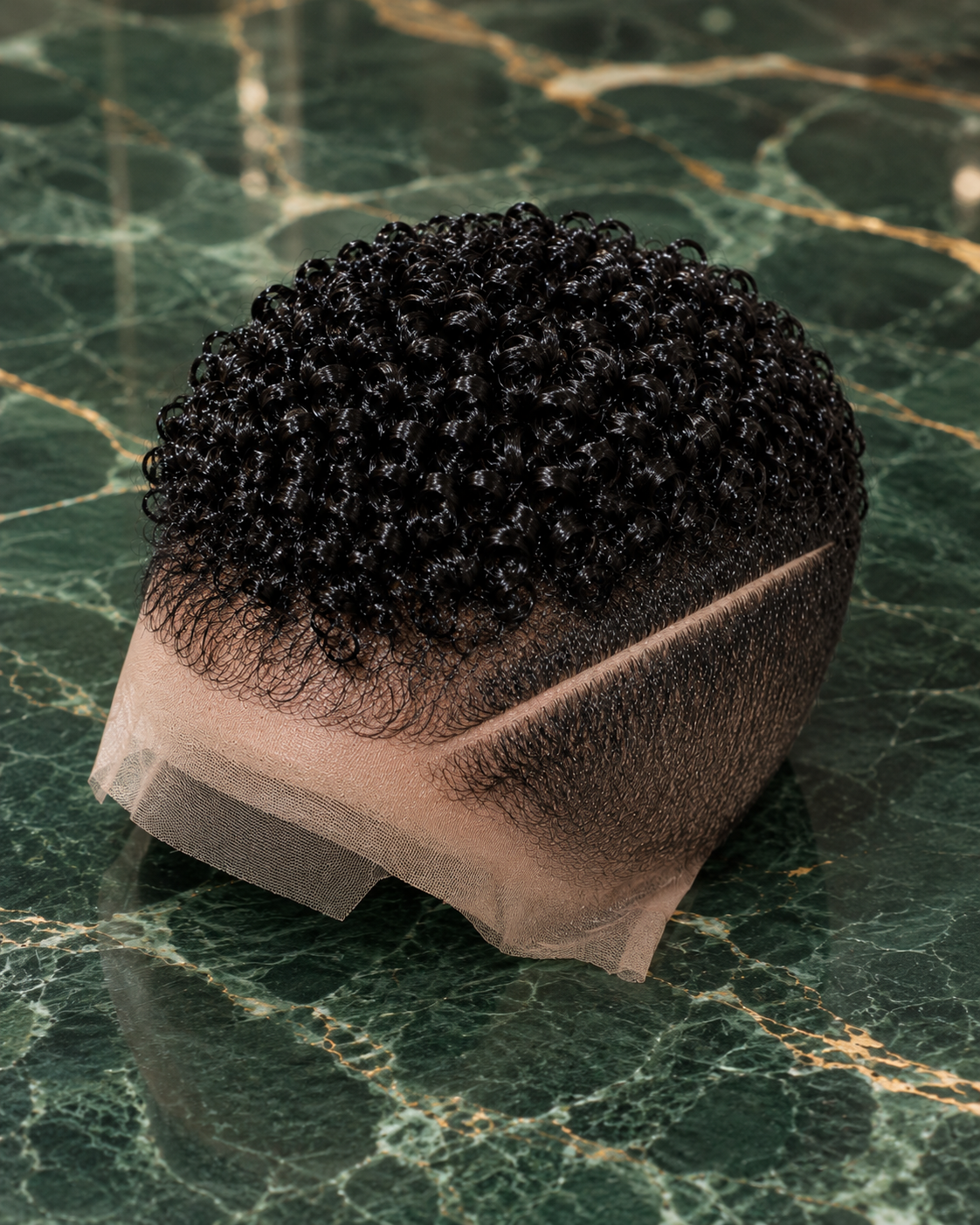
Placed on a green marble surface with the lace left fully untrimmed, this unit shows the sort of details buyers should study before getting distracted by styling alone. The crown is tightly packed with small, glossy finger coils in a deep jet black. The side drops into a closely tapered section cut through by one long diagonal curved line. Along the front, light baby hairs soften the hairline, and the lace extends well past the edge, making the construction easier to read.
There is no model, no dramatic pose, and no cap interior on display here. That actually makes the image useful. It forces attention onto the parts that decide whether a short wig reads like a haircut or a wig: the proportion of the crown, the density drop through the side, the placement of the carved line, the softness of the front, and the amount of lace you are being given to work with.
The strongest thing about this piece is restraint. One long side line instead of several. A compact crown instead of oversized volume. A short tapered side instead of a bulky lower perimeter. Short wigs do not have much room for error. If the crown is too wide, the whole unit starts to feel top-heavy. If the side stays too dense, the style loses the haircut effect. If the line is weak, it disappears. If the hairline is heavy, the lace becomes much harder to disguise. All of those decisions are visible here.
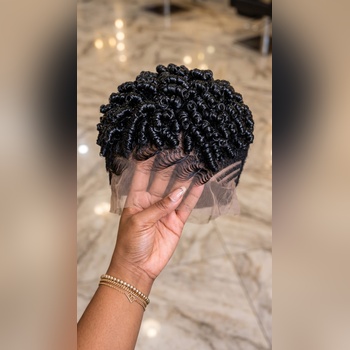
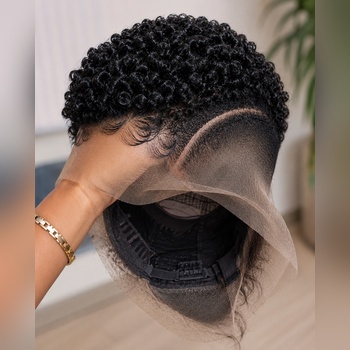
Where To Buy A Wig Like This
This is the kind of wig that should push you toward custom makers, lace specialists, and short-style wig sellers rather than broad mass-market catalog shops. Plenty of sellers can offer a “curly pixie wig.” Far fewer can actually reproduce a compact coiled crown, a believable short side, and one long carved line that still looks intentional once the wig is installed.
Instagram and TikTok are usually the richest places to search because the best short-wig makers tend to post side angles, close-up hairline shots, and styling clips rather than only polished front-facing glamour images. That matters here. A front shot alone would not tell you whether the tapered side really sits close to the head or whether the line stays visible from another angle.
Look for sellers who regularly show:
- short finger-coil pixie units
- lace fronts before trimming
- side-profile photographs
- temple design work
- movement videos of the crown
- natural-light close-ups of the hairline
Etsy can work for made-to-order units, but be selective. Read descriptions closely. Check buyer-uploaded photos. Some sellers use one strong display image and then ship a much simpler short curly unit with no real side shaping and no convincing line work.
Search terms that narrow the field properly:
- “finger coil pixie wig with side line”
- “short tapered lace wig human hair”
- “jet black curly pixie with temple design”
- “custom coily pixie wig with baby hairs”
- “HD lace pixie wig with curved line”
- “glueless finger coil pixie wig”
If a maker never shows side work anywhere in their portfolio, assume they do not consider it a strength. That tells you enough.
Contact / Order Inquiries
WhatsApp is still the standard route for many independent makers once the first conversation begins.
[WhatsApp: +XX XXX XXX XX XX]
Send the full reference image and ask directly:
“Can you replicate this exact short pixie with the dense finger-coil crown, tapered side, one long diagonal line, soft front baby hairs, and untrimmed lace?”
Do not reduce the request to “a short curly wig.” That is too vague. A broad request invites a broad result.
Also ask for:
- a true side profile
- the opposite side view
- a back view
- a close-up of the front hairline
- a lace close-up in daylight
- a short video of the coils being touched lightly
- an interior cap photograph
- cap measurement options
If the seller can produce the crown but avoids showing side angles, be careful. On a wig like this, the side is not an extra detail. It is half the style.
How Much It Costs
Because the colour is black, there is no lifting, toning, or colour correction driving the price upward. The money here is in the shape, the hand-finishing, the lace work, and the side construction.
Typical ranges may look like this:
- 100% human hair, fine lace, dense finger-coil crown, tapered side, one carved curved line, soft front hairline, and custom finishing: generally $200–$430
- 100% human hair with a similar coiled top but a simpler side and no temple design: typically $145–$310
- 100% human hair, standard short curly cap, little or no detailed side work: typically $80–$190
- Higher-quality synthetic with a comparable silhouette: usually $60–$145
- Basic synthetic curly pixie: often $20–$60
The specific arithmetic matters. A long single side line does not sound like a major addition until you remember what surrounds it. The maker has to reduce density through the side, control the gradient under the crown, and leave enough contrast for the line to stay visible without turning the side into an empty patch. That is labour, and it is why a carefully finished short pixie costs much more than a plain one with the same hair colour.
Also ask whether the quoted price includes:
- lace customisation
- cap sizing
- front hairline preparation
- full styling before shipment
- shipping charges
- approval video before dispatch
What looks like a lower price at first can rise quickly once those details are added.
Shipping, Delivery, And What To Expect After Ordering
Custom timing is the normal expectation here. A unit with this sort of side shaping and crown control is rarely something a careful seller throws together in two days.
Expect two to four weeks for many made-to-order versions, though some makers may take longer depending on their queue. If the seller works alone or customises the cap to measurement, the wait can stretch further.
The lace will usually arrive untrimmed, as shown. That is a good sign rather than a problem. It gives the installer room to position the wig correctly against the wearer’s actual hairline instead of forcing a factory guess.
Before paying, confirm:
- processing time
- tracked shipping
- whether customs fees may apply
- whether the wig is shipped fully styled
- whether the curls are protected during packing
- whether a final approval video is included
- whether custom orders can be returned or altered
Returns on custom wigs are often limited, especially if the seller has matched a specific design. Get the details in writing. A short pixie leaves too little room for misunderstandings.
The Finger-Coil Crown
The crown is built from many small, glossy coils packed closely together to form a rounded top. They are tighter and shorter than loose ringlets, but not so tiny that the surface turns fuzzy. That balance is what keeps the unit looking sculpted rather than puffy.
The coils are doing most of the volume work here. If they were looser, the top would spread wider and the side line would lose visual impact. If they were smaller and drier, the crown could start to look rough instead of polished.
How to judge it:
- similar coil size across the crown
- enough separation that individual spirals stay visible
- no large empty gaps between sections
- a rounded top rather than a flat shelf
- flexibility rather than hard product stiffness
Ask the maker what creates the pattern. Is it the natural texture of the hair, finger coiling, rod setting, perming, or a product-heavy finish? That answer matters because a beautiful still photo cannot tell you how the crown behaves after washing.
A useful direct question is: “When this wig is washed, will these same coils come back, and how do I refresh them?” A good maker should answer clearly rather than vaguely saying the hair is “easy to style.”
The Long Curved Line
The diagonal side line is the most distinctive feature of the unit. One line, placed well, does more here than a busy cluster of lines would have done. It slices through the tapered side cleanly and gives the piece a barbered finish without competing too hard with the crown.
Curved or diagonal lines are harder than they look. Straight lines at least give the stylist a rigid visual reference. A longer slanted curve has to stay even in width while following the contour of the head. Any wobble becomes obvious immediately.
What to judge:
- consistent width from front to back
- clear contrast against the surrounding side
- no broken or fading sections
- enough nearby density for the design to stand out
- placement that follows the natural side contour
If the line is too shallow, it disappears once the wig is worn. If it is too broad, the temple starts to look sparse. This one works because the surrounding side still carries enough hair to support it.
Ask the seller whether they can replicate the same angle exactly. “A side line” is not the same thing as this side line.
The Tapered Side
Below the crown, the side has been reduced in both length and apparent density. That is what helps the wig read as a haircut instead of a rounded curly cap. Buyers often focus on the crown and forget this part, but short wigs live or die at the side and nape.
A weak short wig usually fails here. The maker leaves the lower side too full, trims it shorter, and hopes that is enough. It is not. Short length without density control produces a heavy, dark block. A convincing taper needs both shorter fibres and a reduction in how much hair is sitting there.
This image suggests a good transition. The crown does not appear to sit on top of a thick lower band. Instead, the density steps down gradually into the temple area, leaving the line readable.
But do not guess the whole construction from one side. Ask for:
- the opposite profile
- the back view
- the nape area
- a closer view of the temple transition
A good displayed side does not automatically mean the rest of the perimeter matches it.
The Hairline And Lace
The lace is broad, visible, and still fully untrimmed. That lets you inspect the amount of material included and see how the front baby hairs have been placed before installation. The hairline itself is light and wispy, which is exactly what a short wig needs. A thick blocky front would ruin the realism immediately.
The photograph does not prove every lace detail, though. It cannot reliably confirm lace type, knot quality, or how the lace will look against different skin tones.
Questions to ask directly:
- Is the lace HD, Swiss, or another type?
- Are the knots bleached?
- Is the hairline pre-plucked?
- What lace shades are available?
- Can I see the lace on skin in natural light?
A short wig exposes the front constantly. Beautiful coils cannot rescue a poor lace front.
What The Image Does Not Show
This is where buyers need some discipline. The photo gives a strong view of the outside, but it does not show the cap interior. So you should not assume:
- the number of combs
- whether the wig is glueless
- whether an adjustable strap is included
- whether there is an elastic band
- how the nape is constructed
- how secure the unit feels during wear
Ask for the inside-cap photo. Serious makers who understand buyers usually provide it without much resistance. Short wigs need secure fit, because any shifting changes the hairline position and the angle of the side line.
Before You Pay
Send these questions before you commit:
- Is the wig human hair, synthetic, or a blend?
- Can you recreate this exact coil size?
- Will the curls return after washing?
- Can you match this same diagonal side line?
- What lace type and lace tone do you use?
- Are the knots bleached?
- Is the hairline pre-plucked?
- Can I see the cap interior?
- How many combs or straps are inside?
- Can the cap be built to my measurement?
- Will the wig arrive fully styled?
- Can you send a final video before shipping?
- What is the return or alteration policy?
The safest sellers are the ones who answer specifically. Vague enthusiasm is not a specification.
Trimming The Lace
Cut slowly. Position the wig properly first, then trim. Use small staggered snips instead of one long straight cut.
On a piece like this, the front hairs and the lace need to work together. The wispy baby hairs help disguise the boundary of the lace, but only if the lace itself has been cut carefully. A rough front edge will make even good baby hairs look less convincing.
If you are new to short lace pixies, paying a stylist for the first trim is sensible. There is very little excess length here to hide mistakes.
Maintaining The Coils And The Side Detail
The crown should not be raked through with a fine comb. That will break up the spirals and widen the whole silhouette.
Better routine care:
- mist the crown lightly with water
- apply a small amount of curl foam or light styling product
- re-form loose spirals around a finger
- let the wig dry on a stand
- separate only where necessary
- keep heavy oils away from the lace and line area
The side line needs protection too. Product buildup or stray fibres can weaken its contrast. Use a small brush or pointed comb to move nearby hair back into place rather than dragging product through the carved section.
Search Terms
finger coil pixie wig with side line · jet black tapered lace pixie · custom coily pixie wig human hair · short curly wig with temple design · HD lace finger coil pixie · where to buy a pixie wig with a curved line
Final Thoughts
Study this piece if you want to understand how much of a short wig’s value sits in small visible decisions. Black colour, short length, and curls alone do not make it special. The value is in the controlled crown, the lowered side, the long diagonal line, the light front hairline, and the workable amount of lace.
Take away the line and it becomes a much more ordinary coiled pixie. Leave the side too full and the haircut illusion weakens. Make the front too dense and the lace becomes harder to hide. The realism depends on the combination.
That is why buying carefully matters. A maker who can reproduce the coils but not the side structure is not building the same piece. A maker who can carve a line but ignores lace quality is also missing the point. Get the specifications in writing, ask for all angles, and insist on a final video before shipping.