
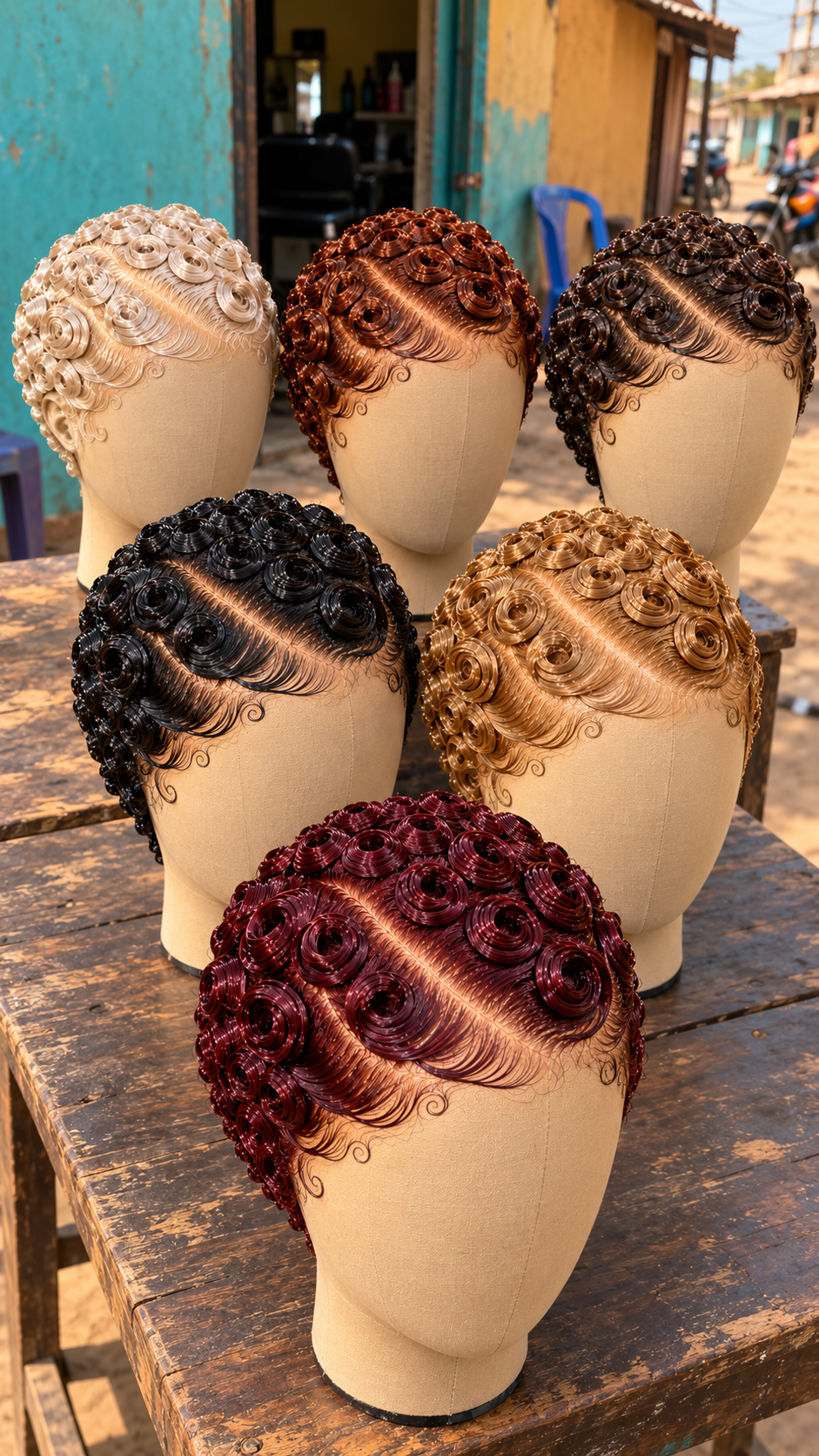
Six carefully arranged pixie wigs can tell a surprisingly detailed story about color, curl placement, and the artistry of a well-shaped hairline. In this photograph, six compact curly wigs are displayed on beige canvas mannequin heads outside a neighborhood hair salon. Their colors range from pearl blonde and warm copper to chocolate brown, glossy black, golden caramel, and deep burgundy. Each wig combines raised circular finger curls with an elegant diagonal parting and sweeping finger waves across the forehead.
The presentation is refreshingly practical. Rather than appearing on models in a studio, the wigs are arranged across weathered wooden tables in natural daylight. This makes the individual curl shapes, color differences, and front styling easier to compare. Three mannequin heads stand at the back, two occupy the middle, and one burgundy wig sits prominently in the foreground.
Although the hairstyles belong to the same general family, their individual curl arrangements are not perfectly identical. Some contain larger circular openings, others have more compact ringlets, and the sweeping front waves vary slightly in their direction and length. These differences are important for customers who want to purchase a specific version rather than simply order a curly pixie in their preferred color.


The collection demonstrates how a compact hairstyle can create an elaborate appearance without requiring long hair. Its appeal comes from the relationship between circular upper curls, diagonal parting channels, and carefully arranged forehead waves.
The Six Colors and Their Visible Differences
The photograph contains exactly six wigs, displayed in three staggered rows. Identifying each position helps buyers communicate accurately with a seller or custom wig maker.
| Display Position | Visible Hair Color | Distinctive Styling Detail |
|---|---|---|
| Back Left | Pearl Blonde | Pale circular curls with a broad, sweeping forehead wave. |
| Back Center | Copper Auburn | Warm reddish-copper ringlets with an angled parting. |
| Back Right | Dark Chocolate Brown | Deep brown circular coils with subtle reflective highlights. |
| Middle Left | Glossy Black | Dark spiral curls and a pronounced diagonal front division. |
| Middle Right | Golden Caramel | Warm golden ringlets with closely arranged front waves. |
| Front Center | Wine Burgundy | Rich burgundy circular curls and a sweeping side hairline. |
The colors provide the most immediate distinction, but buyers should also compare the curl diameter, the height of the upper section, and the arrangement of the hairline. These details can produce different results even when two wigs have similar coloring.
Pearl Blonde Finger Curls With a Delicate Front Sweep
The back-left mannequin wears the lightest wig in the collection. Its color appears pearl blonde with creamy ivory reflections and subtle warmer undertones. The pale strands make the circular curl arrangement especially noticeable against the beige mannequin surface.
The upper hair contains numerous compact ringlets, several of which form recognizable circular openings. Smaller curls surround the larger ones, giving the crown a dense yet decorative appearance.
A diagonal parting creates a visible division near the upper front. Beneath it, the hair is arranged into closely aligned finger waves that sweep across the forehead. Fine ends curve gently near the side, creating a delicate transition between the raised curls and the mannequin’s face.
The photograph does not establish whether the shade is technically platinum blonde, ivory blonde, or pearl white according to a particular supplier’s color system. Its visible appearance is a pale creamy blonde rather than a strongly yellow golden shade.
Customers interested in this version should request a daylight photograph of the actual available unit. Very light hair can appear warmer or cooler depending on lighting, so choosing by a commercial color name alone may lead to disappointment.
Warm Copper Auburn With Sculpted Spiral Details
The back-center wig introduces a rich reddish-brown color. Its curls display copper and auburn reflections, with brighter orange-brown strands along the exposed circular surfaces and darker areas between the ringlets.
The upper curls are arranged into compact loops that follow the rounded contour of the mannequin head. Several prominent circular openings appear near the upper front, while smaller coils fill the surrounding sections.
The diagonal parting is particularly noticeable because it exposes a lighter channel beneath the copper hair. From this division, the front strands flow into sweeping finger waves that curve across the forehead.
This version is an attractive option for buyers who want a warm hairstyle without moving into pale blonde or bright red. The copper shade provides visual interest, while the compact silhouette keeps the overall design controlled.
A buyer should distinguish copper auburn from burgundy. Copper contains more orange and brown influence, while burgundy generally has a deeper wine-red appearance.
When ordering, describe this wig as warm copper auburn with circular finger coils, an angled front parting, and sculpted forehead waves.
Dark Chocolate Brown for a Rich, Natural-Looking Color
The back-right mannequin displays a deep chocolate-brown pixie. Its upper curls appear glossy, with warm brown reflections visible across the rounded strands. Darker areas inside the loops provide depth and contrast.
The curl arrangement is compact, with several circular openings positioned near the front and upper side. The curls do not descend into long hanging sections; instead, they remain concentrated close to the head.
The front hairline contains an angled division and directional waves that follow the forehead. The brown color makes these curves slightly softer in appearance than the corresponding design on the black wig.
This version may appeal to customers who prefer dark hair but want a warmer alternative to jet black. Chocolate brown can appear especially rich in daylight, although its actual shade should be confirmed through product photographs.
Do not assume that the wig contains intentional highlights simply because some strands appear lighter. Natural daylight can produce warm reflections on dark hair, particularly when the strands are glossy and closely arranged.
Glossy Black Coils With a Pronounced Diagonal Part
The middle-left wig has a predominantly black appearance. Its circular curls are tightly arranged across the upper section, with several larger loops visible near the front and smaller ones clustered around them.
The diagonal parting is one of the most noticeable details. It runs across the upper front area, separating raised ringlets from the closely directed hair beneath them.
The front strands follow sweeping curves toward the temple. Some fine ends form small decorative loops near the edge of the hairline.
Because the wig is very dark, the structural details become especially important. The circular openings, parting direction, and wave alignment create visual interest without relying on contrasting colors.
For customers who prefer a classic dark pixie, this version provides a useful reference. However, a generic black curly wig may not reproduce the same finger-wave arrangement.
When contacting a supplier, specify glossy black circular coils with an exposed diagonal parting and closely arranged forehead waves.
Golden Caramel Ringlets With Warm Daylight Reflections
The middle-right mannequin wears a golden caramel wig with brighter honey-brown reflections. Its coloring is warmer and more saturated than the pearl blonde version, with a noticeable golden influence throughout the upper curls.
The circular ringlets form a dense, rounded arrangement. Several loops near the forehead appear relatively broad, while smaller curls are distributed toward the sides.
The diagonal parting follows an angled path through the upper front. Beneath it, the strands flow into narrow finger-wave curves that remain close to the mannequin’s forehead.
The warm color makes the ringlet openings particularly visible, as bright golden strands contrast with darker recessed sections.
Customers comparing this wig with the copper auburn version should pay attention to the color balance. Golden caramel leans toward honey and gold, while copper auburn contains stronger reddish-orange tones.
For a custom order, request warm golden caramel finger curls with a compact crown and flowing front waves. A daylight color sample can help establish whether the proposed shade matches the reference.
Wine Burgundy Takes the Foreground
The front-center wig occupies the most prominent position in the collection. Its rich burgundy color and carefully arranged circular curls make it a striking reference for customers who enjoy darker red hairstyles.
The upper ringlets display deep wine-red and cherry-burgundy reflections. Several large circular openings are visible along the front and crown, while smaller coils fill the spaces between them.
A diagonal parting runs through the upper front section. The strands beneath it form sweeping finger waves that curve toward the visible side, with several delicate ends extending near the temple.
The darker roots and recessed sections make the brighter burgundy curls appear particularly reflective in daylight. However, the photograph cannot establish whether the color was applied through chemical processing or manufactured into precolored fibers.
This version may appeal to customers who want a compact pixie with noticeable color but prefer a deeper shade than bright scarlet red.
When ordering, specify wine burgundy rather than generic red. Request confirmation of the shade under natural lighting, because commercial burgundy products can range from reddish brown to purple-red.
The Diagonal Parting Is Essential to the Hairstyle
All six wigs display an angled parting that contributes to their recognizable appearance. The parting is not merely a decorative line; it helps organize the direction of the upper curls and front finger waves.
On one side of the division, the hair rises into circular coils. On the other, the strands are directed into flatter, sweeping curves that follow the forehead.
This contrast creates movement within a compact hairstyle. Without the angled parting, the curls could appear more uniformly distributed and the front waves might lose their distinctive structure.
The exact parting direction varies slightly among the displayed units. Customers should therefore identify the preferred mannequin and specify the desired orientation from the wearer’s perspective.
A seller should not automatically assume that all six wigs use identical parting placement. An approval photograph can help establish whether the finished unit matches the requested arrangement.
Finger Curls and Finger Waves Perform Different Roles
The collection combines two related but visually distinct styling techniques.
Finger curls create the small circular or spiral shapes covering the upper head. Their openings give the crown depth, while their compact placement creates volume without excessive length.
Finger waves form the flatter, sweeping patterns near the front hairline. These strands travel in controlled curves, producing a decorative transition between the raised curls and the forehead.
Both elements contribute to the finished appearance. A wig with attractive circular curls but no front waves would look substantially different. Likewise, a hairstyle composed entirely of flat waves would lack the raised ringlet structure visible in this collection.
The small decorative curl ends near several mannequins’ temples also deserve attention. They complement the larger forehead waves but should not be confused with random loose hairs.
For a close reproduction, a stylist should understand the intended placement of both the raised circular curls and the flatter front-wave sections.
What the Canvas Mannequin Heads Reveal
Unlike displays using realistic mannequin faces, these six wigs are presented on beige canvas-style heads. This makes the hair the main focus and allows the viewer to compare the upper shape and front arrangement without makeup or facial accessories influencing the presentation.
The canvas heads also make the diagonal parting areas particularly visible. Their light surface contrasts with the darker hair and helps reveal the direction of the front waves.
However, the display does not establish the wigs’ actual cap construction. The photograph does not clearly show interior straps, combs, clips, or the complete underside of any unit.
The presence of a realistic-looking parting does not automatically prove that a wig uses a particular lace technology. Cap materials, ventilation methods, and attachment systems must be confirmed by the seller.
Before purchasing, ask for individual photographs of the actual wig removed from its display head. The underside, front hairline, side areas, and rear should all be visible.
How To Order This Style
The first step is to choose the exact display position that best matches the desired color and curl arrangement. A customer interested in the burgundy version should send a cropped photograph of the front-center wig, while someone preferring the pearl blonde version should identify the back-left mannequin.
Next, describe the essential characteristics: compact circular finger curls, an angled front parting, and sweeping finger waves along the forehead.
Ask whether the seller offers a ready-made version or whether the hairstyle requires custom production. Ready-made wigs may provide a similar silhouette, but the number, size, and placement of the circular curls can differ.
For custom work, request photographs during the styling process. An image of the parting and front waves before final completion can help identify differences while adjustments may still be possible.
Confirm the actual hair material, color, cap size, and recommended installation method. The photograph alone cannot establish whether the displayed wigs are human hair, synthetic fibers, or blends.
Also ask whether the quoted price includes styling, shipping, lace preparation if applicable, and any fitting or installation services.
Finding a Salon That Understands Sculpted Pixie Curls
A hairstylist experienced with loose curly wigs may not necessarily be familiar with compact circular ringlets and precision finger-wave styling. This collection requires deliberate curl placement and careful control of the front strands.
Look for salons or wig makers offering sculpted pixie styling, finger coils, finger-wave hairlines, and custom wig fitting.
When booking, send the reference photograph and explain which mannequin hairstyle you want to reproduce. Mention the preferred parting direction and the approximate size of the ringlets.
If the wig will be installed on a person, accurate measurements are important. The stylist may request head circumference, front-to-nape distance, ear-to-ear measurements, and other measurements relevant to the cap.
The front finger waves should be positioned carefully during fitting. If the cap sits too far forward or backward, the decorative hairline may appear incorrectly placed.
Any lace trimming should take place only after the fit is established. Removing hair or lace from the wrong area may be difficult to reverse.
Illustrative Prices for Sculpted Finger Curl Pixie Wigs
Wig pricing depends on several factors, including material, cap construction, color preparation, and the labor required to create the circular curls and front finger waves.
The following amounts are illustrative USD planning ranges, not verified current prices or quotations for the six wigs in the photograph.
| Wig Category | Illustrative USD Range | Possible Purchase Scope |
|---|---|---|
| Premium Custom | $280–$690+ | Individual measurements, elaborate circular coil styling, customized front waves, and personalized color preparation. |
| Standard Custom | $145–$335 | Custom compact pixie styling with an angled parting and professionally arranged finger curls. |
| Basic Human Hair | $90–$235 | A human-hair pixie base that may require additional curl formation, color preparation, and styling. |
| Premium Synthetic | $60–$165 | Higher-priced synthetic alternatives with prearranged circular curls or front-wave styling, subject to product specifications. |
| Basic Synthetic | $20–$85 | Budget curly pixie wigs that may resemble the general silhouette without reproducing every ringlet and finger wave. |
The color may influence the final cost. A pale pearl blonde unit could require different preparation from a glossy black or dark chocolate version, depending on the chosen material.
Creating numerous circular curls can also involve significant styling time. The front finger waves may require additional work to achieve consistent direction and separation.
Customers should compare complete quotations rather than focusing exclusively on the initial wig price. Installation, customization, shipping, and later restyling may be charged separately.
The table describes possible purchasing categories. It does not establish the actual material or price of any wig shown in the display.
Choosing a Wig Based on More Than Color
Color is often the first characteristic a buyer notices, but curl size and front styling can have an equally important influence on the final appearance.
A wig with large circular ringlets may create a more decorative crown, while smaller curls can produce a denser surface. The placement of the diagonal parting also affects how the hair frames the forehead.
Buyers should consider whether they prefer the bright appearance of pearl blonde, the warmth of copper auburn, the richness of chocolate brown, the simplicity of black, the golden reflections of caramel, or the dramatic depth of burgundy.
There is no universal best color. The right selection depends on personal preference, styling expectations, and the availability of a well-made unit in the desired shade.
It may also be helpful to consider maintenance. Highly arranged curls and finger waves can require more attentive handling than ordinary loose curly wigs.
Keeping the Circular Curls Recognizable
The ringlets are the main maintenance concern throughout this collection. Their appearance depends on preserving the circular openings and avoiding unnecessary separation of the strands.
Aggressive brushing may disturb the curls, particularly when they have been individually arranged into sculpted shapes.
Before washing or restyling, confirm the material and obtain the maker’s recommended care procedure. Human hair and synthetic fibers may respond differently to moisture, heat, and styling products.
If the wig is made from human hair, the curls may need resetting after washing depending on how they were created. If the hair has been chemically colored, its processing history may also influence the appropriate care routine.
If the wig is synthetic, do not use heated tools without confirming the manufacturer’s heat limits.
Excessive oils and heavy products may collect between the compact ringlets, reducing their visible separation.
When handling a wig, support the cap rather than pulling on individual curls. This helps reduce unnecessary tension on the styled sections.
Protecting the Sweeping Front Waves
The forehead waves require different handling from the raised circular curls. Their appearance depends on the direction of fine strands arranged into continuous curves.
Repeated rubbing, uncontrolled combing, or excessive manipulation may disturb the wave pattern.
If the front styling loses its arrangement, consult a stylist familiar with finger-wave techniques rather than attempting aggressive restyling without knowing the fiber or setting method.
The decorative ends near the temples should also be handled carefully. Pulling or trimming these small sections could alter the overall hairline design.
When storing the wig, use an appropriately sized stand that supports the cap without compressing the upper curls. Avoid stacking several styled wigs together or allowing the front waves to rub against rough surfaces.
Why This Six-Wig Collection Makes a Useful Buying Reference
The strongest quality of this display is the opportunity to compare six compact finger-curl hairstyles in natural daylight. The weathered wooden tables and simple outdoor setting keep attention on the hair rather than elaborate boutique decorations.
The pearl blonde wig emphasizes the circular shapes through its light color. Copper auburn introduces reddish warmth, while chocolate brown provides a rich, understated alternative. Glossy black places attention on the actual styling, golden caramel highlights the curved surfaces, and wine burgundy creates a deeper, more dramatic appearance.
The collection also makes it clear that the front styling matters as much as the upper curls. The diagonal parting and sweeping finger waves are essential elements that distinguish these wigs from ordinary curly pixies.
Before purchasing, identify the exact version you prefer, obtain photographs of the actual product, and confirm its material, cap construction, and fitting requirements.
For buyers seeking a close reproduction, an experienced wig maker can help coordinate the curl arrangement, parting direction, and hairline styling.
Whether the final choice is burgundy, black, chocolate, copper, caramel, or pearl blonde, the aim should be to preserve the elegant relationship between the rounded finger curls and the carefully arranged waves at the front.
Search Terms
Six finger curl pixie wig colors · Pearl blonde sculpted ringlet pixie · Copper auburn finger wave wig · Chocolate brown circular curl hairstyle · Glossy black side part coil wig · Golden caramel finger curl pixie · Wine burgundy spiral wave wig · Compact curly wigs on canvas mannequins