
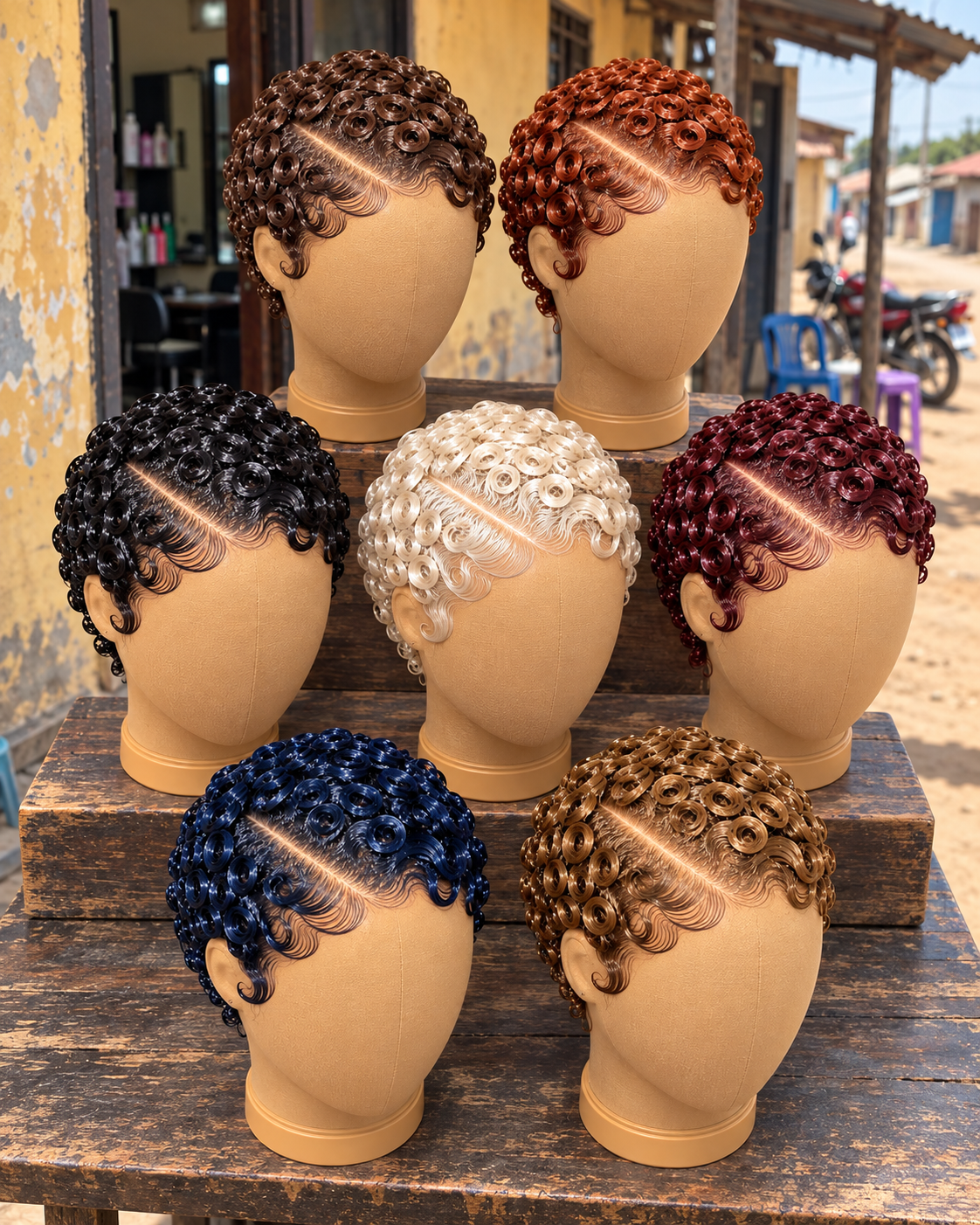
Seven beautifully arranged pixie wigs can reveal just how much personality a single hairstyle can have. In this outdoor display, seven mannequin heads wear compact, glossy finger-curl wigs in chocolate brown, copper, jet black, pearl white, burgundy, midnight blue, and golden brown. Each hairstyle combines tiny circular curls, a clearly visible diagonal side part, and delicately sculpted finger waves around the forehead and temples. Although the wigs share a recognizable silhouette, their different colors create seven distinct styling possibilities.
The collection is arranged across three levels of rustic wooden stands outside a neighborhood hair salon. Two wigs occupy the highest level, three appear in the middle, and two sit at the front. The weathered yellow storefront and sunlit street provide an everyday retail setting rather than a formal studio background. This presentation makes it easy to compare the colors, curl arrangements, and front styling from a consistent viewing angle.
One particularly important detail is the choice of mannequin heads. Unlike beauty mannequins with painted facial expressions, these displays use plain beige heads without facial features. Their simplicity directs attention toward the wigs, especially the intricate finger curls and decorative hairlines.


For shoppers looking for a finger curl pixie wig, this collection offers a useful opportunity to compare how one compact hairstyle can be interpreted in several color families. However, the photograph does not establish the hair fibers, cap construction, lace specifications, or the actual seller. Those details must be verified before purchasing.
Seven Colors Arranged Across Three Display Levels
The collection contains exactly seven wigs, arranged in a two-three-two presentation. The upper level includes a chocolate-brown wig on the left and a bright copper wig on the right. The middle row contains black, pearl white, and burgundy units. The front row displays midnight blue and golden brown.
This arrangement allows shoppers to compare both darker and lighter colors without requiring separate photographs. The central pearl-white wig provides a particularly strong contrast against the neighboring black and burgundy units.
All seven wigs share a compact pixie silhouette with circular curls concentrated across the upper head. Their front styling includes sweeping finger-wave formations, while a diagonal part separates the upper curls from the lower front section.
The visible hairstyles are similar, but the photograph does not prove that every wig has identical construction or curl density. Slight differences in the size and placement of the circular formations can be seen across the display.
Buyers should therefore inspect the specific color they intend to purchase rather than assuming that every available shade has exactly the same curl arrangement.
The Chocolate Brown Pixie on the Upper Left
The first wig on the highest level displays a rich chocolate-brown color with warm reflections along its tightly arranged circular curls. Its upper surface contains numerous small ringlets, many forming recognizable spiral openings.
The diagonal side part is particularly noticeable because the exposed lighter surface contrasts with the darker brown strands on either side. Beneath this separation, fine hair is arranged into sweeping finger waves that follow the forehead and temple.
The curls are concentrated closely around the crown, giving the wig a rounded silhouette without excessive height.
Chocolate brown can appeal to customers who want a dark hairstyle with warmer undertones than conventional black. Under sunlight, the brown reflections become more noticeable, helping individual curls stand out.
However, color perception can change under different lighting conditions. A buyer seeking this particular shade should request an indoor photograph before ordering.
Why Chocolate Brown Works Well With Circular Curls
Dark brown shades can emphasize curl structure through subtle tonal variation. The outer edges of the ringlets catch the light, while their inner sections appear darker.
This creates visual depth without introducing contrasting highlights. The result is a hairstyle where the curl placement remains the central attraction.
When ordering a comparable wig, ask for a warm chocolate-brown shade rather than simply requesting brown. The latter description can refer to a wide range of colors, from very dark espresso to much lighter caramel.
The Copper Finger Curl Wig on the Upper Right
The second wig on the top level introduces a brighter, warmer color. Its hair displays a vivid copper-orange shade with reddish undertones, particularly noticeable along the circular curls.
The upper coils form compact loops that follow the rounded shape of the mannequin head. Near the front, several curls transition into sculpted finger waves arranged along the forehead.
A diagonal part separates the upper coil section from the decorative front styling. The part appears relatively narrow and follows a consistent direction across the visible side.
The copper color makes the circular curls highly noticeable, particularly under direct daylight. Individual strands reflect warm orange highlights that emphasize their curved arrangement.
This option may appeal to customers who enjoy a bright hairstyle without choosing unconventional colors such as blue or purple.
Choosing Copper Instead of Auburn
Although copper and auburn belong to related color families, their appearances can differ considerably.
Copper generally emphasizes orange-red warmth, while auburn often contains a deeper reddish-brown foundation. The wig in this display appears closer to vivid copper than muted auburn.
Customers should request actual color photographs or samples rather than relying exclusively on the supplier’s shade name.
If the wig is made from human hair, the coloring history may influence maintenance requirements. If it is synthetic, the selected color may be manufactured into the fiber.
The photograph cannot establish either material category.
The Jet Black Pixie Anchors the Middle Row
The black wig on the left side of the middle level presents the same general hairstyle in a deep, glossy shade. Its upper curls appear particularly compact, with numerous circular formations concentrated across the crown.
The diagonal part creates a visible contrast against the dark hair. Below it, sweeping finger waves form closely spaced curves along the front and temple.
Black emphasizes the arrangement of the hair through reflective highlights rather than color variation. The curls appear darker in shadow and brighter where their surfaces face the sun.
This hairstyle may appeal to customers who want the sculpted pixie appearance without introducing additional colors.
A black unit can also provide a useful reference when comparing the construction of the other wigs. Because its color is relatively uniform, differences in curl placement and hairline direction become easier to examine.
Inspecting the Black Wig Beyond Its Shine
Glossiness alone is not a reliable indicator of fiber quality. Both human hair and synthetic fibers can reflect light strongly under favorable conditions.
Instead, ask about the wig’s construction, fiber specifications, curl retention, and maintenance requirements.
A close photograph of the crown can reveal whether the circular curls are arranged consistently. Additional side and rear views can help establish how the hairstyle continues around the head.
The Pearl White Wig Takes the Center Position
The central mannequin carries a striking pearl-white pixie wig with tightly arranged circular curls and elaborate front finger waves.
The light color makes the individual curl openings especially visible. Shadows inside the loops create contrast, allowing neighboring formations to remain distinguishable despite their similar shades.
The diagonal part is also easy to identify, although its lighter surrounding hair produces a softer contrast than in the black or burgundy versions.
Near the forehead, several fine wave formations create a decorative transition between the part and the front hairline.
The pearl-white shade appears slightly warm under the outdoor lighting, with ivory reflections visible across some curls.
Buyers should distinguish between pearl white, platinum blonde, silver, and cream blonde. These shades may appear similar in promotional photographs but can differ noticeably in person.
Care Considerations for Light-Colored Wigs
Light-colored hair can make product residue and discoloration more noticeable. The appropriate cleaning method depends on the confirmed fiber type and the manufacturer’s instructions.
For human-hair units, previous lightening or coloring may influence the hair’s response to washing and heat. For synthetic units, conventional human-hair toners and dyes may be inappropriate.
A buyer should not attempt to change the shade without confirming material compatibility.
The Burgundy Pixie Brings Deep Red Contrast
On the right side of the middle level, a rich burgundy wig displays compact circular curls in deep wine-red tones.
The curls appear glossy, with brighter red reflections along their outer surfaces. The color remains relatively dark in shaded areas, producing a strong contrast against the beige mannequin.
The diagonal part is clearly visible, and the sculpted front waves follow a similar arrangement to those seen on the neighboring wigs.
Burgundy provides a different appearance from the brighter copper unit above. Its deeper red coloring gives the hairstyle a richer, more subdued tone while retaining noticeable color.
For shoppers who prefer red-based hair colors but do not want the brightness of copper, burgundy may be a suitable alternative.
Comparing Burgundy Under Indoor and Outdoor Light
Deep red shades can look particularly different depending on lighting. Under sunlight, burgundy may reveal stronger ruby or wine-red reflections. Indoors, the same wig may appear closer to dark brown or black-red.
Ask the supplier for actual product photographs taken under different lighting conditions.
If an exact shade is important, compare physical color samples when possible.
Midnight Blue Creates a Distinctive Front-Row Option
The front-left mannequin wears a dark midnight-blue wig with tightly arranged glossy coils.
Unlike bright electric blue, this shade appears considerably deeper, approaching navy in shaded areas. Under the sunlight, the blue coloring becomes more visible along the circular strands.
The diagonal part follows the same general direction seen across the collection. Fine finger waves curve across the front and temple, providing a decorative contrast to the rounded coils above.
The wig’s compact shape remains consistent with the other displays, despite the stronger color identity.
Midnight blue can appeal to customers who want a fashion color that appears darker and more restrained than vivid royal blue.
The photograph does not reveal whether the color is produced through manufactured fibers or a dyeing process.
The Golden Brown Pixie Completes the Collection
The seventh wig, positioned at the front right, displays a rich golden-brown color with warm caramel reflections.
Its circular curls appear densely arranged across the upper head. Several prominent ringlets are visible near the front, while smaller formations continue toward the rear.
The diagonal part and front finger waves remain important styling elements, creating a coordinated appearance with the other six wigs.
The golden-brown shade is deeper than the pearl-white option and less orange than the copper wig. Its warmth comes primarily from caramel and bronze-like reflections.
This color may appeal to customers seeking a lighter brown hairstyle that still retains noticeable depth.
One of the most consistent visual details across the display is the prominent diagonal part.
Rather than dividing the hair into equal sections down the middle, the part travels at an angle across the upper front.
Above the separation, the hair forms tightly arranged circular coils. Below it, finer strands are shaped into decorative finger waves.
This arrangement establishes a clear relationship between two styling techniques.
The part also helps create a directional appearance. The hair does not simply rise uniformly around the head; instead, the diagonal separation guides the viewer’s attention across the front and toward the curled crown.
When ordering a similar wig, buyers should specify the direction and placement of the part. A central part or opposite-facing diagonal line would create a different hairstyle.
Why the Part Should Be Examined Closely
The visible separation may result from the arrangement of the hair, the construction of the wig, or a combination of techniques.
The photograph does not establish the exact manufacturing method.
Customers should ask whether the part can be maintained after washing and whether professional resetting is required.
Attempting to widen the part through aggressive plucking or cutting may damage the wig’s construction.
Finger Waves Around the Forehead and Temples
The front styling is another important characteristic shared by the collection.
Fine strands are arranged into sweeping curves that follow the forehead and extend toward the temples. Several sections resemble classic finger waves, with repeated curved ridges that create a carefully sculpted appearance.
Small curled strands appear near the temples, contributing to the decorative hairline.
The finger-wave sections lie relatively close to the mannequin surfaces, contrasting with the more elevated circular coils above.
This difference in height gives the hairstyles a compact but detailed silhouette.
Although the front arrangements are broadly similar, minor differences in wave placement and curl direction can be seen between the wigs.
Buyers should request a close view of the particular unit they intend to purchase rather than assuming the hairlines are identical.
Are These Wigs Lace Front, Glueless, or Human Hair?
The photograph does not show the interior construction of any wig. The mannequin heads conceal the caps, and no lace extensions or fastening components are clearly visible.
It is therefore not possible to determine whether the wigs are lace front, full lace, closure-based, or constructed using another method.
The image also cannot establish whether the units are glueless or whether they contain human hair, synthetic fibers, or a blend.
These details should be verified with the seller before purchasing.
Request a full underside photograph showing the cap, seams, available attachment points, and any adjustment hardware.
For buyers who specifically want lace construction, ask for the dimensions and specifications of the lace area.
If adhesive-free installation is important, request explicit confirmation that the cap is designed for that purpose.
How To Order This Style in a Preferred Color
The photograph is useful as a visual reference, but it does not identify a verified supplier or current product listing.
Customers can look for similar wigs through local wig boutiques, online hair retailers, and custom wig makers specializing in sculpted pixie hairstyles.
When contacting a seller, send the image and identify the desired color by its position in the display.
Explain that the hairstyle should include compact circular finger coils, a diagonal part, and carefully arranged front finger waves.
Ask whether the selected color is available as a completed wig or requires custom production.
Information to Confirm Before Payment
Verify the hair fiber, cap size, construction method, available color options, and whether the hairstyle arrives fully arranged.
Request photographs of the front, side, back, crown, and interior.
Ask whether the finished wig requires adhesive installation, adjustment hardware, or another fitting method.
For custom orders, confirm the production timeline and revision policy.
Finally, establish whether the quoted price includes shipping, taxes, installation, and any additional salon services.
Illustrative Prices for Finger Curl Pixie Wigs
The following USD figures are illustrative budgeting ranges rather than verified live prices. The actual selling prices, materials, and suppliers of the seven displayed wigs are unknown.
| Wig Category | Illustrative USD Range | Potential Purchase Considerations |
|---|---|---|
| Premium Custom | $280–$720+ | Personalized cap sizing, carefully arranged circular finger coils, sculpted front waves, and selected color production. |
| Standard Custom | $150–$380 | Selected cap options with customized curl arrangement and coordinated finger-wave styling. |
| Basic Human Hair | $90–$250 | A human-hair starting unit that may require professional coil setting, cutting, and hairline styling. |
| Premium Synthetic | $60–$175 | A manufactured pixie with preformed circular curls and selected color options. |
| Basic Synthetic | $25–$85 | A lower-cost curly pixie that may offer less flexibility in cap construction and styling customization. |
Pricing may depend on the fiber, cap construction, hair density, color availability, and amount of specialist styling required.
Bright colors do not automatically cost more than black. A manufacturer’s existing color range may influence the price more than the apparent intensity of a shade.
Custom finger-wave styling and individually arranged coils can increase labor costs when the hairstyle must be reproduced from a specific reference.
Installation, shipping, taxes, and future maintenance may be charged separately.
Choosing Between Ready-Made and Custom Pixie Wigs
Ready-made wigs can be a convenient option when the desired color and curl arrangement are already available.
However, a customer who wants a specific diagonal part or particularly intricate finger-wave hairline may benefit from custom work.
A wig maker can potentially adjust the curl arrangement and cap measurements during production, depending on the available materials.
Before commissioning a custom unit, request examples of previous work involving circular coils and sculpted finger waves.
Also ask whether the hairstyle will remain arranged after washing or require professional resetting.
The most economical choice is not always the lowest initial price. Consider the total cost of customization, installation, and future maintenance.
Maintaining the Circular Finger Curls
The central maintenance challenge is preserving the shape of the small circular coils.
Repeated brushing may separate the loops and reduce their carefully arranged appearance.
Handle the hairstyle gently, avoiding unnecessary pulling or manipulation.
If the wig contains human hair, the appropriate resetting method may depend on its coloring history and the products originally used.
If the wig contains synthetic fibers, conventional curling irons or steam may be unsuitable without confirmed heat compatibility.
Follow the manufacturer’s care instructions and consult a professional if the coils begin to lose their shape.
Protecting the Front Finger Waves
The fine strands arranged along the forehead and temples should be handled separately from the circular coils above.
Aggressive brushing may disturb the curved ridges and change the appearance of the hairline.
If the wig includes lace, take care not to pull excessively on the fine front strands.
For maintenance, use only techniques appropriate for the confirmed hair material and construction.
Unnecessary cutting or plucking should be avoided because the decorative front arrangement depends on the existing strand lengths.
Storing Several Colored Pixie Wigs
Customers who purchase multiple colors should consider storing each wig separately.
Appropriately sized wig stands can help support the compact silhouettes while preventing the circular curls from being compressed.
Avoid stacking the wigs directly on top of one another, as pressure may disturb the arranged coils.
For travel, use protective packaging that provides sufficient space around the crown and prevents delicate hairline sections from being crushed.
If the wigs are displayed near windows or outdoors, follow the supplier’s recommendations for limiting unnecessary exposure to direct sunlight, heat, and dust.
Color retention and material durability depend on the fiber and manufacturing method, which should be confirmed before establishing a long-term care routine.
Finding the Right Color Among Seven Beautiful Options
Each wig in this collection offers a different interpretation of the same compact finger-curl hairstyle.
Chocolate brown provides warm depth, copper introduces brighter orange-red reflections, and jet black emphasizes the sculpted curls through glossy contrast.
Pearl white makes the individual circular formations particularly noticeable, while burgundy provides a rich wine-red appearance.
Midnight blue offers a deeper fashion-color alternative, and golden brown combines caramel warmth with a more natural-looking brown foundation.
The best choice depends on the buyer’s preferred color, curl arrangement, cap fit, and maintenance expectations.
Before placing an order, compare actual photographs of the selected wig, verify its material and construction, and confirm whether the advertised product includes the exact styling shown.
What makes this seven-piece display appealing is the consistency of its design language: compact circular coils, sweeping diagonal parts, and decorative finger waves. With the correct product information and professional fitting, buyers can select a color that suits their preferences while preserving the distinctive sculpted appearance that connects the entire collection.
Search Terms
Seven finger curl pixie wigs · Chocolate brown spiral coil pixie · Copper sculpted finger wave wig · Jet black circular curl hairstyle · Pearl white finger curl pixie · Burgundy diagonal part wig · Midnight blue compact spiral curls · Golden brown sculpted pixie wig