
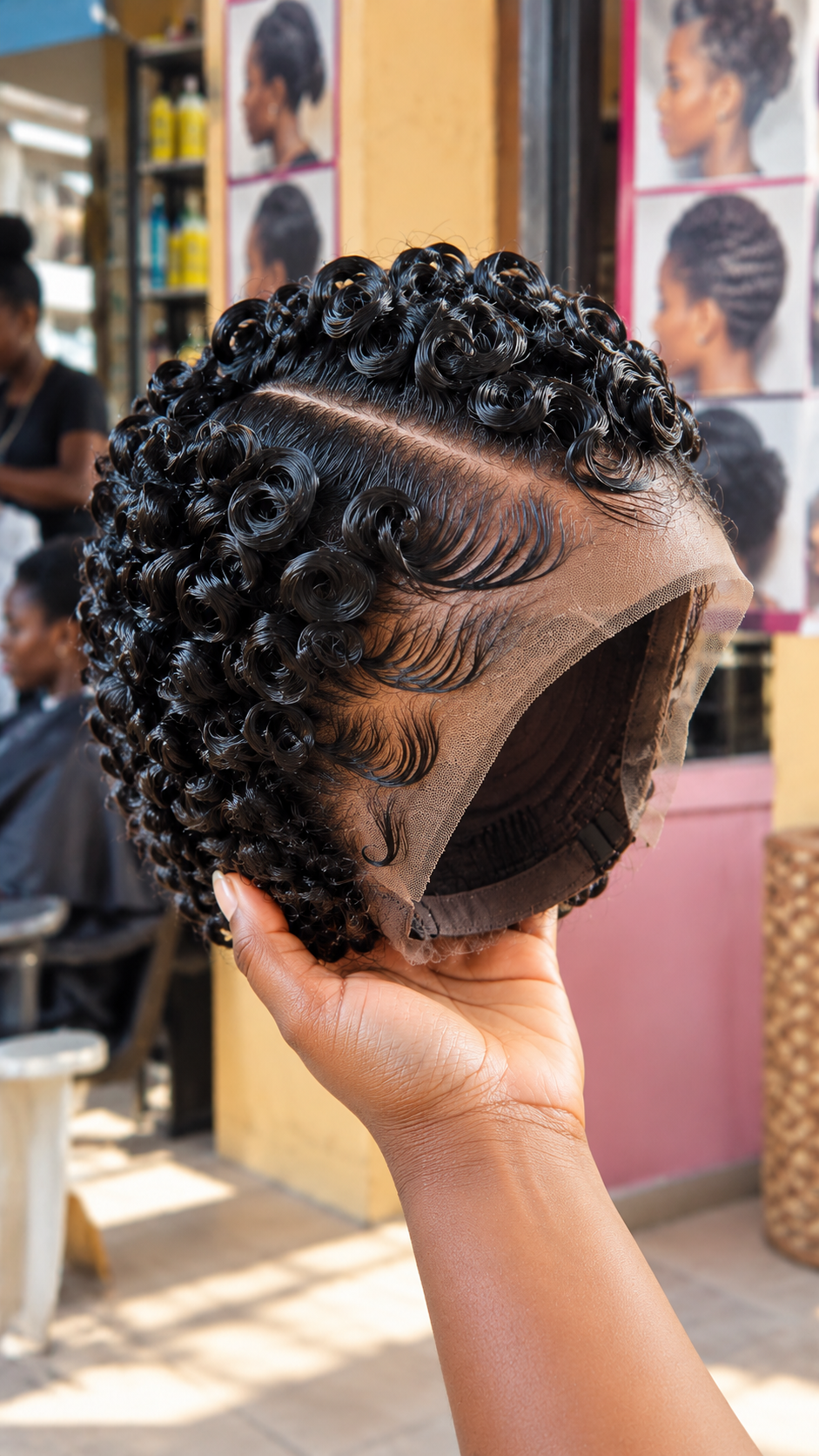
There is something particularly attractive about a hairstyle that combines tightly arranged circular curls with delicate waves around the forehead. This black pixie wig brings those two styling ideas together in an eye-catching design. Its crown and outer side are covered with glossy rose-shaped curls, while a diagonal parting introduces a beautifully arranged series of finger waves that flow toward the temple. A small curled strand near the lower hairline adds a final decorative touch.
The wig is photographed before installation, supported by one hand outside a neighborhood hair salon. The beige lace remains untrimmed, extending beyond the front and side hairline. A dark brown interior cap and part of the adjustment hardware are visible beneath the styled hair. The photograph offers an unusually clear look at the relationship between the circular curls, the diagonal separation, and the fine front strands.
The hair appears consistently black, with cool charcoal reflections caused by daylight. No separate blonde, brown, copper, or burgundy sections are clearly visible. The appearance therefore depends on the shape of the curls, the direction of the finger waves, and the contrasting spaces between the dark strands and the exposed lace.


For women interested in black curly pixie wigs, the appeal of this hairstyle goes beyond a simple cropped haircut. The individual curls look carefully positioned, and the front hairline is styled into a distinctive flowing arrangement. A buyer hoping to reproduce the design should pay as much attention to these small details as to the wig’s overall size and color.
A Closer Look at the Rose-Shaped Curl Arrangement
The most noticeable characteristic is the collection of circular curls covering the upper and outer sections. Many resemble miniature roses, with strands curling inward around visible centers.
The arrangement is dense without appearing completely uniform. Some curls are broad and prominent, while smaller ones fill the spaces between neighboring sections. Their different sizes create depth and keep the crown from looking like a repeated pattern of identical rings.
Several larger rosettes are positioned near the upper middle and front-side area. Moving toward the lower outer edge, the curls become more compact and closely gathered.
The result is a rounded hairstyle with an attractive sense of fullness. The crown has visible height, but the curls remain relatively close to the head-shaped cap rather than extending into a large Afro silhouette.
These circular forms distinguish the wig from ordinary loose curly pixies. A wig containing freely falling spirals might have a similar length but would not reproduce the organized rosette appearance.
The Importance of Curl Placement
When commissioning this hairstyle, curl placement deserves careful discussion. The individual rings are not simply scattered across the crown. Their sizes and directions appear coordinated.
Some curls face outward, revealing their centers, while others turn slightly toward neighboring sections. This produces a layered arrangement that reflects light from different angles.
Adding too much hair could conceal the circular openings and make the upper section look heavy. Too little hair could create gaps between the curls.
A suitable wig maker should consider the relationship between curl size, spacing, and density rather than concentrating only on achieving maximum fullness.
The Diagonal Parting Creates an Attractive Contrast
A visible diagonal parting travels through the upper front-side section. It separates the circular curls above from a more closely arranged panel of directional strands below.
The exposed channel has a lighter appearance than the surrounding black hair, making its path easy to follow.
The parting is not positioned as a conventional straight middle separation. Instead, it creates a diagonal boundary that complements the direction of the front waves.
Hair above the parting forms numerous rounded curls, while the strands below follow sweeping curved paths. This difference in styling gives the hairstyle its distinct visual structure.
The parting should be preserved during customization. Moving it to a substantially different position would affect the balance of the upper curls and front waves.
Choosing the Correct Side
The wig is being held at an angle, so the photographed orientation does not automatically establish how the parting should appear on a wearer.
Customers should tell the wig maker whether they prefer the design on the left or right side of the head.
The stylist should also consider how the diagonal separation will relate to the wearer’s forehead and temples.
A properly positioned parting helps the upper curls and lower waves appear coordinated rather than disconnected.
The Front Finger Waves Are Beautifully Arranged
Beneath the diagonal parting, the hair forms a delicate collection of finger waves that follow the front hairline.
The individual strands remain closely aligned, creating fine curves across the beige lace. Some travel diagonally toward the forehead, while others bend toward the temple.
The arrangement produces a flowing appearance that contrasts with the tightly wound circular curls above.
Several waves gradually decrease in size as they approach the lower side, creating a natural progression rather than an abrupt ending.
This front hairline is an important part of the hairstyle. A wig with similar rosette curls but an ordinary unstyled front edge would create a noticeably different appearance.
Why Fine Waves Require Careful Styling
Finger waves depend on the strands remaining in carefully planned positions.
Repeated brushing or unnecessary handling may disturb the curves and make the arrangement less recognizable.
The photograph does not establish which products or setting techniques were used. The wig maker should explain how the front waves will be maintained and whether they need professional restyling after washing.
For a custom order, buyers should request a close-up photograph of the completed hairline before the wig is shipped.
The Small Temple Curl Adds a Lovely Finishing Touch
Near the lower edge of the visible side, a small curved strand extends toward the temple and ends in a delicate spiral.
This detail is considerably smaller than the circular curls covering the crown, but it adds character to the hairstyle.
The lower curl follows the direction of the neighboring finger waves, creating continuity between the front hairline and outer side.
Because the wig has not been installed, the final position of this strand against the wearer’s skin cannot be confirmed.
A professional stylist should establish the correct lace position before making permanent changes to the temple curl.
Customers who particularly like this finishing detail should identify it when requesting a similar wig.
Glossy Black Hair Without Contrasting Colors
The hairstyle appears consistently black throughout the visible curls and waves.
Daylight reflects across the curved strands, creating charcoal-gray highlights that make individual hairs easier to distinguish.
These reflections should not automatically be interpreted as deliberately colored silver or gray highlights.
The hairstyle achieves its visual richness through the contrast between glossy outer strands, dark curl openings, and the exposed diagonal parting.
For a faithful reproduction, natural black or deep jet black hair is a suitable color reference.
However, the exact commercial color number should be confirmed with the seller because naming conventions differ between manufacturers.
Understanding the Untrimmed Lace and Interior Cap
The photograph shows beige lace extending beyond the styled front and side hairline.
The mesh remains untrimmed, indicating that the wig has not yet been prepared for its final wearing position.
Part of the dark brown cap is visible inside the unit, including stitched fabric sections and adjustment hardware.
These details provide useful information, but the photograph does not reveal every attachment point or the complete cap construction.
The exact lace grade also cannot be determined from appearance alone. A fine-looking mesh does not prove that the unit contains HD lace.
Buyers should request written specifications and a full underside photograph before purchasing.
Why Fitting Should Come Before Lace Trimming
The wig should first be positioned on the wearer’s head to assess the hairline, diagonal parting, and temple waves.
Correct placement is important because the decorative strands extend close to the lace perimeter.
Trimming the lace before establishing the fit may make later adjustments difficult.
Measurements such as head circumference, front-to-nape length, and ear-to-ear width can help determine whether the selected cap is suitable.
The photograph does not establish whether adhesive-free installation is appropriate. That decision depends on the actual cap construction and the wearer’s needs.
Where to Find This Type of Black Pixie Wig
Customers can begin by searching specialist wig salons, independent wig makers, beauty supply shops, and online retailers offering sculpted pixie hairstyles.
Useful search descriptions include black rosette curl wigs, sculpted finger-wave pixies, and black pin curl lace wigs.
However, not every black curly wig will have the same circular curl arrangement or carefully styled front hairline.
When contacting a seller, send the reference photograph and identify the important details: deep black color, compact rose-shaped curls, a diagonal side parting, and flowing front finger waves.
Ask whether the seller has an actual ready-made unit or accepts custom styling orders.
No verified seller, stock listing, or live product price can be established from the photograph alone.
Choosing a Wig Maker With the Right Experience
A stylist experienced in ordinary wig installation may not necessarily specialize in sculpted circular curls or delicate finger waves.
Look for portfolios containing compact pin curls, rosette arrangements, and carefully styled lace hairlines.
Close-up photographs of previous work can help reveal whether the stylist has experience controlling individual curl shapes.
During the consultation, discuss the desired curl size, crown height, side density, and front-wave arrangement.
The maker should also explain whether the selected material can support the hairstyle and what maintenance will be necessary after washing.
Questions to Ask Before Ordering
Confirm the proposed hair material and whether the wig will arrive fully styled.
Ask for photographs showing the front, sides, back, and complete interior cap.
Request information about the lace dimensions, cap measurements, and available adjustment components.
The seller should explain whether professional installation is recommended and whether that service is included in the quotation.
For online orders, request written confirmation of the agreed design, production time, shipping details, and revision policy.
Ready-Made Pixie Wigs Versus Custom Orders
A ready-made black curly pixie may provide a similar general silhouette at a lower initial cost.
However, many ready-made units contain ordinary loose curls rather than the carefully arranged rosettes visible in this photograph.
They may also lack the diagonal parting and delicate front finger waves.
A custom order is more appropriate when the customer wants the distinctive curl and hairline arrangement reproduced closely.
A ready-made base might still be suitable if its hair length, density, and cap construction allow the stylist to create the desired design.
Before purchasing an unstyled base wig, ask the intended stylist whether it can support the required customization.
Estimated Prices for Black Rose Curl Pixie Wigs
The cost of a comparable wig may depend on the selected material, cap construction, curl arrangement, lace preparation, and labor involved in styling the front waves.
The following USD amounts are illustrative planning ranges only. They are not verified current retail prices or quotations for the photographed wig.
| Wig Category | Illustrative USD Range | Purchasing Considerations |
|---|---|---|
| Premium Custom | $340–$800+ | Individual rose curl arrangement, detailed finger-wave hairline styling, personalized cap fitting, and specialist finishing work. |
| Standard Custom | $170–$400 | Custom circular curls and front-wave styling on a suitable prepared wig foundation. |
| Basic Human Hair | $95–$250 | A possible base unit requiring additional curl setting, hairline styling, and fitting services. |
| Premium Synthetic | $60–$180 | A potential pre-styled black curly alternative if the fiber can support the circular curl arrangement. |
| Basic Synthetic | $25–$85 | A lower-budget curly pixie option that may not reproduce the rosette curls or intricate front-wave design. |
These categories describe possible purchasing options rather than the verified material of the photographed unit.
Additional charges may include lace trimming, cap adjustment, installation, shipping, and future styling restoration.
Customers should request an itemized quotation showing which services are included before making payment.
Planning the First Installation
The first fitting should begin with an inspection of the lace and interior cap.
The stylist should position the wig carefully and check whether the diagonal parting and front waves align naturally with the wearer’s forehead.
The crown should maintain its rounded shape without appearing unnecessarily high or wide.
Any required cap adjustments should be completed before trimming the lace.
The small temple curl should also be assessed because its final position may change slightly when the wig is worn.
The appropriate attachment method should follow the cap construction, the wearer’s preferences, and professional guidance.
Keeping the Rose-Shaped Curls Beautiful
The circular curls depend on retaining their rounded openings and carefully arranged positions.
Repeated brushing may disturb the rosette shapes and cause neighboring curls to separate.
Customers should avoid pulling the curls apart merely to increase volume.
Ask the wig maker whether the hairstyle can be refreshed at home or whether professional restyling is recommended after washing.
If the wig contains human hair, cleansing should account for any previous coloring or setting techniques.
If synthetic fiber is used, follow the manufacturer’s care instructions and confirm heat tolerance before attempting to restyle the curls.
Protecting the Front Finger Waves
The fine front waves require careful handling because their appearance depends on individual strands remaining aligned.
Repeated rubbing or excessive combing may disturb their curved paths.
The diagonal parting should remain visible, and neighboring hair should not be pulled across the exposed separation.
A professional wig stylist can explain how to refresh the hairline without altering the upper curls.
Why This Black Pixie Is Suitable for Different Occasions
The black color gives the hairstyle considerable flexibility, while the sculpted curls and front waves provide decorative detail.
It may appeal to women seeking a distinctive hairstyle for celebrations, portrait photography, fashion-focused occasions, or personal everyday styling.
The compact silhouette can coordinate with formal clothing, casual outfits, and a wide range of accessories.
Because the hair already contains an intricate arrangement of curls and waves, simple jewelry and makeup can allow the hairstyle to remain the main visual focus.
For frequent wear, customers should consider the maintenance required to preserve the circular curls and delicate front hairline.
A Pixie Wig That Combines Beautiful Curls and Precision
This hairstyle demonstrates how black hair can create a distinctive appearance through careful styling rather than contrasting colors.
The rose-shaped curls give the upper hair depth and fullness, while the diagonal parting introduces direction. Fine finger waves travel across the hairline, and a small temple curl completes the lower side.
The exposed beige lace and partially visible cap also highlight the importance of confirming construction details and fitting requirements before installation.
For women seeking a similar wig, the most important priorities are the compact rosette arrangement, correctly positioned parting, and carefully styled front waves.
When these elements are reproduced by an experienced wig maker, the result can capture the distinctive character of this beautiful black pixie while remaining appropriate for the wearer’s comfort, styling preferences, and maintenance needs.
Search Terms
Black rose curl pixie wig · Glossy circular pin curls · Diagonal side part black wig · Finger wave lace front pixie · Black rosette crown hairstyle · Beige lace sculpted curl wig · Curved front hairline black pixie · Black spiral wig with temple curl