
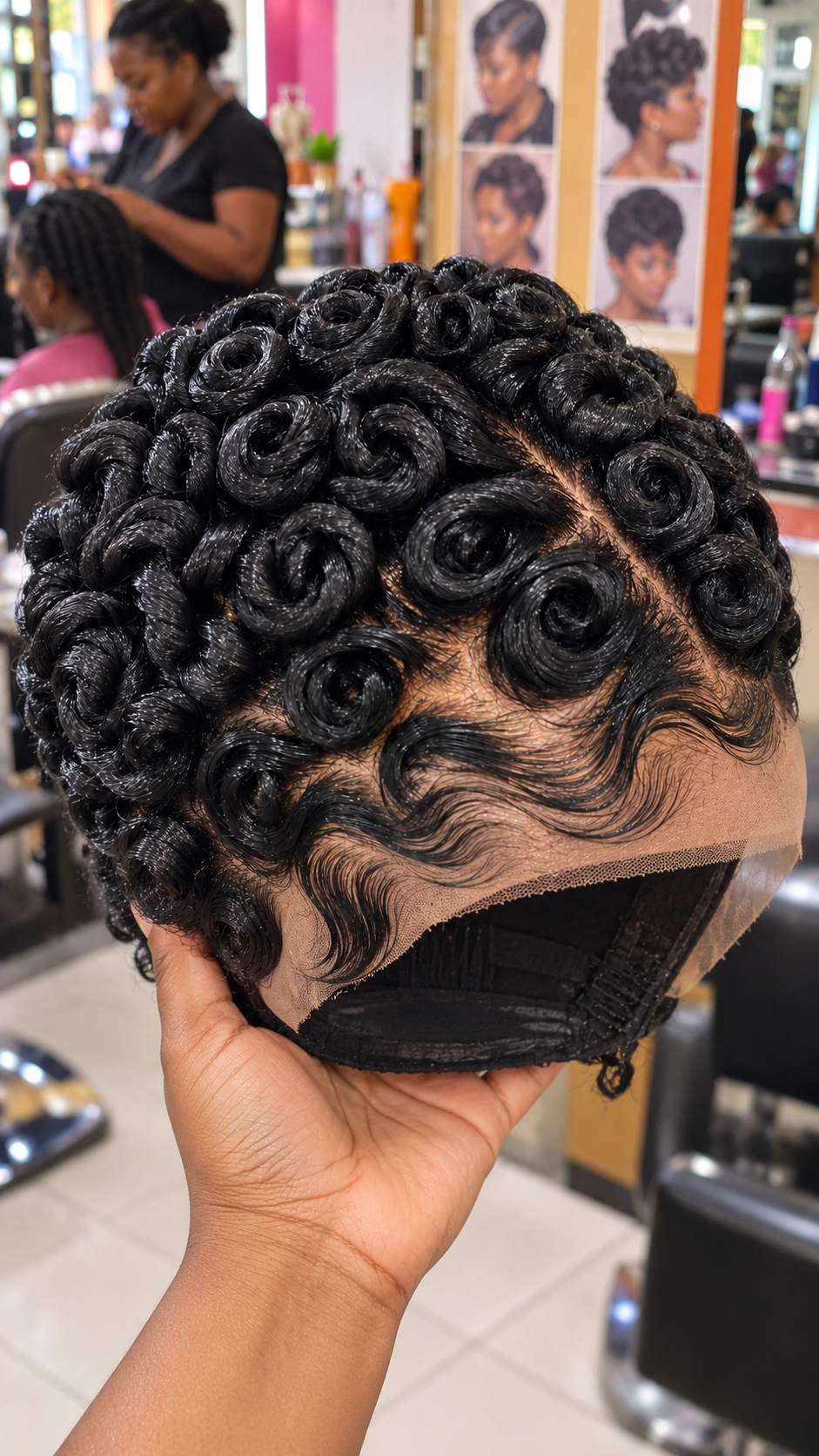
Some hairstyles make their strongest impression through length or dramatic color. Others rely on the precision of every curve, parting, and carefully arranged strand. This jet black pixie lace wig belongs to the second category. Its crown is covered with glossy, rose-shaped coils, while the front combines exposed diagonal partings with flowing finger waves and delicate curled baby hairs. The contrast between the rounded coils and the flatter waves gives the hairstyle its distinctive appearance.
The photograph shows the wig being held before installation inside a working hair salon. The extended beige lace remains visible around the forehead and sides, and the dark interior cap can be seen beneath the hairline. Unlike a finished hairstyle worn by a model, this presentation offers a useful opportunity to examine the curl placement, hairline arrangement, and visible construction before the wig is fitted.
What makes this design particularly interesting is the way the circular coils interact with the exposed scalp-like sections. The curls do not simply cover the entire crown in a uniform arrangement. Several diagonal divisions remain visible between the larger rosettes, while the forward hair is sculpted into continuous waves that follow the shape of the forehead.


For customers searching for a black curly pixie wig, this design offers a more specialized alternative to ordinary finger coils or loose ringlets. Reproducing it accurately requires attention to the rosette arrangement, the direction of the front waves, and the relationship between the lace hairline and the raised crown.
A Crown Filled With Glossy Rose-Shaped Coils
The upper hairstyle is dominated by numerous circular formations that resemble small hair roses. Each coil consists of strands arranged into overlapping curves, producing a rounded shape with a visible center or tightly folded interior.
Some rosettes are relatively large, particularly across the upper front and central crown. Others are smaller and more closely clustered toward the visible rear and outer edge. This variation creates a sculpted appearance without making every curl look identical.
The black strands are highly reflective, with bright highlights tracing the direction of the curved hair. These reflections emphasize the layered structure of the rosettes and make individual formations recognizable even where several coils overlap.
Unlike loose spiral curls that hang downward, the circular formations remain relatively close to the crown. Their arrangement creates a rounded pixie silhouette with moderate elevation rather than a large, outward-expanding hairstyle.
The visible rear portion contains a dense collection of smaller curls, while several larger rosettes are positioned closer to the exposed front parting. This progression gives the hairstyle depth and prevents the upper surface from appearing completely uniform.
What Makes These Curls Different From Ordinary Ringlets?
A conventional ringlet usually follows a spiral direction, with hair extending into a corkscrew-like formation. The coils in this wig appear more compact and circular, with several strands arranged around a central point.
Some resemble miniature rosettes, while others display broader overlapping loops. Their layered construction is a defining element of the hairstyle.
This distinction matters when shopping. A supplier advertising a black curly pixie might offer small spring coils, loose spirals, or naturally shaped curls. None of those alternatives necessarily reproduces the circular arrangement visible here.
When evaluating a similar product, request a close-up photograph of the crown. Examine the diameter of the coils, their spacing, and whether the individual formations remain recognizable.
A photograph taken from above can reveal whether the rosettes continue across the entire crown or are concentrated only around the front.
The current photograph provides a strong view of the upper and front sections, but the complete rear arrangement remains partially outside the frame.
The Exposed Partings Make the Hairstyle More Interesting
Between the larger front rosettes, several narrow scalp-like channels remain visible. These exposed areas create a diagonal pattern that travels through the forward crown.
Rather than one continuous central part, the photograph shows an arrangement of divisions separating groups of circular curls. The most prominent diagonal channel runs across the upper front, while smaller exposed sections appear between neighboring coils.
The dark strands contrast with the lighter underlying surface, making the parting arrangement particularly noticeable.
This design approach allows the curls to appear individually positioned rather than forming an uninterrupted mass of hair.
The exposed sections also establish a relationship between the raised rosettes and the flatter finger waves below. The viewer can follow the movement from the circular curls through the diagonal divisions and into the sculpted front hairline.
Why Parting Placement Should Be Approved Before Styling
For a custom wig, the visible divisions should be planned before the final rosettes are arranged. Changing the parting direction after the curls have been completed may disturb the surrounding hair.
A buyer should provide the reference photograph and ask whether the maker can recreate the diagonal arrangement without introducing large unintended gaps.
The photograph does not establish whether the exposed channels were created through hair placement, temporary styling, or another manufacturing method.
That question should be answered by the supplier because it influences how the partings can be maintained after washing.
Customers should avoid widening the exposed sections through aggressive plucking or cutting. Removing too much hair from a lace unit can produce permanent gaps that may be difficult to conceal.
The Front Finger Waves Are the Second Main Attraction
The front hairline introduces a very different styling technique from the circular crown. Instead of raised coils, the strands are arranged into elongated, flowing finger waves that follow the shape of the forehead.
Several S-shaped ridges travel across the visible front section, creating alternating curves. Their direction is coordinated, making the waves appear continuous rather than individually scattered.
Near the lower front and temple, the strands become finer and form more elaborate curved sections. One prominent sweep extends downward before turning back into the surrounding hairline.
The waves remain close to the lace surface, creating a flatter appearance than the rosettes above them.
This contrast is essential. If the front were filled with ordinary loose curls, the hairstyle would lose the distinct separation between the sculpted waves and circular crown.
Reproducing the Wave Direction Accurately
A professional stylist should study the direction of the front waves before attempting to recreate them.
The visible strands flow through several connected curves, with the ridges positioned close together. The spacing between these ridges influences how the hairstyle appears from the front.
If the waves are spread too far apart, the hairline may appear less coordinated. If the strands are pressed into one continuous section without visible ridges, the decorative movement may disappear.
Customers should ask whether the front waves are intended to retain their shape after washing or require professional resetting.
The appropriate technique depends on the hair material and the products used during styling. Human hair and synthetic fibers may respond differently to moisture, setting products, and heat.
The Delicate Baby Hair Design Deserves Special Attention
The front contains fine strands arranged into decorative curves that extend beyond the larger finger-wave formations. These smaller sections contribute significantly to the hairstyle’s character.
Near the temple, several strands sweep downward and inward, creating an ornamental appearance without requiring additional color or accessories.
The baby hairs are visibly finer than the surrounding rosette curls. Their placement creates a gradual transition between the heavily styled crown and the exposed lace perimeter.
This type of detail can be easy to overlook when ordering a wig online. A supplier may reproduce the circular crown but deliver a simpler hairline with ordinary short strands.
For customers who want the photographed appearance, the baby-hair arrangement should be included explicitly in the order description.
Should the Baby Hairs Be Cut After Delivery?
Not automatically. The photographed unit already contains strands arranged into specific shapes. Additional cutting may remove the length needed to reproduce those curves.
During installation, a stylist should first evaluate whether the existing hairline can be positioned correctly against the wearer’s forehead.
If small adjustments are necessary, they should be made conservatively.
Excessive trimming can permanently change the design, particularly around the temple where several decorative sections depend on elongated strands.
Buyers should discuss hairline customization with a wig stylist familiar with sculpted finger waves rather than assuming that conventional baby-hair techniques will produce the same result.
Why the Jet Black Color Complements the Design
The visible hair is consistently deep black, with strong glossy reflections across the circular coils and finger waves.
There are no obvious blonde, copper, burgundy, or other contrasting highlight sections. The appearance depends on the direction of the strands and the way light reflects from their curved surfaces.
The raised rosettes display brighter reflections along their outer edges, while their centers and overlapping sections appear darker.
Across the front, the glossy finger waves produce continuous reflective lines that make their curved ridges easier to distinguish.
The black color allows these two styling techniques to remain visually connected while still showing their differences.
Although the hair has a polished appearance, the photograph cannot establish whether it is human hair, synthetic fiber, or a blend.
Buyers should confirm the actual material before selecting styling products or attempting any heat-based adjustments.
What the Untrimmed Lace Reveals
The wig is displayed with a broad section of beige lace extending beyond the front hairline. This material is visible beneath the finger waves and around the lower perimeter.
The lace has not yet been cut to the final wearing shape. Its exposed position helps show how the styled front strands are arranged relative to the mesh.
The color appears beige or light brown under the salon lighting, although the exact shade may look different against a wearer’s skin.
It would be inappropriate to assume that the unit uses a particular premium lace grade based solely on its appearance.
Buyers should request the manufacturer’s lace specifications and ask about available color options.
Why Lace Color Matters With an Elaborate Hairline
The finger waves and decorative baby hairs are positioned close to the front lace. Once the wig is installed, the appearance of the exposed mesh may influence how naturally the hairline blends with the wearer’s complexion.
A lace shade that contrasts strongly with the skin may be more noticeable between the carefully arranged strands.
Ask the supplier for a close photograph of the lace under neutral lighting and confirm whether alternative shades are available.
If lace customization is required, discuss the process with a professional who can avoid disturbing the intricate front styling.
Heavy product application or careless trimming may affect both the mesh and the fine hairline strands.
The Exposed Interior Helps Explain the Wig’s Construction
The lower portion of the photograph reveals part of the dark interior cap. Black fabric panels and visible structural sections appear beneath the lace perimeter.
At the side of the opening, dark fastening hardware and a comb-like attachment are visible.
These observations provide useful information about the wig’s construction, but they do not establish the complete fastening system.
The number of internal combs, the full adjustment range, and the presence of additional security components cannot be confirmed from this partial view.
The photograph also does not prove that the wig is designed for adhesive-free installation.
Questions to Ask About the Cap
Before purchasing, request a photograph showing the complete interior with the cap opened fully.
Ask the seller to identify the available combs, adjustable components, seams, and any elastic security bands.
Confirm the available cap sizes and provide the measurements requested by the manufacturer or wig maker.
For a hairstyle with an elaborate front hairline, cap positioning is especially important. A poor fit may shift the finger waves or place the decorative temple strands at an unintended angle.
If glueless installation is preferred, request explicit confirmation that the complete construction supports that method.
Choosing a Specialist Who Can Recreate the Rosettes
This hairstyle may require more specialized work than an ordinary curly pixie. Its circular coils are arranged deliberately, and the front finger waves introduce another technical challenge.
When searching for a wig maker, look for examples of previous work involving sculpted rosette curls, finger-wave hairlines, and compact lace hairstyles.
A supplier who produces conventional straight or loosely curled wigs may not necessarily have experience creating these circular formations.
Ask for close photographs of completed pieces rather than relying entirely on distant promotional portraits.
A useful portfolio should demonstrate consistent coil placement, well-organized partings, and carefully arranged front styling.
How To Order This Style
Send the original photograph and describe the hairstyle as a jet black pixie lace wig with raised circular rosette coils, visible diagonal partings, continuous front finger waves, and decorative curved baby hairs around the temple.
Specify that the crown should contain compact, individually recognizable circular formations rather than loose hanging ringlets.
Explain that the front styling should remain relatively flat against the lace while the rosettes provide elevation above it.
Ask whether the supplier can reproduce the hairstyle as a fully finished unit or whether additional salon styling will be required after delivery.
Confirm the hair fiber, cap measurements, lace specifications, and intended installation method.
Before payment, establish the production timeline, revision conditions, and whether photographs of the completed wig will be provided for approval.
Buying a Ready-Made Wig Versus Commissioning Custom Work
A ready-made black curly pixie may offer the desired color and approximate length at a lower initial cost.
However, many standard units contain ordinary finger coils or spring curls rather than the layered rosette formations shown here.
The elaborate front finger waves may also be absent.
A custom wig maker can potentially coordinate the circular crown, exposed partings, and decorative hairline during production.
That additional control may be valuable for buyers who want a close reproduction.
Nevertheless, custom work does not automatically guarantee accuracy. The result depends on the maker’s experience, construction methods, and ability to interpret the reference.
Before commissioning a unit, ask for examples of comparable hairstyles and clarify which details can be reproduced reliably.
Illustrative Pricing for Black Rosette Curl Wigs
The following USD amounts are illustrative budgeting ranges rather than verified current product prices. The photographed wig’s actual material, supplier, and selling price are unknown.
| Wig Category | Illustrative USD Range | Potential Cost Considerations |
|---|---|---|
| Premium Custom | $350–$850+ | Individual cap measurements, detailed rosette coil arrangement, exposed parting design, and specialist finger-wave hairline styling. |
| Standard Custom | $190–$450 | Selected cap options with customized circular curls and coordinated front styling. |
| Basic Human Hair | $110–$290 | A human-hair starting unit that may require professional coil setting, parting adjustments, and decorative hairline work. |
| Premium Synthetic | $85–$210 | A manufactured black curly unit with prearranged coils and possible sculpted front styling. |
| Basic Synthetic | $30–$95 | A lower-cost curly pixie alternative that may not reproduce the individual rosettes or elaborate finger waves. |
The circular coil arrangement may influence labor costs because each rosette needs to maintain its recognizable shape.
The exposed partings introduce another consideration, as the curls must be positioned around the visible sections without creating unintended gaps.
Detailed finger-wave styling can also require specialist work, particularly when the front includes multiple continuous curves and decorative temple strands.
Additional costs may include lace customization, cap sizing, shipping, taxes, installation, and future professional resetting.
Ask whether the quoted price includes a fully finished hairstyle or only the base wig.
Comparing complete quotations is more useful than selecting a product based solely on its advertised price.
Finding a Salon for the First Installation
A professional wig stylist experienced in lace fitting and sculpted hairstyles is a sensible choice for the first appointment.
The stylist should begin by checking the cap size and positioning the wig correctly against the forehead.
The decorative front waves need to sit at the intended angle, while the rosette crown should retain its compact shape.
Once the cap position has been established, the stylist can determine whether any excess lace needs to be trimmed.
Cutting should be conservative because the fine front strands are arranged close to the lace perimeter.
If the unit arrives with compressed coils, the stylist should confirm the fiber type before attempting to restore their shape.
Heat styling should not be applied automatically because different materials have different temperature tolerances.
Maintaining the Circular Coils Without Losing Their Shape
The most important maintenance challenge is preserving the individual rosette formations.
Repeated brushing through the crown can stretch the circular curls and disturb their layered arrangement.
Instead, handle the coils carefully and avoid unnecessary pulling or separation.
Some curls may require professional resetting after washing, depending on the material and original styling method.
If the wig contains human hair, the appropriate techniques may involve compatible setting products and controlled styling methods.
If the wig contains synthetic fibers, conventional heated tools may be unsuitable. The manufacturer’s instructions should determine which methods are safe.
Heavy product buildup can collect between the rosettes and make the individual circular formations less visible.
Protecting the Exposed Partings
The visible diagonal divisions should remain recognizable between the curls.
Brushing strands across the exposed areas may obscure the parting arrangement and make the crown appear less organized.
If a section becomes irregular, consult a stylist familiar with the wig’s construction before attempting corrective plucking or cutting.
Removing additional hair may permanently change the design.
The goal should be to preserve the existing arrangement rather than enlarging the exposed channels.
Care for the Sculpted Finger Waves
The front waves require a different approach from the raised rosettes.
Their appearance depends on maintaining the direction and spacing of the curved ridges.
Aggressive brushing may separate the strands and reduce the flowing pattern.
When cleaning the lace, avoid unnecessary rubbing around the decorative hairline.
If the waves lose their arrangement, ask a professional how they can be restored without damaging the fine strands.
The appropriate maintenance technique will depend on the material, styling products, and construction method.
Keeping the Temple Curves in Place
The longer baby-hair sections around the temple should be handled gently.
Repeatedly pulling or repositioning these strands may change their carefully arranged curves.
Do not trim the decorative sections simply because they appear longer than conventional baby hairs.
Their length contributes to the shape of the visible loops.
If customization is necessary, it should be planned after the wig has been correctly positioned on the wearer’s head.
Storage for a Wig With Sculpted Rosette Curls
A suitable wig stand can help maintain the compact silhouette between wears.
The stand should support the cap without pressing directly against the circular coils or decorative front waves.
When handling the wig, hold the cap rather than lifting it by the curls.
For travel, choose protective packaging that allows enough room for the raised rosettes.
Compressing the wig into a tightly packed bag may flatten individual formations and disturb the parting arrangement.
The lace should also be protected from snagging on accessories or packaging edges.
For long-term storage, follow the manufacturer’s instructions regarding cleanliness, humidity, and exposure to heat.
Who Will Appreciate This Sculpted Pixie Design?
This hairstyle may appeal to customers who enjoy intricate curl arrangements and decorative hairline styling.
The compact silhouette provides a relatively contained hairstyle, while the numerous rosette coils create substantial visual detail.
The exposed partings add another element of interest, making the upper crown more intricate than a conventional all-over curly wig.
At the front, the continuous finger waves create a distinctive transition into the lace hairline.
The jet black color allows the hair’s structure to remain the main attraction without relying on contrasting highlights.
For special occasions and photography, the elaborate styling can provide a strong visual statement.
For regular wear, buyers should consider the maintenance needed to preserve the circular coils and decorative front sections.
A simpler curly pixie may offer greater flexibility for frequent restyling, while this design places more emphasis on maintaining a carefully arranged appearance.
Evaluating the Finished Wig Before Making a Decision
The strongest characteristic of this hairstyle is the combination of raised rose-shaped coils and flowing front finger waves.
The diagonal partings create visible spaces between the larger curls, while the glossy black strands emphasize the circular formations.
The decorative baby hairs provide an additional layer of styling around the forehead and temple.
Before purchasing, buyers should verify the hair material, cap measurements, lace specifications, fastening components, and intended installation method.
Request additional photographs showing the opposite side, rear, crown, and complete interior. The current image provides valuable information about the front and upper construction but does not reveal every part of the unit.
For a custom commission, choose a wig maker who can demonstrate experience with individually arranged rosette curls and sculpted finger-wave hairlines.
A successful reproduction should preserve the deep black circular coils, exposed diagonal partings, layered crown arrangement, and elaborate front waves. Those details establish the identity of the hairstyle and provide practical criteria for evaluating suppliers, planning installation, and maintaining the finished wig.
Search Terms
Black rosette curl pixie wig · Sculpted finger wave lace front · Jet black circular coil crown · Diagonal parting rosette hairstyle · Glossy black rose curl wig · Decorative baby hair wave lace unit · Compact black sculpted pixie curls · Untrimmed beige lace finger wave wig