
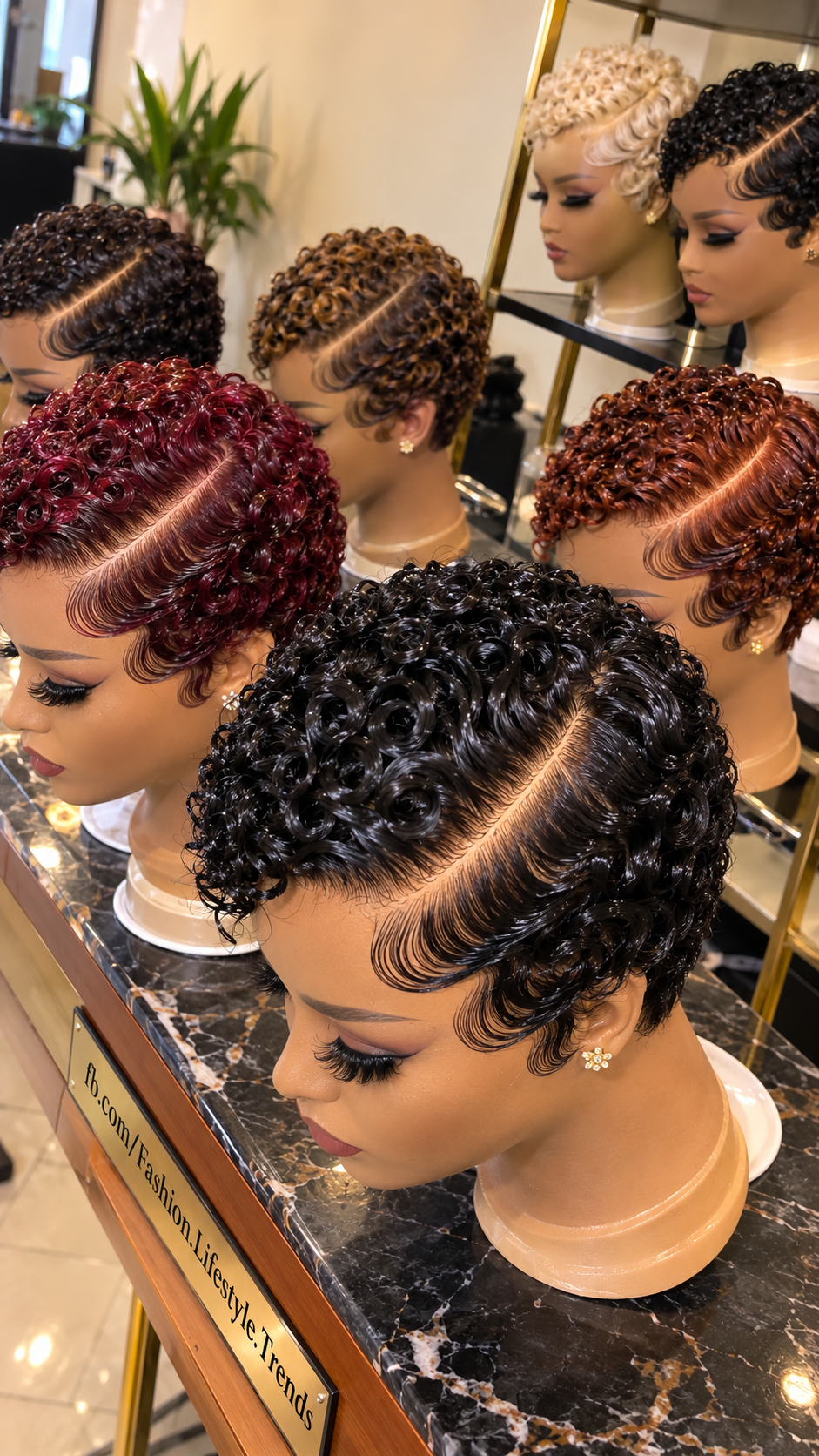
This salon display shows why a finger-coil wig should be chosen by construction rather than color alone. The collection includes glossy black, deep burgundy, warm copper, bronze-brown and pale blonde variations, but the real differences appear in the way each crown is mapped. Some units concentrate circular coils across the upper surface, others combine those rings with long diagonal partings, and several use sweeping finger-wave sections around the forehead and temple. Seen together, the wigs function almost like a visual customization menu for customers deciding which details they want combined in one finished unit.
The foreground black wig provides the clearest construction reference. Its crown contains numerous glossy circular coils with open centers, while a pronounced diagonal part travels from the upper crown toward the forehead. On the opposite side of that division, the hair changes completely: instead of circular rings, long parallel arcs sweep across the front and toward the temple. Smaller curls then complete the transition near the side. The surrounding burgundy, copper and bronze units demonstrate how the same broad styling family can take on a different personality through color and curl distribution.
Because all of the wigs are already positioned on mannequin heads, the photograph does not reveal enough of their underside construction to verify a particular lace type, cap system or attachment method. The visible scalp-like parting should not automatically be interpreted as proof of HD lace. Customers interested in a specific mannequin should ask the seller to photograph that exact unit off the display head and confirm its construction separately.
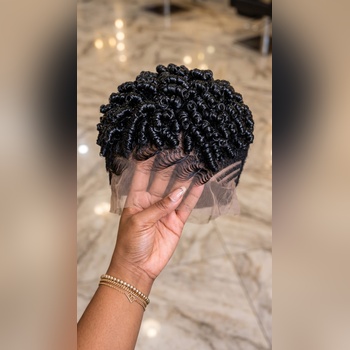
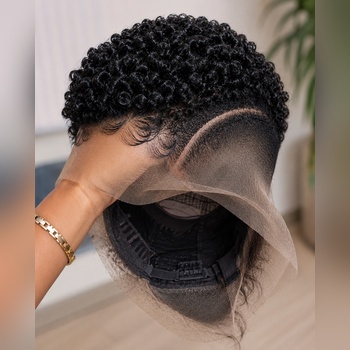
The Foreground Black Wig Uses Contrast Between Rings and Long Arcs
The most striking element of the foreground unit is the change in curl language across the parting. The upper crown is dominated by circular formations. Many have clearly visible centers, giving them the appearance of individually rolled rings. They sit close enough together to create density without completely closing the spaces between neighboring sections.
Along the diagonal division, the construction becomes more elongated. Fine strands travel in closely spaced parallel arcs, producing a broad sweeping section rather than another cluster of circles. This gives the front an entirely different direction from the crown.
The combination is important. A recreation using ring coils everywhere would lose the dramatic face-framing movement. Likewise, replacing the circular crown with ordinary waves would remove the strongest contrast in the design.
The Diagonal Part Acts as a Boundary Between Two Styling Zones
The visible part is more than a narrow decorative separation. It organizes the entire wig. On one side sits the dense ring-curl field; on the other, the strands are stretched into longer curved movements.
The angle of that part therefore influences how much crown hair appears on either side. Moving it toward the center would change the distribution significantly, while placing it farther to the side would create a larger uninterrupted coil field.
For custom ordering, the diagonal route should be approved before the finer front styling is completed. An elevated photograph is particularly useful because it shows the entire path rather than only the section visible from a frontal angle.
Mixed Coil Diameters Keep the Black Crown From Looking Mechanical
The black rings are not identical copies. Larger circles occupy several prominent crown positions, while smaller formations fill the spaces between them and help the pattern adapt to the rounded head shape.
This variation gives the crown a hand-arranged quality. Using one identical diameter everywhere could create a repetitive surface, especially with highly reflective black hair. The combination of several sizes produces more natural visual rhythm.
Customers requesting this crown should therefore provide an overhead reference rather than asking only for finger coils. That phrase describes the general family but does not communicate the exact scale and distribution shown here.
Glossy Black Lets Light Outline Every Circular Formation
The foreground unit remains within a deep black color family, yet it contains substantial visual variation because of reflected light. Raised coil surfaces catch bright highlights, while the centers and recessed spaces remain almost completely black.
This gives the crown dimensional contrast without needing a second hair color. The effect depends on clean separation between strands and coils, so excessive styling product can actually work against the design.
Heavy oils or waxes may cause neighboring sections to stick together and close the circular openings. Maintenance should focus on preserving the existing ring structure rather than creating maximum artificial shine.
Burgundy Turns Each Ring Into a Multi-Tonal Section
The large burgundy wig in the foreground demonstrates how color changes the same broad styling vocabulary. Deep areas appear wine-red, while raised loops catch brighter cherry and ruby reflections. The color variation occurs naturally across the curved surfaces.
A strong diagonal part is also visible, with elongated red strands following the exposed route toward the forehead. This allows customers to compare how similar directional styling behaves in black and burgundy.
Burgundy should be approved under more than one lighting condition when possible. Warm salon lights can intensify red, while daylight may reveal a considerably deeper wine or plum base. The actual unit should be photographed in neutral light before a custom color order is finalized.
Copper Creates a Brighter Interpretation of the Sculpted Crown
The copper wig toward the right side of the display brings substantially more warmth into the collection. Its raised sections reflect bright auburn and copper tones, while darker root areas remain visible underneath.
This contrast makes the curl direction particularly easy to follow. Long front sweeps become clearly separated from the smaller curled pieces around the crown and side.
A customer requesting this color should avoid depending solely on terms such as copper, cinnamon or auburn. These names can describe noticeably different shades between suppliers. Sending the reference photograph and asking for an image of the available color is more reliable.
Bronze Brown Provides Warmth With Greater Root Depth
The bronze-brown unit farther back offers a deeper warm alternative. It contains golden and caramel reflections but preserves enough dark brown within the roots and recessed areas to maintain strong shadow.
This can suit customers who like the visibility of copper but prefer a less vivid result. The ring curls remain easy to distinguish because their outer surfaces reflect warm light while the interiors stay darker.
When combining this color with another mannequin’s crown construction, make the request explicit. The seller should understand that the buyer wants a particular shade and a separately selected coil map rather than simply whichever construction normally comes in bronze.
Pale Blonde Makes Strand Direction Impossible to Hide
The blonde wig visible in the upper background changes the balance completely. Because the hair is very light, individual curves are visible with less dependence on shadow. Circular sections, perimeter waves and transitions can all be inspected easily.
This can make precision especially important. Small placement differences that disappear into black hair may be much more noticeable in pale blonde.
The material should also be confirmed before maintenance decisions are made. If the unit is human hair, ask about its processing history and recommended heat range. If it is synthetic, obtain the fiber specifications before using hot tools. The photograph itself cannot establish either material.
Face-Framing Waves Should Be Selected Separately From Crown Color
One of the most useful lessons from this display is that customers do not need to think of every mannequin as an indivisible package. The long sweeping front waves of the black wig could serve as one reference, while the burgundy or bronze color serves as another.
A custom consultation can therefore separate the request into crown pattern, parting direction, front-wave arrangement and color. The stylist can then explain which combinations are practical.
This process is more precise than asking for “the burgundy version of the black wig” because it identifies exactly which construction details need to remain unchanged.
The Temple Area Completes the Transition From Crown to Face
The foreground black wig shows smaller curved pieces near the temple after the long front waves have completed their sweep. These shorter sections prevent the elongated arcs from ending abruptly.
The scale therefore changes in stages: circular crown coils, broad parallel forehead arcs and smaller temple curls. That progression is a major part of the face-framing effect.
Repeated trimming can gradually remove the length needed for these shapes. During maintenance, displaced strands should first be repositioned rather than automatically shortened.
Choose the Crown Map Before Choosing the Final Shade
For buyers who are undecided, a useful shopping sequence begins by temporarily ignoring color. Compare the crowns first. Look at ring diameter, density, parting angle and the amount of front-wave work.
Once the preferred construction is identified, ask whether it can be ordered in black, burgundy, copper, bronze or blonde. This prevents a customer from selecting a color they love only to discover later that its standard construction is not the one they wanted.
Ready-made stock may offer fewer combinations than a custom maker, so the seller should clarify which options require additional production.
Ask for Individual Photos After Selecting a Mannequin
A group display is ideal for comparison but not sufficient for final inspection. Once a customer chooses a unit, the seller should photograph that wig individually from the front, both sides, above and behind.
The elevated photograph should show the full diagonal part and coil distribution. Side images should reveal the long forehead waves and temple work. A rear view can confirm whether the curl pattern continues consistently.
If lace or another premium construction is advertised, request a separate underside photograph of the actual wig. This is the appropriate way to evaluate cap and lace information that the mannequin display conceals.
Custom Ordering Works Better With a Component Checklist
A clear order can begin with the crown: large and medium circular coils arranged densely but with visible openings. Next comes the parting: a pronounced diagonal route rather than a center division.
The third component is the perimeter: long parallel finger-wave arcs moving toward the temple, followed by smaller curved side pieces. The fourth is color, selected independently from the construction.
After those visible elements are approved, the customer can discuss cap measurements, confirmed hair or fiber type, available lace options and whether the unit arrives fully styled.
This approach makes approval objective. Both customer and maker know which characteristics need to be checked instead of relying on a vague request for a similar wig.
Salon Booking Should Depend on Whether the Crown Is Already Finished
A ready-styled display wig may need only fitting and minor preservation work. If its ring crown and front arcs already match the desired design, a stylist should avoid dismantling them unnecessarily.
A basic foundation is a different project. Creating dozens of circular coils, establishing the diagonal part and arranging the long face-framing arcs can require substantial salon time.
Tell the salon what stage the wig is in before booking. This allows enough time to be reserved and helps determine whether one stylist can complete the work or whether a specialist is required.
Pricing Should Account for Hand Arrangement, Not Just Hair Length
The compact silhouette may use less hair than a long wig, but the styling can involve considerable labor. Each circular section must be arranged, the parting needs deliberate placement and the perimeter arcs require careful direction. Custom color adds another variable.
| Category | Estimated Price Range | Possible Scope of Work |
|---|---|---|
| Premium Custom | $320–$575+ | Higher-grade hair, individualized cap sizing, hand-mapped ring coils, custom color placement, directional parting and detailed face-framing work. |
| Standard Custom | $195–$340 | Prepared coil crown, selected color and planned front-wave construction with more standardized fitting options. |
| Basic Human Hair | $115–$210 | A human-hair foundation requiring additional professional coil setting, part creation and perimeter styling. |
| Premium Synthetic | $75–$150 | A quality pre-set option that may retain the circular crown and sweeping front sections with less frequent rebuilding. |
| Basic Synthetic | $35–$85 | A budget interpretation where coil variation, directional front work or cap construction may be simplified. |
These ranges are general planning references rather than verified prices for the exact wigs pictured. Hair source, fiber, color processing, seller location, cap construction, labor, shipping and installation can all change the final cost.
When comparing sellers, ask whether the crown arrives fully arranged. A lower-priced foundation that still requires several hours of professional coil work should not be compared directly with a completed custom unit.
Human Hair Makes Sense for Buyers Who Want Future Styling Freedom
A human-hair version can be useful when the wearer expects to refresh or modify the coil map professionally. Individual rings can potentially be reset, and the stylist has more freedom to adjust direction when the hair is suitable for the intended technique.
Color processing still matters. Burgundy, copper and blonde units may have undergone more chemical work than a dark black version, which can influence safe heat levels.
Ask the maker for care guidance specific to the actual unit rather than treating all human-hair wigs as though they have identical tolerance.
Premium Synthetic Can Be Effective for a Pre-Set Ring Crown
A well-made synthetic wig can appeal to customers who want the circular arrangement to remain largely unchanged. Pre-set fibers may hold their shape with less frequent salon reconstruction.
The tradeoff is reduced flexibility. Heat resistance varies, and major restyling may not be appropriate. Confirm the fiber before using any heated tool.
For a customer who wants to wear the design as shown rather than continually reinvent it, shape retention can be a meaningful advantage.
Photograph the Exact Coil Map Before the First Wash
An overhead photograph should record the position and diameter of the major rings. A side image should capture the diagonal part, long front arcs and temple curls.
During cleansing, avoid rubbing the crown as one mass. This can combine neighboring coils and close their circular openings. Use products appropriate for the confirmed hair or fiber.
After drying, repair only the sections that have shifted. Preserving most of the original map is safer than rebuilding the entire wig after every wash.
Keep the Circular Openings Free From Heavy Product
The glossy appearance of these wigs can encourage excessive use of oils and holding products. Too much product can collect inside the rings and cause adjacent strands to adhere together.
Use a light hand. When the hair begins looking dull because of buildup, appropriate cleansing may restore its reflective quality more effectively than adding another layer of shine.
This is particularly important on black hair, where the contrast between bright reflections and deep ring centers creates much of the dimensional appearance.
Protect the Long Front Arcs From Repeated Cutting
The elongated sections around the forehead depend on having enough strand length to complete their sweeping curves. Repeated trimming can gradually shorten them until they no longer resemble the original design.
If one arc moves out of position, reset its direction first. Use the original photograph as a guide. Cutting should be reserved for genuine damage or imbalance rather than becoming routine maintenance.
The smaller temple curls should be treated with the same restraint because their job is to complete the transition rather than become progressively shorter with every appointment.
Color Refresh Should Respect the Original Crown Map
For human-hair burgundy, copper or bronze units, future color work should take the curl arrangement into account. Raised surfaces and recessed sections may fade differently depending on wear and processing.
A professional colorist can evaluate whether the entire unit needs attention or whether selected areas can be refreshed. Applying one flat formula without considering the crown may reduce some of the tonal depth visible in the original.
Pale blonde units should be assessed particularly carefully before additional chemical processing, while synthetic colors should only be altered using methods appropriate for the confirmed fiber.
Store Each Wig as an Individual Sculpted Object
A ring-coil crown needs physical space. Store the wig on an appropriate stand or mannequin head rather than stacking it beneath other hairpieces. Compression can close the circular openings and flatten the front-wave arrangement.
The unit should be fully dry before storage. Pale hair should also be kept away from surfaces that could transfer pigment.
For transport, use a container with enough depth to avoid pressing on the crown. Protecting the original shape can save substantial professional maintenance later.
The Best Custom Order Combines the Right Construction With the Right Color
This collection demonstrates that black, burgundy, copper, bronze and blonde are only the outer layer of the decision. The real personality comes from the crown map, coil diameter, diagonal part and sweeping front direction. Color then changes how strongly those structural details are revealed.
For buyers, the most reliable approach is to identify the preferred construction first and treat color as a separate choice. Request photographs of the exact unit, verify any lace or cap claims independently and confirm which styling work is included in the quoted price.
For wig businesses, displaying several related units together can become a powerful customization tool when each option is documented accurately. Customers can point to the crown they want, select another color if available and understand exactly which elements are being combined. That makes the gallery useful not only as inspiration but as a practical bridge between salon consultation and a clearly specified wig order.
Search Terms
black ring coil crown wig · burgundy diagonal part wig · copper finger coil wig · bronze brown ring curl wig · blonde sculpted coil wig · sweeping forehead finger waves · mixed size circular coil wig · salon finger coil wig collection