
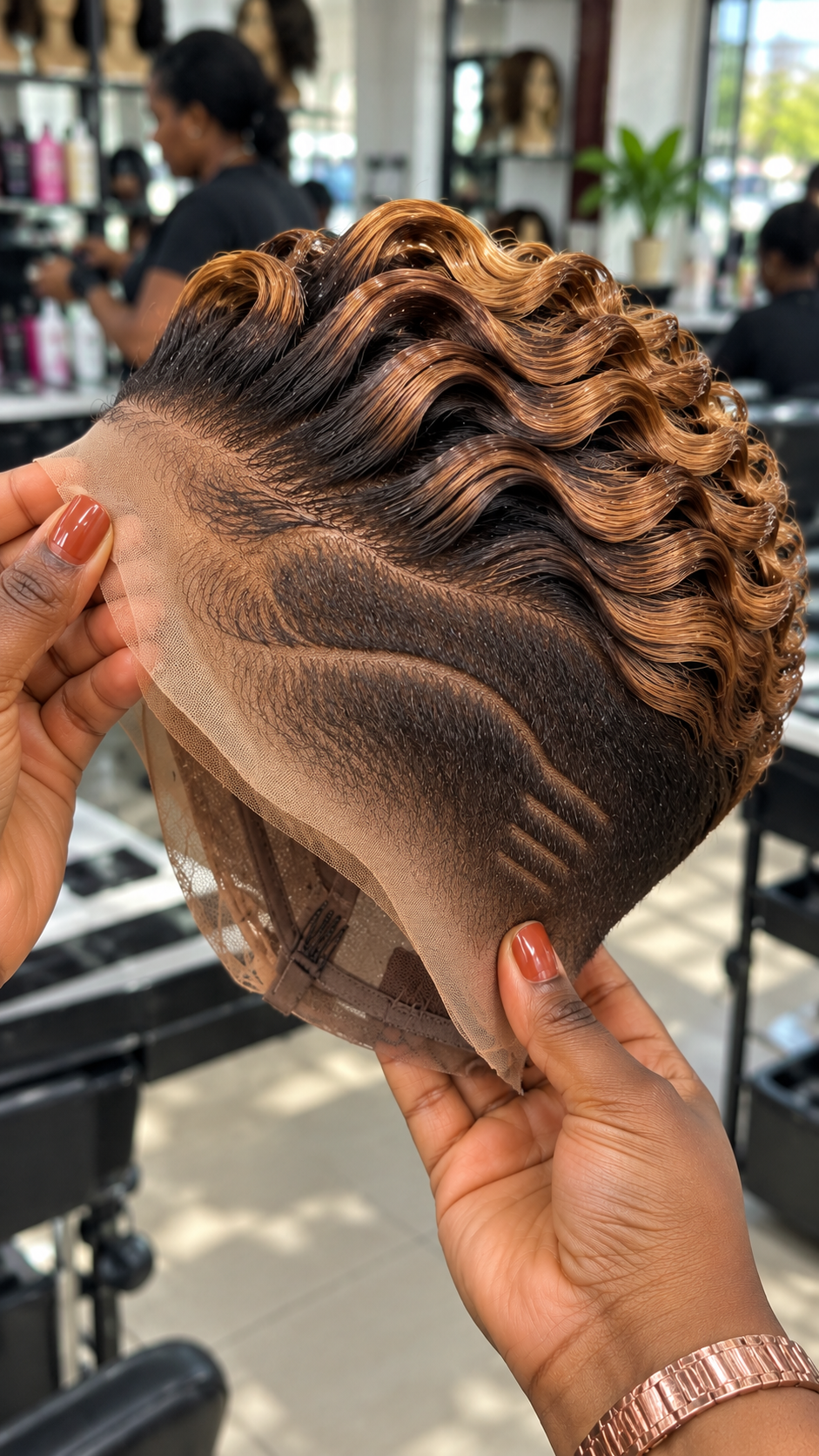
A short hairstyle can make a powerful fashion statement when beautiful color, graceful movement, and precise styling come together. This stunning honey-bronze pixie wig captures that combination through its flowing S-shaped crown waves, rich dark foundation, and intricately arranged side details. The warm highlights create a luminous appearance, while the carefully sculpted lower section introduces an elegant contrast that makes the entire hairstyle stand out.
The photograph presents a short lace wig being held by two hands inside a professional beauty salon. Across the upper portion, broad waves rise gently from dark roots before flowing backward in smooth, overlapping curves. Their golden-bronze surfaces catch the light, creating warm reflections that emphasize the direction and shape of each section. Beneath the crown, the hair becomes shorter-looking and more closely fitted, with graceful curved separations running toward the lower side.
What makes this hairstyle particularly distinctive is the balance between its elevated upper waves and closely arranged lower hair. The crown contains generous movement and volume, but the sides remain sleek enough to preserve the compact proportions of a pixie cut. The decorative side pattern adds personality without competing with the highlighted crown.


Unlike hairstyles built around tightly rolled circular curls, this design features elongated waves that follow a flowing direction. The strands form connected ridges rather than individual ringlets. This gives the crown a sculpted appearance that feels graceful, organized, and full of movement.
The contrast between the warm honey-bronze highlights and the dark brown foundation also plays an essential role. The lighter shades emphasize the upper curves, while the darker strands add depth near the roots, sides, and lower portions of the wig.
For women who appreciate short wigs with distinctive styling, this hairstyle offers an attractive combination of reflective color, flowing crown movement, and beautifully arranged side accents.
The Beauty of Flowing Honey-Bronze Waves
The most striking element of the hairstyle is its collection of broad waves across the crown. These formations rise above the darker foundation and travel backward in a coordinated arrangement.
Rather than creating numerous separated curls, the stylist has arranged the strands into continuous flowing sections. Each wave bends gently before transitioning into the next, producing an attractive sequence of raised curves.
The warm honey-bronze color follows the upper surfaces of these waves. As the strands catch the surrounding light, their golden-brown reflections become particularly noticeable.
Some areas appear lighter and more golden, while others retain a deeper bronze appearance. This variation gives the hairstyle dimension without introducing an excessive number of contrasting colors.
The waves are also different in height. Larger formations appear prominently across the upper crown, while smaller curves gradually blend toward the rear.
This creates a balanced silhouette that provides noticeable fullness without requiring long hair.
Women seeking a similar hairstyle should pay particular attention to the width and direction of the waves. Broad, flowing formations are essential to the appearance of this design.
Why the S-Shaped Crown Creates Such an Elegant Look
The crown features a series of smooth S-shaped formations that move across the upper head. Each section rises from the darker roots before bending into a broad curve.
The individual waves overlap slightly, giving the impression of continuous movement from the front toward the back.
This directional styling creates a very different appearance from ordinary pixie hairstyles with loose curls or small spiral coils.
Instead of allowing the strands to fall randomly, the waves follow an organized arrangement that emphasizes the shape of the crown.
The result is a hairstyle that appears carefully styled from every visible section.
The raised waves also create natural-looking height. Their volume comes from the curved arrangement of the strands rather than from excessive teasing or unrestricted fullness.
For a close reproduction, the stylist should preserve the smooth transitions between neighboring waves.
If the sections are made too narrow, the hairstyle may begin to resemble small finger coils. If they become excessively wide, the crown may lose the layered movement that gives the design its character.
The Warm Color Combination Makes the Waves Shine
The upper hair contains a beautiful mixture of honey, caramel, golden brown, and bronze reflections. These warm shades complement the flowing shape of the crown.
Near the roots, the hair appears significantly darker, creating a strong foundation for the lighter upper sections.
The color distribution is not completely uniform. Brighter highlights follow the raised curves, while darker strands remain visible beneath them.
This placement helps separate the individual waves and makes their direction easier to recognize.
The hairstyle therefore achieves depth through both color and shape.
Under bright salon lighting, the golden strands reflect light more prominently than the surrounding dark hair. In softer lighting, the color may appear more subdued and closer to warm brown.
Customers should request photographs taken under natural daylight when selecting a comparable hair color.
The photograph does not establish the exact commercial color formula or whether the lighter strands were created through dyeing or blended pre-colored fibers.
Dark Roots Give the Pixie a Beautiful Foundation
The darker roots are an important part of the hairstyle’s overall appearance. They create contrast beneath the warm upper waves and visually connect the crown with the closely arranged sides.
The front roots appear deep brown to nearly black, while the highlighted hair becomes more noticeable as the waves rise.
This gradual contrast produces a dimensional look that differs from a uniformly honey-blonde wig.
The dark foundation also emphasizes the glossy surface of the highlighted strands.
Because the roots remain darker, the warm color appears concentrated mainly through the elevated sections.
This distribution is particularly attractive on a short pixie because it creates visual movement without relying on long layers.
Women interested in reproducing this color arrangement should explain that the roots and lower sides should remain noticeably darker than the crown.
Choosing a completely light blonde or uniformly golden unit would change the appearance considerably.
Artistic Side Sweeps Give the Hairstyle Its Character
Beneath the highlighted crown, the lower side contains an elegant arrangement of curved separations. The most prominent line sweeps across the dark hair before bending downward toward the lower front section.
Additional narrower channels follow a similar direction, creating a layered decorative pattern.
These separations are particularly interesting because they echo the flowing movement of the upper waves.
The crown curves backward through raised sections, while the lower decorative lines sweep downward through closely arranged hair.
This relationship makes the entire hairstyle feel coordinated.
The exposed channels appear lighter than the surrounding dark strands, allowing their curved paths to stand out.
The design is not based on straight geometric lines. Instead, it emphasizes graceful movement and gradually narrowing curves.
Because the hairstyle is displayed on a wig, the photograph does not establish whether these lines were created through sectioning, styling, or another construction technique. They should not automatically be described as cuts shaved into someone’s natural scalp.
The Lower Side Creates a Beautiful Contrast
The hairstyle contains a noticeable difference between the elevated crown and the lower side.
Across the upper section, the hair rises into generous waves with warm highlights. Beneath these formations, the strands lie close to the cap and follow the contour of the wig.
This difference in height makes the crown appear fuller without creating excessive width around the lower head.
The dark side also provides a clear background for the decorative curved channels.
Near the front, fine strands follow a sweeping direction toward the lace foundation. Farther down, the hair becomes shorter-looking and more compact.
The visible lower section narrows into a tapered-looking silhouette, complementing the raised upper waves.
This balance is essential for maintaining the hairstyle’s pixie proportions.
If the lower side were filled with the same volume as the crown, the overall result would appear considerably rounder and less sculpted.
The Sweeping Curves Work Together Beautifully
One of the most attractive characteristics of this design is the relationship between the upper and lower curves.
The highlighted crown waves rise and bend backward, while the darker decorative sections flow across the side in graceful arcs.
Although these elements have different heights and directions, they share a similar sense of movement.
This makes the hairstyle visually connected rather than divided into unrelated parts.
The broader upper formations create the main attraction, while the lower channels introduce a second layer of detail.
The result is an artistic pixie that looks carefully planned.
When commissioning a similar style, customers should avoid requesting additional unrelated lines or geometric decorations unless they intentionally want a different result.
The existing curved arrangement already provides considerable character.
The Front Hairline Has a Delicate Finish
The front hairline features fine strands arranged along the beige lace foundation. These strands gradually transition into the darker roots beneath the highlighted crown.
The hair near the forehead appears closely directed rather than heavily curled.
This creates a smooth connection between the skin-facing perimeter and the raised upper waves.
The fine front strands also complement the closely arranged lower side.
Unlike hairstyles featuring elaborate baby hair loops across the entire forehead, this design relies on a relatively restrained front arrangement.
The primary decorative details remain the elevated crown waves and sweeping side channels.
For women ordering a comparable wig, the hairline should be positioned carefully so that the front strands follow the intended direction.
Additional decorative baby hairs are not necessary to reproduce the reference accurately.
The Compact Shape Makes This a Distinctive Pixie
Although the upper hair contains raised waves, the hairstyle remains short and closely shaped.
The crown has noticeable height, while the lower sections narrow toward the cap.
This creates a compact silhouette that distinguishes the hairstyle from longer wave wigs.
The upper waves gradually become smaller toward the visible rearward section, allowing the hairstyle to follow the rounded shape of the head.
The photograph does not reveal the complete back or nape, so the exact finished length of those areas cannot be confirmed.
Customers seeking a close reproduction should request additional photographs showing the rear and opposite side.
These views can help establish whether the finished wig maintains consistent proportions throughout the entire hairstyle.
The important objective is preserving the contrast between the raised crown and the shorter-looking sides.
Understanding the Visible Lace Front
The photograph shows a broad beige lace area extending beyond the front and side hairline.
This indicates that the wig is being displayed before its lace perimeter has been fully prepared for installation.
Fine strands are visible near the lace foundation, while part of the interior cap can also be seen beneath the styled hair.
These details provide useful information about the unit’s construction, but they do not establish every specification.
In particular, the exact lace grade cannot be reliably identified from the photograph.
It would be inaccurate to classify the unit specifically as HD lace without confirmation from the manufacturer.
Customers should request written information about the lace type, cap construction, available adjustment components, and recommended installation method.
These details influence comfort and the final position of the hairstyle.
Choosing the Correct Wig Cap Size
Accurate measurements are important for any wig, but they become especially relevant when the hairstyle contains distinctive decorative details.
The curved side channels should sit in their intended position after installation.
If the cap is too large, the unit may shift during wear, changing the apparent placement of the side design.
If the cap is too small, it may create unnecessary pressure or fail to sit correctly along the hairline.
Common measurements include head circumference, front-to-nape distance, and ear-to-ear width.
Some wig makers may request additional measurements around the temples.
Customers should follow the measuring instructions supplied by their chosen seller because sizing standards may differ.
A suitable fit should provide comfort while maintaining the intended position of the crown and decorative sides.
Closure, Frontal, and Glueless Installation Options
Different wig constructions provide different amounts of lace coverage and fitting flexibility.
A closure typically covers a more limited lace area, while a frontal may extend farther across the front and temples.
For a hairstyle with carefully arranged side details, the position of the lace can influence how the final wig sits.
However, the photograph does not establish whether this particular unit uses a closure, frontal, or another construction.
Customers should confirm the specifications before choosing an installation method.
Glueless wear may be possible with an appropriately constructed and fitted cap, but the presence of lace alone does not guarantee adhesive-free suitability.
A professional wig stylist can help determine whether additional adjustments are necessary.
The final installation should preserve the direction of the highlighted waves and the position of the curved lower design.
How to Find a Stylist for This Hairstyle
Creating flowing elevated waves requires experience with directional styling and sculpted short hairstyles.
A suitable stylist should understand how to arrange strands into broad, connected ridges while maintaining a compact lower silhouette.
When examining professional portfolios, look for examples of sculpted pixies, raised finger-wave styles, and carefully designed temple sections.
Pay attention to the alignment of individual strands within each wave.
Uneven sections can disrupt the smooth flowing appearance.
It is also useful to examine photographs taken from several angles to determine whether the stylist maintains consistent crown height and side proportions.
During consultation, explain that the upper hair should contain warm honey-bronze highlights while the roots and lower sections remain darker.
The curved side separations should be reproduced accurately rather than replaced with unrelated decorative designs.
Where To Buy This Wig
Women interested in a similar hairstyle can begin with independent wig makers, professional hair salons, specialist beauty boutiques, and online retailers offering custom short wigs.
Useful descriptions include honey-bronze sculpted pixie wigs, highlighted S-wave lace wigs, and short directional wave hairstyles with curved temple details.
However, ordinary ready-made wigs may differ considerably from the photograph.
Some feature small spiral curls rather than broad waves. Others have uniformly colored hair without the darker roots and sides.
Customers should examine actual product photographs rather than relying entirely on product titles.
A custom wig maker may be the more suitable option when the raised crown waves and curved lower design are essential.
Before ordering, request photographs of previous work showing comparable styling.
No verified manufacturer, current inventory listing, or confirmed retail price can be established from the photograph alone.
How to Place a Custom Wig Order
Begin by sharing the reference photograph with a professional who accepts personalized wig orders.
Explain that the crown should contain broad flowing S-shaped waves rather than individual circular ringlets.
Specify the warm honey-bronze highlights and deeper brown or black-brown roots.
The lower side should remain closely arranged, with curved decorative separations that follow the reference.
Discuss the desired crown height and compact finished silhouette.
Ask whether the proposed hair material can support the required wave structure.
Before making a deposit, confirm the cap size, lace specifications, fiber composition, total price, production arrangements, and revision policy.
For online orders, request photographs of the finished wig from multiple angles before shipment whenever possible.
Choosing Between Ready-Made and Custom Wigs
A ready-made highlighted pixie may provide a convenient option for customers who appreciate the general color and short shape.
However, ready-made products may not reproduce the exact wave arrangement or decorative side pattern.
Some contain ordinary curls, while others feature flat waves that do not rise above the crown in the same way.
A custom wig allows greater control over color placement, wave height, side design, and cap measurements.
The maker can also adjust the finished proportions to suit the customer’s preferences.
Custom work may require more labor and a higher initial cost.
Before purchasing an unstyled base unit, customers should confirm that its length, density, and material are appropriate for the planned styling.
Not every wig fiber can tolerate the techniques required to create elevated waves.
Choosing the Right Hair Density
Density influences the fullness of the crown and the visibility of the individual wave formations.
The pictured hairstyle has considerable upper volume, but the broad waves remain distinguishable.
Excessive density could make the crown appear crowded and reduce the separation between neighboring curves.
Insufficient density might create unwanted gaps and make the raised sections appear less substantial.
Some suppliers advertise density options such as 130%, 150%, and 180%, but the photograph does not establish the actual density of this unit.
The appropriate choice depends on the starting length, styling method, and desired finished silhouette.
A professional wig maker should recommend a suitable density after reviewing the reference.
Customers should prioritize the appearance of the completed waves rather than selecting a density percentage without considering the styling requirements.
Understanding Hair Length for Elevated Waves
The finished hairstyle appears short, but the individual strands may be longer than their visible arrangement suggests.
Hair formed into raised waves occupies less apparent length than the same strands when fully extended.
The upper sections require enough hair to rise from the roots and bend backward into broad curves.
If the strands are too short, the stylist may struggle to create the desired wave height.
If they are excessively long, additional shaping may be necessary to preserve the compact pixie silhouette.
The photograph does not provide a reliable measurement of the original strand length.
Customers should therefore discuss finished crown height and side proportions with the stylist rather than relying exclusively on advertised inch measurements.
Human Hair and Synthetic Fiber Considerations
Different wig materials respond differently to styling, washing, and heat.
Human hair may offer greater flexibility for reshaping, depending on its processing and condition.
Some synthetic fibers can maintain pre-set wave patterns effectively, although their heat tolerance varies considerably.
The photograph does not establish whether the displayed wig contains human hair, synthetic fiber, or a blend.
The glossy finish alone cannot confirm its composition.
Customers should request accurate material specifications from the seller.
Before attempting to change the waves or color, confirm that the fiber is compatible with the intended treatment.
The selected material should support the elevated crown arrangement and the closely styled lower side.
Estimated Prices for Honey-Bronze Wave Pixie Wigs
The price of a comparable wig depends on several factors, including hair material, cap construction, density, color preparation, wave styling, and the complexity of the curved side design.
The following USD amounts are illustrative budget-planning estimates rather than verified live retail prices or quotations for the photographed unit.
| Price Tier | Estimated Price Range | Typical Features and Considerations |
|---|---|---|
| Budget | $30–$95 | Basic synthetic short wigs with warm highlights and simpler wave arrangements. |
| Value | $70–$190 | Pre-styled synthetic pixies with more elaborate directional waves and potentially improved cap construction. |
| Mid | $120–$310 | Human hair or specialty base wigs that may require additional coloring and professional wave styling. |
| Premium | $210–$495 | Custom honey-bronze wave placement, dark sculpted sides, curved decorative channels, and personalized fitting. |
| Salon-Grade | $400–$975+ | Individual cap construction, intricate elevated wave styling, carefully coordinated color placement, and extensive finishing. |
These categories represent possible purchasing options rather than verified specifications of the pictured wig.
Additional expenses may include shipping, installation, cap adjustments, lace preparation, custom coloring, and professional restyling.
Customers should request an itemized quotation before making a purchase.
Maintaining the Beautiful Raised Waves
The upper waves depend on preserving their direction, height, and aligned strands.
Repeated brushing or unnecessary manipulation may disturb the raised formations and reduce their sculpted appearance.
Customers should avoid pulling the waves apart simply to increase volume.
Ask the wig maker how the hairstyle was originally set and whether the waves can be refreshed safely at home.
If the wig contains human hair, the care routine should account for any previous coloring and setting techniques.
If synthetic fiber is used, follow the manufacturer’s instructions and verify heat compatibility before attempting to reshape the hair.
Professional restyling may be appropriate when the original wave pattern becomes difficult to restore.
Protecting the Warm Honey-Bronze Color
Highlighted hair may require special attention depending on its composition and coloring method.
If the wig contains chemically colored human hair, the seller should recommend suitable cleansing and conditioning products.
Some warm dyes may change with repeated washing or exposure to environmental conditions.
However, the photograph does not reveal whether the highlights were created through dyeing or blended pre-colored fibers.
Customers should confirm this information before selecting color treatments.
Conventional dye should not be applied to synthetic hair unless the manufacturer specifically confirms compatibility.
The goal is to preserve the golden-bronze reflections without disturbing the raised wave structure.
Keeping the Artistic Side Design Neat
The curved lower channels depend on neighboring strands remaining in their intended positions.
Repeated combing against the original direction may cause hair to shift across the exposed separations.
This could reduce the visibility of the decorative pattern.
Customers should handle the closely arranged side gently during installation, removal, and washing.
The stylist should explain how to refresh the lower hair without changing the curvature of the visible lines.
Permanent trimming or reshaping should be approached cautiously because it may alter the original silhouette.
Occasional professional maintenance may help preserve the side design when the hairstyle is worn frequently.
A Practical Care Schedule
The ideal maintenance routine depends on wearing frequency, hair material, styling products, and environmental conditions.
After each use, inspect the crown to ensure that the waves retain their intended height and direction.
Check the lower side for displaced strands that may conceal the curved separations.
Examine the lace perimeter and interior cap for visible wear or damage.
Washing frequency should follow the manufacturer’s material-specific instructions rather than a universal fixed interval.
During cleansing, avoid unnecessary friction that could disturb the sculpted upper sections.
After washing, dry and reshape the wig using suitable techniques for the selected fiber.
If the raised waves lose their original form, professional restoration may be preferable to repeated home manipulation.
Storing the Wig Without Damaging Its Shape
Proper storage can help preserve the elevated waves and compact pixie silhouette.
The crown should not be compressed beneath heavy objects or tightly folded materials.
A suitable wig stand or storage form may help maintain the rounded shape.
The wig should be completely dry before extended storage.
Care should also be taken around the lace, stitching, and attachment components.
Customers should follow the wig maker’s recommendations for protecting the original set.
Thoughtful storage may reduce the need for frequent professional restyling.
Styling This Pixie for Different Occasions
The warm honey-bronze color and flowing crown waves can complement a variety of personal fashion choices.
For formal events, the sculpted upper section provides decorative movement without requiring additional accessories.
For portrait photography, the raised waves create an attractive silhouette, while the curved temple design adds detail from the side.
For everyday wear, the compact shape may appeal to women who prefer shorter-looking hairstyles.
Gold jewelry can complement the warm highlights, while darker accessories may emphasize the contrast between the crown and roots.
Clothing in black, cream, brown, and other complementary shades can coordinate beautifully with the hairstyle.
The design remains expressive even without additional decorative elements.
Advantages of This Honey Wave Pixie
The hairstyle offers noticeable crown volume without requiring long hair.
Its broad S-shaped waves create flowing movement, while the golden-bronze highlights emphasize their direction.
The darker roots and lower sides provide depth and contrast.
The artistic side channels introduce decorative detail while maintaining the compact pixie silhouette.
The closely arranged lower hair also prevents the hairstyle from appearing excessively bulky.
Another advantage is the relationship between the upper and lower curves, which creates a coordinated appearance throughout the visible sections.
This hairstyle may appeal to women seeking a distinctive look for celebrations, fashion photography, social events, or personal everyday styling.
Potential Limitations Before Purchasing
Carefully arranged elevated waves may require more maintenance than ordinary loose curls.
Depending on the material, washing and repeated handling may disturb the original formations.
The decorative lower channels may also require attention to prevent neighboring strands from covering them.
Custom color placement and precision wave styling can increase the total cost compared with a basic ready-made pixie.
Some customers may prefer hairstyles that require less professional maintenance.
Before purchasing, consider cap comfort, intended wearing frequency, care requirements, and access to suitable restyling services.
These considerations can help determine whether a custom unit or a simpler ready-made alternative is more practical.
What to Check Before Final Installation
When the completed wig arrives, compare the crown arrangement with the approved reference photograph.
The upper hair should contain broad elevated S-shaped waves with warm honey-bronze highlights.
The roots and lower sides should remain significantly darker.
The curved decorative separations should follow the intended paths and remain clearly visible.
Inspect the front hairline to ensure that the fine strands are arranged in the correct direction.
Check the lace and interior cap for visible damage before trimming or installation.
Confirm that the cap fits comfortably and that the side design sits in the intended position.
If the wig was custom-made, significant differences should be discussed with the seller before permanent alterations.
The Lasting Beauty of Sculpted Honey Waves
This hairstyle demonstrates how flowing waves, warm highlights, and carefully arranged side details can transform a compact pixie into an elegant salon creation.
The raised honey-bronze crown provides movement and luminosity, while the darker roots introduce depth beneath the highlighted strands.
The sleek lower side creates a carefully balanced contrast that allows the upper waves to remain prominent.
The sweeping curved channels add an artistic finishing detail without overwhelming the hairstyle.
The visible beige lace also emphasizes the importance of accurate construction information and professional fitting before installation.
For women seeking a similar appearance, the essential priorities are the warm honey-bronze color, elevated S-shaped crown waves, dark compact sides, and precisely arranged decorative curves.
With suitable customization, comfortable fitting, and appropriate maintenance, this short wig can provide an attractive combination of flowing movement, radiant color, and beautiful pixie styling.
Search Terms
Honey bronze S wave pixie wig · Golden caramel sculpted crown waves · Dark root honey wave lace wig · Short highlighted pixie with artistic sides · Bronze swept crown hairstyle · Curved side part honey blonde pixie · Glossy caramel brown wave wig · Short lace pixie with sweeping temple lines