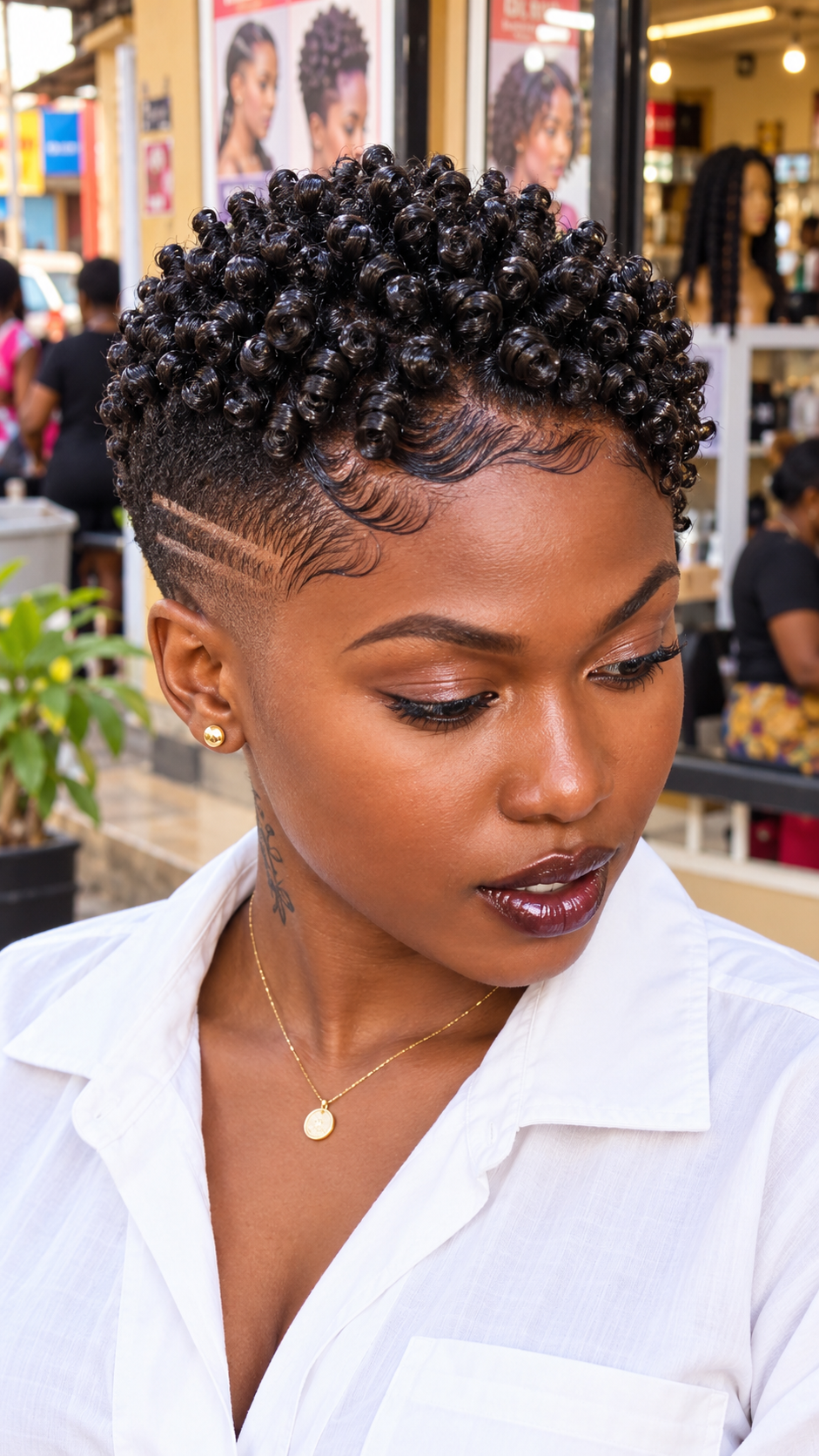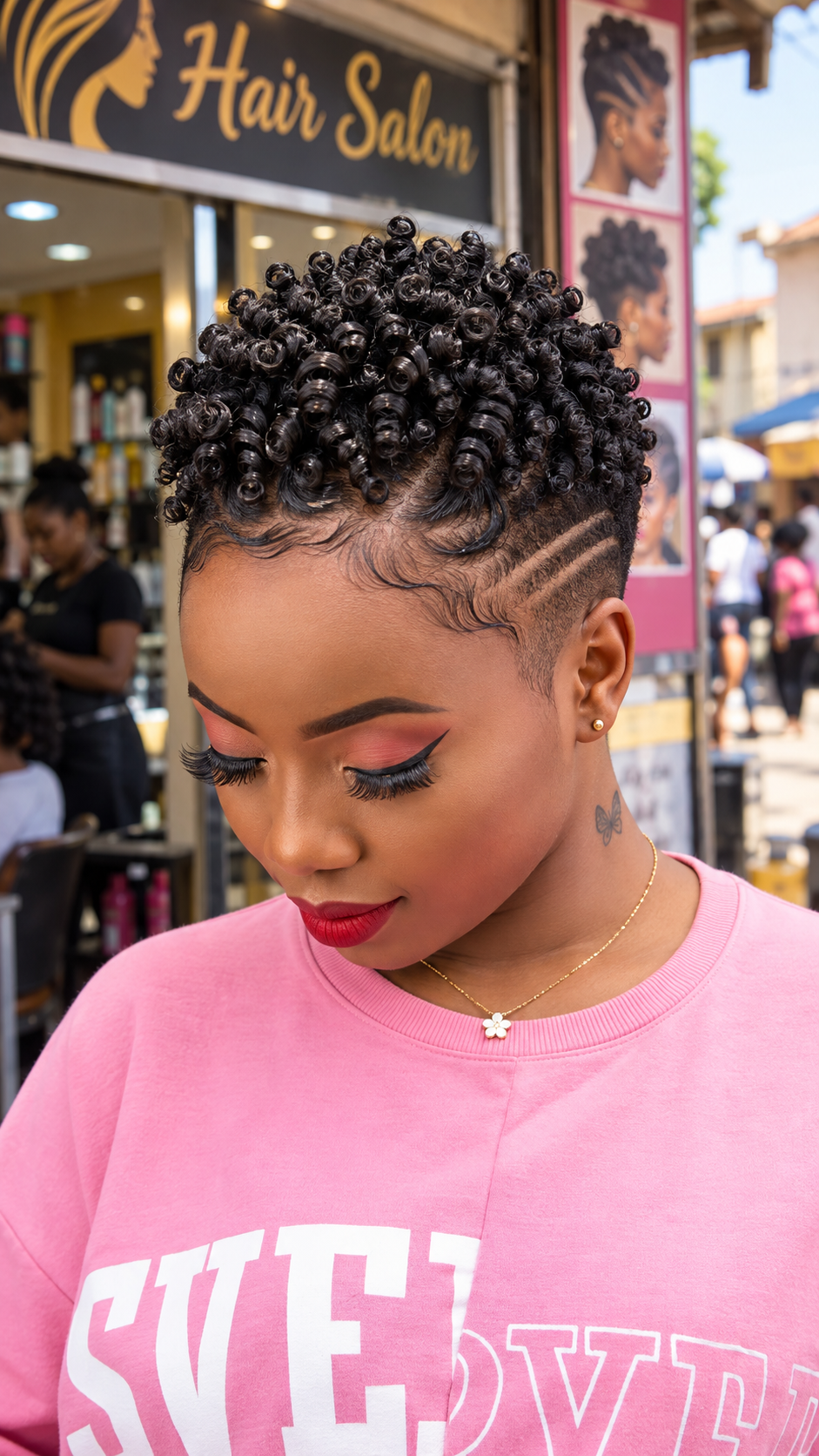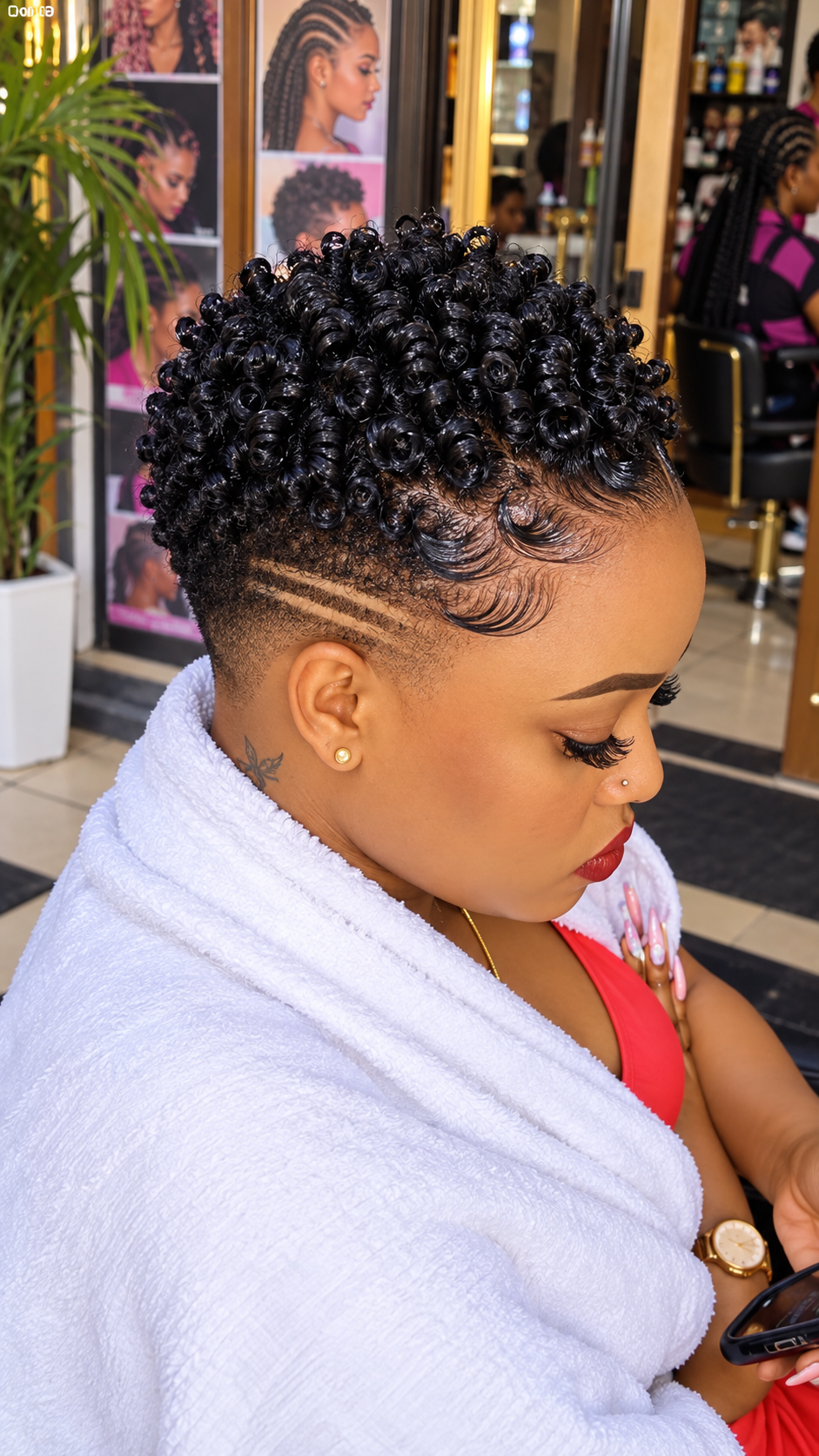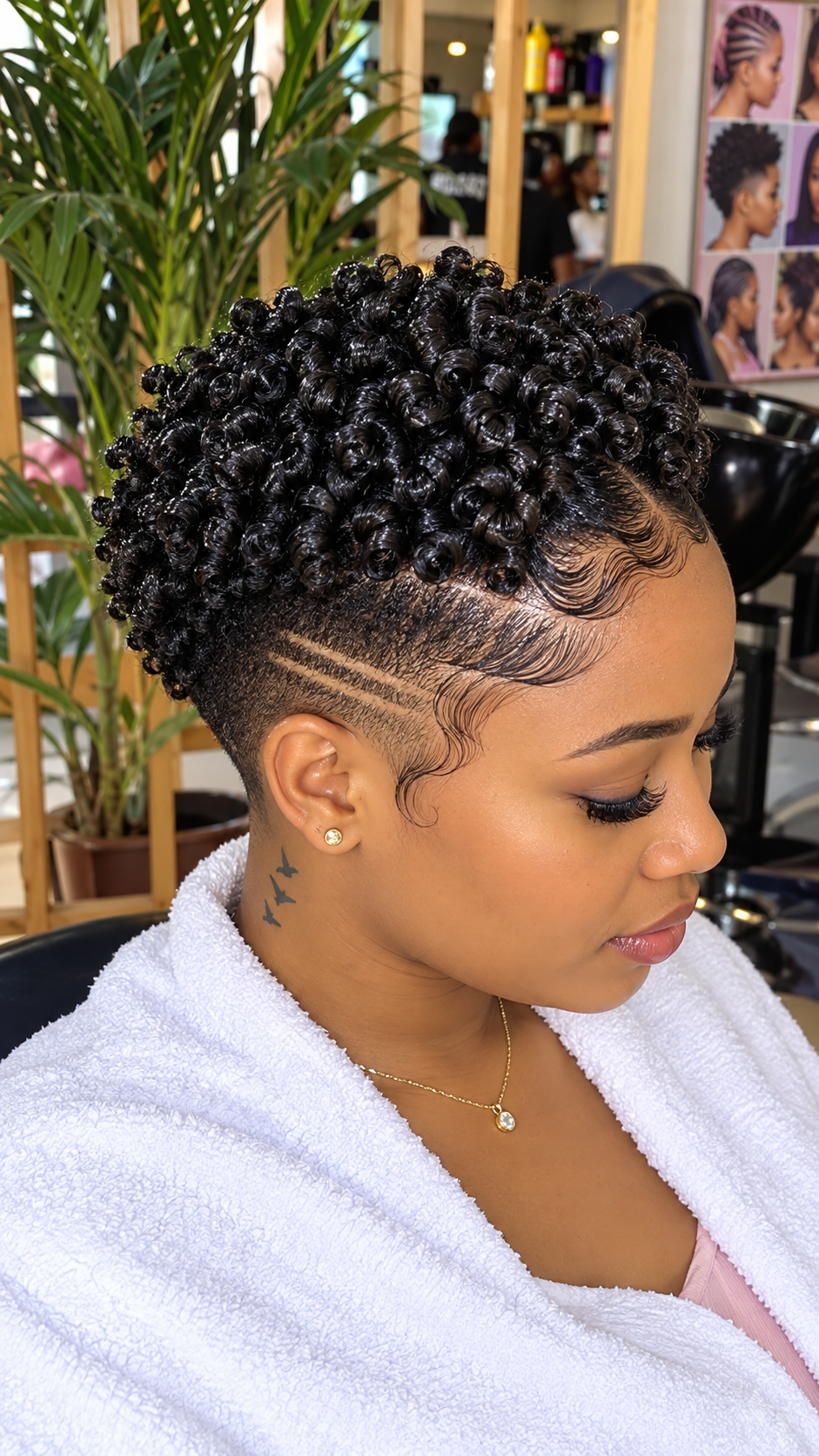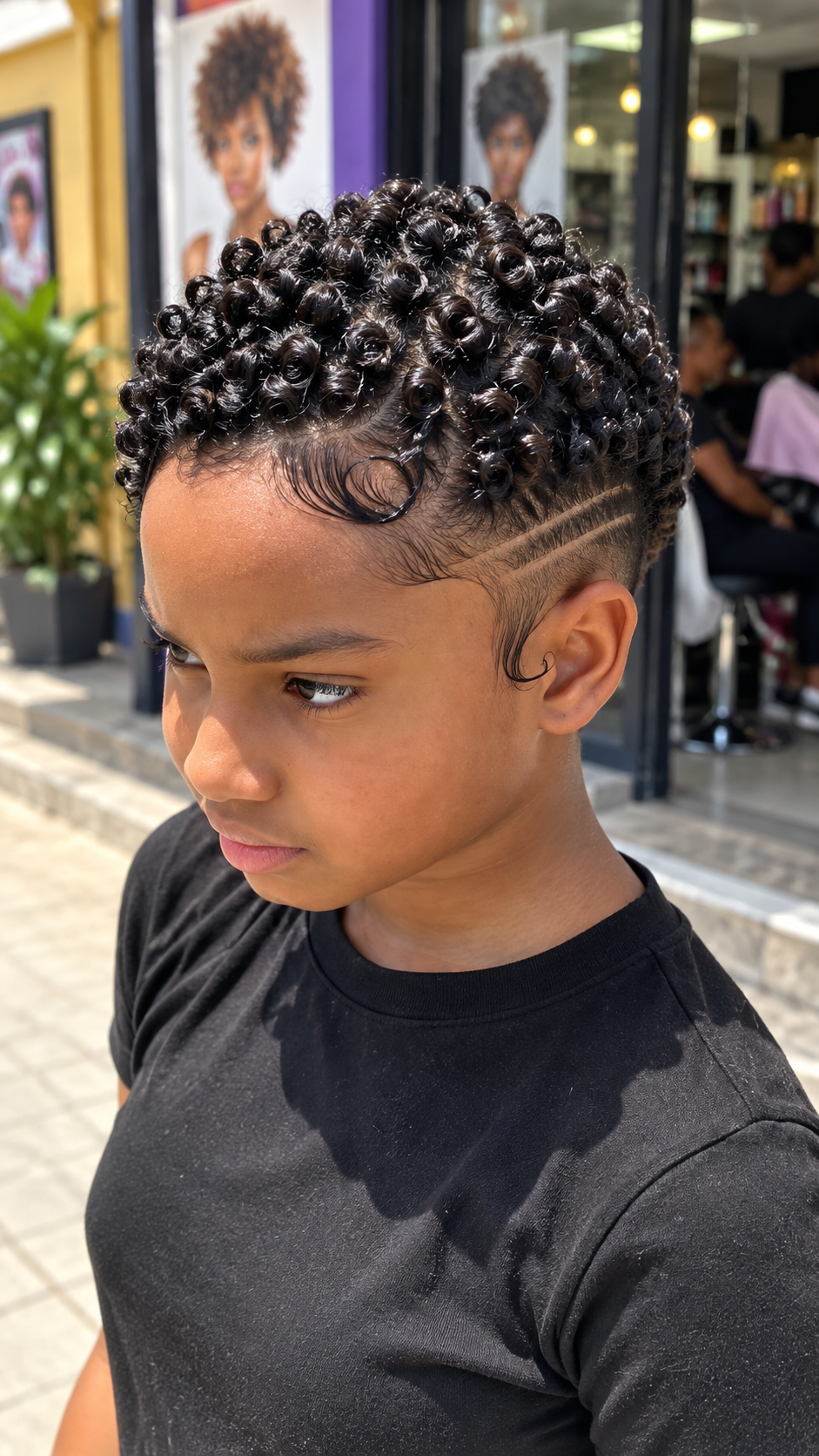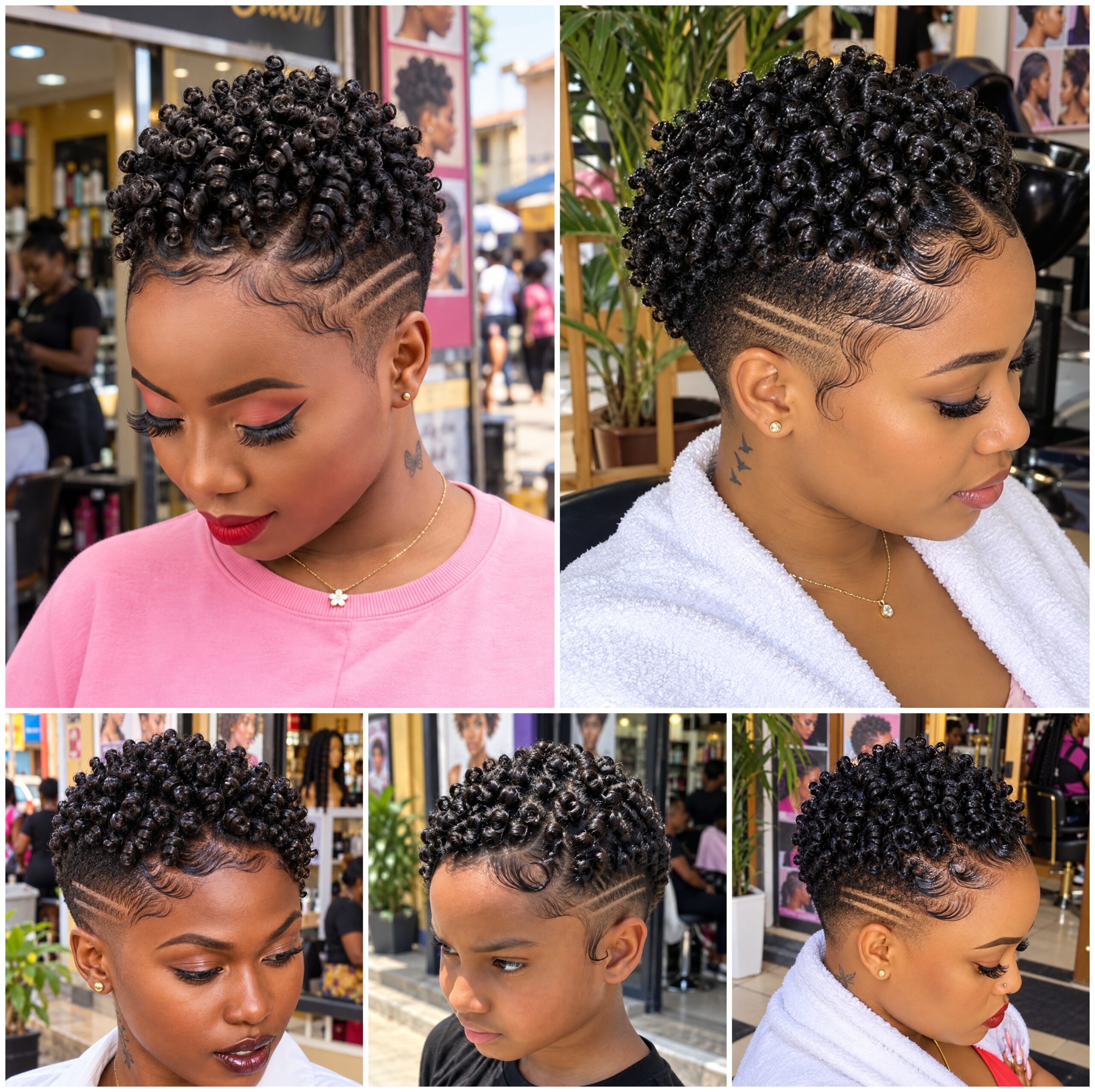
A radiant crown of individually sculpted finger coils, paired with gradually shortened sides and delicate shaved artwork, creates a hairstyle that brings together natural beauty and precision cutting. The reflective surface of the curls draws attention to their spiral formation, while etched detailing near the temple introduces a personalized finishing touch. This combination is especially attractive for women seeking glossy finger coil hairstyles, tapered Afro pixie cuts, and artistic side-shaved hair designs.
The hairstyle works through contrast rather than excessive length. A compact crown provides dimension and movement, while the shorter sides establish a neat silhouette that can be maintained with regular barber appointments. The etched accent adds visual interest without requiring an elaborate pattern, making the overall appearance suitable for both everyday wear and occasions when a more distinctive haircut is desired.
The Appeal of Reflective Finger Coil Styling
Finger coils have a recognizable spiral structure that becomes particularly noticeable when the hair is properly conditioned and individual sections are carefully arranged. Light reflects across the curved surfaces of the spirals, giving the crown a luminous appearance without requiring excessive styling products.


The most successful results begin with healthy-looking natural hair and a curl-forming technique suited to its density. Some women have naturally recognizable spirals, while others benefit from additional finger styling to encourage greater separation.
For tightly coiled hair, the finished crown should retain enough length for the curls to form without creating unnecessary bulk. The stylist can adjust the shape according to the desired profile, allowing slightly more height through the center or maintaining an evenly rounded silhouette.
The objective is a flexible, touchable curl finish with visible spiral separation, rather than a rigid surface created by excessive gel or heavy wax.
Planning the Crown Before the Taper Begins
The upper length should be evaluated before the sides are shortened. Natural shrinkage can significantly change the appearance of tightly curled hair, making it important to consider the dry curl height rather than relying only on stretched measurements.
A compact crown may benefit from carefully graduated layers that prevent excessive fullness around the outer edges. This allows the upper curls to sit comfortably above the tapered sides.
Women who prefer a softer profile can retain additional length toward the front. Those wanting a more uniform appearance may choose a rounded crown with similar curl height throughout.
The stylist should avoid removing too much hair before assessing how the coils settle after drying. Conservative cutting followed by gradual refinement provides greater control over the finished proportions.
Creating a Taper That Supports the Crown
The taper provides the structural foundation for the hairstyle. Hair length decreases gradually around the temples, ears, and neckline while remaining fuller toward the upper sides.
A low taper creates a subtle transition and preserves more natural density around the head. This approach works particularly well when the wearer wants the curls to remain the primary feature.
A closer taper produces stronger contrast and can make the etched side artwork more visible. However, it may also require more frequent maintenance as the hair grows.
The transition should appear balanced rather than abruptly disconnected. Careful blending allows the crown and shortened sections to form one cohesive silhouette.
At the back, the neckline can be softly graduated to follow the natural contour of the head. This helps the haircut maintain an attractive appearance from multiple angles.
Adding Character Through Side Etching
Side etching refers to decorative lines or shapes carved into a closely cut section of hair. On a tapered natural hairstyle, these details are commonly positioned near the temple or slightly above the ear.
The artwork may consist of a narrow diagonal accent, a gentle curve, or a small combination of carefully arranged marks. The exact pattern can be adapted to the available side length and the wearer’s preferences.
Unlike a large shaved design extending across the head, compact etching can add personality while preserving the simplicity of the overall haircut.
Precision is more important than complexity. A narrow, accurately positioned accent often creates a stronger visual impression than several uneven lines.
The barber should discuss the desired placement before beginning because even a small change in direction can noticeably alter the side profile.
Choosing an Etching Pattern That Ages Gracefully
Decorative shaved lines gradually become less visible as new hair grows. For this reason, the original design should be planned with both its fresh appearance and its eventual grow-out in mind.
A short curved accent may soften naturally into the surrounding taper, while a narrow diagonal line can remain recognizable for a period before blending into the new growth.
Very intricate patterns may lose their separation more quickly and require frequent touch-ups to remain visible.
Women who cannot visit the barber regularly may prefer a simpler design with enough surrounding hair to prevent the carved sections from merging too quickly.
It is also helpful to avoid placing artwork too close to fragile temple corners. Keeping the etching within an appropriate tapered section protects the natural hairline from unnecessary cutting.
Preparing Hair for a High-Gloss Coil Finish
Before styling, cleanse the hair with a gentle shampoo to remove accumulated oils, creams, and previous styling products. Follow with a moisturizing conditioner to soften the strands and improve manageability.
Detangle in small sections while the conditioner is present. This reduces unnecessary pulling and helps preserve the integrity of tightly curled hair.
After rinsing, gently remove excess water with a microfiber towel or soft cotton fabric. The hair should remain damp enough for styling products to distribute evenly.
Apply a lightweight leave-in conditioner, concentrating on areas that feel dry. A curl foam or flexible-hold gel can then be used to encourage spiral formation.
Product layering should remain controlled. Applying several heavy products at once can create buildup, reduce movement, and make short coils appear weighed down.
Forming Individual Spirals Without Excessive Tension
Finger coiling involves rotating small sections of damp hair around a finger until the strands form a recognizable spiral. The technique should be performed gently, without pulling tightly at the roots.
For a crown with fine strands, smaller sections can make the curls appear more individually separated. Dense natural hair may benefit from slightly larger sections to prevent an overcrowded appearance.
The stylist can work systematically across the crown, paying particular attention to areas where the natural curl direction changes.
It is not necessary for every spiral to be identical. Small variations in curl diameter and direction can contribute to a natural-looking finish.
Once the coils are formed, allow them to dry before excessive manipulation. Air drying or carefully controlled diffuser drying can help preserve the spiral structure.
Maintaining Shine in Dark and Naturally Colored Hair
Deep black and dark brown curls often display noticeable reflections when the strands are properly conditioned. However, natural hair colors vary, and achieving a healthy-looking finish does not require chemical coloring.
A small amount of lightweight finishing serum can enhance surface reflection after the curls have dried. Distribute it sparingly to avoid making the crown greasy.
For color-treated hair, moisturizing products designed for the specific hair condition may help reduce dryness associated with chemical processing.
Women considering permanent coloring should consult a professional colorist, particularly if their hair has previously been relaxed, bleached, or chemically treated.
The emphasis should remain on hydration, flexible coils, and controlled reflective shine rather than excessive product application.
Keeping the Hairline Neat Without Overcutting
A carefully shaped hairline can complement the tapered sides, but aggressive outlining is not necessary to achieve a polished appearance.
The barber should follow the existing growth pattern and avoid repeatedly moving the temple corners backward to create a sharper shape.
Women with delicate edges may prefer minimal brushing and lightweight styling foam instead of heavy edge-control products.
Small front sections can be gently arranged to complement the crown. The decorative side etching already provides a strong visual element, so additional elaborate hairline styling is optional.
Finding a Salon That Offers Coil Styling and Barber Artwork
A suitable professional may be found through an Afro hair salon, natural hair studio, curl specialist, or barber experienced with women’s tapered hairstyles.
Search phrases such as finger coil stylist near me, women’s Afro taper haircut, natural hair barber with etched designs, and short coily pixie salon can help identify relevant services.
Review photographs of completed hairstyles rather than relying only on service descriptions. Look for examples showing clear curl separation, proportional crown shaping, and carefully executed temple artwork.
Side and rear photographs are especially valuable because they reveal how well the taper connects with the upper curls.
If the salon specializes primarily in curl styling, confirm whether a barber is available for the decorative cutting. Some establishments offer both services, while others require separate appointments.
How To Order This Style
For a natural haircut, begin by sending reference photographs through the salon’s Instagram account, WhatsApp contact, website booking form, or direct messaging service.
Explain the preferred crown height, curl size, taper depth, and side artwork. Mention whether the etched design should be subtle or particularly noticeable.
Ask whether the appointment includes shampooing, conditioning, finger-coil styling, cutting, tapering, and razor detailing.
Confirm the total price before booking because some salons charge separately for decorative designs or natural hair styling.
For a wig order, contact a specialist retailer or custom wig maker and provide reference photographs showing the desired cropped silhouette. Request confirmation of the available hair type, density, cap construction, and customization options before paying.
Exploring Ready-Made and Custom Wig Alternatives
A short coily wig can offer a similar rounded crown for women who prefer a removable hairstyle. Suitable options may be available from specialist Afro wig retailers, beauty supply stores, independent wig makers, and online hair shops.
Useful searches include glossy finger coil pixie wig, short tapered Afro human hair wig, natural black coil wig for women, and cropped finger coil lace front wig.
Human-hair wigs allow greater flexibility for reshaping curls and adjusting the crown. Synthetic units may offer convenient ready-made spiral patterns but can be less adaptable to extensive restyling.
The etched temple detail presents a challenge because conventional wigs do not naturally reproduce scalp-level shaved artwork. Custom makers may reduce side density to imitate a tapered haircut, but authentic carved designs are generally easier to achieve on natural hair.
Before purchasing, ask for photographs showing the wig from the front, side, and back rather than relying exclusively on a front-facing promotional image.
Understanding Wig Caps and Installation Choices
A glueless wig with an adjustable band can be convenient for women who prefer quick installation and removal. Proper cap sizing is essential because an excessively tight unit may cause discomfort, while a loose cap may shift during wear.
Closure wigs generally feature a smaller lace section and can be easier to maintain. Frontal wigs offer a wider lace area that allows greater hairline styling flexibility but may require additional installation care.
Basic machine-made caps can be practical for compact curly units when the hairline is not prominently exposed.
For a cropped coily appearance, a moderate or lighter density may help prevent the sides from becoming bulky. The crown should retain enough fullness to form recognizable spirals without overwhelming the head shape.
Buyers should compare the finished curl height rather than relying only on stretched hair measurements, since tightly coiled hair can appear considerably shorter after curling.
Comparing Wig Prices and Construction Quality
Wig prices vary according to fiber quality, construction, density, cap design, and customization. The following amounts are illustrative US-dollar shopping estimates, not verified current retailer quotations.
| Wig Tier | Estimated Price | Construction and Features |
|---|---|---|
| Budget | $20–$45 | Basic synthetic spiral curls with a standard machine-made cap |
| Value | $45–$90 | Improved synthetic coil formation with adjustable cap features |
| Mid | $90–$180 | Entry-level human hair suitable for coil refreshing and restyling |
| Premium | $180–$350 | Human-hair lace-front construction with flexible hairline styling |
| Salon-Grade | $350–$700+ | Custom handmade unit with personalized crown density and cap measurements |
A higher price does not automatically guarantee that a wig will resemble a closely tapered natural haircut. The proportions, side density, coil size, and cap fit are equally important.
When ordering a custom unit, confirm the expected production period, return policy, cap measurements, and whether the finished wig can be professionally trimmed after delivery.
Daily Care for a Compact Coiled Crown
Short finger coils do not necessarily require complete restyling every morning. When individual spirals become flattened or lose separation, a small amount of water and lightweight leave-in conditioner may be sufficient to refresh them.
Rewind loose sections around a finger and allow them to dry before touching them repeatedly.
A satin bonnet, scarf, or pillowcase can reduce overnight friction and help preserve the hairstyle’s moisture balance.
Avoid brushing through dry spirals aggressively because this can disturb the curl pattern and create unnecessary frizz.
For naturally worn hair, cleansing frequency should reflect scalp condition, activity level, and product use. Wig wearers should follow the care recommendations appropriate to the specific fiber type.
Planning Taper and Etching Maintenance
The closely cut sides generally show new growth sooner than the crown. A fresh taper may gradually lose its original contrast as the temple and neckline areas grow.
Decorative etched lines can become less distinct even before the overall haircut needs reshaping.
Women who prefer crisp artwork may benefit from barber touch-ups approximately every one to three weeks, depending on hair growth and the desired appearance. A full crown reshaping appointment may be needed less frequently.
Preserving the original line width and placement during maintenance helps prevent the design from becoming progressively larger.
Between appointments, avoid attempting complex razor work without appropriate training. Uneven cutting around the temples can change the artwork and create unnecessary irritation.
Practical Benefits and Styling Limitations
This hairstyle offers several advantages, including a manageable crown length, attractive spiral definition, reduced side bulk, and the opportunity for personalized barber artwork.
The compact silhouette can be comfortable during warm weather, while the reflective curls provide enough visual interest without requiring additional accessories.
However, finger coils may need refreshing after washing or sleeping. Decorative etched lines also require periodic maintenance to remain visible.
Women with fragile temple hair should discuss suitable design placement with their barber before cutting. Those who prefer minimal upkeep may choose a softer taper and simpler etched accent.
Wig alternatives offer convenient removal and installation but may not reproduce the exact appearance of shaved artwork on natural hair.
Making the Hairstyle Work for Everyday Life
The key to long-term satisfaction is choosing proportions that match personal preferences and maintenance habits. A compact crown with flexible spirals can remain practical for daily activities, while a carefully positioned side accent provides individuality.
Women who enjoy frequent barber appointments may prefer sharper etched details and closer tapers. Those with busier schedules may choose a softer transition that grows out more gradually.
With appropriate moisture care, thoughtful cutting, and occasional maintenance, reflective natural coils and carefully shaped side artwork can create a distinctive hairstyle that celebrates Afro texture while remaining comfortable, wearable, and easy to personalize.
Search Terms
glossy finger coils for Black women · finger coil taper with side etching · short Afro pixie with etched temple design · natural coily haircut with shaved side detail · glossy spiral coils with low taper · women’s finger coil barber haircut · short tapered finger coil human hair wig · Afro coil crown with razor artwork