
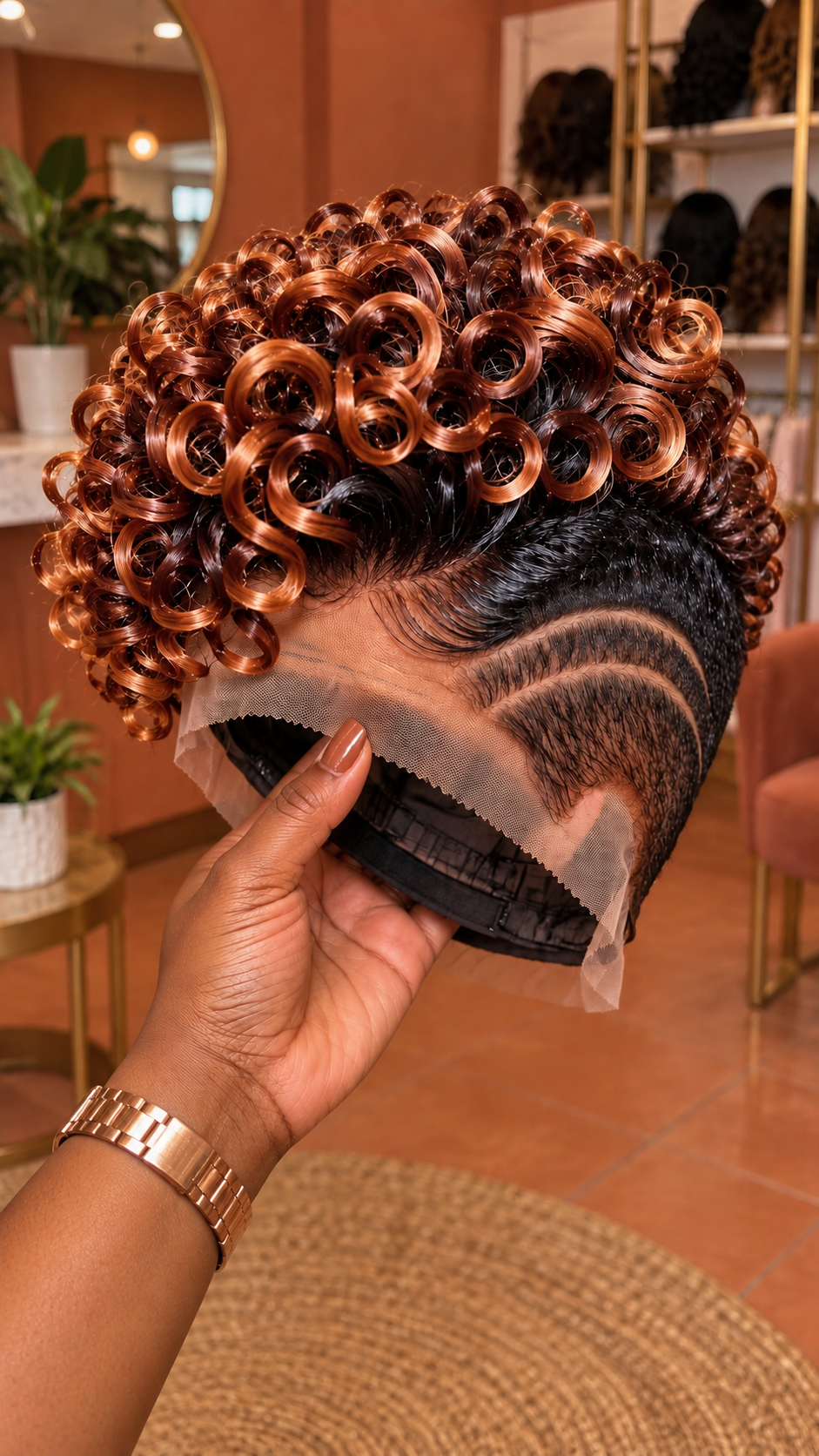
What makes a wig worth commissioning rather than buying as a standard ready-made style? Sometimes the answer is a detail that would be almost impossible to recreate by choosing color and length alone. In this photograph, the answer lies in the relationship between a brilliant amber copper crown and a raven-black temple panel shaped around two prominent curved channels. Above the dark side, dozens of glossy circular ringlets create a raised, rounded hairstyle. Below them, the closely arranged hair follows the contour of the cap, forming a completely different visual rhythm.
The wig is being held in one hand inside a warm-toned hair boutique. Its front lace remains untrimmed, and part of the dark interior cap is visible. This pre-installation presentation makes it possible to inspect the hairline, side geometry, and curl arrangement before the unit is placed on a person’s head.
Although the photograph shows a highly polished hairstyle, it does not identify the fiber, lace grade, manufacturing process, or supplier. Those details must be confirmed separately. What can be examined with confidence is the unusual balance between the copper loop crown, darker foundation, curved temple channels, and fine front hairline.


Two Temple Arches That Deserve Their Own Design Brief
The side panel is particularly important because it contains two broad, curved separations positioned one above the other. They follow an arched path across the temple rather than running as straight diagonal stripes.
The upper channel begins toward the front and curves backward beneath the glossy black hair. The second channel follows a similar direction below it, creating a narrow band of dark hair between the two exposed areas.
Near the lower front, the hair forms a curved, pointed contour that helps distinguish the design from an ordinary tapered side. Fine strands are visible inside the lower panel, with the lighter underlying lace showing through the channels.
These are visually similar to barber-inspired carved lines, but the photograph does not establish exactly how the pattern was manufactured. The separations could involve controlled hair placement, cutting, or a combination of construction and styling techniques.
For buyers, the distinction is important. A seller who understands only conventional razor-line haircuts may not automatically know how to create the same appearance safely on a lace wig.
Matching the Curvature Rather Than Counting Lines
Ordering a wig with two side lines is not enough to reproduce this design. The channels have a particular curvature, and their spacing changes subtly as they travel across the temple.
The upper arch sits immediately beneath a glossy black section that transitions into the copper curls. The lower arch creates a second visual boundary, with closely fitted hair continuing toward the lower edge.
If the channels are made too straight, the side will look more geometric. If they are placed too close together, the band of hair between them may become difficult to distinguish.
A custom wig maker should receive an enlarged side photograph and be asked to explain how the curved separations will be produced. Buyers should approve the placement before any irreversible cutting or hair removal.
Amber Copper Ringlets With Visible Circular Openings
The crown contains a dense arrangement of copper-colored curls, many forming almost complete circular loops. Their open centers are especially noticeable across the front and upper middle sections.
The ringlets vary slightly in diameter and orientation. Some stand upright, others lean toward neighboring curls, and several overlap in layered formations. This variation creates a rounded hairstyle without making every loop appear identical.
The color is a rich amber copper with warm reddish-brown undertones. Bright reflections appear along the outer curves of individual strands, particularly where the light strikes their upper surfaces.
Deeper auburn tones are visible between the ringlets, while a much darker foundation appears beneath portions of the crown. The color arrangement therefore contains more contrast than a uniformly dyed copper wig.
The crown is compact relative to the cap, but the raised ringlets provide noticeable height. The visible curls continue toward the rear edge, although the photograph does not establish the complete back arrangement.
What the Circular Openings Tell a Buyer
The loops are a major part of the hairstyle’s identity. A wig advertised as curly may contain loose spirals, spring coils, or irregular waves, none of which necessarily produce these prominent circular openings.
When comparing products, ask for a close-up photograph of the crown taken under ordinary lighting. Examine whether the loops remain individually recognizable and whether their placement resembles the reference.
It is also useful to request a view from above. This can reveal whether the circular arrangement continues across the entire crown or is concentrated only along the front.
The photograph cannot establish whether the curls were formed through heat, setting products, specialized manufacturing, or another technique. Their maintenance requirements will depend on the confirmed material and construction.
The Black-to-Copper Boundary Controls the Silhouette
One of the most effective aspects of this hairstyle is the strong division between the warm copper crown and the dark side.
The ringlets are predominantly amber copper, while the area immediately beneath them contains glossy black hair directed backward. This darker section forms a transition between the raised curls and the carved temple design.
The black hair appears closely arranged, with individual strands following a coordinated direction. Near the front, several strands curve gently along the hairline before continuing toward the side.
This placement creates a visually organized boundary. The copper ringlets remain prominent without overwhelming the temple pattern, while the dark section provides enough contrast for the curved channels to remain recognizable.
A reproduction that places copper throughout the entire side would lose much of this contrast. Likewise, a unit with black curls covering most of the crown would substantially change the balance.
Color Instructions That Avoid an Incorrect Result
Buyers should describe the hairstyle as an amber copper loop crown with a predominantly black temple panel and dark hair beneath portions of the raised curls.
That description is more precise than requesting a black and copper ombre wig. The image does not show a simple, continuous gradient from dark roots to light ends across every strand.
Instead, the colors occupy recognizable styling zones. The copper dominates the circular ringlets, while black remains especially prominent in the closely arranged side.
Ask the supplier to provide a photograph of the proposed color under neutral lighting. Warm salon lighting can intensify copper reflections and make the hair appear more orange than it would in daylight.
If the supplier offers several copper shades, compare the actual samples rather than relying solely on names such as ginger, auburn, cinnamon, or bronze.
What the Exposed Cap Reveals About the Product
The unit is shown before installation, with beige lace extending beyond the front and temple hairline. The lace has not yet been cut to its final wearing shape.
Fine strands are visible near the front, and the dark hairline appears carefully arranged into the surrounding hairstyle. The exposed lace provides a useful view of the transition between the hair and the mesh.
Inside the lower opening, a dark cap structure with visible stitching and band-like construction is apparent. However, the photograph does not show the complete underside or clearly establish every attachment component.
It would therefore be inappropriate to assume that the wig includes particular combs, clips, adjustable straps, or an elastic security system without additional photographs.
The lace appears fine in the image, but its exact grade cannot be verified. Buyers should request the manufacturer’s specification rather than interpreting photographic appearance as proof of a particular lace category.
Why the Temple Area Needs Special Attention During Fitting
The curved side channels sit close to the region where the wig will meet the wearer’s temple. Their position relative to the natural hairline is therefore important.
If the cap is too large, the side pattern may shift or sit loosely. If it is too small, excessive tension may affect comfort and the way the lace lies against the skin.
Before ordering, provide the head measurements requested by the wig maker. Ask whether the curved side design can be positioned appropriately for the selected cap size.
Customers who want adhesive-free installation should obtain explicit confirmation that the unit is constructed for that method. The presence of lace and a visible cap band does not establish glueless compatibility.
Finding a Specialist for a Copper Loop Crown
A wig maker experienced in sculpted pixie units is a sensible starting point for this design. The hairstyle requires coordination between circular curl placement, contrasting color zones, and the curved temple arrangement.
Local wig boutiques may be useful for customers who prefer to examine the cap and lace in person. Independent custom wig makers can potentially offer more control over the styling details, while online retailers may provide ready-made alternatives with similar colors.
When contacting a supplier, send the reference photograph and explain which details are essential. The copper loop crown, dark transition section, two temple arches, and fine front hairline should be identified separately.
Ask whether the wig will arrive fully styled. A base unit that requires substantial salon work may cost more overall than a finished custom piece.
Photographs to Request Before Approving Production
The reference provides a useful front-side perspective, but several areas remain unseen. Request a straight front photograph to evaluate the overall hairline and symmetry.
Ask for a photograph of the opposite side to determine whether it carries the same carved pattern or a different arrangement.
A rear photograph is necessary to establish how the copper curls and darker hair continue around the back.
Finally, request a complete underside view showing the cap structure and fastening hardware. These photographs will help distinguish a well-documented product from one marketed using only an attractive presentation image.
When Custom Construction Offers Better Value
A ready-made copper curly pixie may provide a similar color and rounded crown at a lower initial cost. However, finding a product with the same circular loops and two curved temple channels may be more difficult.
Custom construction allows the buyer to specify the position of the color boundary and the side pattern. It may also permit more accurate cap sizing and hairline placement.
Nevertheless, custom work does not automatically guarantee a perfect result. The quality depends on the maker’s experience, materials, and ability to interpret the reference.
Before paying, ask for examples of completed wigs with comparable curl construction and curved side styling. A portfolio of ordinary straight lace wigs may not demonstrate the specialist skills needed for this particular design.
Clarify the revision policy and establish whether photographs of the finished unit will be provided before shipment.
Budgeting for Amber Copper Ringlet and Temple-Carving Work
The following USD amounts are illustrative planning estimates rather than verified live product prices. The photographed wig’s fiber, supplier, and actual selling price are unknown.
| Wig Category | Illustrative USD Range | Potential Cost Drivers |
|---|---|---|
| Premium Custom | $340–$760+ | Individual cap measurements, intricate copper ringlet arrangement, contrasting black hair placement, and specialist curved temple work. |
| Standard Custom | $185–$390 | Selected cap options with custom curl styling, coordinated color sections, and a simplified or individually arranged side pattern. |
| Basic Human Hair | $105–$265 | A human-hair starting unit that may require coloring, curl formation, and professional temple customization. |
| Premium Synthetic | $75–$185 | A manufactured curly pixie with copper coloring and possible prearranged side detailing. |
| Basic Synthetic | $30–$90 | A lower-cost copper pixie alternative that may not reproduce the hollow loops or curved channels accurately. |
The complexity of the circular curls may influence labor costs, particularly when their placement must be arranged individually. The contrasting black and copper sections can also affect the production process.
The temple pattern introduces another variable. Its curved channels must be coordinated with the cap structure and surrounding hair coverage.
Additional charges may include lace customization, fitting, shipping, taxes, and salon installation. Ask whether the quoted amount covers a fully finished hairstyle or only the base unit.
Comparing complete quotations is more useful than choosing the lowest advertised price. A budget wig requiring extensive specialist work may not provide the expected savings.
Planning the Installation Without Damaging the Side Arches
Once the wig arrives, the first fitting should focus on positioning the cap correctly. The curved temple design must sit at the intended angle relative to the wearer’s forehead and side of the head.
A professional wig stylist can check the cap tension, hairline alignment, and whether the lace lies appropriately against the skin.
The excess lace should not be trimmed until the correct position has been established. Cutting too close to the fine hairline may damage strands or reduce the available fitting margin.
The stylist should also examine the upper ringlets for compression caused by packaging. If any loops have shifted, their restoration should follow the manufacturer’s instructions for the confirmed fiber.
Do not assume that heat styling is appropriate. Human hair and synthetic fibers can require substantially different techniques, and some materials may be damaged by unsuitable temperatures.
Preserving the Copper Circles and Black Side Contrast
The upper curls depend on retaining their circular openings. Pulling a brush through the crown can stretch the loops and change the arrangement.
Instead, handle the hair carefully and avoid unnecessary separation of the individual rings. If a curl becomes displaced, seek guidance on the appropriate resetting method.
The black temple panel requires a different approach. Its closely arranged strands should remain in their intended direction, and the curved channels should not be obscured by hair moved across them.
Heavy styling products may collect between the loops or along the side, reducing the visibility of the individual formations.
Material-Specific Care Before Any Restyling
If the wig is made from human hair, ask about its coloring history and recommended products. Previously processed copper-colored strands may have different care requirements from untreated hair.
If the wig is synthetic, avoid conventional recoloring and heated tools unless the manufacturer explicitly confirms compatibility.
When the wig is not being worn, support it on an appropriately sized stand. Keep the crown free from pressure and avoid placing objects against the sculpted temple.
For travel, use packaging that allows enough room for the raised ringlets and protects the lace from snagging or folding.
A Statement Pixie Built Around Contrast and Precision
This wig offers a distinctive combination of warm copper color, raised circular curls, and a dark temple panel with carefully positioned curved channels.
Its strongest visual quality is the way these elements remain separate but connected. The copper ringlets create elevation, the black section provides contrast, and the temple arches introduce controlled geometry beneath the crown.
The design may appeal to buyers seeking a compact statement hairstyle for celebrations, photographs, or regular personal styling. Its suitability for frequent wear will depend on cap comfort, installation requirements, and the maintenance needed to preserve the arranged curls.
Before purchasing, verify the fiber, lace specification, cap measurements, and fastening method. Request complete photographs and establish whether the supplier can reproduce the side geometry as accurately as the copper crown.
A successful custom order should preserve the relationship between the amber copper ringlets, dark foundation, paired temple arches, and fine lace hairline. Those visible details provide a reliable starting point for evaluating suppliers and planning a professional installation.
Search Terms
Amber copper hollow ringlet pixie wig · Raven black double arch temple design · Copper circular loop crown lace wig · Black side panel with curved hair channels · Warm auburn copper sculpted pixie · Untrimmed beige lace with temple arches · Two curved side lines copper wig · Black foundation amber ringlet hairstyle