
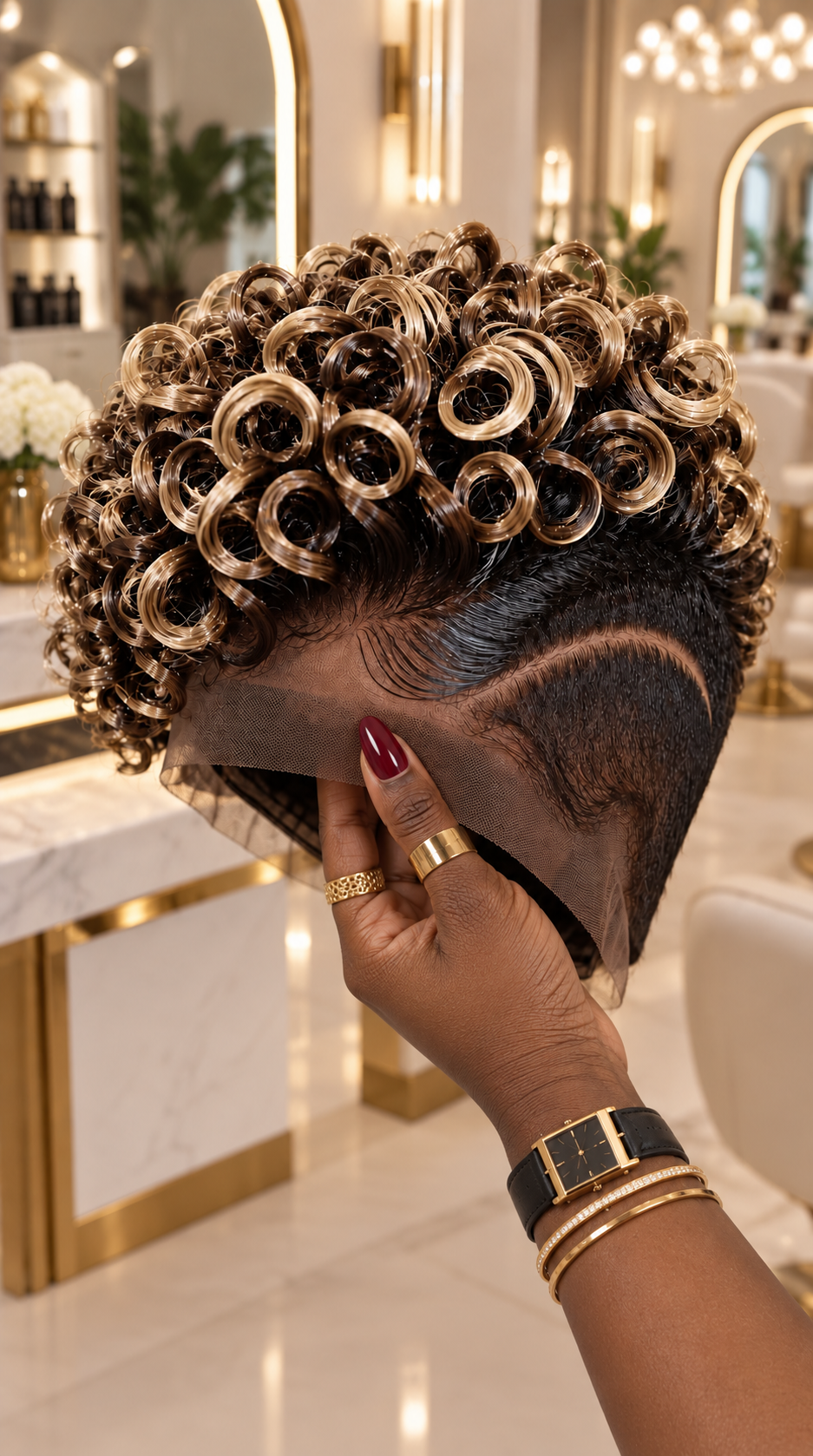
The most revealing detail in this wig is not simply its abundance of circular curls. It is the contrast between champagne-blonde strands catching the light, the espresso-brown hair visible inside the loops, and the dark, closely arranged temple beneath them. Photographed while being held in a salon, the hairpiece presents a striking combination of color variation and deliberate curl placement that deserves careful examination before purchase.
The upper hairstyle consists of numerous rounded loops, many with open centers and overlapping strands. Some appear pale golden blonde, others warm beige, while the deeper sections remain dark chocolate or espresso brown. Beneath this arrangement, the hair transitions into a flatter, swept-back section near the front hairline. A single prominent curved separation channel runs through the visible temple, creating a distinctive boundary within the dark side hair.
The wig is photographed before installation, with beige lace extending below the hairline and a portion of the dark cap interior visible. This allows prospective customers to consider both the decorative appearance and practical fitting requirements. However, the image does not confirm the fiber material, lace grade, complete cap construction, or the method used to secure the ringlets.


For anyone considering a blonde-and-brown sculpted pixie wig, the key purchasing question is whether a supplier can reproduce the layered color appearance and compact circular curl arrangement without changing the hairstyle’s proportions.
Color Placement Is the Main Reason This Design Stands Apart
The upper curls display a combination of champagne blonde, golden beige, light caramel, and deep brown tones. The brighter strands appear prominently along the outward-facing surfaces of many loops, while the inner areas often look substantially darker.
This produces a striking visual effect: each circular curl appears to contain its own mixture of light and shadow. Some ringlets show a pale blonde outer curve surrounding a dark center. Others contain alternating brown and golden strands within the same rounded formation.
The lower portion of the hairstyle remains predominantly dark brown-black. This provides a strong foundation for the lighter upper curls and prevents the wig from appearing uniformly blonde.
It is important to distinguish the visible appearance from an unverified coloring technique. The photograph supports describing the hair as a warm blonde-and-brown combination, but it cannot establish whether the lighter strands were individually highlighted, blended during manufacturing, or made more prominent by the salon lighting.
The warm lighting in the photograph may intensify the golden appearance. A customer ordering the same style should therefore request additional images under neutral daylight before selecting a final color.
Why a Uniform Blonde Shade Would Produce a Different Result
A wig made entirely from pale blonde fibers could reproduce the circular curl shape but would not necessarily have the same depth. In the reference, dark areas remain visible between and beneath the lighter strands.
These darker sections help separate neighboring loops and emphasize their individual outlines. They also create a stronger contrast with the pale outer surfaces of the curls.
For a custom order, ask the maker to preserve the dark foundation while incorporating champagne and golden-beige tones across the upper hairstyle. The exact balance should be agreed upon using photographs or physical color samples.
Do not assume that a standard blonde color code will reproduce the reference. Different manufacturers may use the same color description for considerably different shades.
The Upper Hair Is Arranged Into Open Circular Loops
Numerous rounded curls cover the upper section, forming a compact but visually elaborate arrangement. Many ringlets face outward, allowing their circular openings to remain clearly visible.
The loops vary in diameter. Several larger formations occupy the front and central areas, while smaller curls fill the spaces between them and continue toward the rearward portion.
Some curls appear as nearly complete circles. Others resemble overlapping spirals, with individual strands curving around neighboring sections.
The hairstyle does not resemble ordinary loose curls falling freely around the face. Instead, the ringlets appear deliberately positioned to create a rounded upper silhouette.
The front-left portion contains several curls that extend slightly forward, creating a decorative edge above the forehead. These curls remain relatively compact rather than forming a long fringe.
Although the upper section appears full, the hairstyle is not excessively tall. Its volume comes from the arrangement of individual loops rather than long hair extending far above the head.
Evaluating Loop Size Before Commissioning a Reproduction
Buyers often describe hairstyles like this as curly pixie wigs, but that description does not communicate the most important structural detail.
The curls are not merely small spirals. Many form broad, open circles with visible spaces inside them.
A custom wig maker should understand the desired loop diameter, spacing, and direction. If the curls are made too small, the upper surface may resemble tightly packed ordinary ringlets. If they are made too large, the silhouette may become bulky or lose its compact proportions.
Ask the supplier for a photograph taken from slightly above the wig. This view can reveal whether the loops are arranged with the same combination of larger central circles and smaller surrounding curls.
The maker should also explain whether the circular styling is intended to remain in place after washing or whether periodic professional resetting will be required.
The Dark Temple Provides a Controlled Contrast
Beneath the light-catching upper curls, the visible temple is styled close to the wig base. Dark strands travel backward from the front hairline in a carefully directed arrangement.
The flatter temple hair creates a strong contrast with the raised ringlets. This difference in height is essential to the overall silhouette.
Near the front, the hair is arranged into a sweeping wave that curves toward the side. Fine strands follow the direction of the larger wave, creating a gradual transition from the hairline into the darker upper-side section.
The temple does not display several parallel decorative stripes. Instead, one particularly prominent curved separation channel can be seen running through the dark side hair.
This channel begins near the upper front-side area and curves downward and backward, following the contour of the hairstyle.
The photograph does not prove that the channel was produced using a razor or clippers. It is more accurate to describe the visible separation than to assume a particular cutting method.
One Curved Parting Changes the Entire Side Profile
The single prominent side channel is visually important because it creates a clear boundary within the otherwise closely arranged dark hair.
Above the channel, the strands appear directed backward toward the upper hairstyle. Below it, a darker, compact side panel follows the shape of the wig.
The curve is not perfectly straight. It rises near the front-side region before bending toward the rearward edge, producing a flowing separation rather than a rigid geometric line.
This design differs from pixie wigs with two or three parallel shaved patterns. Adding extra lines during customization would substantially change the reference.
Customers who want the photographed appearance should tell the stylist to preserve the single curved channel and avoid introducing additional decorative divisions.
The width of the dark panel beneath the channel also matters. Excessive thinning could expose too much of the underlying base, while additional hair volume could conceal the separation.
What the Untrimmed Lace Reveals About Installation
A broad section of beige-toned lace extends from the front and visible temple. The mesh remains uncut and hangs below the styled hairline.
The lace appears relatively fine in the photograph, but its exact commercial classification cannot be established visually. It should not be advertised as HD lace without reliable product information.
The photograph also shows part of the dark interior cap beneath the lace. However, the complete underside is not visible, so the number of combs, strap configuration, and full construction remain unknown.
These details are important because the wig’s elaborate upper styling should not be repeatedly disturbed during fitting.
Before installation, the cap should be positioned correctly and the relationship between the front hairline, upper curls, and curved temple channel evaluated.
Only after confirming the fit should the stylist determine where the excess lace needs trimming.
Cutting the lace prematurely may reduce fitting flexibility and make later adjustments more difficult.
Cap Measurements Should Be Confirmed Before Purchase
A compact hairstyle does not necessarily indicate a small cap. The wig may have been constructed in any of several sizes, and the photograph does not provide measurements.
Ask the seller for the cap circumference, front-to-back length, and ear-to-ear dimensions.
If adjustable hardware is included, request a photograph showing its position and available adjustment range.
Customers who prefer adhesive-free installation should ask whether the wig was designed for that purpose. Visible lace and a partially exposed cap do not establish glueless suitability.
A secure and comfortable fit depends on the complete construction, the wearer’s measurements, and the intended installation method.
Finding a Supplier Who Can Match the Blonde-Brown Balance
The combination of circular curls and contrasting colors makes this design more specialized than an ordinary blonde pixie wig.
When searching online, consider custom wig makers, sculpted pixie specialists, and salons experienced in circular curl setting.
Useful descriptions include champagne blonde ringlet wig, brown-rooted sculpted pixie, circular curl lace wig, and blonde-and-espresso finger-coil hairstyle.
Review the seller’s portfolio for examples of controlled curl placement. A supplier who regularly produces loose curly wigs may not necessarily specialize in structured circular loops.
For a ready-made unit, request photographs of the actual product being shipped. Catalog photographs may not accurately represent the curl placement or color distribution of every individual wig.
For custom production, provide the reference image and explain which elements must remain unchanged: the dark foundation, warm blonde upper loops, compact silhouette, and single curved temple channel.
Ready-Made or Custom: Which Purchase Route Makes Sense?
A ready-made wig can be a practical choice if the available product already resembles the desired design and fits the buyer’s measurements.
However, finding an exact match may be challenging because the reference combines several specific characteristics.
A generic blonde curly pixie may have the correct approximate length but lack the open circular loops. Another wig may reproduce the curls while using a uniformly blonde color or a different temple pattern.
Custom production offers greater control over these details, although it may involve additional time and cost.
Before placing a custom order, ask whether the maker can reproduce the color placement and loop arrangement with the selected hair material.
Request written confirmation of the cap size, lace specifications, styling expectations, and any limitations affecting the finished result.
If possible, ask for a progress photograph before the final styling is completed. This provides an opportunity to identify major differences while corrections may still be feasible.
Choosing the Right Salon for Fitting and Future Curl Work
Installation is only one part of owning a structured curl wig. The wearer may eventually need assistance restoring individual loops or correcting the direction of the front wave.
Look for a salon that offers lace wig fitting and has experience with sculpted pixie hairstyles.
When booking, explain that the upper hair contains carefully arranged circular curls and that the visible temple has a single curved separation channel.
Ask whether the stylist can preserve these details during fitting and whether they offer maintenance services for structured curls.
At the appointment, the stylist should first assess cap comfort and hairline placement.
If the wig requires minor adjustments, the underlying construction should be examined before cutting or reshaping the side hair.
Using clippers or razors without checking the cap could damage the wig or expose supporting materials.
Illustrative Pricing for a Champagne Blonde Circular Curl Wig
The cost of a comparable wig may depend on hair material, cap construction, lace coverage, color processing, and the labor involved in arranging the circular curls.
The photograph does not establish the actual manufacturer, fiber composition, or retail price.
The following US dollar ranges are illustrative budgeting estimates, not verified current selling prices.
| Purchase Category | Illustrative USD Range | Potential Cost Considerations |
|---|---|---|
| Premium Custom | $350–$790+ | Individual cap sizing, complex circular curl placement, personalized blonde-brown color work, and specialist hairline preparation. |
| Standard Custom | $185–$410 | Selected adjustments to color distribution, curl arrangement, cap sizing, and temple styling. |
| Basic Human Hair | $110–$275 | A human-hair base unit that may require additional coloring and professional curl setting. |
| Premium Synthetic | $75–$205 | A higher-grade synthetic option with potentially prearranged loops and blended blonde-brown coloring. |
| Basic Synthetic | $30–$105 | A budget alternative where exact curl placement and color distribution may be limited. |
These categories represent possible purchasing options rather than confirmed versions of the photographed wig.
Color complexity may increase the cost of custom production, especially if the buyer requests a specific relationship between dark roots and lighter upper curls.
Installation, shipping, lace preparation, and future restyling may be charged separately. Ask for an itemized quotation before paying.
A higher price does not automatically guarantee a closer visual match. The maker’s demonstrated ability to arrange circular curls and reproduce the desired color balance is an important consideration.
Maintaining Light-Colored Loops Without Losing Their Shape
The upper ringlets require careful handling because their circular openings are central to the hairstyle’s appearance.
Brushing through the curls could separate the strands and alter their arrangement. Before attempting maintenance, ask the supplier how the loops were formed and whether they are intended to retain their shape after washing.
If the wig contains synthetic fibers, avoid heat styling unless the manufacturer confirms the material’s temperature tolerance.
If the unit contains human hair, professional curl resetting may be possible, but the appropriate method depends on the hair’s processing history and original styling technique.
The lighter blonde areas may also require particular attention. Depending on the material and products used, pale strands can make residue or changes in color more noticeable.
For confirmed color-treated human hair, repeated washing, excessive heat, and sunlight may affect the shade over time.
For synthetic fibers, conventional dyeing should not be attempted without specific manufacturer guidance.
The dark temple section should be maintained separately from the upper curls. Excessive brushing across the curved channel could shift the hair and reduce the visibility of the separation.
What Additional Photographs Would Make This Purchase Safer?
The reference provides a useful view of the upper curls and one temple, but several important areas remain outside the frame.
A direct front photograph would reveal how the ringlets are distributed across the forehead and whether the hairline is symmetrical.
An opposite-side view would establish whether the curved temple channel is repeated or whether the other side has a different arrangement.
A rear photograph would show how the circular curls continue toward the nape.
A complete underside image would help confirm the cap construction, lace coverage, and attachment hardware.
Finally, a brief video under neutral lighting would help distinguish the actual blonde-brown color distribution from reflections created by the salon’s warm lights.
These additional views are particularly important when commissioning a custom reproduction or purchasing from a remote seller.
The Appeal of Champagne Loops Against a Dark Foundation
This wig demonstrates how contrasting color and carefully arranged curls can create an elaborate hairstyle without relying on long hair or multiple decorative side lines.
The upper section contains numerous open circular ringlets, with champagne-blonde and golden-beige strands appearing against deeper espresso-brown areas. Beneath them, the dark temple remains closely arranged, interrupted by one prominent curved separation channel.
The untrimmed lace and partially visible cap provide useful construction clues, although they do not establish the complete product specifications.
For buyers who appreciate sculpted pixie hairstyles, the design offers a distinctive combination of warm blonde color, dark depth, and compact circular curls.
The most reliable purchasing approach is to confirm the actual color, inspect the cap construction, communicate the desired loop arrangement, and arrange fitting with a stylist experienced in structured wigs.
Preserving the balance between the pale upper curls and the dark lower styling is what will make a finished reproduction resemble this particular reference rather than an ordinary blonde curly pixie.
Search Terms
Champagne blonde espresso ringlet wig · Golden beige open loop pixie hairpiece · Dark rooted blonde circular curl wig · Single curved temple parting pixie · Brown and blonde sculpted crown wig · Untrimmed beige lace spiral wig · Honey champagne hollow coil hairstyle · Dark side panel blonde ringlet wig