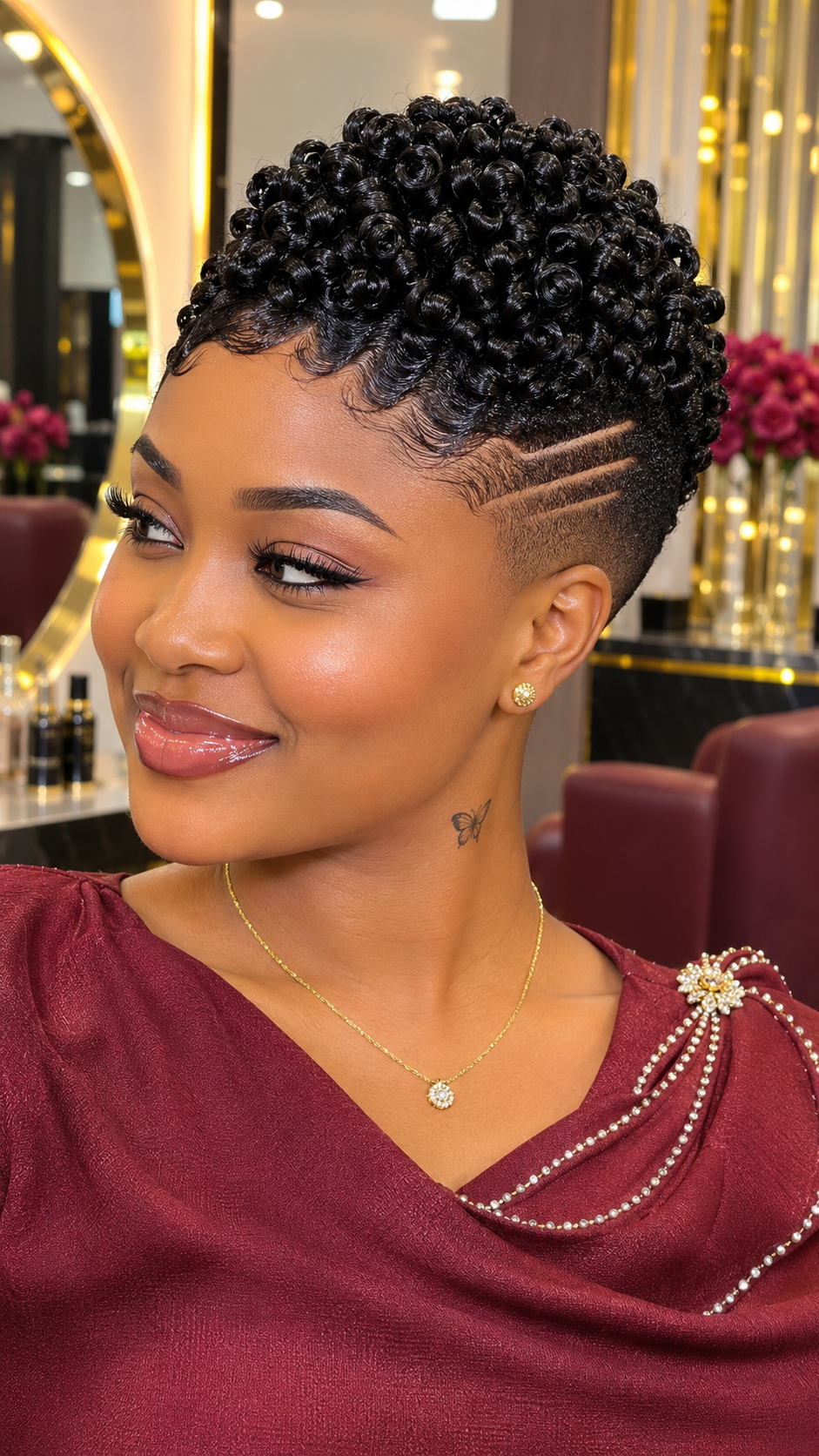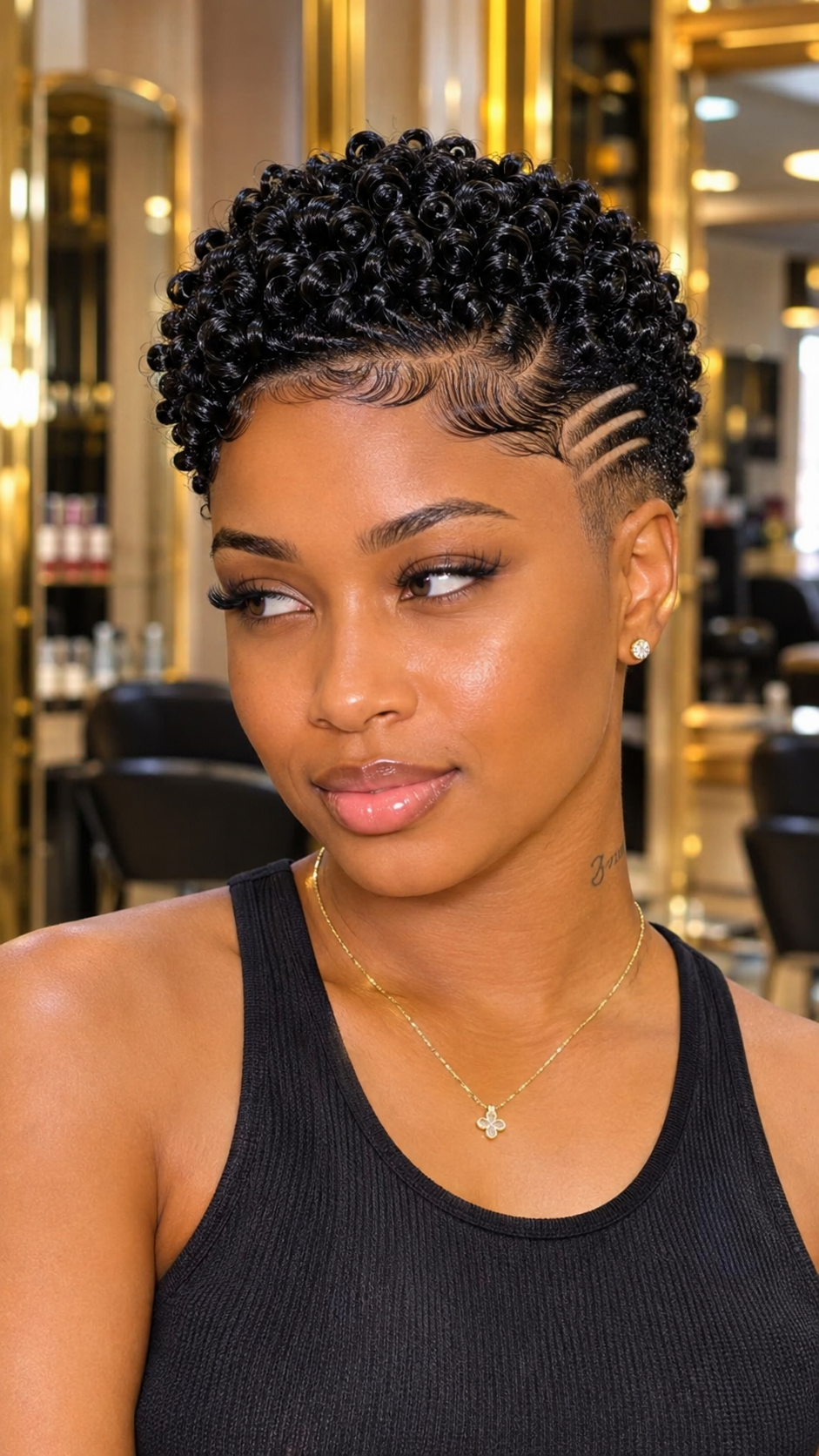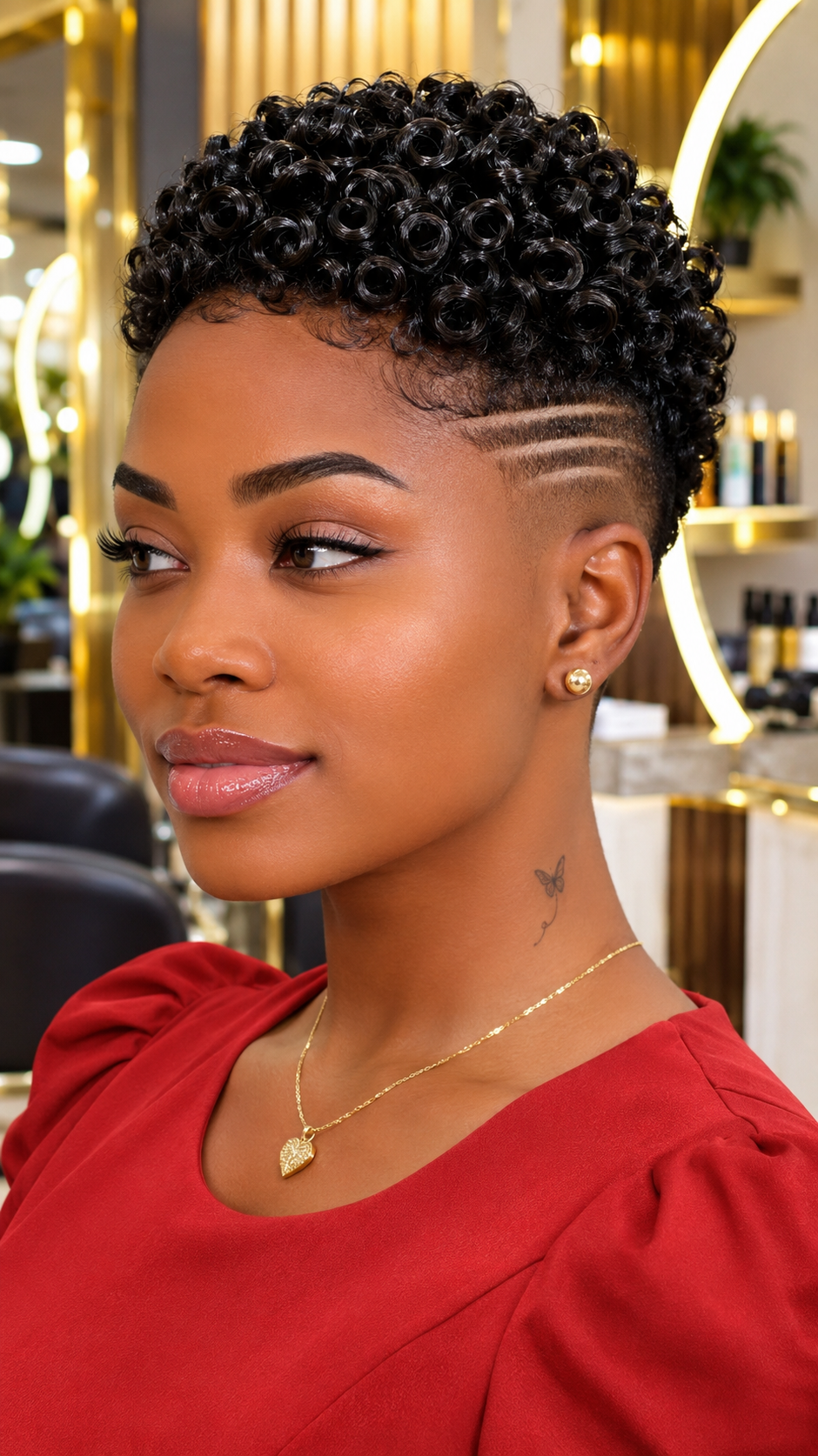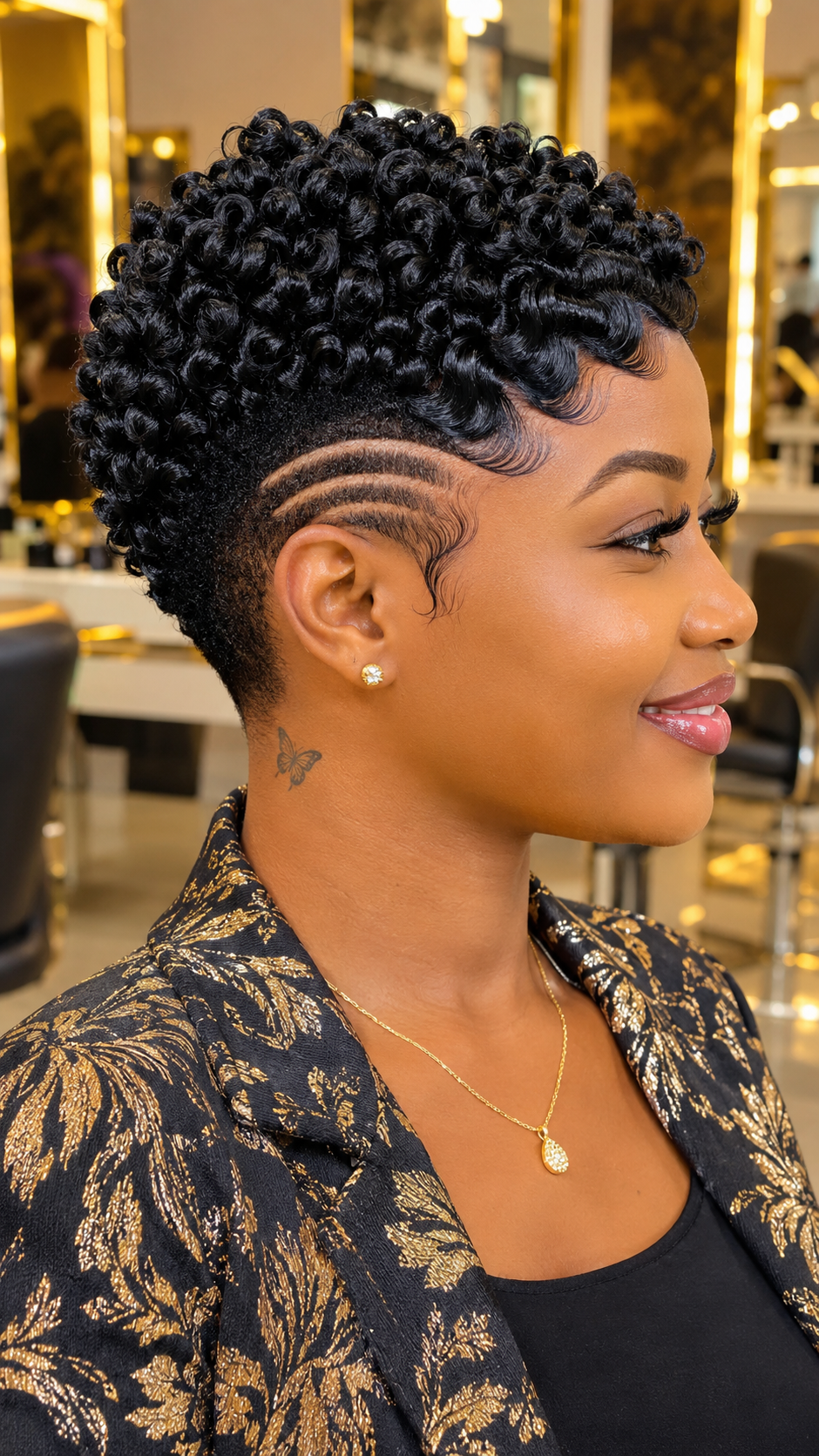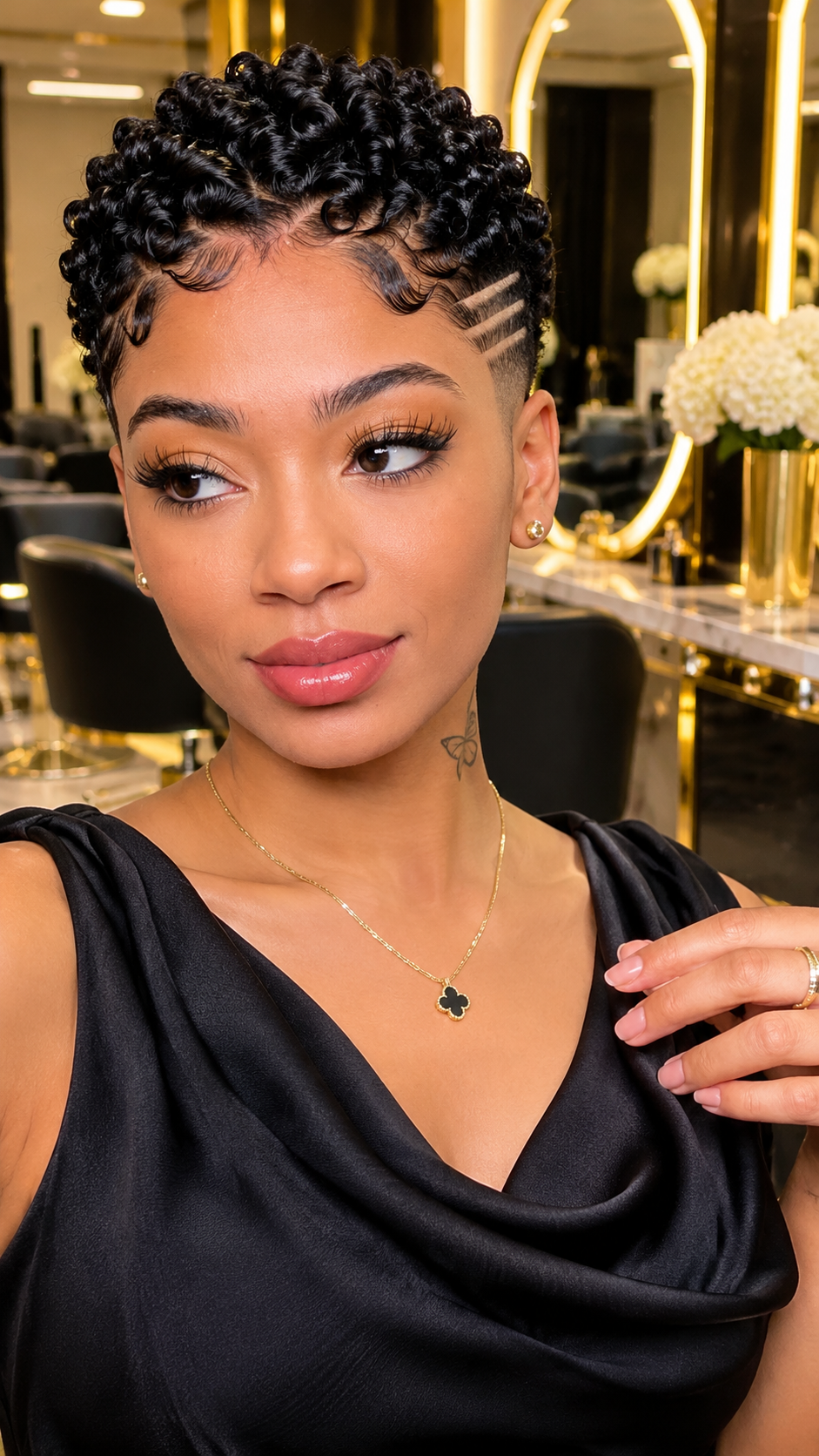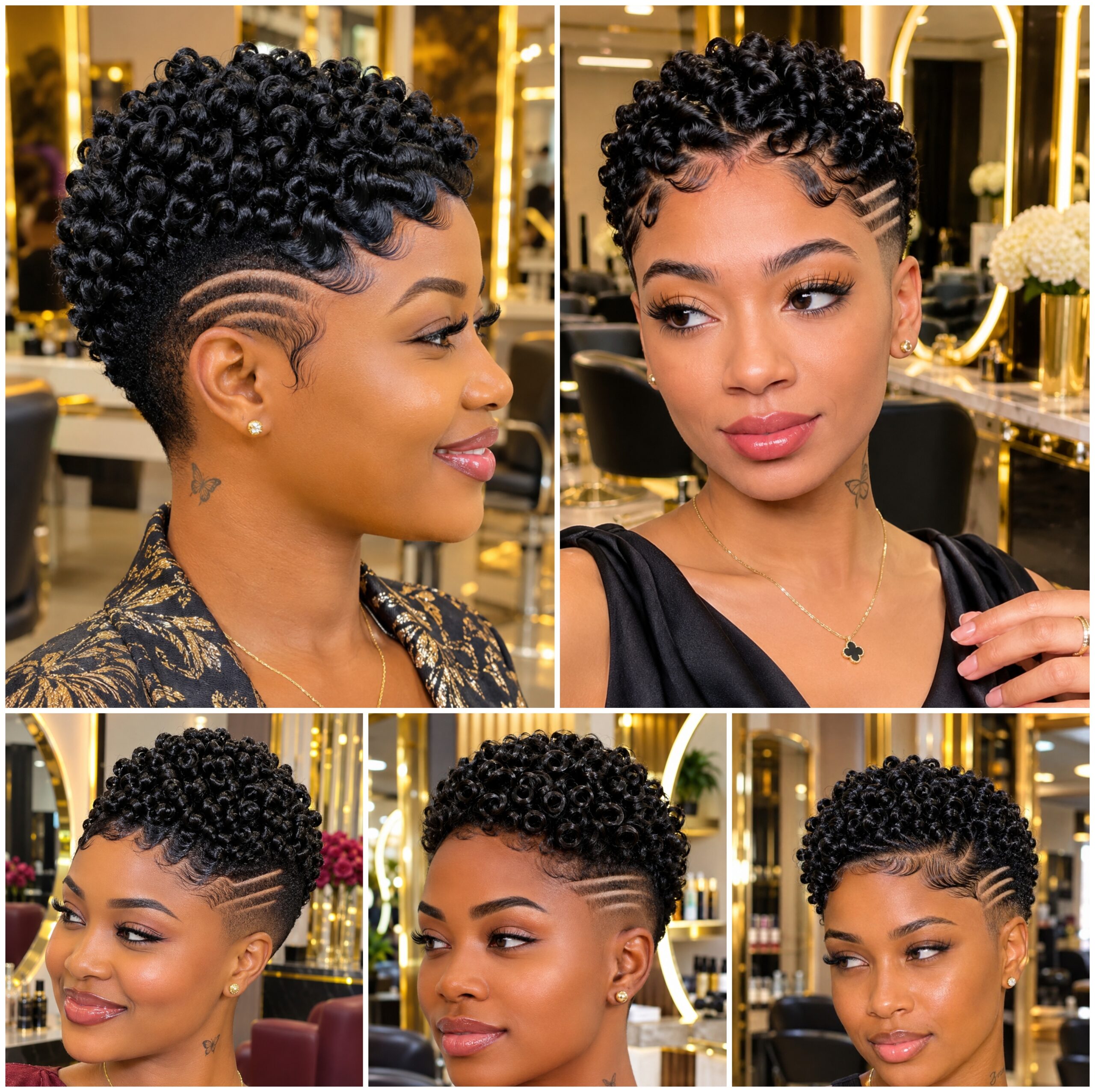
A beautifully shaped short hairstyle can communicate confidence, personality, and outstanding attention to detail without relying on long extensions or elaborate accessories. Low taper spiral coils with temple stripes combine a richly curled crown with closely tapered sides and decorative lines near the temples. The result is a striking haircut that balances softness and structure, offering an attractive choice for women who enjoy short natural hairstyles, artistic barbering, and carefully styled curls.
The defining beauty of this hairstyle comes from the relationship between its different sections. The upper hair features rounded spiral coils that create fullness and movement, while the lower sides gradually become shorter toward the temples and nape. Carefully positioned stripes introduce an additional decorative element, emphasizing the shape of the haircut without overwhelming the curls above.
This combination is particularly appealing because the hairstyle can be adapted to different natural hair densities, curl patterns, and personal preferences. Some women prefer closely arranged, glossy finger coils that create a sculpted appearance. Others favor softer spirals with greater movement and a slightly more natural finish. The temple stripes can be narrow and understated or more noticeable, depending on the desired overall effect.


Although the hairstyle is especially attractive when created directly on natural hair, similar proportions can also be reproduced through customized short wigs. Professional wig makers may create a spiral-coil crown with closely arranged tapered sections and decorative temple details. The choice between a natural haircut and a removable wig depends on the customer’s hair, styling preferences, desired flexibility, and willingness to maintain a permanent taper.
For women considering a short spiral coil hairstyle with tapered sides, understanding the cutting process, curl preparation, temple artwork, product selection, maintenance requirements, and available installation options can make the difference between an ordinary result and a beautifully balanced finished style.
The Appeal of a Low Taper with Spiral Curls
A low taper gradually reduces the apparent hair length around the lower sides and nape while preserving greater fullness above. Unlike a high fade, which removes more hair farther up the head, a low taper keeps the transition relatively close to the lower perimeter.
This distinction is important when combining a taper with spiral coils. The curls require enough space across the upper crown to develop their rounded shapes, while the lower sections provide a contrasting foundation.
The hairstyle therefore maintains a recognizable curly silhouette without allowing the side hair to become excessively bulky.
The taper can also emphasize the shape of the head. When carefully executed, it creates a gradual transition between the fuller curls and the shorter hair surrounding the ears and nape.
For customers who appreciate short feminine hairstyles, the combination offers an attractive balance between decorative volume and precise cutting.
Spiral Coils Bring Fullness to the Crown
The upper section is the most expressive part of this hairstyle. Spiral coils form rounded curls that may appear as compact rings, spring-shaped strands, or carefully arranged circular formations.
The exact appearance depends on the natural curl pattern, hair length, styling method, and products used.
Some coils form tight spirals with small openings, while others develop broader curves that create a softer silhouette.
A crown containing a mixture of curl sizes can look especially attractive because the individual formations provide depth without requiring excessive length.
Professional stylists should evaluate the natural hair before deciding how tightly the coils should be arranged. The objective is to create a flattering shape that complements the customer’s hair density and facial proportions.
The Difference Between Finger Coils and Natural Spirals
Finger coils are created by winding small sections of hair around the fingers, guiding the strands into organized spirals. This technique can help produce consistent curl formations, particularly on hair with a naturally coily pattern.
Natural spirals may develop through the hair’s existing curl structure without every section being individually wrapped.
Both approaches can complement a low taper, but they produce different visual effects.
Finger coils often create a more deliberate arrangement, while naturally formed curls may offer greater variation in direction and shape.
Customers should discuss the preferred appearance with their stylist rather than assuming that every spiral hairstyle requires the same technique.
The ideal method depends on the desired definition, available styling time, and natural hair characteristics.
The Crown Should Have a Balanced Rounded Shape
The most attractive spiral-coil tapers generally maintain a carefully proportioned upper silhouette. The crown should look full enough to showcase the curls without extending disproportionately beyond the tapered sides.
A stylist may adjust the upper length to control the hairstyle’s height and movement.
Shorter coils typically create a more compact appearance, while longer sections may introduce additional fullness and flexibility.
The arrangement should also account for the direction in which the curls naturally fall.
Rather than forcing every strand into an identical position, a skilled professional can work with the existing growth pattern to create a coordinated overall shape.
For women who want a compact pixie appearance, keeping the crown relatively short can help preserve the hairstyle’s distinctive proportions.
Low Tapered Sides Create a Beautiful Contrast
The lower sides provide the structural foundation for the curled crown. Hair gradually becomes shorter around the temples and ears, creating a transition that emphasizes the curls above.
This contrast helps distinguish the hairstyle from an evenly cut curly afro.
The taper should remain low enough to preserve fullness around the upper sides while allowing the lower hair to appear controlled.
The exact transition can be adjusted according to head shape, hair density, and the desired level of contrast.
Women who prefer a softer appearance may request a gradual taper with minimal visible scalp exposure.
Those who enjoy a stronger contrast may choose a closer lower cut while preserving the overall low-taper structure.
Temple Stripes Introduce Decorative Precision
Temple stripes are narrow decorative lines positioned within the shorter hair surrounding the temples. They introduce an artistic element that complements the rounded spiral curls.
The lines may follow gentle diagonal paths, short parallel directions, or subtle curved shapes depending on the intended design.
The most important consideration is their placement within the tapered section.
Stripes that extend too high may interfere with the transition into the fuller crown.
Similarly, excessively broad lines can dominate the side profile and reduce the visual emphasis on the curls.
A balanced arrangement keeps the decorative elements recognizable while allowing the spiral crown to remain the central attraction.
Choosing Between Straight and Curved Temple Lines
Different stripe directions can change the hairstyle’s overall character. Straight lines create a sharp, structured effect, while curved stripes introduce softer movement.
Parallel stripes may emphasize symmetry and precision.
Single narrow lines can provide an understated accent for women who prefer minimal artwork.
The design should complement the proportions of the temple area rather than following a fixed template for every customer.
For example, a shorter temple section may look better with a restrained pattern, while a slightly broader tapered area can accommodate additional detailing.
Customers should review the desired stripe shape before the barber begins cutting because removing hair is not immediately reversible.
The Importance of Proper Stripe Placement
Successful temple artwork begins with understanding the natural hairline and the shape of the head.
A stripe positioned too close to the hairline may create an awkward transition, while one placed too far into the crown may interrupt the intended low taper.
The barber should identify an appropriate location before creating the design.
Both the thickness and spacing of the lines influence the final appearance.
Thin, carefully placed stripes can create an elegant effect, particularly when paired with compact spiral coils.
Professional experience is especially valuable when creating matching details on both sides of the head.
However, symmetrical artwork is not mandatory. Some women prefer a single decorated temple while keeping the opposite side comparatively simple.
The Nape Should Complement the Lower Taper
The back of the hairstyle contributes to its overall balance. A low taper generally continues around the nape, creating a gradual transition from the fuller upper hair toward the shorter lower perimeter.
The exact shape may be rounded, softly squared, or naturally contoured according to the customer’s preference.
A well-executed nape prevents the haircut from appearing unfinished when viewed from behind.
The spiral coils should gradually transition toward the shorter areas rather than ending in an abrupt, uneven line.
Customers should request a rear-view mirror check before leaving the salon to ensure that the taper matches the intended proportions.
Hair Density Influences the Finished Appearance
Natural hair density plays an important role in the appearance of spiral coils. Thicker hair may support a fuller crown, while lower-density hair can produce a lighter silhouette.
Neither automatically determines whether the hairstyle will look attractive.
The stylist should adapt the number, size, and arrangement of the coils to the available hair.
Attempting to create too many tiny coils on low-density hair may expose more scalp than desired.
Conversely, arranging very thick sections on dense hair may produce excessive volume.
A customized approach helps the crown maintain its intended shape while respecting the customer’s natural hair characteristics.
Selecting the Right Length for Spiral Coils
Spiral coils require sufficient hair length to wrap into recognizable curls. However, the necessary length depends on the tightness of the curl pattern and the intended finished appearance.
Very short hair may produce tiny, closely arranged coils.
Longer hair can form larger spirals or more prominent rounded sections.
Hair shrinkage also affects the visible result, particularly on naturally coily textures.
Customers should discuss the desired finished height with their stylist before cutting.
A haircut that appears short when stretched may become considerably more compact after the hair dries and curls into its natural formation.
Understanding this difference can help prevent unwanted length changes.
How Hair Texture Affects the Coil Pattern
Different natural curl patterns respond differently to finger-coiling techniques. Tightly coiled hair may form compact spirals with considerable shrinkage, while looser curls may create broader formations.
The amount of product and the size of each styling section also influence the result.
Styling techniques should therefore be adapted rather than copied mechanically.
For women with tightly coiled hair, working in small sections may help create consistent curl definition.
Those with looser curl patterns may prefer slightly larger sections to maintain fullness.
A stylist familiar with different natural hair textures can recommend an appropriate technique during consultation.
Preparing Natural Hair Before Coil Styling
Good preparation makes the styling process easier and helps the finished curls retain their shape.
The hair should be cleansed using products appropriate for the individual’s scalp and hair condition.
A suitable conditioner can help improve manageability before the coils are formed.
After cleansing, the stylist may divide the hair into manageable sections.
The upper crown should be prepared for curl formation, while the lower sides remain accessible for tapering and decorative line work.
Depending on the preferred workflow, the barber and stylist may complete the cutting and curl-setting stages in different orders.
Creating Spiral Coils with Finger Styling
Finger coiling generally involves separating the hair into small sections and guiding each section into a spiral using the fingers.
A compatible styling cream, mousse, or gel may help provide hold and reduce frizz.
The amount of product should suit the hair’s characteristics rather than following a fixed quantity for every customer.
Each section can be wrapped in a consistent direction to create a coordinated appearance.
Once the coils are arranged, they should be allowed to set without unnecessary manipulation.
The drying method should follow the stylist’s recommendations and the condition of the hair.
Touching the coils repeatedly before they have dried can interfere with their formation.
Styling Products Should Support the Curl Structure
The ideal product combination depends on the hair’s porosity, density, natural curl pattern, and preferred finish.
Some women achieve attractive results with lightweight mousse, while others need a product that provides stronger hold.
Excessive product application can create unwanted residue or make the curls appear heavy.
The objective is to encourage well-formed spirals without obscuring the natural appearance of the individual strands.
Customers should consider how the products feel on their scalp and how easily they can be removed during washing.
A professional stylist can recommend suitable options based on the actual hair rather than relying entirely on generalized product recommendations.
Creating a Glossy Finish Without Heavy Buildup
Glossy spiral coils can appear especially attractive because light follows the curved surfaces of the strands.
However, excessive shine products may cause neighboring coils to stick together.
A carefully chosen leave-in product or styling mousse may provide sufficient definition without requiring multiple heavy layers.
Some hair types benefit from a small amount of lightweight finishing product after the coils have completely dried.
Others may achieve the desired appearance without additional oil.
The stylist should evaluate the finished curls before adding products simply for extra shine.
Where to Get This Hairstyle Professionally
Women interested in this haircut should look for a salon or barbershop experienced with natural hair, low tapers, and decorative temple artwork.
The hairstyle combines several skills, including precise cutting, curl shaping, and controlled line placement.
A professional specializing only in conventional long hairstyles may not have extensive experience creating short barbered designs.
Reviewing photographs of previous work can help identify an appropriate stylist.
Customers should look for examples showing neatly blended lower tapers, well-formed spiral coils, and carefully positioned temple stripes.
A consultation is especially useful when the customer wants to preserve a particular amount of natural hair length.
Booking a Barber and Natural Hair Appointment
Some salons provide both haircutting and curl styling during one appointment. Others may divide the work between a barber and a natural hair stylist.
Before booking, customers should explain that they want a low taper with spiral coils across the crown and decorative stripes near the temple.
Ask whether the quoted service includes shampooing, conditioning, cutting, curl setting, and line detailing.
The required appointment length depends on the existing hairstyle, hair density, and desired level of detail.
Customers should confirm the total price before the service begins.
Providing reference photographs from several angles can help communicate the intended result.
How To Order This Style as a Wig
Women who prefer not to cut their natural hair can explore custom short wigs designed to imitate a tapered spiral-coil haircut.
A specialist wig maker may create a rounded curly crown with shorter-looking side sections and decorative temple lines.
The construction requires careful planning because the wig foundation must support the contrast between the upper curls and the tapered lower areas.
Some designs use closely arranged strands to create the appearance of a taper rather than exposing the wearer’s natural scalp.
Customers should request photographs of previous custom tapered wigs before commissioning the hairstyle.
It is important to confirm how the temple stripes will be formed and whether their appearance remains consistent after installation.
Where to Buy Similar Short Curly Wigs
Short curly pixie wigs can be found through beauty supply retailers, specialist wig boutiques, independent wig makers, and professional salon businesses.
However, a standard curly pixie may not include low-taper proportions or decorative temple stripes.
Customers may need to purchase a suitable foundation and arrange separate customization.
When evaluating options, ask about the actual hair material, cap construction, density, color, and styling flexibility.
Photographs of the physical product are more informative than generic promotional pictures.
Buyers should also review return policies and determine whether customization affects eligibility for returns.
Choosing Between Human Hair and Synthetic Wigs
Human-hair wigs may provide additional flexibility for professional restyling and curl formation, depending on the quality of the hair.
Some synthetic wigs retain their original spiral patterns with relatively limited daily manipulation.
However, synthetic fibers vary considerably in their compatibility with heat and styling products.
Customers should confirm the fiber composition before attempting to reshape the coils.
The ideal material depends on budget, expected wearing frequency, and whether the customer plans to change the hairstyle regularly.
A wig intended to preserve a fixed sculpted style may have different requirements from one designed for frequent restyling.
Understanding Wig Cap Construction
A customized tapered pixie requires a foundation that fits comfortably and supports the intended hair distribution.
Possible constructions include lace-front, closure, frontal, and other cap designs.
The most appropriate choice depends on the location of the parting, the visibility of the hairline, and the desired side appearance.
A lace-front construction may provide additional flexibility around the forehead, while other foundation types may be sufficient for particular designs.
HD lace should only be advertised when the supplier verifies that the product uses that material.
Customers should request accurate specifications rather than assuming that every fine-looking lace is commercially classified as HD lace.
Can a Tapered Pixie Wig Be Glueless?
Some short wigs can be manufactured for adhesive-free wear using suitable caps and securing components.
Other constructions may require adhesive or professional installation.
The presence of adjustable straps or combs does not automatically guarantee a comfortable glueless fit for every wearer.
Customers should specify their preferred installation method before ordering.
The supplier should explain the available fastening features and recommend a construction appropriate for the customer’s measurements.
For women who regularly remove their wigs, comfort and ease of installation may be particularly important considerations.
Choosing the Right Wig Density and Crown Length
A customized spiral-coil wig should preserve a full upper crown without creating excessive bulk.
Too much density may cause the curls to overlap heavily, while insufficient coverage may expose unwanted gaps.
The lower side should appear shorter and more compact than the upper section.
Hair length must also account for the amount of shrinkage produced by the chosen curl-setting technique.
A wig maker should determine the required starting length according to the intended finished hairstyle.
Customers should request photographs of completed examples before approving density and length choices.
Estimated Prices for Spiral Coil Tapers and Custom Wigs
The cost of this hairstyle varies depending on whether it is created on natural hair or purchased as a customized wig. Hair quality, cutting complexity, styling labor, construction, and the amount of temple detailing all influence the final quotation.
The following estimates describe illustrative wig-purchase budgets in US dollars, not verified current prices or quotations from a particular seller. Natural-hair salon appointments are normally priced separately and may cost substantially less than purchasing a complete custom hairpiece.
| Price Tier | Illustrative Wig Price | Typical Considerations |
|---|---|---|
| Budget | $40–$95 | Basic synthetic short curly wig with limited taper customization and simplified spiral styling. |
| Value | $95–$185 | Improved synthetic or blended fiber with more carefully arranged coils and basic decorative side work. |
| Mid | $185–$325 | Selected human-hair or higher-grade alternatives with professional curl setting and improved tapered proportions. |
| Premium | $325–$525 | Detailed custom shaping, precise temple stripes, controlled crown density, and professional finishing. |
| Salon-Grade | $525–$850+ | Personalized cap construction, specialist styling, advanced hairline preparation, and individual fitting services. |
Actual prices depend on supplier, location, materials, customization requirements, shipping, taxes, and installation charges.
Buyers should verify exactly which services and components are included before placing an order.
Daily Maintenance for Natural Spiral Coils
Natural finger coils can remain attractive with gentle handling and a consistent care routine.
Repeated brushing or excessive manipulation may separate the curls and increase frizz.
After styling, allow the coils to dry properly before touching them extensively.
Between wash days, inspect the crown and restore individual sections as necessary.
The amount of maintenance depends on the natural curl pattern, product hold, environmental conditions, and personal activity level.
Women who exercise frequently or spend considerable time outdoors may need to refresh their curls more often.
Nighttime Protection Helps Preserve the Curls
Friction during sleep can flatten spiral coils and disturb their individual formations.
A satin or silk bonnet may help reduce unnecessary rubbing against bedding.
Some women also use a smooth pillowcase as an additional protective measure.
The hairstyle should not be compressed too tightly, particularly when the crown contains carefully arranged finger coils.
In the morning, minor adjustments may be sufficient to restore sections affected by sleep.
Avoid automatically applying large amounts of water or styling product when the existing coils remain in good condition.
Refreshing Coils Without Starting Over
Individual spirals may gradually loosen or become frizzy after several days of wear.
Rather than restyling the entire crown, customers can focus on the sections that need attention.
A small amount of compatible styling product may help restore definition when appropriate.
Each affected section can be gently separated and re-coiled according to its original direction.
Allow the refreshed curls to set before handling them repeatedly.
Targeted maintenance can help preserve the overall hairstyle while reducing unnecessary manipulation.
Maintaining the Low Taper
The tapered sections will gradually change as natural hair grows. The lower sides may lose their original contrast with the fuller crown.
Regular professional touch-ups can help restore the intended shape.
The appropriate interval depends on individual hair growth, the closeness of the taper, and personal preferences.
Some women prefer consistently sharp lower sections, while others are comfortable allowing a softer transition between appointments.
A barber can recommend a practical maintenance schedule after evaluating the haircut.
Keeping Temple Stripes Visible
Decorative stripes gradually become less distinct as the surrounding hair grows.
A professional may need to refresh the lines during future taper appointments.
Customers should avoid repeatedly widening the stripes at home without appropriate barbering experience.
Excessively broad lines may change the balance of the original design.
Taking photographs immediately after a successful haircut can help the barber reproduce the same shape during later visits.
The objective is to preserve the decorative character without gradually expanding the artwork beyond the intended area.
Washing and Conditioning Short Coily Hair
A cleansing routine should account for the individual’s scalp, hair density, styling products, and activity level.
Use an appropriate shampoo to remove buildup without unnecessarily rough handling.
Conditioning can help improve manageability before the next coil-setting session.
After washing, the hair may be divided into manageable sections for styling.
Careful detangling should take place using suitable techniques rather than pulling forcefully through tightly formed curls.
The stylist can recommend washing frequency based on the customer’s actual hair and scalp needs.
Preventing Excessive Dryness and Breakage
Short natural hairstyles still require appropriate moisture management and gentle handling.
Repeated pulling, tight manipulation, and unsuitable products may contribute to breakage.
A suitable conditioning routine can help maintain flexibility and manageability.
Customers should pay attention to how their hair responds to styling products rather than assuming that heavier applications always provide better results.
The temple and hairline areas deserve particular care because they may be exposed to repeated cutting and styling.
If persistent scalp irritation or unusual hair loss develops, professional medical advice may be appropriate.
Care Requirements for a Spiral Coil Wig
A wig featuring structured spiral coils should be handled according to its verified fiber type.
Human-hair units may require periodic professional curl restoration, while synthetic designs may have specific limitations regarding heat and reshaping.
Avoid aggressive brushing that could disturb the coils.
Use suitable cleansing products and follow the manufacturer’s recommended washing procedure.
Allow the wig to dry without unnecessary pressure on the crown.
Professional maintenance may be useful when the tapered appearance or decorative temple stripes become difficult to preserve.
Storing a Short Curly Wig Properly
A wig stand or suitably sized mannequin head can help maintain the rounded crown between wears.
Avoid compressing the curls beneath other hairpieces or heavy objects.
For transportation, use packaging with enough space to protect the spiral formations.
The wig should be completely dry before extended storage.
Customers should also inspect the interior cap periodically for signs of wear or damage.
Appropriate storage helps preserve the hairstyle’s shape and reduces the amount of restoration required before the next installation.
Advantages of This Hairstyle
The combination of spiral coils, a low taper, and decorative temple stripes offers several attractive qualities.
The full crown provides softness and dimension, while the shorter lower sections create structure.
The hairstyle can be adapted to different natural curl patterns and head shapes.
Its decorative stripes allow personal expression without requiring permanent hair coloring.
Women who prefer short hairstyles may also appreciate the absence of long hair around the shoulders.
A wig version provides an alternative for those who want to enjoy the appearance without permanently cutting their natural hair.
Potential Disadvantages to Consider
The hairstyle requires periodic maintenance to preserve the taper and decorative lines.
Individual finger coils may need refreshing, especially after repeated handling or exposure to conditions that increase frizz.
Creating precise temple stripes requires experienced barbering.
Women who frequently change their hairstyles may find a permanent low taper less flexible than longer natural hair.
Custom wig versions may also cost more than ordinary short curly units because of the additional styling work.
These considerations should be weighed against the hairstyle’s attractive proportions and distinctive appearance.
Styling the Look for Everyday Occasions
The compact silhouette makes this hairstyle suitable for women who appreciate expressive short hair.
The curls provide fullness, while the taper creates a controlled lower shape.
Decorative temple stripes introduce personality without requiring additional accessories.
For everyday wear, customers may prefer softer curl definition and relatively subtle lines.
For celebrations or professional photography, a more carefully sculpted crown can emphasize the hairstyle’s decorative qualities.
The final appearance should remain consistent with the wearer’s preferences and available maintenance routine.
Choosing Accessories That Complement the Taper
Short spiral-coil hairstyles can pair attractively with earrings, glasses, and other accessories because the lower sides remain relatively compact.
Small earrings may create an understated appearance, while larger hoops can introduce a stronger decorative element.
The temple stripes remain visible when accessories do not cover the side detailing.
Customers should choose accessories according to personal comfort and style rather than following a fixed combination.
The hairstyle already contains considerable visual interest, so additional decoration is optional.
Communicating the Hairstyle to Your Barber
A clear consultation helps prevent misunderstandings about the taper height, coil size, and stripe placement.
Customers should explain whether they want tightly arranged finger coils or softer natural spirals.
The desired taper should remain low, preserving greater fullness around the upper sides.
Temple stripes should be discussed separately, including their direction, thickness, and whether the design should appear on one or both sides.
Reference photographs showing the front, side, and rear are particularly helpful.
Before any significant cutting, confirm how much length will remain on the crown.
Maintaining the Hairstyle Over Time
Successful long-term maintenance depends on balancing curl care with periodic barbering.
The crown needs gentle cleansing, conditioning, and occasional reshaping of individual coils.
The lower sides require touch-ups as the taper grows out.
The temple stripes may need professional refreshing to remain recognizable.
Customers should adjust their routine according to hair growth, product performance, and personal preferences.
For wig wearers, the focus shifts toward preserving curl structure, protecting the foundation, and arranging professional maintenance when necessary.
A Distinctive Balance of Spiral Beauty and Barbering Precision
Few short hairstyles combine softness and structure as effectively as a carefully executed spiral-coil taper with decorative temple artwork. The rounded curls create fullness across the crown, while the low tapered sides introduce a flattering transition toward the lower perimeter.
The temple stripes provide a recognizable decorative accent without requiring dramatic coloring or long extensions. Their placement adds movement to the side profile and emphasizes the skill involved in creating the haircut.
Women considering this hairstyle should prioritize accurate cutting, well-formed spiral coils, thoughtful stripe placement, and a maintenance routine appropriate for their natural hair or chosen wig construction.
For beauty salons, barbershops, and wig businesses, this style offers an opportunity to showcase detailed craftsmanship through close-up photographs and clear information about available customization services.
Whether created directly on natural hair or reproduced through a professionally customized wig, the combination of a compact spiral crown, low taper, and carefully positioned temple stripes offers a memorable short hairstyle with exceptional visual character.
Search Terms
low taper spiral coil haircut · short finger coils with temple stripes · black curly pixie low taper · double temple stripe coil hairstyle · short natural spiral crown taper · women’s low taper finger coils · curly pixie with shaved temple lines · sculpted spiral coils with tapered sides