
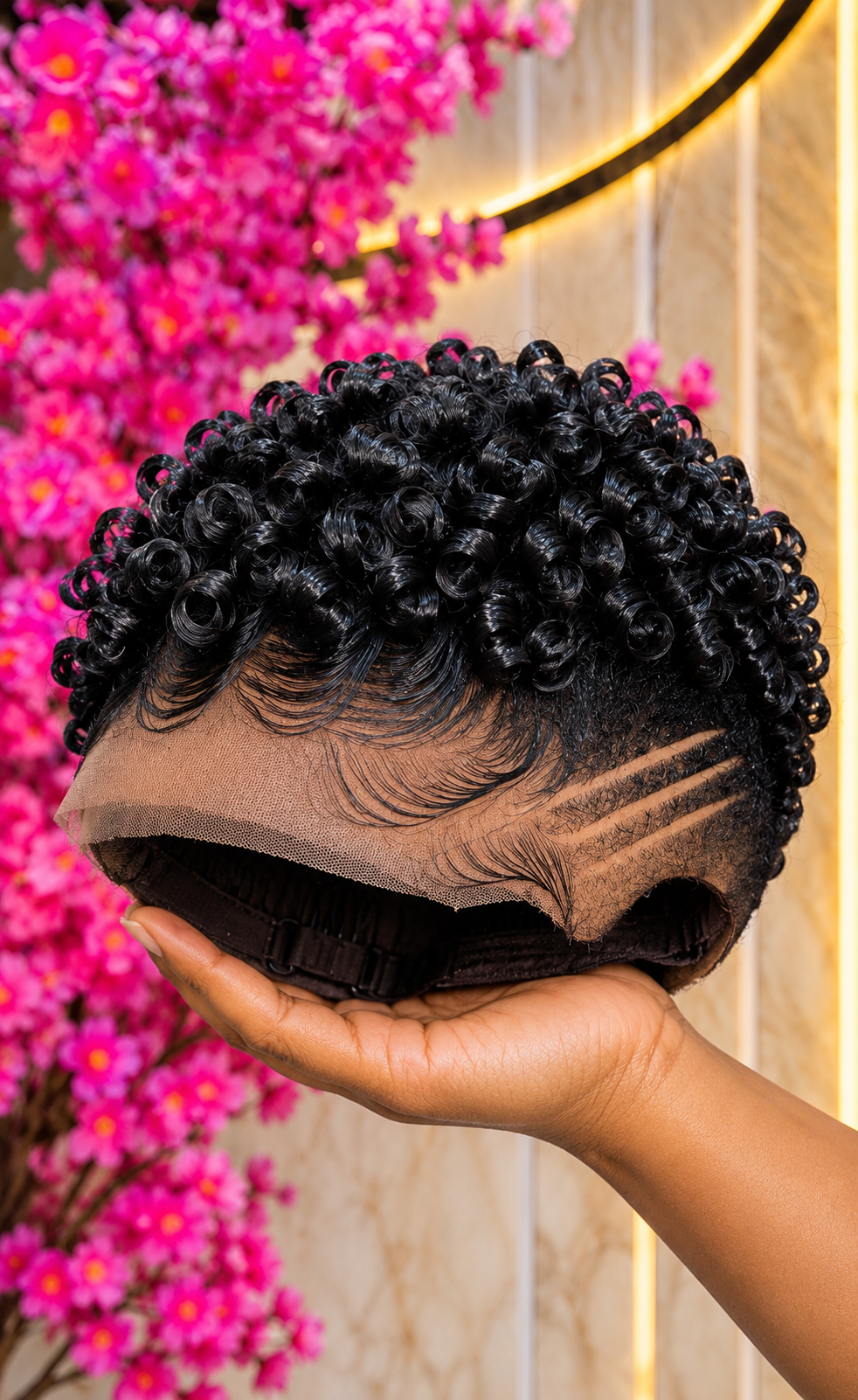
A short hairstyle can become a remarkable expression of creativity when glossy curls meet carefully arranged details around the temples. This striking jet-black pixie wig combines a densely curled crown, delicate sweeping hairline waves, and three parallel side accents that give the hairstyle its distinctive personality. The result is a beautiful combination of soft circular movement and precise geometric styling, offering an eye-catching interpretation of short curly hair.
The most captivating feature is the crown, which contains numerous compact ringlets arranged into a rounded silhouette. Each curl forms a small, open spiral with individual strands reflecting light along its curved surface. The curls vary slightly in diameter and position, creating a layered appearance without losing their recognizable circular shapes. Their deep black color enhances the glossy finish, allowing the raised coils to stand out against the darker foundation beneath them.
Along the front, carefully directed strands form graceful waves that sweep across the forehead. These flatter sections provide an attractive contrast to the raised ringlets above them. On the visible side, three narrow, parallel accents cut through the dark lower styling, producing a sharp design beneath the curled crown. The lines are positioned at a slight diagonal and gradually follow the direction of the side hair.


The photographed wig is supported in one hand, with its beige lace front extending beyond the styled hairline. The dark interior cap and adjustable fastening components remain visible underneath, showing the hairstyle before installation. The combination of a detailed hairline, compact crown, and decorative temple styling makes this piece especially interesting for women seeking a custom short wig rather than an ordinary curly hairstyle.
For women who enjoy jet-black curly pixie wigs with sculpted ringlets and distinctive side detailing, this design provides inspiration for professional styling appointments, personalized wig orders, and elegant short-hair fashion.
A Crown Filled with Glossy Midnight Ringlets
The upper section is dominated by a remarkable collection of small circular ringlets. Unlike loose curls that naturally fall around the face, these formations sit closely together across the crown, creating a full but compact silhouette.
Many of the curls have visible circular openings, giving them the appearance of carefully rolled spirals. Their smooth outer strands reflect light, while their darker centers create depth.
The placement of the ringlets is not perfectly uniform. Some face outward, revealing their complete circular structure, while others turn slightly sideways. This difference in orientation makes the crown appear more dimensional.
Smaller coils fill spaces between larger curls, creating a dense arrangement that remains visually organized. Rather than making the crown excessively tall, the curls follow its rounded outline.
This is an important distinction for anyone requesting a similar hairstyle. Ordinary curly wigs may feature springy, freely moving spirals, but the photographed style relies on compact rolled formations that retain a carefully sculpted appearance.
A professional stylist should preserve the circular openings and controlled positioning of the curls. Separating them too much would create a fluffy appearance and change the hairstyle’s character.
Why Jet Black Makes Every Curl More Noticeable
The hairstyle features an extremely dark black color with glossy reflections across the ringlets. The strands appear consistently black, without obvious contrasting color highlights.
What gives the crown dimension is the way light interacts with the circular shapes. Brighter reflections appear along the outer curves, while deeper shadows remain inside the tightly rolled formations.
This relationship between light and darkness creates a naturally layered visual effect.
The flatter front waves also reflect light, but their highlights follow longer, sweeping lines rather than circular paths. This allows the different styling techniques to remain recognizable even though they share the same color.
Customers seeking a comparable appearance can compare jet-black and natural-black hair samples. The exact commercial shade cannot be determined from a photograph alone, particularly when lighting conditions influence how glossy hair appears.
When communicating with a wig maker, requesting a deep black finish with consistent coloring will help avoid unwanted brown, blonde, or burgundy highlights.
Maintaining the dark color throughout the hairstyle also allows the intricate ringlets and temple accents to become the primary decorative elements.
The Triple Temple Accents That Set This Pixie Apart
One of the most recognizable characteristics of this hairstyle is the trio of narrow, parallel lines positioned along the visible side.
These accents sit beneath the tightly curled upper section, cutting through the shorter, closely arranged hair. They follow a slightly diagonal direction and extend toward the rear of the hairstyle.
The lines are visually distinct because the lighter separations contrast with the dark surrounding strands.
They resemble the precision detailing often seen in creative barbering, although this design is incorporated into a removable wig rather than being shown as an actual shaved haircut.
The spacing between the accents contributes to their appearance. They remain relatively close together, forming a coordinated pattern instead of unrelated individual markings.
Their placement also matters. Positioned below the ringlets, they create a clear division between the rounded crown and the compact lower side.
For women interested in reproducing this hairstyle, the side pattern should remain a three-line arrangement. Adding more stripes or replacing them with curved artwork would alter the visible design.
The Balance Between Curved Ringlets and Straight Accents
Short hairstyles often become more interesting when contrasting shapes are combined intentionally.
Here, the upper curls are predominantly circular, while the lower side accents follow straighter diagonal paths.
The contrast creates visual interest without making the hairstyle feel disconnected.
The crown has softness and volume because of the closely arranged ringlets. The lower side introduces precision and a geometric character.
Between these two areas, the smooth forehead waves provide a flowing transition.
As a result, the hairstyle incorporates three different visual movements: rounded curls, sweeping waves, and parallel side lines.
Each element occupies a separate area, allowing the design to remain organized.
This arrangement is particularly appealing to women who want a short haircut with distinctive details but do not want an overly complicated silhouette.
Elegant Front Waves Beneath the Curled Crown
The front hairline contains closely aligned strands arranged into broad, sweeping curves. These sections have a noticeably flatter appearance than the circular ringlets above them.
The waves travel across the forehead and gradually flow toward the temple area. Their smooth arrangement creates a decorative boundary beneath the full curled crown.
Some strands curve more prominently, producing gentle S-shaped movements. Others remain finer and more closely aligned, helping connect the larger waves to the hairline.
This style of front detailing is often associated with finger-wave techniques and carefully arranged edges.
However, the photograph shows a combination of broader swoops and fine hairline strands rather than identical traditional finger waves across the entire front.
When requesting a similar design, customers should show the stylist the exact wave placement.
The front waves should appear graceful and deliberately arranged without extending so far upward that they interfere with the ringlet crown.
How the Crown Creates a Rounded Pixie Silhouette
Despite the density of the curls, the hairstyle maintains the proportions of a short pixie.
The ringlets rise above the foundation but do not extend into long, hanging sections. Instead, they remain grouped closely together and follow the natural curve of the head-shaped cap.
The greatest fullness appears across the upper and central crown.
Toward the outer sides, the curls gradually become less prominent, allowing the shorter lower sections to remain visible.
This creates a recognizable difference between the full upper hairstyle and the compact lower styling.
The shorter silhouette can be appealing to women who prefer hairstyles that leave the neck and accessories unobstructed.
When commissioning a custom wig, customers should specify that the completed hairstyle must remain compact. A dramatically raised crown or longer curls around the sides would produce a noticeably different appearance.
The Importance of Curl Spacing and Placement
A dense ringlet hairstyle requires more than simply curling every strand of hair.
The arrangement of the individual curls determines whether the finished crown looks balanced or crowded.
In the photograph, numerous small ringlets are positioned close together, yet many retain visible openings.
This allows the circular formations to remain recognizable.
Curls positioned too tightly may merge visually, making the crown appear like one continuous mass of hair.
Excessive spacing, however, could create uneven gaps and weaken the rounded silhouette.
A skilled stylist needs to consider the shape and direction of neighboring curls while setting each section.
Close-up reference photographs can help communicate the desired density and arrangement, especially when the customer wants a faithful reproduction of the compact rolled appearance.
Choosing the Appropriate Starting Hair Length
The finished pixie appears short, but the original strands used to form the circular curls may be longer before styling.
Each ringlet wraps around itself, reducing the visible length considerably.
The amount of hair required depends on the diameter of the curl, how many times the strand is rolled, and the desired crown height.
Extremely short strands may not form complete circular openings.
Longer hair may create bulk or require additional setting to maintain the compact silhouette.
The exact starting length cannot be determined from the photograph.
Customers should therefore discuss the desired finished hairstyle with a professional rather than choosing a wig solely because of its advertised length.
A wig maker experienced in sculpted short curls can recommend an appropriate starting length based on the required shape and fiber composition.
Finding the Right Density for the Ringlet Crown
Hair density influences how full the upper curls appear and how comfortably the hairstyle can be worn.
The photographed crown is generously filled, with numerous ringlets positioned throughout the visible upper section.
However, the density percentage cannot be measured from an image.
Some manufacturers offer options such as 130%, 150%, and 180%, although these figures are not always standardized across suppliers.
For this hairstyle, the goal is not simply to select the highest available density.
The wig needs enough hair to support the closely arranged circular curls while maintaining the intended pixie proportions.
Excessively heavy construction may create unnecessary bulk, while insufficient hair may leave the crown looking sparse.
A professional should evaluate the desired curl size, cap design, and finished silhouette before recommending a density.
Understanding the Visible Lace Front
Beige lace extends along the front hairline of the photographed wig. The mesh remains visible because the piece has not yet been prepared for final installation.
The lace continues around the side, beneath the decorative strands and parallel accents.
This construction allows the hairline area to be examined while the wig is being held.
The visible mesh provides useful information about the styling foundation, but it does not confirm the exact lace grade, dimensions, or commercial construction type.
In particular, the photograph alone cannot establish whether the material is HD lace.
Customers should ask the manufacturer for specific details about the lace material, available coverage, and recommended installation method.
For a hairstyle with carefully arranged front waves and side accents, the quality of the lace preparation can influence the overall finished appearance.
Interior Cap Construction and Securing Components
The lower opening reveals a dark interior cap with visible stitching and adjustable fastening components.
These details provide a useful look at the construction supporting the curled crown.
However, the photograph does not show every interior feature or establish the complete cap specifications.
Customers should request additional underside photographs when purchasing a similar wig.
Important questions include the available cap measurements, adjustment range, fastening system, and whether additional combs or securing components are included.
A properly fitted foundation is especially important for this hairstyle because the decorative temple lines need to remain positioned correctly.
If the wig shifts during wear, the side accents and sweeping front waves may no longer sit where intended.
Accurate fitting and suitable securing features help preserve the visual arrangement.
Choosing Between a Lace Closure and a Frontal
Different wig foundations provide different amounts of lace coverage around the front hairline.
A lace closure generally covers a smaller area, while a frontal may extend farther across the forehead and temples.
For this particular design, the visible temple accents and detailed forehead styling may influence the most suitable construction.
The photograph does not confirm the exact closure or frontal dimensions.
Customers should therefore request the manufacturer’s specifications before placing an order.
A wig maker can recommend the appropriate foundation after reviewing the intended hairline design, parting requirements, and installation preferences.
The right construction should support the hairstyle without introducing unnecessary complexity or discomfort.
Can This Pixie Wig Be Worn Glueless?
Glueless wigs can be attractive to women who prefer wearing and removing their hairstyles without adhesive.
The visible fastening components suggest that the cap includes some form of adjustment, but this alone does not confirm a fully glueless design.
Whether adhesive-free wear is appropriate depends on the construction, cap size, and stability of the securing system.
Customers should ask the seller whether the wig is specifically intended for glueless installation.
A properly fitted unit should remain comfortable while allowing the front styling to sit in its intended position.
For this hairstyle, stability is particularly important because the front waves and side accents need careful alignment.
A professional fitting can help determine whether glueless installation is suitable or whether another method would offer better retention.
Human Hair or Synthetic Hair for Compact Ringlets?
The type of hair used can significantly influence the maintenance and longevity of the sculpted curls.
Human hair may offer flexibility for professional resetting after washing, depending on its quality and previous processing.
Suitable synthetic fibers may retain pre-formed curls, although their heat tolerance and restyling possibilities vary.
The photograph’s shiny appearance does not establish the fiber composition.
Customers should request written confirmation of whether the unit contains human hair, synthetic fiber, or a blend.
It is also important to ask which methods are recommended for restoring the circular curls after repeated wear.
Using inappropriate heat tools or styling products could damage the material or change the carefully arranged ringlets.
The best option depends on budget, preferred maintenance routine, and how frequently the wig will be worn.
Where to Get This Hairstyle Done
Women interested in recreating this look can consult professional wig makers, experienced hair stylists, and salons specializing in short sculpted hairstyles.
A stylist familiar with rolled curls can help create the tightly arranged ringlet crown.
Experience with precision side styling is also important because the three parallel temple accents contribute significantly to the finished design.
For natural hair, a barber may help create the lower side pattern before the upper curls are styled.
For wigs, the decorative lines must be created or arranged within the hairpiece itself.
Before booking, review the professional’s previous work for examples of compact curls and carefully styled sides.
Close-up photographs are particularly useful because they reveal whether the stylist can maintain clean separations and consistent curl shapes.
Bring the reference photograph to the consultation and discuss the exact details you want preserved.
Recreating the Design on Natural Hair
A similar hairstyle may be possible on natural hair, depending on length, texture, density, and condition.
The upper hair must be long enough to create recognizable rolled ringlets.
The lower side needs to support a closely shaped section with three narrow decorative accents.
Some clients may achieve comparable results through professional curl setting combined with careful barbering.
Others may need alternative techniques depending on the natural hair texture.
Because the wig combines several specialized styling elements, an exact reproduction cannot be guaranteed for every hair type.
A professional consultation can help establish realistic expectations.
Women who prefer not to cut or carve decorative lines into their natural hair may find a customized wig particularly appealing.
What to Tell Your Professional Stylist
Explain that you want a compact jet-black pixie with a full crown of small, glossy, circular ringlets.
The curls should remain closely arranged and individually recognizable, rather than becoming fluffy or loosely separated.
Ask for broad, sweeping hairline waves beneath the curled crown.
The visible side should contain three narrow, parallel diagonal accents that contrast with the dark lower styling.
Specify that the design must remain short and rounded, without long hanging curls or unnecessary height.
For a custom wig, discuss the cap measurements, lace coverage, density, fiber composition, and preferred installation method.
Ask whether the stylist will complete the ringlet setting and decorative side pattern before delivery.
Providing detailed visual references helps communicate the intended appearance more effectively than using a generic description such as short curly wig.
Where to Buy Similar Jet-Black Ringlet Pixie Wigs
Comparable hairstyles may be available through independent wig makers, professional salons, specialist hair boutiques, and online wig retailers.
Useful searches include jet-black ringlet pixie wigs, short circular coil lace wigs, and curly pixie wigs with three temple lines.
However, standard ready-made curly wigs may not reproduce the exact combination shown in the photograph.
Some products have loose curls without the tightly rolled circular formations.
Others may offer a similarly compact crown but lack the parallel temple accents.
Customers should examine actual product photographs showing the crown, front hairline, and side styling.
When the precise details matter, custom construction may provide greater control over the final appearance.
The photograph does not identify a verified manufacturer or confirmed retail listing for this exact unit.
Where This Wig Comes From
The wig is photographed in a beauty-salon setting, but the image alone does not establish who manufactured it or where it is sold.
Customers seeking this exact hairstyle should use the photograph when contacting specialist wig makers and professional salons.
Ask whether they can recreate the rounded ringlet crown, sweeping front waves, and three parallel temple accents.
Request examples of previous work featuring similar short sculpted hairstyles.
Confirm the available hair materials, cap sizes, lace options, and density choices.
Ask whether the completed unit will arrive fully styled and how the curls should be maintained after washing.
Before payment, obtain a complete quotation covering customization, shipping, and any additional installation services.
For personalized orders, request photographs of the finished wig before shipment whenever possible.
Ready-Made Wigs Compared with Custom Construction
A ready-made black curly pixie may be sufficient for women who want the general appearance of a short, full curled hairstyle.
These products can offer a convenient purchasing process and a variety of cap types.
However, the temple accents and precisely arranged ringlets may not be available on standard designs.
Custom wig makers can discuss individual curl size, crown height, hairline direction, and side detailing.
They may also provide greater flexibility in selecting the cap construction and securing system.
The additional work involved in personalized styling can increase the final price.
Customers should consider whether they want a general resemblance or a close reproduction of the distinctive elements.
For women who consider the three-line temple pattern essential, customization may be the more appropriate route.
Estimated Prices for Ringlet Pixie Wigs
Pricing depends on hair material, construction, density, lace coverage, customization, and the time needed for detailed curl setting.
The following USD ranges are illustrative budgeting estimates, not verified current quotations or the confirmed selling price of the pictured unit.
| Price Tier | Estimated Price Range | Typical Features |
|---|---|---|
| Budget | $35–$95 | Basic synthetic curly pixies with conventional ringlets and limited side customization. |
| Value | $85–$195 | Pre-styled short black wigs with fuller curled crowns and simple decorative hairline styling. |
| Mid | $150–$350 | Human-hair or specialty base wigs requiring additional ringlet setting and temple detailing. |
| Premium | $275–$610 | Customized circular ringlets, precision side accents, tailored cap fitting, and professional finishing. |
| Salon-Grade | $495–$1,100+ | Individual cap construction, extensive hand-setting, specialized lace preparation, and detailed salon styling. |
Additional expenses may include installation, shipping, cap adjustments, lace preparation, and professional maintenance.
Customers should compare complete quotations and ask what services are included before ordering.
Maintaining the Small Circular Ringlets
The tightly arranged ringlets require gentle handling because their circular formations are central to the hairstyle.
Brushing or repeatedly separating the curls may loosen their structure and change the appearance of the crown.
Customers should avoid pulling the coils apart simply to increase volume.
The correct care routine depends on the actual hair material and original setting technique.
Human hair may require suitable conditioning and controlled professional resetting.
Synthetic fibers should be maintained according to the manufacturer’s instructions, particularly concerning heat exposure.
If the curls become flattened, a professional experienced in sculpted ringlets may be able to restore their arrangement.
Preserving individual curl shapes helps maintain the dense, decorative character of the hairstyle.
Protecting the Decorative Temple Lines
The parallel temple accents require careful maintenance because their appearance depends on the surrounding strands remaining correctly positioned.
Brushing across the lines may disturb their alignment.
Excessive styling products can also create buildup and make the separations less visible.
The appropriate maintenance method depends on how the accents were constructed within the wig.
Unlike shaved lines on natural hair, decorative details on a wig may not require periodic barbering, but they can require strand repositioning or professional refreshing.
Customers should ask the maker whether the side pattern can be maintained at home or needs salon attention.
Careful handling around the lace and lower foundation can help protect the styling and prevent unnecessary damage.
Keeping the Sweeping Hairline Waves Intact
The front waves have a different structure from the rolled ringlets and should be maintained accordingly.
Their appearance relies on closely aligned strands following broad, graceful curves.
Repeated rubbing or brushing against the original direction can disturb the arrangement.
Customers should use only products suitable for the wig’s fiber composition.
Applying excessive styling product may create buildup and reduce the clarity of the individual strands.
The lace around the hairline should be handled gently during installation and removal.
If the waves lose their intended shape after washing, professional resetting may be necessary.
Maintaining the front waves preserves the softer transition between the curled crown and the geometric temple accents.
A Practical Maintenance Routine for Regular Wear
The appropriate care schedule depends on wearing frequency, fiber composition, product use, and environmental conditions.
After each use, inspect the crown for flattened or displaced ringlets.
Check whether the temple accents remain visible and properly aligned.
Examine the front waves for changes in direction.
Inspect the lace and interior cap for signs of wear or damage.
Washing frequency should follow the manufacturer’s recommendations rather than a universal timetable.
During washing, minimize unnecessary friction around the delicate curled sections.
After cleansing, dry and reshape the wig using methods suitable for its material.
Periodic professional maintenance may be beneficial when the original design requires extensive resetting.
Storing the Crown Without Flattening Its Curls
Proper storage helps protect the compact ringlets and rounded silhouette.
The crown should not be compressed beneath heavy clothing or other objects.
A suitable wig stand or storage form may provide support between uses.
Ensure the unit is clean and completely dry before extended storage.
When placing it inside a box, allow adequate space for the curls to retain their shape.
Avoid unnecessary pressure against the decorative side accents.
Handle the lace, adjustment components, and cap stitching carefully.
Following the manufacturer’s recommended storage conditions may reduce the need for frequent professional restyling.
Fashion Choices That Complement the Jet-Black Curls
The consistently dark color makes this hairstyle easy to coordinate with many wardrobe choices.
For formal occasions, the sculpted ringlets provide decorative interest without requiring additional hair accessories.
Gold earrings can complement the glossy black finish, while pearl studs create a softer appearance.
For portrait photography, a three-quarter angle can emphasize the parallel temple accents and the rounded crown.
Cream, white, burgundy, emerald green, and warm brown clothing can create attractive contrasts with the dark hair.
The short silhouette also allows earrings and necklines to remain visible.
Women who prefer understated accessories may find that the hairstyle already provides enough decorative detail.
For frequent wear, consider whether the sculpted curls can be maintained comfortably within the intended daily routine.
Advantages of This Short Curly Design
One advantage is the ability to create noticeable crown fullness without long hair.
The tightly rolled ringlets provide dimension while maintaining a compact shape.
The three temple accents introduce a distinctive geometric detail that separates the hairstyle from ordinary curly pixies.
The sweeping forehead waves soften the transition between the curled upper section and the closely shaped lower side.
The jet-black color allows the intricate styling to remain the main focal point.
Another advantage is the option to recreate the appearance through a removable wig.
This can allow women to explore decorative side patterns without permanently altering their natural hair.
For those who enjoy short hairstyles with precise finishing, the design offers a beautiful balance of curls, waves, and geometric accents.
Potential Limitations to Consider
The densely arranged ringlets may require more specialized maintenance than ordinary loose curls.
Repeated washing, brushing, or compression can disturb their carefully rolled shapes.
The temple accents may also need professional attention if the surrounding strands become displaced.
Custom wig construction can cost more than purchasing a basic ready-made pixie.
Some women may prefer hairstyles with simpler maintenance routines.
Before ordering, consider wearing frequency, cap comfort, available budget, and access to professional restyling services.
A professional consultation can help determine whether the hairstyle is appropriate for regular wear or occasional events.
Checking the Wig Before Its First Installation
When a completed custom unit arrives, compare it carefully with the approved reference photograph.
The crown should contain numerous recognizable circular ringlets with a compact rounded outline.
The jet-black coloring should match the agreed specifications.
The front should feature broad sweeping waves beneath the curled crown.
The lower side should contain three narrow, parallel decorative lines.
Check that the design retains its intended short proportions without unnecessary height or length.
Inspect the lace, interior cap, and fastening components before trimming or making permanent adjustments.
Confirm that the unit fits comfortably and that the decorative side pattern sits in the correct position.
If important details differ from the agreed order, discuss them with the seller before installation.
The Distinctive Appeal of Sculpted Ringlets and Temple Details
This hairstyle illustrates how intricate curl styling and precise side detailing can transform a short pixie into a memorable salon creation.
The glossy circular ringlets provide fullness and beautiful movement across the crown, while the three parallel temple accents introduce a striking geometric contrast.
The sweeping front waves connect these elements, adding elegance and softness beneath the densely curled upper section.
Its deep black coloring emphasizes every curve and reflection, allowing the shape of the strands to become the main attraction.
For women seeking a similar hairstyle, the most important characteristics are compact rolled ringlets, a rounded crown, broad hairline waves, and carefully positioned temple accents.
With suitable professional customization, accurate cap fitting, appropriate hair material, and thoughtful maintenance, this design offers a compelling combination of classic pixie proportions and elaborate short-hair artistry.
Search Terms
Jet black ringlet crown pixie · Short black wig with three temple lines · Glossy circular coil lace front · Midnight black curly pixie side stripes · Small rolled ringlets with swooped edges · Black compact curl crown wig · Triple diagonal temple accent pixie · Short black sculpted ringlets with finger waves