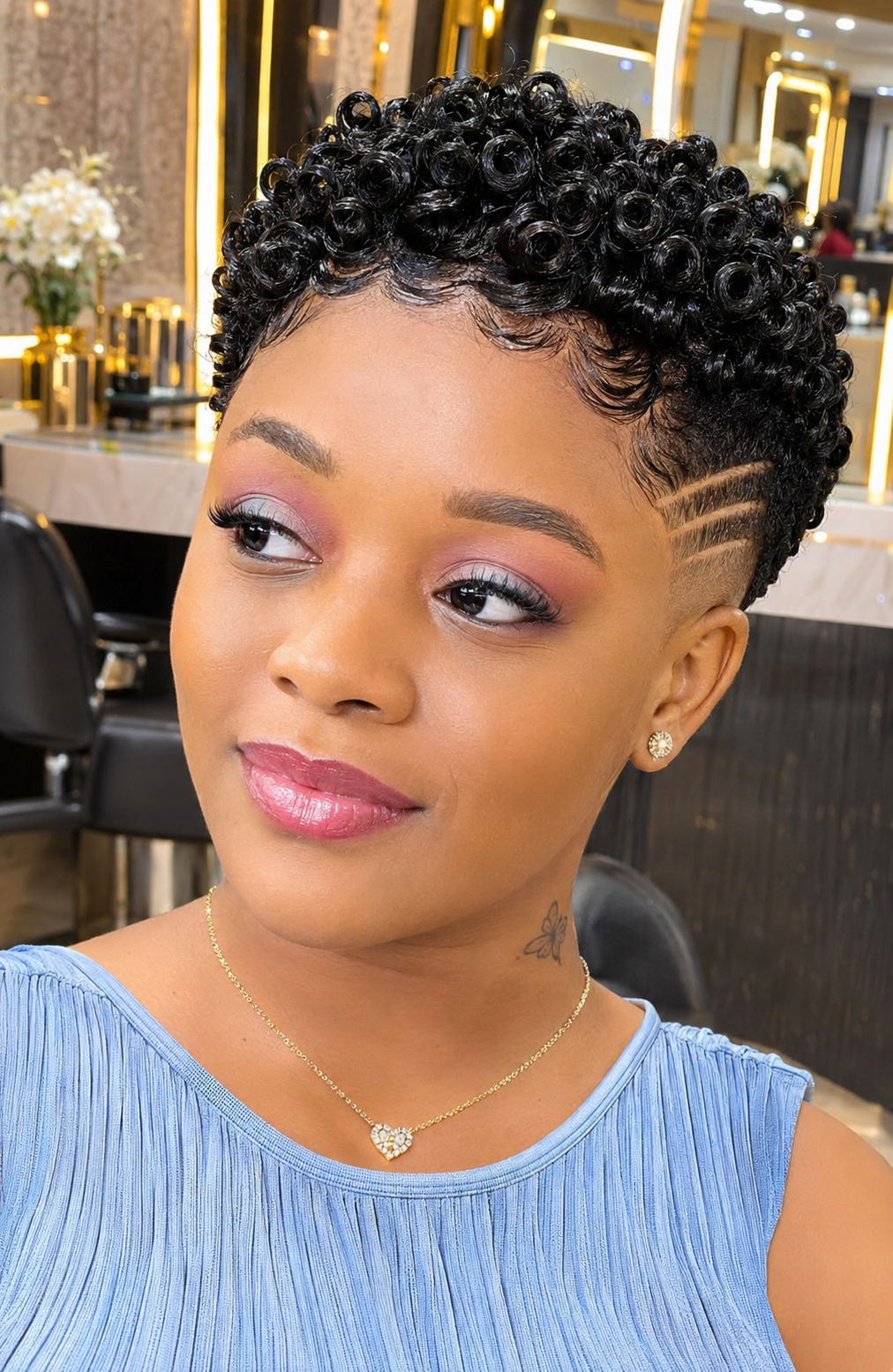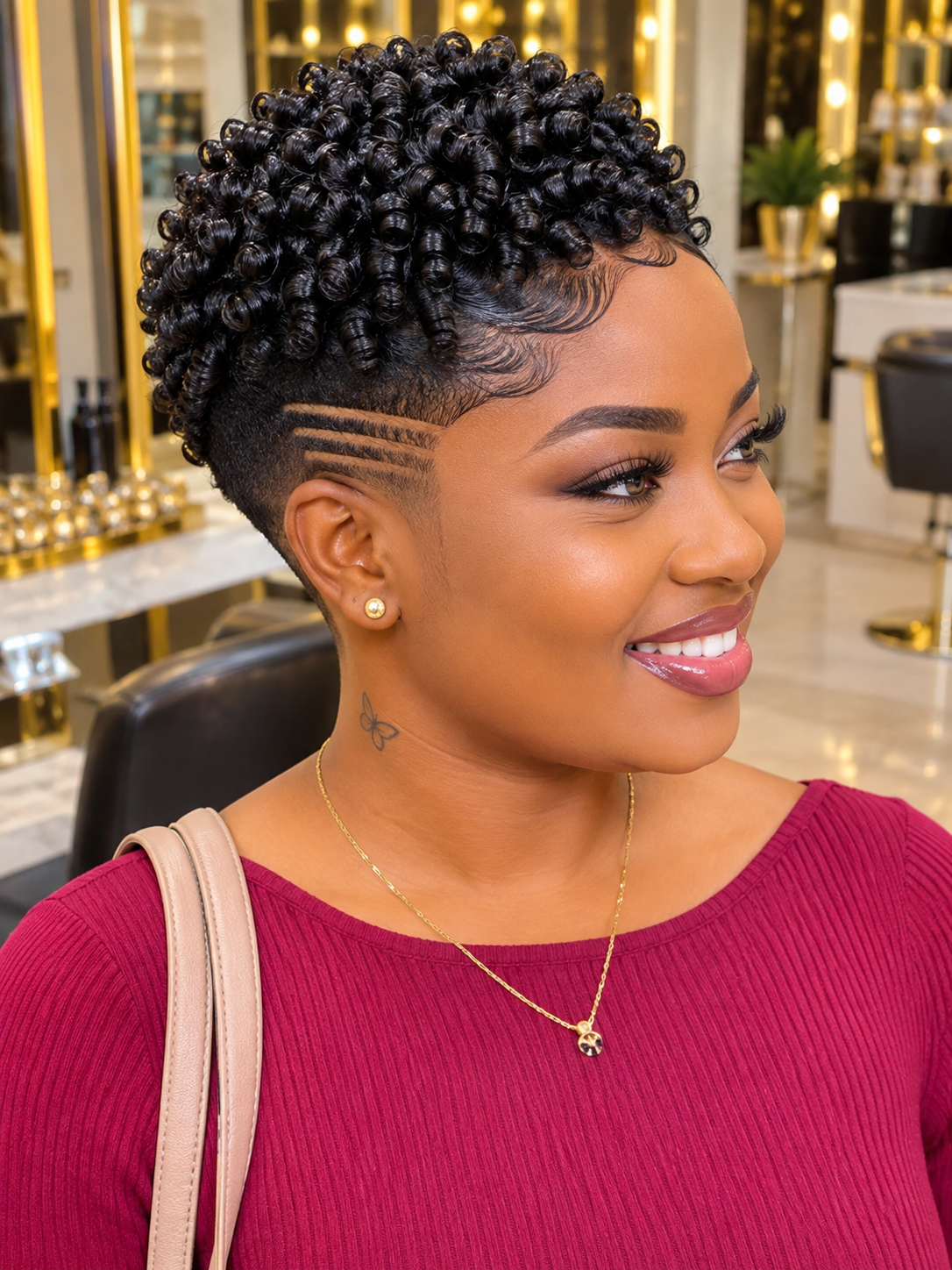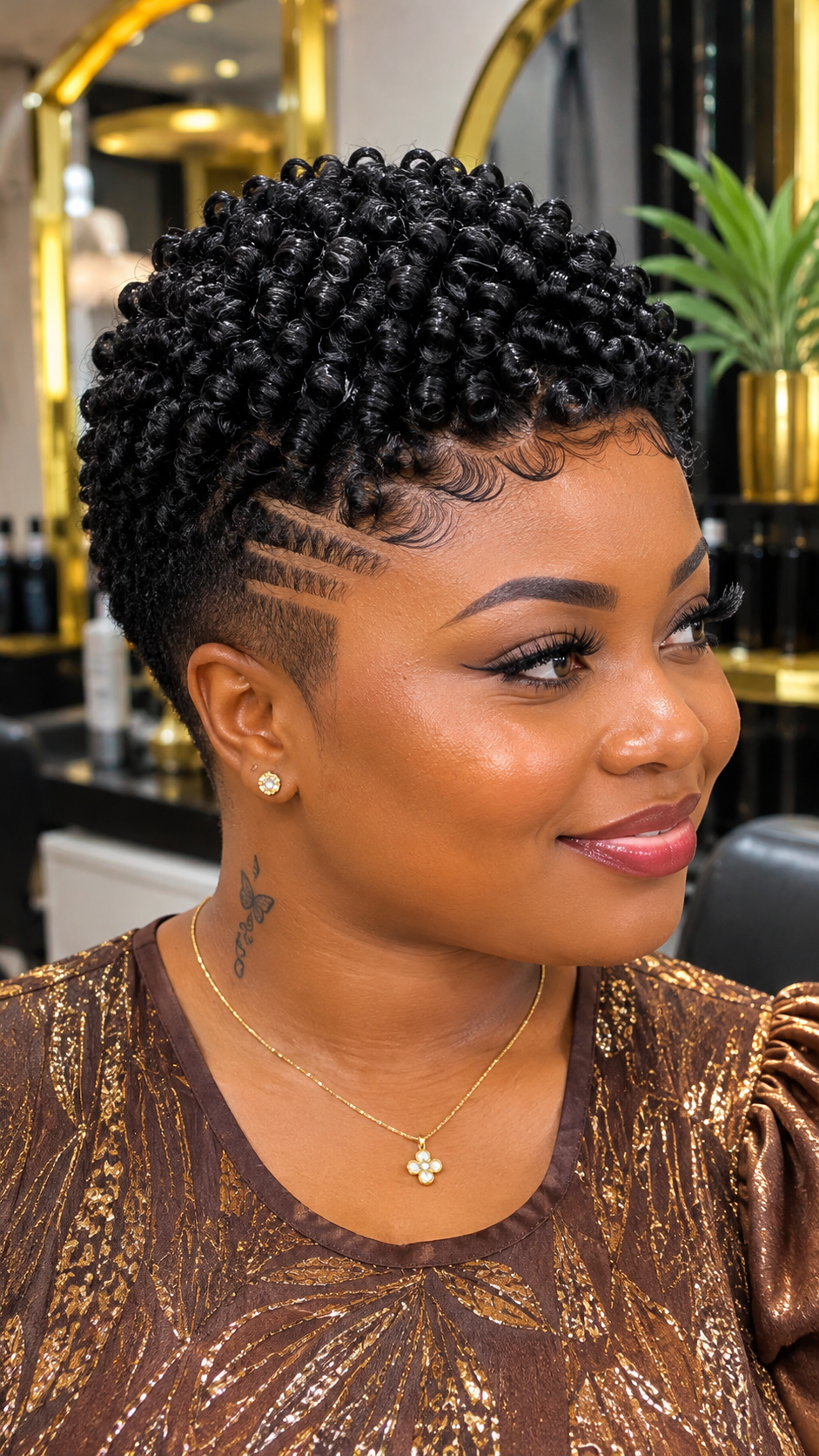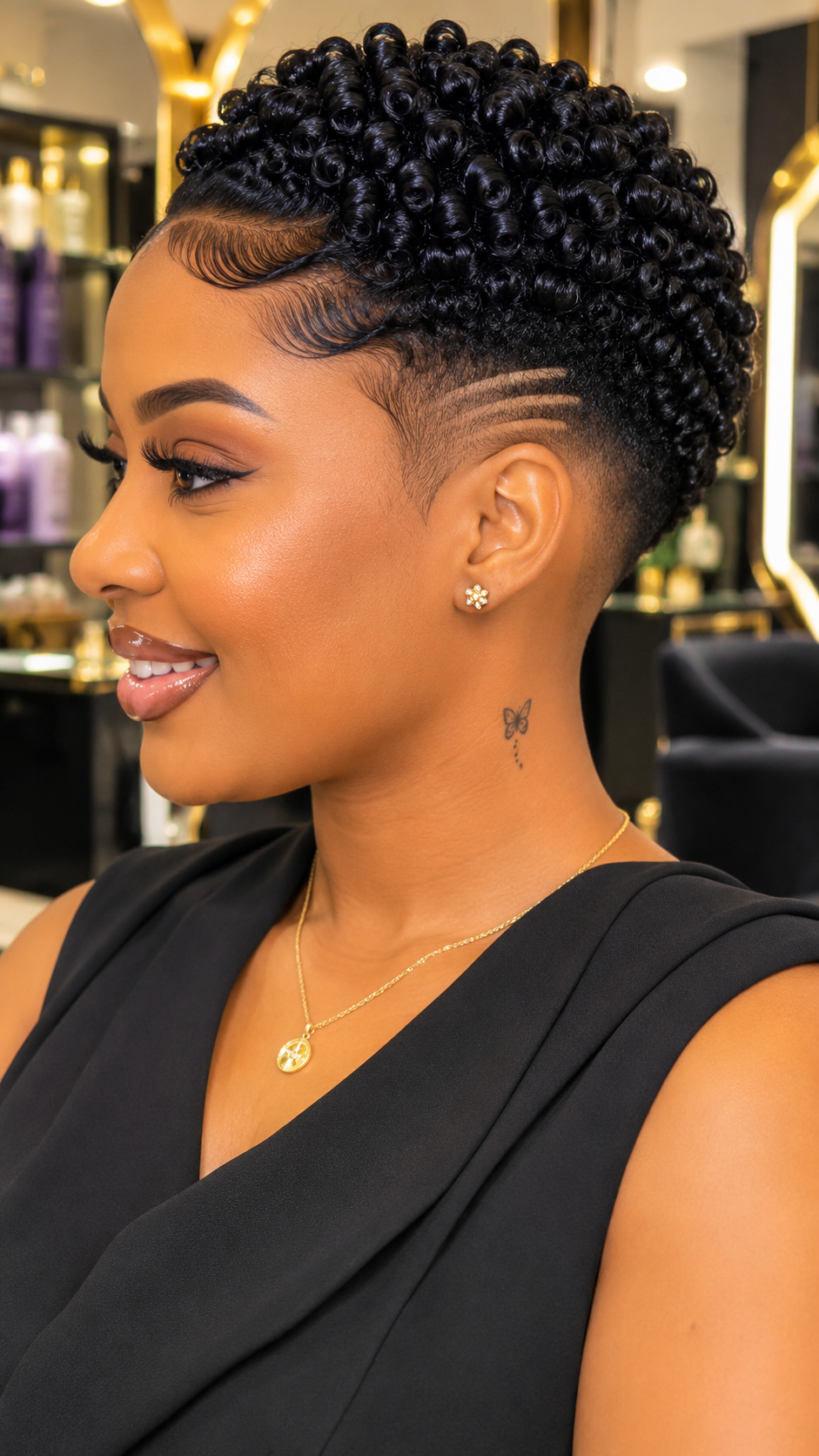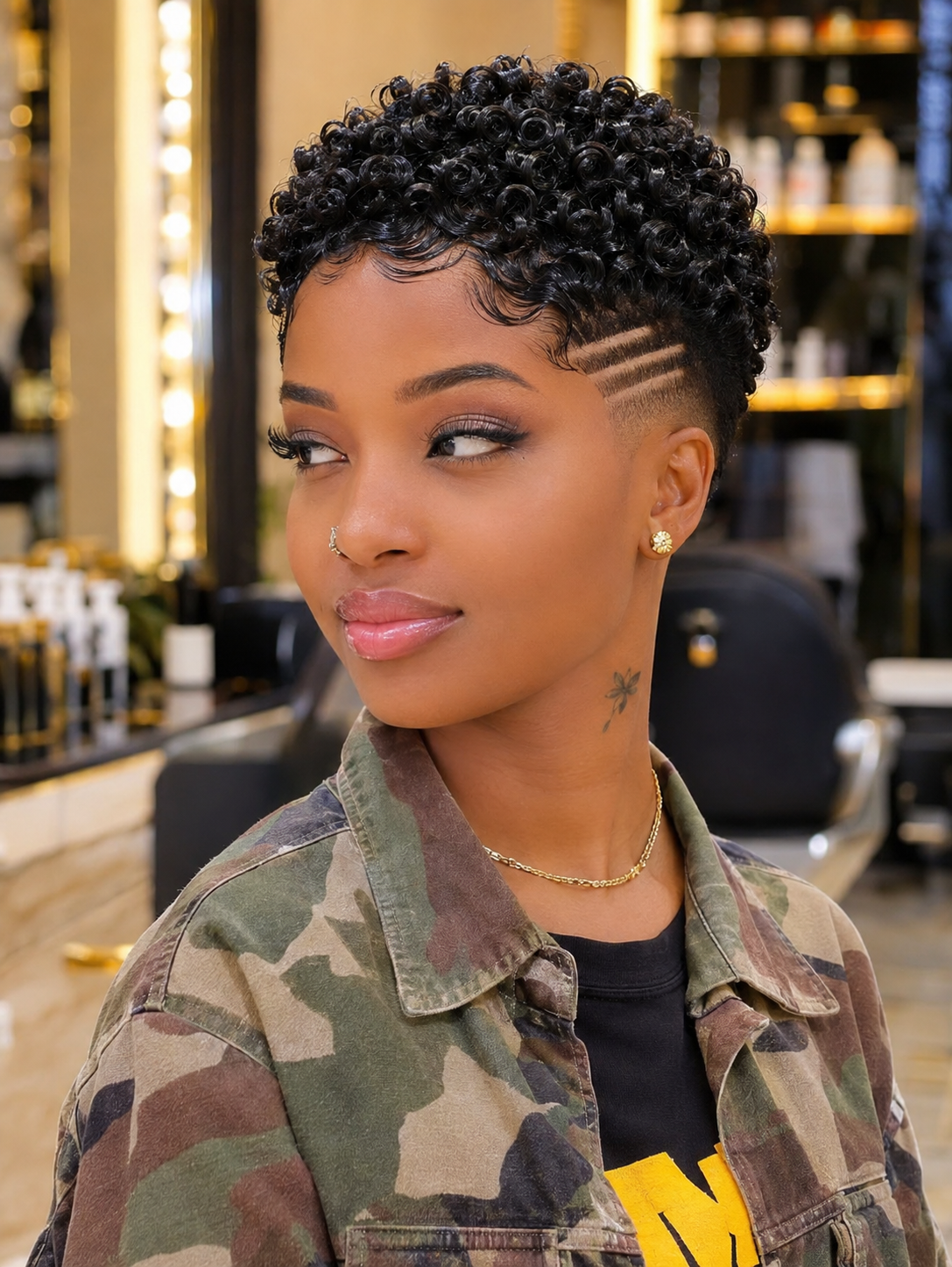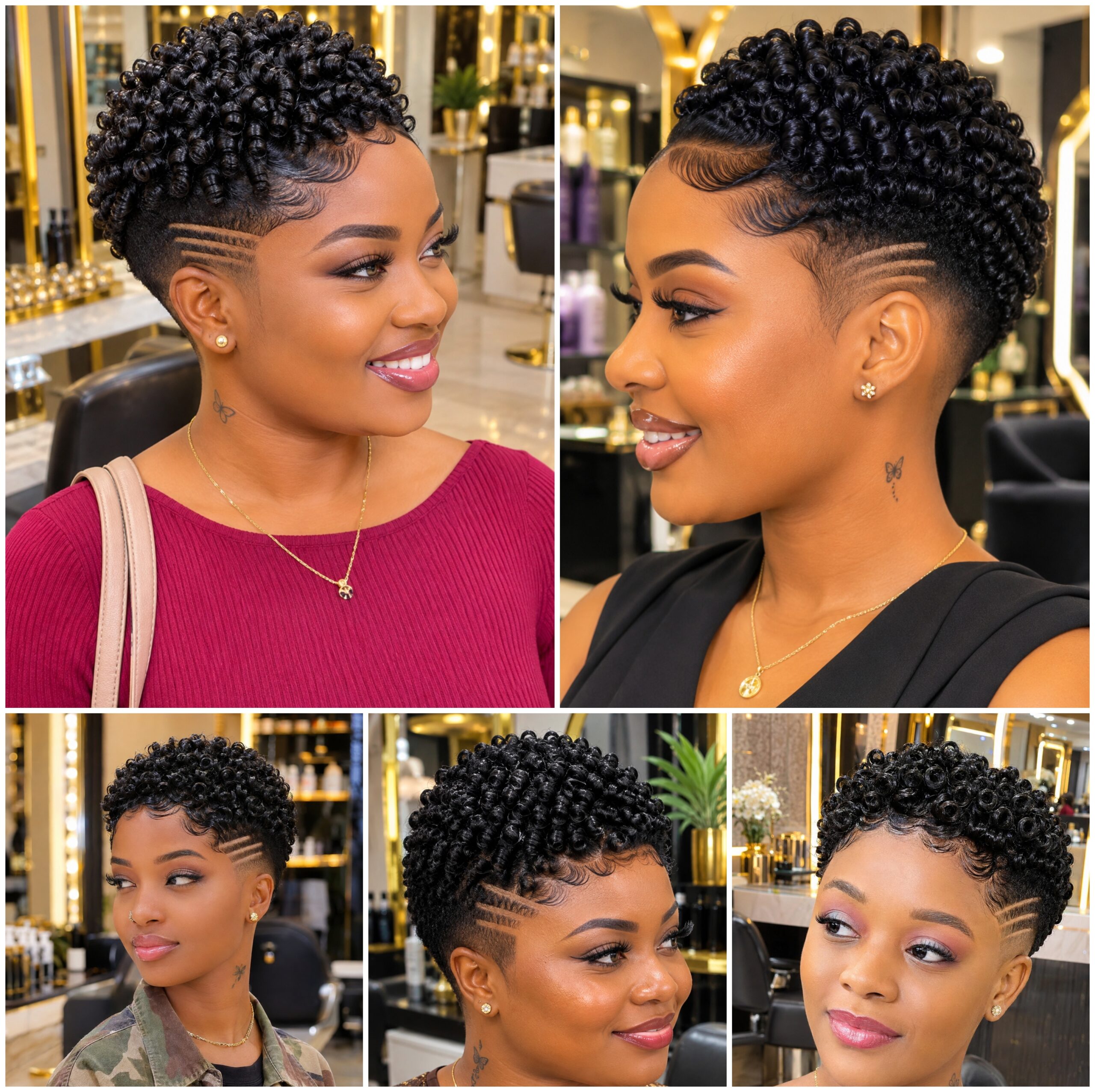
A jet black coil fade brings together the fullness of tightly curled hair and the precise appearance of a closely tapered haircut. Adding two side lines introduces another level of detail, creating a hairstyle that feels expressive without depending on bold colors or excessive length. The result is a compact, sculpted look that draws attention to the relationship between the coiled upper section, the faded sides, and the carefully positioned decorative lines.
For women who appreciate short natural hairstyles, curly pixie cuts, and barber-inspired hair designs, this combination offers several possibilities. The upper coils can remain rounded and compact or carry slightly more volume, while the faded sides provide a close-fitting contrast. Two parallel side lines create a recognizable accent, particularly when positioned around the temple.
The name describes a hairstyle concept rather than a verified product photograph. Therefore, the exact curl diameter, hairline construction, fade height, and side-line geometry may vary between interpretations. A natural-hair version may be created by a professional barber and hairstylist, while a wig version requires suitable construction and sufficient hair coverage for the intended design.


Understanding these differences is especially useful when deciding whether to book a salon appointment, purchase a ready-made pixie wig, or commission a custom unit. The following considerations explain how the hairstyle can be developed, what to discuss with a professional, and how to evaluate the finished result before committing to a particular option.
The Appeal of a Crown That Contrasts with the Sides
The character of this hairstyle comes from two contrasting areas. The upper section carries the coiled hair, while the sides are cut or constructed to appear noticeably closer to the head. This contrast makes the curls more prominent even when the overall hairstyle remains relatively compact.
The coils may be created with naturally curly hair, finger-coiling techniques, or suitable wig fibers arranged into rounded formations. Their exact appearance depends on strand length, curl diameter, density, and styling method.
Small, tightly grouped coils produce a concentrated appearance with numerous individual curls. Larger coils create more visible openings and can make the crown appear softer and fuller.
Neither arrangement is automatically better. The appropriate choice depends on the desired silhouette and the amount of maintenance the wearer is prepared to manage.
The fade provides a different visual quality. By reducing volume along the sides, it creates a gradual progression from the fuller upper hair toward the temple and lower perimeter.
For natural hair, this progression may be achieved using professional clipper techniques. For a wig, the appearance must be created through suitable cutting, strand placement, or construction.
Twin Side Lines Introduce a Distinctive Accent
Two side lines can transform a conventional coil fade into a more recognizable hairstyle. Their impact depends less on their width than on their placement and relationship to the surrounding hair.
The lines are commonly positioned near the temple, where they contrast with the closely fitted side. They may run diagonally backward, follow a gentle curve, or create a more angular appearance.
A pair of parallel lines generally creates a balanced result because both separations follow related directions.
The surrounding hair must remain sufficiently dense to make the lines visible. If the side is cut extremely close, the contrast between the exposed channels and neighboring hair may become less noticeable.
Likewise, overly wide channels can dominate the hairstyle and reduce the visual importance of the coils above.
Choosing Straight or Curved Side Accents
Straight lines create a sharp, geometric impression. Curved lines can follow the shape of the head and create a flowing transition toward the rear.
For a compact curly pixie, gently curved lines may provide a connection between the rounded upper coils and the tapered side.
However, the decision should be made before cutting or wig customization begins.
For natural hair, an experienced barber can discuss suitable line placement according to the existing fade and hair density.
For wigs, the maker must consider how much hair is attached to the foundation and whether removing strands could expose the cap.
A photograph of the desired line direction is helpful when communicating with a professional.
Jet Black Hair Makes Every Detail More Noticeable
Deep black coloring allows the hairstyle to emphasize curl placement and cutting precision rather than contrasting highlights.
Light reflects along the outer surfaces of the coils, while darker areas appear between their overlapping strands. These changes create visual depth across the crown.
The faded side provides another contrast because shorter hair generally reflects light differently from raised curls.
The side lines can become noticeable through the separation between darker surrounding hair and the lighter scalp or underlying surface.
However, on a wig, the appearance of those channels depends on the foundation and construction method. Exposing lace or cap fabric does not necessarily reproduce the appearance of a natural shaved line.
Buyers should therefore evaluate the line work carefully rather than assuming that any dark curly wig can be modified successfully.
Natural Black Versus Intense Jet Black
Hair suppliers often distinguish between natural black and jet black color options.
Natural black may contain subtle brown undertones, while jet black typically appears deeper and more uniform.
Color descriptions vary across manufacturers, so requesting actual photographs is preferable to relying exclusively on a product color number.
When purchasing a wig, ask for photographs under daylight and neutral indoor lighting.
If the hairstyle will be created using natural hair, discuss whether the existing color already provides the desired appearance before considering additional coloring.
Coil Size Changes the Personality of the Fade
The coiled upper section can be styled in several ways, and the choice influences both appearance and daily care.
Fine finger coils produce small, closely arranged spirals. Their compact size can create a richly detailed crown even when the hair is relatively short.
Medium coils provide more noticeable circular formations and may create additional visual separation between individual curls.
Larger curls can introduce greater fullness, although they may require enough strand length to maintain their rounded shapes.
For a hairstyle emphasizing side-line precision, the coils should complement rather than overwhelm the lower design.
A balanced arrangement keeps the crown prominent while leaving the temple accents visible.
Matching Curl Diameter to the Desired Silhouette
Before booking an appointment, decide whether the preferred crown should appear tightly packed or more openly curled.
For natural hair, the stylist can assess the existing curl pattern, length, and styling potential.
Some hair types may require specific setting methods to achieve consistent finger coils.
For wigs, the intended curl diameter should be discussed with the manufacturer.
Ask whether the curls arrive in their finished form and what happens to them after washing.
This information is particularly important for sculpted curls that may require professional resetting.
Fade Height Influences the Overall Balance
A low fade concentrates the shortest hair near the lower temple and perimeter. It generally preserves more coverage above the faded section.
A mid fade introduces a stronger transition through the side, making the difference between the upper coils and lower hair more noticeable.
A higher fade removes more side volume and may create a more dramatic silhouette.
For a design containing two side lines, the available space around the temple should influence the chosen fade height.
If the fade extends too high, there may be insufficient hair coverage for the desired decorative lines.
If the side remains too full, the channels may be obscured by surrounding strands.
The best approach is to plan the fade and line placement as related elements.
Where to Get the Hairstyle Done
For natural hair, look for a barber or hairstylist experienced in women’s tapered cuts, precision hair designs, and finger-coil styling.
A barber may be particularly useful for creating the faded side and decorative lines. A curl specialist can help establish the upper coils and recommend a suitable maintenance routine.
Some salons offer both services through the same professional or team.
When contacting a salon, explain that the requested hairstyle combines a curly crown, faded sides, and two decorative temple lines.
Ask whether the appointment includes both cutting and curl styling, or whether the services require separate bookings.
For customers who prefer wearing a wig, seek a stylist experienced in cutting and fitting compact lace pixies.
Not every barber who works with natural hair will necessarily have experience modifying wig foundations.
Preparing for the Consultation
Bring reference photographs showing the preferred coil size and side-line arrangement.
Discuss whether the lines should be straight, curved, or angled backward.
Ask the stylist to assess whether the existing hair length and density can support the requested crown.
If the hairstyle involves natural hair, clarify how frequently the fade and side lines may need refreshing.
If a wig is being customized, discuss the risks of cutting into the foundation before agreeing to any permanent changes.
Buying a Similar Coil Fade Wig
Ready-made pixie wigs can provide a starting point for this hairstyle, but buyers should examine more than the product’s general description.
A conventional black curly pixie may contain the correct crown texture without a faded side or decorative lines.
Another unit may have a close-fitting side but use loose curls instead of compact coils.
To find a closer match, search for specialist wig makers who have experience with sculpted curl arrangements and barber-inspired side designs.
Local wig boutiques offer the advantage of examining the unit before purchasing.
Online wig retailers and independent makers may provide additional options, particularly for custom orders.
However, a seller should not be assumed to offer a specific design without confirmation.
What to Request From an Online Seller
Ask for clear photographs of the front, both sides, crown, rear, and complete interior.
Confirm whether the side lines are already incorporated into the unit or need to be added after purchase.
Request details about the fiber composition, cap measurements, lace construction, fastening hardware, and available density options.
If the wig is described as glueless, ask the seller to explain which components support adhesive-free wear.
Do not assume that a visible elastic band or comb automatically establishes this capability.
Ask whether the curls are pre-set and whether the hairline can be customized without damaging the foundation.
Custom Wig Construction for a More Precise Result
A custom wig may be preferable when accurate side-line placement is a priority.
The maker can plan the relationship between the crown, side coverage, and decorative channels before construction is complete.
This is important because removing hair from an unsuitable ready-made unit can create permanent gaps.
A custom maker may also offer options for crown fullness, curl diameter, and finished length.
For a design with a closely fitted side, ask how the taper will be represented and whether the cap foundation could become visible.
The final result depends on construction quality and professional skill rather than the custom label alone.
Closure, Frontal, and Other Cap Options
Different wig constructions provide different areas of lace coverage and styling flexibility.
A frontal may offer broader lace coverage around the front and sides, depending on its dimensions.
A closure generally provides a more limited lace area, which may influence how decorative side styling can be incorporated.
Other cap constructions may also be suitable, depending on the intended design.
The correct option should be selected through consultation with the maker rather than assuming one construction works for every coil fade.
HD lace should only be requested as a verified specification, not assumed from a product photograph.
Illustrative Pricing for Jet Black Coil Fade Styles
The following USD ranges are illustrative planning estimates rather than verified live retail prices. They represent possible purchasing categories and should not be interpreted as quotations from specific suppliers.
| Wig Category | Illustrative USD Range | What May Affect the Price |
|---|---|---|
| Premium Custom | $340–$820+ | Individual sizing, detailed coil styling, carefully planned fade appearance, and precision twin-line temple work. |
| Standard Custom | $185–$445 | Selected cap construction with personalized curl diameter and decorative side styling. |
| Basic Human Hair | $110–$295 | A human-hair starting unit that may require cutting, coil setting, and specialist side customization. |
| Premium Synthetic | $80–$215 | A manufactured curly pixie with preformed coils and possible side detailing. |
| Basic Synthetic | $30–$100 | A lower-cost curly pixie that may not reproduce the fade or twin side lines accurately. |
The cost of a natural-hair salon appointment is separate from these wig categories and will depend on the salon, location, cutting requirements, and styling services.
For wigs, additional charges may apply for lace customization, professional installation, shipping, taxes, and future curl resetting.
Custom side work can increase the price because the stylist must preserve appropriate hair coverage around the decorative separations.
Before paying, request an itemized quotation identifying which services and modifications are included.
Planning the Installation in the Right Order
When a wig arrives, begin by inspecting its construction and comparing the delivered hairstyle with the approved reference.
Check the lace, cap size, fastening components, and condition of the coils.
Next, arrange a fitting to establish the intended front hairline and temple positions.
The side lines should be evaluated while the wig is correctly positioned, not while the cap is held loosely in the hands.
If additional customization is necessary, the stylist should explain the proposed changes before cutting.
Any excess lace should be trimmed only after the wearing position is established.
If the wig supports glueless installation, follow the manufacturer’s instructions for securing it. Otherwise, discuss suitable installation alternatives with a qualified stylist.
Keeping Natural-Hair Coils Looking Their Best
When the hairstyle is created on natural hair, the upper coils need a maintenance routine appropriate for the individual’s curl pattern and hair condition.
Gentle cleansing, suitable conditioning, and careful handling can help maintain the appearance of the curls.
Repeatedly pulling the coils apart may change their shape and create unwanted frizz.
Some wearers may prefer refreshing individual coils between salon appointments, while others may require more extensive resetting.
The frequency depends on hair growth, styling products, daily activities, and personal preferences.
Ask the stylist to demonstrate how to refresh the coils without disturbing the faded sides.
Refreshing the Twin Side Lines
Decorative side lines can become less noticeable as natural hair grows.
The frequency of touch-ups depends on the original cut, hair growth rate, and how sharp the wearer wants the design to remain.
A barber can refresh the lines while checking that the surrounding fade retains a balanced shape.
Repeated cutting should be approached carefully to avoid gradually widening the design beyond the intended pattern.
For wigs, the situation is different because the hair does not grow back. Do not deepen the lines automatically during maintenance.
Caring for a Coil Fade Wig
Wig maintenance depends on the confirmed fiber composition and the method used to establish the curls.
For human-hair wigs, washing and restyling should take account of any chemical processing and previous heat exposure.
For synthetic wigs, the manufacturer’s instructions should determine whether heat, steam, or other reshaping methods are appropriate.
Do not assume that a synthetic unit can be straightened, recolored, or curled with conventional heated tools.
Brushes and combs should be used cautiously on sculpted curls because aggressive detangling may separate their formations.
Product buildup can also affect the appearance of compact coils, so the amount and type of styling product should be considered carefully.
Protecting the Side Design Between Wears
When removing a wig, avoid pulling directly on the closely fitted temple sections.
Support the cap and release any fastening components according to the manufacturer’s instructions.
Store the unit on an appropriately sized stand to reduce pressure on the crown.
For travel, use protective packaging that provides adequate room around the coils.
If the unit contains lace, keep the mesh away from rough surfaces and sharp objects that could cause snagging.
Before the next wear, inspect the side lines and hairline to determine whether any strands need professional repositioning.
Advantages and Limitations of This Pixie Design
One advantage is the compact length. The hairstyle offers curl fullness without requiring long hair around the shoulders.
The jet black coloring keeps the appearance focused on shape and detail rather than complicated color combinations.
The twin side lines create an expressive accent that can be adapted to different angles and fade heights.
However, the style also has practical limitations.
Natural-hair versions may require regular barber appointments to maintain the fade and decorative lines.
Wig versions may need specialist maintenance because cutting additional strands can permanently change the construction.
Carefully arranged coils may also require more attention than a simple close-cropped hairstyle.
Choosing the Version That Fits Your Routine
For someone who already wears a tapered natural hairstyle, adding coils and twin side lines may provide a relatively straightforward change through a skilled salon professional.
For someone who prefers removable hairstyles or wants to avoid cutting their natural hair, a custom pixie wig may be worth considering.
The choice should reflect comfort, maintenance expectations, desired styling flexibility, and the available budget.
A ready-made wig may provide a convenient interpretation, while a carefully planned custom order offers more control over the crown and side geometry.
Whichever option is chosen, the most important details are the coil size, fade transition, and placement of the two side lines.
Those characteristics create the hairstyle’s identity and should guide both salon consultations and purchasing decisions.
Search Terms
Jet black twin line coil fade · Black finger coil temple fade · Double side stripe curly pixie · Jet black tapered coil crown · Women’s two line fade haircut · Black spiral coils with side design · Twin diagonal temple lines pixie · Compact black coil fade hairstyle