
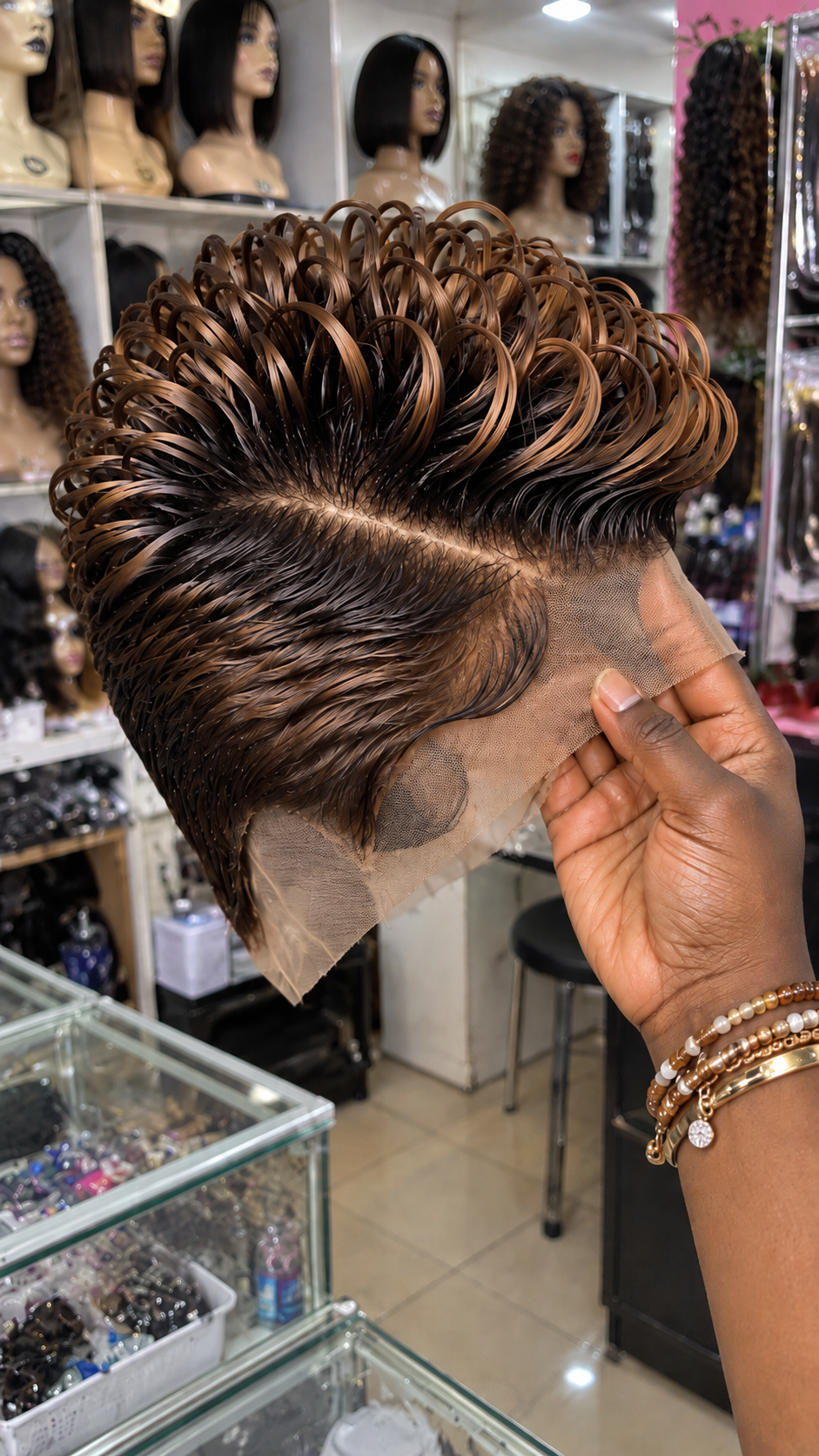
Imagine ordering a wig because of its beautiful golden-brown curls, only to discover that the delivered product has ordinary spirals instead of the dramatic upright loops you expected. That difference is precisely why this hairstyle deserves a detailed buying guide. Its distinctive appearance comes from a dense collection of elongated, arch-shaped loops rising above a dark espresso foundation, accompanied by a diagonal parting and carefully directed finger waves along the side.
The photograph presents a wig held in one hand inside a hair retail shop. The lace remains untrimmed, and part of the underlying cap can be seen through the loose frontal mesh. Unlike photographs taken after installation, this perspective reveals how the ornamental crown relates to the lower hair sections before the wig is fitted to a wearer.
The upper loops display warm golden toffee and medium chestnut-brown tones, while the roots and much of the lower hairstyle remain deep brown to nearly black. The side contains elongated, glossy waves that flow downward and backward rather than following the upward movement of the crown. A clearly visible diagonal separation between these areas contributes to the overall structure.


For buyers who appreciate sculpted pixie wigs, this design offers an alternative to conventional curled crowns. Its success depends on the height, spacing, and direction of the loops, as well as the way the lower waves frame the side. Understanding these details can help customers find an appropriate ready-made unit or commission a more accurate custom version.
Start With the Architecture of the Upright Loops
The upper hair is arranged into numerous tall, narrow loops that stand above the darker roots. These formations are not compact circular ringlets facing directly toward the camera. Many appear as elongated arches, with strands rising from the base, curving over, and returning toward the surrounding hair.
The loops overlap across the crown, producing an intricate arrangement that resembles a series of interlocking ribbons. Some arches are relatively narrow, while others open into broader curves. Their varying heights prevent the crown from appearing completely uniform.
The central upper section contains several especially prominent loops. Around them, smaller formations fill the spaces and create a continuous ornamental surface. This dense placement is important because large gaps could make the hairstyle appear unfinished, while excessive packing could conceal the individual arches.
The dark roots remain visible beneath the loops, creating a foundation that visually supports the lighter hair above. The hairstyle therefore has two distinct levels: a lower section of closely directed strands and an elevated arrangement of decorative loops.
The Difference Between Arch Loops and Ordinary Spiral Curls
Many wig listings use the word curly without distinguishing between curl shapes. That can create problems when purchasing a design as specific as this one.
Traditional spiral curls often travel downward in corkscrew formations. The loops in this photograph rise more vertically and bend into elongated arches. Their individual strands remain closely grouped, creating broad ribbon-like surfaces rather than fluffy coils.
When discussing this hairstyle with a wig maker, explain that the crown should contain upright, open arch loops with visible spaces between their curved sections.
A reference photograph taken from the side is particularly helpful because it shows the height and direction of the formations. A top-down image can provide additional information about how the loops overlap across the crown.
The photograph does not establish the technique used to create these shapes. They may involve specialized setting or other professional styling methods, but the exact process should be confirmed with the maker.
Golden Toffee Color Concentrated Above Dark Roots
The color distribution is more structured than a simple brown wig with highlights. The elevated loops contain warm golden toffee, caramel-brown, and chestnut reflections. Beneath them, the hair becomes substantially darker, approaching deep espresso and near-black tones.
This contrast is especially visible where the loops emerge from the root area. The darker strands create a pronounced visual base before transitioning into the lighter arches.
Some loops appear more golden, while others have deeper brown surfaces. The variation is subtle enough to maintain a coordinated palette without making the crown look like a collection of unrelated colors.
The lower side contains a mixture of dark brown and lighter brown reflections. Its coloring is less concentrated than the upper loops, allowing the directional waves to remain visually distinct.
The image does not show bright blonde, silver, copper-red, or burgundy sections. Customers seeking a faithful reproduction should therefore avoid introducing additional colors that would alter the warm brown character.
Confirming the Color Before a Custom Commission
Golden toffee and caramel are descriptive color terms rather than universal manufacturer codes. One supplier may interpret them as medium golden brown, while another may offer a much lighter blonde-brown shade.
Request photographs of the proposed hair under daylight and neutral indoor illumination. This is particularly useful for a glossy hairstyle because reflective surfaces can appear considerably lighter under strong shop lighting.
If possible, ask the supplier to show the lighter color beside the intended espresso root shade. The relationship between the two tones is more important than matching either color independently.
A successful reproduction should preserve the darker base while allowing the upper loops to display their warm brown character.
The Diagonal Separation That Organizes the Hairstyle
Across the visible side of the wig, a diagonal scalp-toned parting separates the elevated crown from the lower hair. The channel travels across the head at an angle, creating a clear division between the two styling directions.
This is a particularly important detail because the hairstyle does not rely on multiple decorative carved stripes. One prominent diagonal separation provides the main structural boundary.
Above the channel, strands rise toward the ornamental crown. Below it, the hair flows diagonally downward into a broad, sculpted side arrangement.
The exposed channel appears relatively narrow and consistent across much of its visible length. Its placement helps create the impression that the upper and lower sections have been deliberately organized rather than styled independently.
Although the separation resembles a scalp part, the photograph does not establish the precise construction beneath it. Buyers should avoid assuming that it was created through a particular ventilation or parting technique without confirmation.
Espresso Finger Waves Beneath the Golden Crown
The lower side offers a different visual experience from the upright loops. Here, the hair is directed into elongated, glossy waves that sweep backward and downward across the temple region.
The strands appear carefully aligned, producing broad curved surfaces with darker roots and brown reflections. Several wave ridges can be seen following the same general direction.
Near the front, the hair forms a pronounced curved section that frames the area adjacent to the lace. Farther downward, the strands become narrower and taper toward the lower edge of the visible hairstyle.
This arrangement is closer to sculpted finger-wave styling than to a conventional faded or shaved side. The photograph does not show a clearly shaved skin fade, and describing the lower section as a barber-cut fade would be inaccurate.
The side also contains more visible length than many closely cropped pixie wigs. Its strands extend into a pointed lower section rather than ending in a uniformly close-cut boundary.
Why the Lower Wave Direction Should Remain Intact
The upper loops already provide considerable visual activity. The lower waves balance them by directing the viewer’s attention along the side rather than adding another collection of circular curls.
Replacing these waves with loose spirals would make the hairstyle fuller and reduce the contrast between the two areas.
Customers should therefore ask the stylist to preserve the elongated side-wave arrangement, including the curved frontal section and the tapered lower edge.
If the wig requires adjustment after purchase, the stylist should evaluate whether the existing strands can be repositioned without damaging the intended pattern.
The Lace Front Is Still Awaiting Its Final Fit
A substantial section of beige lace extends beyond the hairline. The person holding the wig supports the frontal area, allowing the mesh to hang visibly beneath the styled hair.
The lace appears across the front and along the visible side, with some darker interior material showing through portions of the mesh. The loose lace has not yet been shaped to a wearer’s individual hairline.
This matters because the finished appearance may change after installation. The lace must be positioned correctly before excess material is removed.
The photograph provides no independent confirmation that the mesh is HD lace. Its exact grade, dimensions, and material specifications should be obtained from the supplier.
Likewise, the presence of lace does not establish whether adhesive is required. Installation options depend on the actual cap construction, attachment hardware, and fit.
Assessing the Hairline Without Disturbing the Waves
The frontal hairline sits close to the sculpted side-wave arrangement. Aggressive lace trimming or unnecessary manipulation could interfere with the surrounding styling.
A professional installer should begin by placing the wig on the wearer’s head and checking the position of the diagonal parting and lower waves.
Only after confirming the fit should the installer determine how much lace needs to be removed.
Customers can request a close-up photograph of the frontal mesh lying flat before purchase. This can help them evaluate the transition between the lace and the styled hair.
What the Photograph Cannot Tell You About the Cap
Part of the interior cap is visible through the loose lace, but the photograph does not provide a complete underside view.
As a result, the exact cap circumference, number of attachment combs, presence of adjustable straps, and complete construction layout remain unverified.
These details should be discussed before ordering, especially when the wig is intended for regular wear.
Ask the seller to provide an underside photograph showing the complete cap, including any adjustment mechanisms and attachment components.
Cap measurements should be compared with the customer’s head measurements rather than relying entirely on generic size labels.
For this hairstyle, correct positioning is particularly important because the diagonal separation and side waves need to sit at the intended angle relative to the face.
Finding the Right Seller for Sculpted Loop Styling
A customer searching for this design should prioritize wig makers experienced in ornamental pixie hairstyles rather than general curly wig suppliers alone.
Custom wig studios, specialist lace wig boutiques, and salons offering sculpted hairpiece styling may be suitable starting points.
When reviewing a supplier’s previous work, look for examples of upright ribbon loops, precise directional waves, and carefully arranged color transitions.
A maker who specializes in ordinary spiral curls may not necessarily be experienced in constructing the elevated arches shown here.
Send the reference photograph and identify the elements that must remain consistent: golden toffee loops, dark espresso roots, a single diagonal separation, and the lower sweeping waves.
Ask whether the proposed material can maintain the upright loop arrangement and what maintenance will be required.
Deciding Whether to Buy Ready-Made or Commission Custom
A ready-made wig may be convenient if it already contains the correct loop structure and side-wave arrangement. It can also reduce the amount of specialist styling needed after delivery.
However, a generic caramel pixie wig may not provide the same result. The upper arches and lower waves require more specific construction than ordinary curled hair.
Custom production may allow the buyer to select the root shade, loop dimensions, cap size, and frontal configuration.
Before commissioning the work, confirm the production timeline, payment terms, revision policy, and whether the completed styling is included in the quoted price.
Request actual photographs of the finished unit before shipment, ideally from the front, side, and above.
Illustrative Budget for an Elaborate Toffee Loop Wig
The complexity of the crown can influence the price because numerous individual loops may require careful placement and shaping. The diagonal parting and lower finger-wave arrangement can add further styling requirements.
The following USD amounts are illustrative planning ranges rather than verified current retail prices or quotations for the photographed product.
| Purchase Category | Illustrative USD Budget | Potential Cost Considerations |
|---|---|---|
| Premium Custom | $340–$760+ | Detailed loop construction, personalized toffee color placement, specialist side-wave styling, and possible lace customization. |
| Standard Custom | $185–$390 | Commissioned styling with selected adjustments to crown loops, diagonal parting, and color distribution. |
| Basic Human Hair | $105–$255 | A potential human-hair foundation that may require separate shaping and coloring to resemble the reference. |
| Premium Synthetic | $80–$185 | A possible pre-styled option if the manufacturer offers comparable upright loops and directional side waves. |
| Basic Synthetic | $35–$95 | Lower-cost alternatives may capture the general brown color combination without matching the elaborate styling. |
These categories describe possible purchasing routes. The photograph does not establish whether the wig contains human hair, synthetic fiber, or a blend.
Before accepting a quotation, determine whether the price includes the completed loops, color work, lace preparation, and cap adjustments.
Shipping, installation, and future maintenance may be separate expenses.
For this design, comparing the quality of the finished styling is more useful than comparing prices based on hair length alone.
Keeping the Upright Arches From Losing Their Form
The elevated loops are the most delicate visual component of this hairstyle. Their appearance depends on the strands retaining their curved, upright arrangement.
Repeated brushing, compression, or pulling may disturb the arches and reduce the separation between individual loops.
Customers should avoid attempting to reshape the crown with heat until the fiber type and temperature compatibility have been confirmed.
If the wig is synthetic, unsuitable heat may permanently damage the strands. If it is human hair, previous coloring and styling treatments may affect its response to additional processing.
The lower finger waves may require a different maintenance approach from the upper loops. Their appearance depends on the strands remaining aligned along the curved side pattern.
Ask the original stylist which products and techniques are appropriate for each area.
Handling and Storage Between Wears
Lift the wig by suitable structural areas rather than pulling on the lace or ornamental loops.
When storing the unit, avoid placing pressure on the crown. A correctly sized support may help preserve the overall shape without stretching the cap.
Keep the hairstyle away from unnecessary friction, particularly around the upper arches and lower wave ridges.
If the loops begin collapsing or the side waves lose their alignment, professional restyling may be preferable to attempting extensive corrections without knowing the original setting method.
Choosing This Hairstyle for Its Construction, Not Just Its Color
The defining quality of this wig is the contrast between two different styling directions. Golden toffee loops rise above dark roots, while the lower espresso hair follows elongated waves beneath a diagonal parting.
The warm brown palette contributes to the appearance, but color alone cannot reproduce the design.
Buyers should evaluate the height and spacing of the arches, the position of the diagonal channel, the shape of the lower waves, and the suitability of the lace and cap.
A supplier who understands these details will be better positioned to explain whether a ready-made product is appropriate or whether custom production is necessary.
With accurate reference photographs, clear measurements, and careful installation, this hairstyle can serve as an excellent example of decorative pixie wig craftsmanship. Its appeal lies in the deliberate relationship between the elevated loops and the flowing side waves, creating a distinctive silhouette without relying on excessive length.
Search Terms
Golden toffee upright loop pixie wig · Espresso root caramel arch curl crown · Diagonal scalp part lace wig · Brown sculpted finger wave side hairpiece · Tall ribbon loop crown wig · Beige untrimmed lace toffee pixie · Chestnut brown sweeping temple waves · Black root golden caramel loop hairstyle