
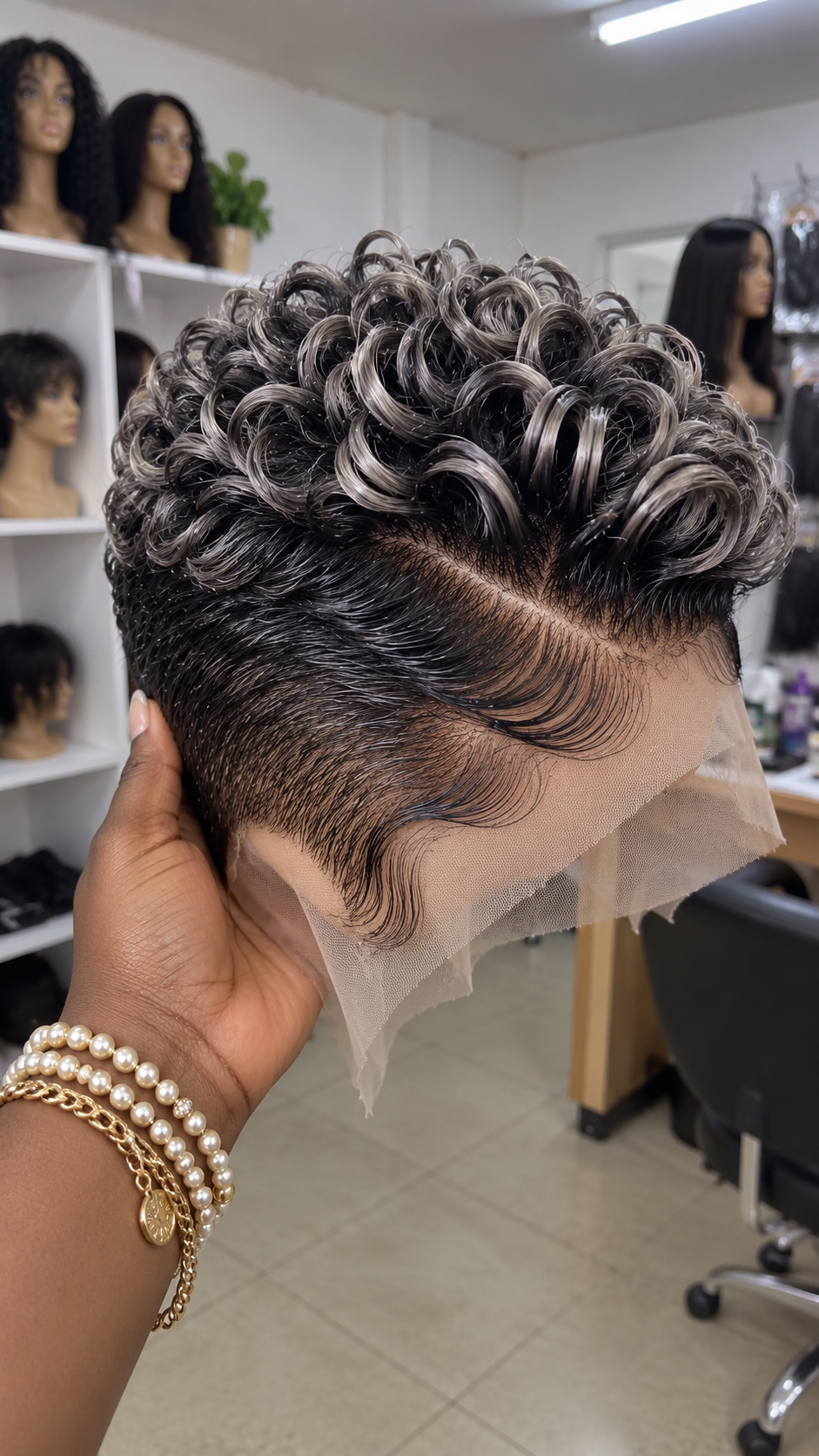
The most revealing detail in this salon photograph is not simply the abundance of silver-touched curls. It is the way the dark hair travels from a carefully arranged front hairline into a dense formation of raised ribbon ringlets. The transition creates two distinct styling experiences within one wig: a closely directed, sweeping lower section and an elevated crown filled with overlapping circular loops.
The unit is being held in one hand before installation, with an extended section of beige-brown lace hanging beneath the front and visible side. The camera angle allows the viewer to examine the directional hairline work, the distribution of smoky silver strands, and the contrast between the compact lower hair and the raised curls. It also reveals an important characteristic: the lighter color does not form a solid silver cap. Instead, pale gray and silver reflections travel through individual ribbons against a predominantly raven-black foundation.
For anyone searching for an elegant pixie wig with sculpted curls, this design offers a useful lesson in proportion. The upper loops create fullness, but the lower hair remains closely arranged. The sweeping hairline introduces movement without requiring shaved artwork, while the silver accents make the curl structure easier to appreciate.


The Front Hairline Is the Starting Point of the Design
Many curly wigs place nearly all their visual emphasis on the crown. Here, the front hairline deserves equal attention. A series of dark strands is arranged into long, flowing curves that travel across the visible front and side. These strands are closely grouped, forming narrow, parallel ridges that resemble elaborate finger-wave styling.
The wave pattern begins near the upper front section and sweeps diagonally across the hairline. Several curved strands continue toward the lower visible temple, where they form a pronounced hook-like turn before tapering into finer ends.
This is an important distinction from a wig with a carved or shaved side. The visible decoration is created by the direction of the hair itself. There are no clearly identifiable razor-cut geometric channels, intersecting triangles, or parallel shaved lines in the photographed area.
The darker hair also provides a deliberate visual boundary beneath the silver-accented curls. Rather than allowing the ringlets to descend directly onto the lace, the stylist has created an intermediate area that guides the eye from the raised crown toward the face.
The Lower Wave Has Its Own Direction
The longest visible wave travels downward before curling back into a rounded point near the lower edge of the styled hairline. This detail gives the hairstyle a distinctive side profile.
It would be easy for a custom wig maker to overlook this element while concentrating on the upper curls. However, removing the lower sweep or replacing it with ordinary baby hairs would change the appearance substantially.
A buyer requesting a close reproduction should specifically mention the elongated finger-wave section, the narrow strand grouping, and the rounded lower turn. The stylist should also understand that the wave is part of the main hairline arrangement rather than a collection of loosely placed decorative hairs.
Because the wig is photographed before fitting, the final position of this wave on a wearer’s forehead cannot be established with certainty. Its placement should be assessed during a proper fitting appointment.
Silver Accents Follow the Shape of the Ringlets
The upper curls display a mixture of deep black, charcoal gray, and smoky silver tones. The lighter strands are especially visible along the outward-facing surfaces of the loops, where the salon lighting emphasizes their curved paths.
Some ribbons appear nearly pearl silver, while others contain darker gray strands running alongside black hair. This produces a layered appearance rather than an evenly colored silver hairstyle.
The silver distribution is particularly interesting because it reinforces the direction of the curls. As each ribbon bends upward or inward, the lighter strands trace the curve and help reveal the loop opening.
At the base, black hair remains prominent. The dark foundation is visible between the ringlets and throughout the closely arranged lower section. This contrast gives the hairstyle depth and prevents the pale accents from overwhelming the composition.
The photograph does not prove whether the lighter strands were individually colored, incorporated as separate hair sections, or produced using another method. It also cannot establish how much of the apparent gray brightness comes from actual color versus reflected salon lighting.
Nevertheless, the visible result is clearly a dark hairstyle with silver-gray accents rather than a uniformly white or platinum wig.
Communicating the Desired Shade to a Supplier
When ordering, avoid describing the wig simply as gray curly hair. That phrase may lead to products with an entirely gray crown, which would not reproduce the strong dark foundation shown here.
A more useful description is raven-black hair with smoky silver and charcoal-gray ribbons concentrated through the raised curls. Ask for photographs in natural daylight so the lighter strands can be distinguished from reflective black hair.
Customers should also compare silver-gray, ash gray, and platinum shades carefully. A bright platinum mixture could produce a much stronger contrast than the reference, while a darker charcoal mixture might make the highlighted loops less noticeable.
For a custom order, request confirmation of the color distribution before the final curl arrangement is completed. This is often easier than trying to correct an unsuitable color after the loops have been carefully formed.
The Crown Is Built Around Overlapping Ribbon Openings
Across the upper surface, the curls form a densely arranged collection of elongated loops. Several openings are nearly circular, while others resemble folded ribbons or narrow arches. Their sizes vary, creating an organic composition despite the deliberate styling.
The front contains prominent loops that rise directly above the dark hairline. Toward the center, additional curls overlap and turn in different directions, producing a layered effect. The visible upper rear remains full, although the photograph does not provide a complete view of the back of the wig.
The loops are not ordinary hanging ringlets. They sit relatively close together and are directed upward or backward, creating a raised sculptural silhouette.
The individual strands within the ribbons remain visible. Some curl openings expose dark spaces beneath them, while others are partially filled by neighboring loops. These differences are important because a perfectly uniform arrangement would look quite different from the photographed hairstyle.
Balancing Density Against the Open Curl Pattern
A successful reproduction needs enough hair to maintain the full upper shape without filling every curl opening. Excessive density can cause the loops to merge into a solid mass, while insufficient density may expose large gaps between the arranged sections.
The photographed wig appears relatively full across the crown, but its volume remains concentrated above the compact lower area. This creates a clear separation between the two styling zones.
Customers should request a photograph taken from slightly above the front to evaluate the distribution of the loops. A side view is equally useful for checking whether the crown height remains proportional to the lower hairline.
The maker should also explain how the curls are intended to retain their arrangement. Depending on the actual material and styling technique, maintaining the loop openings may require specialized setting or occasional professional attention.
What the Uncut Lace Reveals About the Installation Stage
A broad section of light beige-brown lace extends beyond the styled front hairline. The mesh is clearly visible against the salon background, particularly where it hangs freely beneath the lower wave.
The lace follows the general contour of the front and visible side, but it has not yet been trimmed to fit an individual wearer. This is consistent with a pre-installation presentation.
Fine dark hairs emerge from the lace near the front styling area. Their placement contributes to the appearance of the sweeping waves, although the photograph does not establish the exact ventilation technique used to secure them.
The visible mesh should not be described as HD lace without independent confirmation. Lace appearance in a photograph is affected by lighting, background, camera processing, and the distance from the subject.
Similarly, the image does not show enough of the interior to confirm all cap components, adjustment mechanisms, or attachment options. A buyer should request an underside photograph before making assumptions about construction.
Fitting the Wave Pattern Without Sacrificing Its Shape
The front lace is especially important because the hairline contains a long decorative sweep. A conventional installation approach that cuts the lace too close to the arranged strands could interfere with the wave or remove material needed for proper placement.
The stylist should begin by positioning the wig on the wearer’s head and examining where the wave falls relative to the forehead and temple.
Once the cap position is established, the remaining lace can be assessed for careful trimming. The precise cutting method should depend on the construction of the unit and the chosen installation technique.
The wave should not be pulled into a different direction simply to make the lace lie flat. If the fit creates tension or distorts the styling, cap adjustments may be necessary.
After installation, the upper curls should be checked for compression. Handling the wig during fitting may temporarily disturb some of the raised loops, but corrections should be limited to methods suitable for the confirmed fiber.
Buyers should also ask whether the wig is intended for adhesive installation, an alternative securing method, or a combination of adjustments. The photograph alone does not establish that the unit is suitable for glueless wear.
Choosing Between a Custom Wig and an Existing Pixie Base
A ready-made black-and-silver curly pixie may appear similar at first glance, but matching the photographed design requires more than the right color combination.
The most difficult elements to reproduce are likely to be the sweeping lower hairline and the elevated ribbon curls. These details depend on precise hair direction and styling rather than simply cutting the wig to a particular length.
For customers seeking a close match, a custom wig maker with experience in finger-wave styling and sculpted pixie curls may be the strongest option.
Search for salons offering custom lace pixie wigs, finger-wave lace styling, silver-highlighted sculpted curls, or ribbon curl wig customization.
When contacting a salon, send the reference photograph and explain that the dark lower wave must remain prominent beneath the silver-accented crown.
Ask to see examples of previous work involving structured hairline waves. A stylist experienced only with loose curly wigs may not have the necessary expertise to reproduce this particular arrangement.
Useful Photographs to Request Before Paying
Request a clear frontal image of the actual wig, followed by views of both sides and the rear. The reference provides a strong view of the front and one side, but it does not establish the complete rear construction.
An underside photograph should reveal the cap perimeter and any included straps, combs, clips, or other securing components. These details should be confirmed rather than assumed.
For custom work, ask for a close photograph of the hairline before the lace is trimmed. This allows the customer to evaluate the direction of the waves and the transition into the upper curls.
A brief rotating video can also help demonstrate whether the loops maintain their arrangement from different angles.
Finally, confirm the actual hair material, cap measurements, lace specifications, return conditions, and whether styling adjustments are included in the purchase price.
Budgeting for Silver Ribbon Curls and Detailed Hairline Work
The combination of silver-gray color placement, raised loops, and decorative finger-wave styling can increase the amount of labor involved in producing a similar wig. The following figures are illustrative USD planning ranges, not verified current prices or quotations for the photographed unit.
| Wig Category | Illustrative USD Range | Possible Purchase Scope |
|---|---|---|
| Premium Custom | $330–$760+ | Individual cap measurements, specialized silver-gray placement, detailed ribbon curls, and customized sweeping hairline styling. |
| Standard Custom | $175–$370 | Customized black-and-silver coloring, arranged upper loops, and a professionally styled finger-wave front. |
| Basic Human Hair | $105–$255 | A human-hair pixie base that may require additional coloring, curl setting, and hairline customization. |
| Premium Synthetic | $75–$190 | Higher-priced synthetic alternatives with gray accents and prearranged curls, depending on product specifications. |
| Basic Synthetic | $30–$100 | Budget black-and-gray pixie options that may resemble the color scheme without reproducing the elaborate wave and ribbon structure. |
These categories represent possible purchasing choices. The photograph does not confirm whether the displayed wig is human hair, synthetic, or a blend.
Color processing may influence the cost if the silver sections require individual preparation. The maker may also charge additional labor for arranging the upper loops and shaping the front wave.
Ask whether the quotation includes lace preparation, cap adjustments, shipping, installation, and future restyling. A lower initial wig price may not include the services needed to achieve the finished appearance.
Customers should compare complete quotations rather than relying exclusively on advertised product prices.
Preserving the Silver Ribbons Without Flattening the Crown
The elevated loops are likely to be sensitive to repeated brushing, compression, and uncontrolled restyling. Their appearance depends on maintaining the direction of the strands within each ribbon.
Before washing, confirm the wig’s material and obtain the maker’s care instructions. Human hair and synthetic fibers can respond differently to water, heat, and styling products.
If the wig is made from colored human hair, the silver sections may require particular attention because previously lightened strands can be more vulnerable to damage. The actual processing history should be confirmed with the supplier.
If the wig is synthetic, do not assume that heated tools are safe. Heat compatibility varies by fiber and should be established through manufacturer guidance.
Avoid applying excessive heavy products to the upper curls. Product buildup can reduce separation between the ribbons and make the loops appear less distinct.
When storing the wig, use a support that maintains the cap shape without pressing against the raised crown. For travel, a container with enough clearance above the curls may help reduce deformation.
The Sweeping Hairline Needs a Different Kind of Care
The front wave is closely arranged and follows a deliberate direction. Aggressive combing can disturb its ridges or separate the narrow strands that create the sweeping appearance.
If the wave begins losing its shape, consult a stylist familiar with finger-wave techniques rather than attempting to rebuild it with unsuitable products or heat.
The lace beneath the wave should also be handled gently. Pulling on the hairline while removing the wig can place unnecessary stress on the fine mesh and attached strands.
Any trimming or alteration near the decorative front should be performed carefully because removing lace or hair from the wrong area may be difficult to reverse.
A Silver-Accented Pixie That Rewards Attention to Detail
This wig demonstrates how a dark foundation can support an elaborate hairstyle without requiring a fully contrasting color treatment. The smoky silver ribbons emphasize the raised loops, while the raven-black lower section provides a striking setting for the sweeping hairline waves.
The design is particularly appealing to customers who appreciate carefully arranged curls and decorative front styling. Its character comes from the relationship between the compact lower hair, the flowing wave direction, and the densely layered ringlets above.
For a successful purchase, focus on the actual construction rather than generic product descriptions. Confirm the color distribution, request photographs of the finished unit, discuss cap measurements, and choose a stylist with experience in both sculpted curls and detailed lace hairlines.
With appropriate fitting and material-specific maintenance, a similar wig can offer a distinctive combination of silver-gray highlights, intricate ribbon curls, and a graceful dark wave arrangement that remains recognizable from multiple viewing angles.
Search Terms
Smoky silver ribbon ringlet lace wig · Raven black sweeping finger wave hairline · Charcoal gray loop crown pixie wig · Silver accented black sculpted curl wig · Beige untrimmed lace finger wave pixie · Black side swoop with silver spiral curls · Pearl gray ribbon curls dark root wig · Layered silver black circular curl crown