
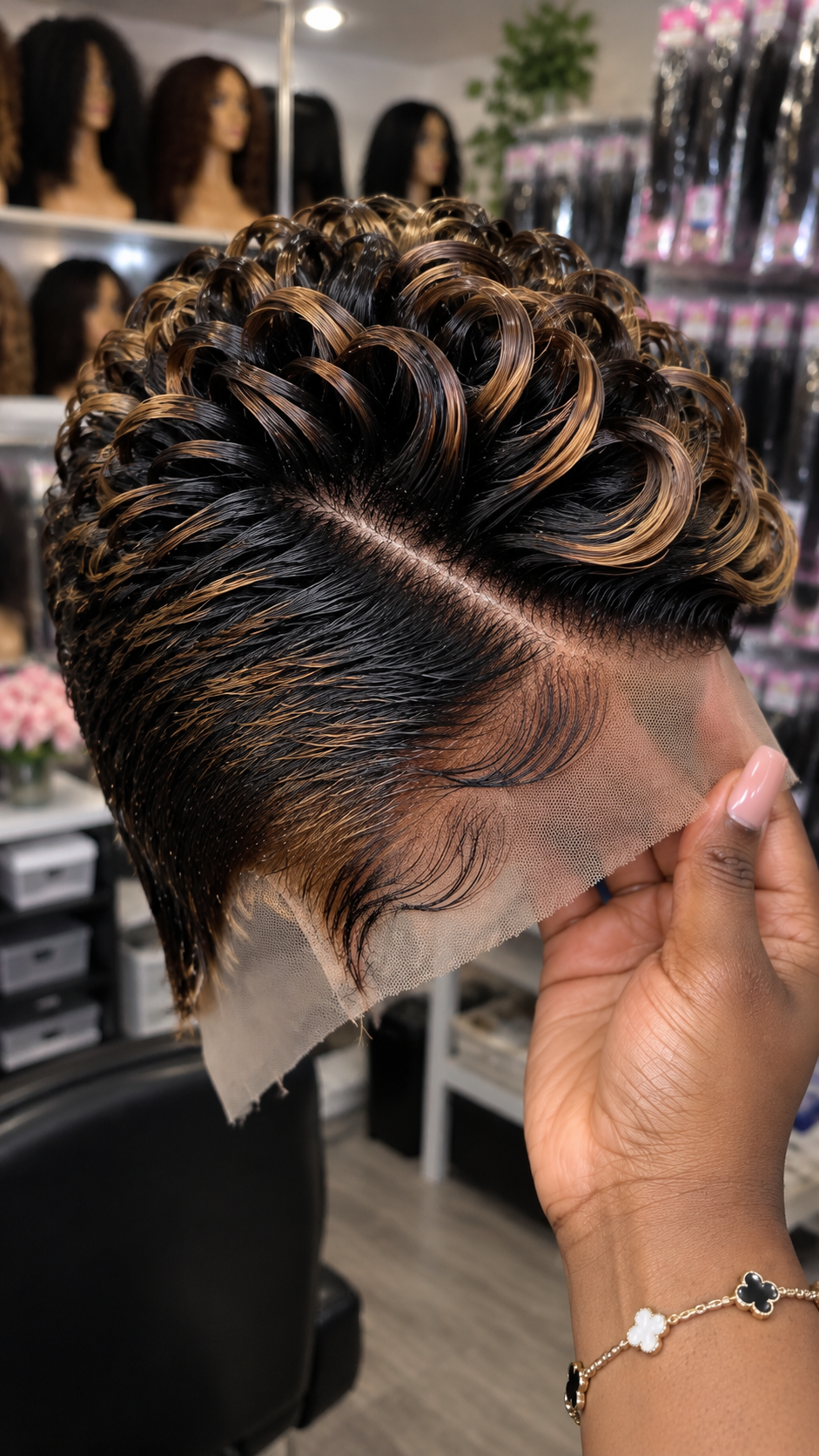
Black and caramel blonde create an especially striking combination when the lighter color follows the movement of individually arranged curls rather than covering the entire hairstyle. In this lace pixie wig, slender caramel and honey-brown ribbons trace the upper loops while the darker hair provides contrast underneath. A diagonal parting separates the elevated curls from a closely arranged side section, and fine temple waves extend toward the exposed lace edge.
The photograph shows the wig being held in one hand inside a beauty supply salon, before installation. Its untrimmed tan lace is visible along the front and lower side, making the relationship between the hairline and the wig foundation easier to examine. The image also reveals the direction of the upper curls, the placement of the lighter strands, and the gradual transition into the compact side hair.
What distinguishes this piece from a conventional highlighted pixie is the deliberate connection between color and shape. The caramel strands do not simply appear as random bright patches. They follow the curvature of the larger loops, emphasizing their openings and giving the upper section a layered appearance. The dark foundation remains dominant, preventing the highlights from overwhelming the hairstyle.


For anyone considering this look, the important purchasing decision is whether a seller can reproduce both the highlighted curl arrangement and the diagonal side separation. Matching the color alone would not be enough.
Caramel Placement Changes How Every Curl Is Perceived
The dominant base color appears to be deep black, with narrow caramel blonde and warm golden-brown sections distributed through the upper hairstyle. The lighter strands are particularly visible along the outer surfaces of the raised loops, where their curved paths contrast against the darker hair underneath.
Some highlighted sections appear pale honey brown under the salon lighting, while others look deeper and closer to toasted caramel. The photograph does not establish whether these differences result from multiple dye shades, the original fiber coloration, or lighting.
Unlike a wig with blonde ends or a broad root-to-tip transition, this hairstyle uses thin ribbons of lighter color. The contrast is concentrated in the upper curls, although a few caramel-toned strands also appear through the swept side section.
The lower hair remains predominantly dark. This gives the hairstyle a visual hierarchy: the highlighted loops attract attention first, followed by the diagonal parting and the finely arranged temple strands.
Why Broad Blonde Streaks Would Produce a Different Result
A common problem when ordering highlighted wigs is receiving sections that are considerably wider than those shown in the reference. Large blonde panels could conceal the black foundation and change the overall color balance.
For this design, request narrow caramel ribbons distributed through the upper curls, with the dark base remaining clearly visible between them. The lighter strands should emphasize the curved movement rather than form unrelated blocks of color.
Ask the seller for a close photograph of the highlighted sections under ordinary daylight. Salon lighting can make warm blonde shades appear brighter and more golden than they will in other environments.
If commissioning a custom piece, discuss the placement before any coloring or fiber selection begins. The stylist should understand that the contrast is connected to the curl architecture, not simply to a percentage of blonde hair.
Following the Diagonal Parting From Front to Crown
A narrow exposed channel runs diagonally across the visible side, beginning near the forward upper section and extending backward beneath the raised curls. It divides the hairstyle into two distinct styling zones.
Above the channel, the strands lift into large looped curls. Below it, the hair follows a closer, backward and downward direction. The separation makes the upper hairstyle appear elevated while keeping the lower portion compact.
The channel has a pale appearance because the underlying foundation is visible between the dark strands. It should not automatically be described as a shaved razor line. The photograph shows a wig rather than hair growing directly from a person’s scalp, and the exact technique used to create the separation cannot be confirmed from the image.
The parting is especially important because its angle determines where the upper volume begins. A line placed too low would enlarge the compact side area, while a line placed too high could reduce the space available for the highlighted loops.
When ordering a similar wig, ask whether the diagonal separation is incorporated into the original construction or created through styling. This information may affect how easily the parting can be maintained or adjusted later.
The Upper Loops Combine Height With Directional Movement
The upper hairstyle contains numerous broad, rounded ribbon curls. Some form nearly circular openings, while others curve backward in elongated arcs. Their overlapping arrangement creates a raised silhouette without making the entire wig appear excessively full.
Near the front, the loops lift away from the hairline before bending backward. Toward the visible rear portion, the curls become more closely grouped, creating a dense continuation of the crown.
The caramel ribbons are particularly effective in this area. They follow the curved surfaces and make individual loops easier to distinguish against the dark background.
The hairstyle is not composed of freely hanging ringlets. Its upper curls appear deliberately positioned, with their direction contributing to the overall shape. A standard loose-curly wig would therefore be an imperfect substitute even if its length and color were similar.
Keeping the Crown Proportionate
The height of the loops should be evaluated relative to the lower side. A larger crown may create a dramatic appearance, but it could also distort the balanced profile visible in the photograph.
For a custom order, request a compact, elevated arrangement with individually recognizable loops. The stylist should avoid adding unnecessary fullness that conceals the dark spaces between the curls.
Because the photograph primarily shows one side and the upper surface, the complete rear construction remains uncertain. Ask for a rear photograph or a slow rotation video before assuming that the same loop pattern continues uniformly around the back.
A video is also useful for examining whether the loops retain their shape when the wig is moved. Still photographs can make an arrangement appear more consistent than it looks from every angle.
Fine Temple Waves Add a Second Styling Language
Beneath the diagonal parting, the side hair is arranged into long, narrow sweeps. Several strands curve toward the temple and front lace area, creating wave-like movements that contrast with the larger circular loops above.
The visible temple section contains carefully directed dark strands, with some fine caramel accents extending into the surrounding hair. The strands lie relatively close to the wig foundation, producing a flatter appearance than the upper curls.
Near the lower front, a longer curved section descends toward the lace edge. This gives the side a distinctive flowing shape rather than ending abruptly beneath the diagonal parting.
There are no clearly visible multiple parallel carved channels in this design. The main geometric separation is the diagonal parting, while the lower decorative effect comes from the direction of the hair itself.
For an accurate recreation, a stylist should treat the temple arrangement as a separate styling task. Reproducing the upper loops while ignoring the fine lower waves would remove an important part of the hairstyle’s identity.
What the Untrimmed Lace Reveals About Preparation
A broad section of tan mesh extends beyond the visible hairline. The lace is especially noticeable around the front and lower side, where it hangs beneath the styled strands.
This confirms that the photographed wig has an exposed lace section awaiting preparation. It does not establish the exact lace grade, cap dimensions, or complete internal construction.
The photograph does not provide a full view of the underside. Consequently, it cannot confirm attachment combs, adjustable straps, elastic bands, or other hardware that may or may not be included.
The visible mesh should also not be advertised as HD lace without independent product information. Lace transparency, softness, and color compatibility require more evidence than this photograph provides.
Checking the Hairline Before Any Cutting
The front strands are arranged close to the lace and flow into the upper hairstyle. Their position makes accurate fitting particularly important because the hairline and diagonal parting need to sit correctly relative to the wearer’s forehead.
Before trimming, the stylist should position the wig on the intended wearer and assess the front contour. Cutting the lace prematurely may remove material needed for a comfortable and visually balanced installation.
Ask the supplier for cap measurements and a complete underside photograph. The most useful dimensions include circumference, front-to-nape length, and ear-to-ear width.
It is also worth confirming whether the wig is delivered with the lace untrimmed, as shown, and whether any preparation services are included in the advertised price.
Comparing Ready-Made and Individually Styled Options
A ready-made black and caramel pixie wig may be suitable if the product already contains the correct loop placement and diagonal parting. However, many highlighted wigs use different curl patterns or distribute the lighter color more broadly.
When browsing online stores, look beyond the product title. Examine the actual photographs for the relationship between the highlights and the curls. A listing described as a caramel highlight pixie may contain loose waves, small coils, or a conventional side part rather than the sculpted arrangement shown here.
A custom wig maker may offer greater control over the placement of the lighter strands and the structure of the crown. This can be particularly useful when the buyer wants the caramel ribbons to follow the curved loops closely.
However, custom work should begin with clear expectations. Ask the stylist which elements can be reproduced accurately and which may vary because of material properties or individual hand styling.
Confirm the fiber composition, cap size, lace specifications, color options, styling process, production time, and return conditions before making payment.
Booking a Stylist for Highlighted Pixie Construction
The ideal professional for this hairstyle is a wig customization specialist familiar with sculpted curls, directional parting, and decorative hairline styling. Experience with color placement is also valuable because the caramel ribbons contribute directly to the appearance of the loops.
When contacting a salon, describe the desired result as a black lace pixie wig with narrow caramel-highlighted ribbon curls, a diagonal side parting, and sweeping temple waves.
Provide the reference photograph and ask whether the stylist can show previous work involving similarly arranged curls. Examples of ordinary loose-curly wigs may not demonstrate the precision required here.
A consultation should address the intended crown height, the angle of the parting, the location of the highlighted strands, and the fit of the lace around the temple.
If the wig is being ordered from a separate supplier, arrange the salon appointment after confirming the expected delivery date. The stylist may need to inspect the actual product before determining whether further customization is possible.
Installation Should Preserve the Original Color Pattern
Once the wig arrives, inspect the highlighted loops before making permanent changes. Check that the caramel strands remain distributed through the upper arrangement and that the dark base is still visible between them.
The stylist should then assess the cap fit and establish the correct position of the diagonal parting. The front hairline and temple waves need to align naturally with the wearer’s face.
If lace trimming is required, it should be performed only after fitting. The stylist should avoid cutting into the fine front strands or disturbing the lower wave arrangement.
Any additional styling should preserve the placement of the caramel ribbons. Rearranging the loops without considering the highlights could change the intended contrast.
The appropriate attachment method depends on the actual cap construction and the wearer’s preferences. The photograph does not establish whether adhesive is necessary or whether the wig is designed for adhesive-free wear.
After installation, examine the hairstyle from the front, the highlighted side, and a three-quarter angle. The curls should retain their raised shape, the diagonal channel should remain visible, and the temple waves should sit close to the head.
Illustrative Price Planning for a Black and Caramel Sculpted Wig
The cost of recreating this hairstyle may depend on three major factors: obtaining the correct black-and-caramel color distribution, arranging the upper ribbon loops, and preparing the lace for the intended wearer.
The following USD ranges are illustrative budgeting estimates rather than verified live selling prices. The photograph does not establish whether the pictured wig is made from human hair or synthetic fiber.
| Wig Category | Illustrative USD Range | Potential Cost Factors |
|---|---|---|
| Premium Custom | $390–$920+ | Individual cap fitting, carefully positioned caramel ribbons, specialist loop construction, and detailed hairline customization. |
| Standard Custom | $200–$450 | Selected cap options, customized color distribution, directional crown styling, and diagonal parting adjustments. |
| Basic Human Hair | $110–$290 | Human-hair base unit that may require additional highlighting, curl arrangement, and lace preparation. |
| Premium Synthetic | $70–$190 | Higher-grade synthetic alternatives with prearranged highlighted curls and material-dependent styling flexibility. |
| Basic Synthetic | $30–$90 | Lower-cost alternatives that may differ in highlight placement, loop precision, and cap construction. |
These categories represent possible purchasing routes, not confirmed classifications of the photographed product. Actual prices vary by supplier, country, workmanship, and included services.
Color placement may increase the price of a custom order, particularly if the stylist must create narrow highlights before arranging the loops. However, a precolored fiber selection may reduce the need for additional processing.
Ask whether the quotation includes the finished curl arrangement, lace preparation, fitting, installation, and shipping. A base wig with a lower purchase price may become more expensive if extensive customization is required afterward.
Protecting the Highlighted Loops During Maintenance
The most important maintenance objective is preserving the relationship between the caramel ribbons and the curved upper strands. Repeated brushing or aggressive finger separation can disturb the loops and alter where the lighter sections appear.
Ask the supplier how the curls were formed and whether they can be safely repositioned. Some constructions may tolerate gentle adjustments, while others may require professional resetting.
The lower temple waves need separate care because their flatter arrangement can be disrupted by excessive rubbing or product buildup. Avoid repeatedly combing across the diagonal parting, as this may cause strands to cross the exposed channel.
Cleaning instructions should follow the verified fiber composition. Synthetic hair should not be exposed to heat unless the manufacturer confirms that the material is suitable. Human hair may require different handling, particularly if the caramel sections were created through chemical lightening.
Color maintenance also depends on the material. Products intended for chemically colored human hair may not be appropriate for synthetic fibers. Confirm the supplier’s recommendations before using toners, dyes, or intensive treatments.
When storing the wig, avoid compressing the raised loops or stretching the lace. A suitable support can help preserve the silhouette without placing unnecessary pressure on the hairline.
If the highlighted curls begin losing their arrangement, professional restyling may be preferable to attempting major changes without knowing the original construction method.
The Purchase Decision Comes Down to Placement, Not Just Color
This hairstyle demonstrates how narrow caramel accents can transform the appearance of black sculpted curls without replacing the dominant dark base. The lighter ribbons emphasize the upper loops, while the diagonal parting and sweeping temple strands give the side its distinctive character.
A successful reproduction should preserve the distribution of the highlights, the backward movement of the upper curls, and the compact lower profile. A wig with the same colors but a different curl pattern would not provide the same visual result.
Before purchasing, request multiple product angles, confirm the fiber and cap specifications, and determine whether the seller can reproduce the highlighted loop arrangement accurately.
The most convincing result will come from treating the color, curl structure, parting, and hairline as connected elements. When each is considered during ordering and installation, the wig can retain the distinctive black-and-caramel appearance shown in the reference while being fitted appropriately to the wearer.
Search Terms
Black caramel ribbon loop pixie wig · Honey brown highlighted sculpted curls · Diagonal side part black lace wig · Caramel streaked barrel curl crown · Black pixie wig with sweeping temple waves · Untrimmed tan lace highlighted hairpiece · Golden brown ribbon accents on black wig · Raised loop crown with dark side waves