
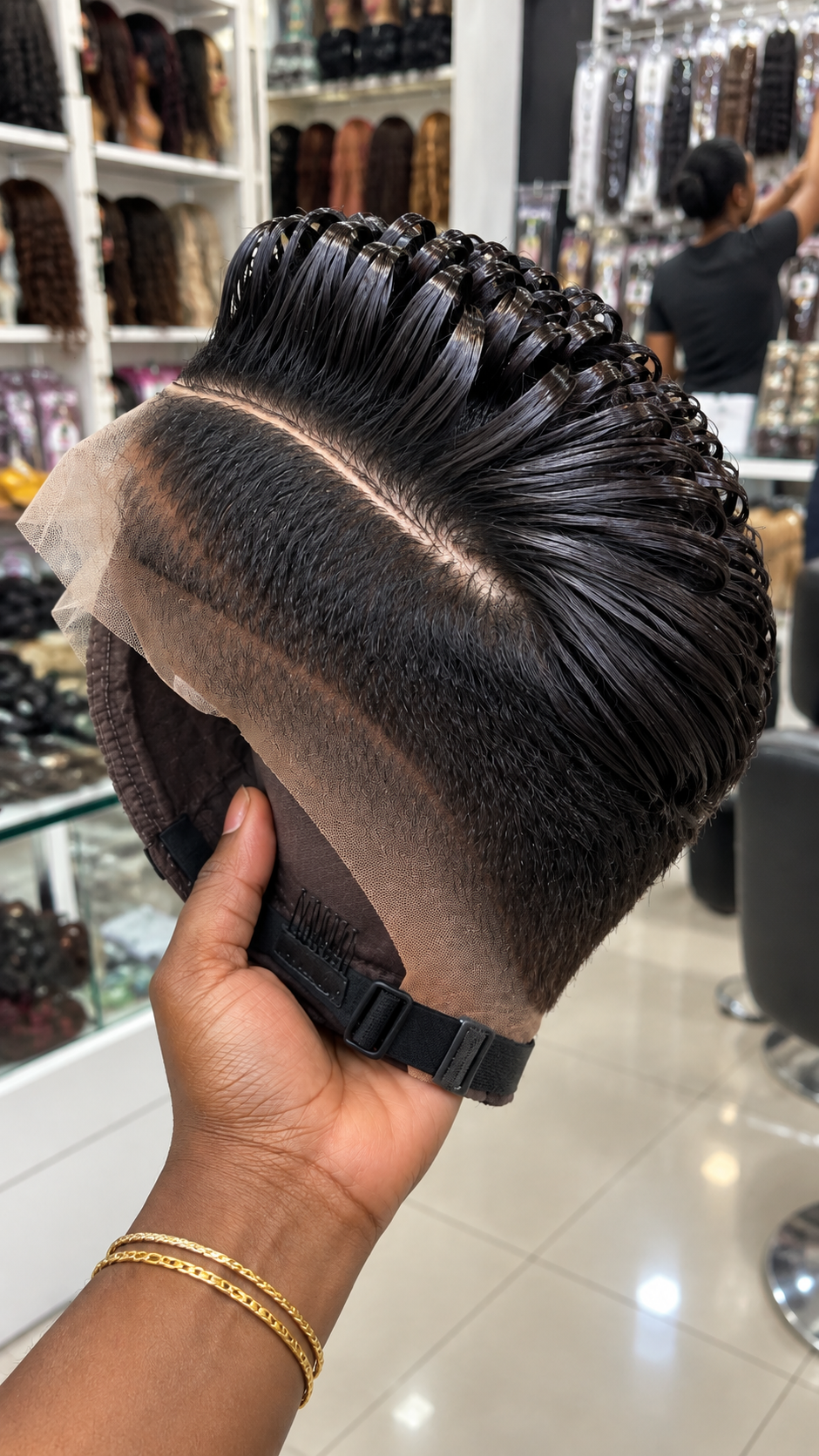
The beauty of this jet-black pixie wig lies in a dramatic change of direction. At the upper crown, closely gathered strands rise into glossy ribbon-shaped loops, forming a lifted crest that bends toward the back. Beneath that elevated section, a narrow diagonal parting introduces a much flatter, closely cropped-looking side panel. The contrast creates an eye-catching hairstyle without additional colors, decorative shaved patterns, or long flowing hair.
Photographed inside a wig shop, the hairpiece is held upright to reveal its exterior styling and part of its interior construction. Beige lace extends beyond the visible front and side hairline, while a brown cap, a black attachment comb, and an adjustable strap with a fastening buckle can be seen underneath. These details make the image particularly useful for anyone considering a custom pixie wig, because the photograph illustrates how an elaborate crown can be combined with a relatively compact lower section.
The hairstyle is predominantly black, with charcoal-like reflections created by the light falling across its glossy strands. The top is not made from small circular finger coils or loose spiral ringlets. Instead, longer, tightly grouped ribbons rise upward and turn backward, forming a sequence of elongated arches. The lower visible section follows a different arrangement, with fine strands lying close together beneath a gently curving parting.


For buyers, this is an important distinction. Searching for a generic curly pixie wig might produce hairpieces with entirely different curl structures. A closer description would emphasize raised ribbon loops, a sweeping side part, and a compact dark lower section. Those elements determine whether a finished wig will resemble the photographed hairstyle.
The Elevated Ribbon Crest Gives the Wig Its Character
The upper styling begins with strands rising from a narrow area near the diagonal separation. Rather than curling into small, rounded rings, these strands travel upward in long parallel groups before folding backward.
Each raised section resembles a narrow ribbon of hair. The individual strands remain aligned closely enough to create broad reflective surfaces, while the arches remain separated enough to reveal their individual shapes.
Near the upper front, the loops appear taller and more upright. Moving toward the visible rear, they gradually turn and overlap, creating a flowing progression across the crown.
This arrangement gives the hairstyle height without the loose fullness associated with an afro or ordinary curly bob. The result is an architectural pixie shape in which strand direction matters more than overall hair length.
One of the challenges in recreating this hairstyle is maintaining the separation between neighboring ribbon loops. If they are pressed together too tightly, the crown may resemble a solid ridge. If they are arranged too loosely, the top could lose its organized appearance.
The reference shows a series of connected arches with recognizable spaces between them. A custom wig maker should preserve this relationship rather than replacing the ribbons with conventional spiral curls.
Matching the Height of the Loops
The raised sections do not have identical heights. Their gradual variation helps the crown follow a rounded shape instead of forming a flat horizontal row.
A stylist recreating the design should pay attention to where each ribbon begins, how far it rises, and where it folds backward.
Excessive height near the front could produce an exaggerated pompadour. Insufficient height could make the crown appear flat and obscure the ribbon structure.
Customers should request a side-view photograph of the finished wig before shipping, particularly if they are commissioning the hairstyle from an online wig maker.
The exact styling method cannot be established from the image. Buyers should ask whether the ribbon formations are prepared through setting, manual shaping, or another technique, and how their shape should be preserved after cleaning.
A Single Parting Creates a Striking Separation
Directly beneath the raised crest, a narrow scalp-toned channel travels diagonally across the visible side of the wig. Its direction follows a gentle curve, becoming less steep as it approaches the rear section.
This exposed parting separates the ribbon loops above from the closely arranged dark hair beneath them.
The hairstyle does not display multiple parallel carved lines or a complex geometric temple design. The single separation is sufficient to create a strong visual distinction between the two areas.
The dark hair immediately below the parting is relatively dense and follows a backward direction. Its closely grouped strands contrast with the elevated loops overhead.
The separation appears narrow and carefully positioned. A considerably wider channel could interrupt the continuity of the hairstyle, while a poorly positioned part might alter the relative size of the upper and lower sections.
Recreating the Side Part Without Damaging the Wig
A custom stylist should establish the parting location before arranging the ribbon crest.
The placement affects the amount of hair available for the elevated crown and the compact side panel. Changing the parting after the top has been styled may require substantial reworking.
Customers should provide the reference photograph and specify that the visible side contains one long, sweeping separation rather than several decorative lines.
The photograph does not confirm whether this channel was created through hair placement, parting on a lace foundation, or another technique.
Cutting or removing hair to imitate the separation should be considered carefully. An unsuitable cap or insufficient hair density may make such modifications difficult to reverse.
The Lower Side Keeps the Overall Shape Compact
Beneath the diagonal parting, the hair lies much closer to the cap. Fine black strands follow the contour of the side, creating a compact, tapered-looking surface.
The upper portion of this panel appears denser and darker. Toward the lower edge, the hair becomes visually finer, with the beige lace visible underneath some sections.
This gradual change in apparent density helps the raised crest remain the main attraction.
The lower side is not completely shaved or bald. Short-looking strands remain visible across the panel, so describing the hairstyle as a skin fade would be inaccurate.
For an equivalent custom hairstyle, the lower section should retain enough hair to create a consistent dark surface. An excessively aggressive taper might reveal more of the foundation than intended.
The photograph provides one substantial side view, but not a complete view of the opposite side or back. A purchaser should request those angles before assuming the entire wig has an identical taper.
Why the Black Shade Works with This Construction
The hair appears black throughout, without visible blonde, copper, red, or silver color sections.
Its glossy appearance produces bright reflections along the elevated ribbon strands. These reflections reveal the direction of each loop and make the crown appear visually layered.
Along the lower side, the same dark shade looks more subdued because the strands lie closer together and follow flatter paths.
The contrast between these surfaces gives the hairstyle depth without requiring multiple colors.
Although jet black is a useful descriptive term for the visible appearance, the manufacturer’s exact color designation cannot be confirmed from the photograph.
Buyers should compare natural black, jet black, and off-black samples before ordering if a precise shade is important.
For this particular hairstyle, maintaining uniform color across the ribbon crest and lower side is more important than introducing contrasting highlights.
The Lace Extends Across the Visible Hairline
Beige lace can be seen extending beyond the frontal edge and across part of the side panel. The mesh is untrimmed, indicating that additional fitting work may be required before the wig is worn.
The lace creates a foundation around the visible hairline, but its exact composition and commercial grade cannot be established from the image alone.
Its fine appearance should not be treated as proof that the unit contains HD lace.
The photograph also does not establish whether the hairpiece can be worn securely without adhesive. That depends on the complete cap construction, the fit, and the attachment system.
Before purchasing, ask the seller to identify the lace material, available lace shades, and the areas covered by the mesh.
Fitting Before Removing Excess Lace
The safest sequence begins with checking the cap size and positioning the wig on the wearer’s head.
The installer should examine how the diagonal separation sits relative to the forehead and temple. The elevated crest should also remain balanced when the unit is properly positioned.
Only then should excess lace be trimmed, if required.
Removing too much mesh near the styled hairline may compromise the surrounding strands or reduce the options for later adjustment.
A professional lace-wig stylist can help determine whether the frontal edge requires additional customization.
The Visible Cap Hardware Deserves Attention
One practical advantage of this photograph is the exposed underside. A brown fabric cap is visible, along with a black attachment comb and an adjustable fastening strap near the lower opening.
The strap includes a visible buckle-like adjustment component, suggesting that part of the cap circumference can be adjusted.
However, the image does not confirm the full adjustment range, whether additional straps are present, or the precise cap measurements.
The attachment comb is another detail worth discussing with the seller. Its placement may help secure the unit, but suitability depends on the wearer’s hair and scalp.
For customers with sensitive scalps or fragile hair, an installer should assess whether the comb could create uncomfortable tension.
A complete underside photograph can reveal the position of any other attachment hardware and provide a clearer understanding of how the wig is intended to be secured.
Choosing Between a Ready-Made Wig and a Custom Order
The unusual crown construction makes this hairstyle more specific than a conventional black pixie.
A ready-made product may offer a similar length and shade, but its upper curls might be ordinary finger coils, loose spirals, or a simple swept-back style.
Those alternatives can look attractive but will not necessarily reproduce the elongated ribbon arches shown in the reference.
Custom production may offer greater control over the height of the loops, their direction, the position of the side part, and the proportions of the lower panel.
Before ordering, buyers should decide which elements are essential. If the raised ribbon crest is the main attraction, its construction should be prioritized over minor variations in lower-side density.
A qualified stylist can also determine whether an existing wig can be adapted or whether a new foundation would produce a more reliable result.
How To Order This Style
Begin by sending the photograph to a wig studio or an independent hairpiece maker experienced in sculpted pixie styling.
Explain that the crown should contain long, raised ribbon loops that turn backward, with a single sweeping side part and closely arranged lower hair.
Ask the maker to provide examples of previous work involving elevated curl arrangements. A portfolio containing only ordinary curly wigs may not demonstrate the specific skills required.
Before paying, confirm the fiber composition, cap size, lace specifications, attachment hardware, production time, and total cost.
Request pictures of the proposed wig from several angles, particularly from above and from the side where the parting is visible.
If ordering online, establish the seller’s revision policy and whether the completed unit can be inspected through photographs before shipping.
The original photograph does not identify a verified manufacturer or confirm where an identical wig is currently available.
Estimated Costs for a Ribbon-Crest Pixie Wig
Price differences may depend on the material, cap construction, time required to form the ribbon loops, and precision of the side parting. The visible hairstyle does not require multicolor processing, but the raised crown may involve specialized styling labor.
The following amounts are illustrative USD planning ranges, not verified live product prices or quotations for the pictured wig.
| Purchasing Category | Illustrative USD Range | What to Evaluate |
|---|---|---|
| Premium Custom | $320–$780+ | Individual ribbon arrangement, controlled crown height, customized side separation, cap fitting, and detailed finishing. |
| Standard Custom | $170–$390 | Modified ribbon styling, a planned side part, and selected cap or frontal adjustments. |
| Basic Human Hair | $100–$265 | A possible base unit requiring additional professional shaping; material authenticity and styling history need confirmation. |
| Premium Synthetic | $75–$195 | A potentially pre-styled option where ribbon-loop shape and care instructions should be verified. |
| Basic Synthetic | $30–$95 | Budget alternatives may resemble the pixie silhouette but lack the distinctive crest and side-part precision. |
The categories describe possible purchasing routes. They do not identify the photographed unit’s confirmed fiber composition.
When comparing prices, ask whether the quoted amount includes the finished ribbon styling, lace customization, cap adjustment, and installation.
Shipping, professional fitting, and later restyling may involve separate charges.
For this design, it can be more sensible to pay for an accurately constructed crown than to purchase a cheaper wig that requires extensive corrective styling.
Salon Installation and Everyday Wear
For the first fitting, choose a wig stylist familiar with lace units and structured pixie hairstyles.
The stylist should inspect the cap and its adjustable strap, evaluate the attachment comb, and position the hairline before making permanent changes.
Any required lace trimming should be conservative, especially where the closely arranged side hair approaches the mesh.
Once the wig is fitted, the raised loops should be checked from the side to ensure that their profile remains proportional.
The design can suit everyday wear or occasions where a carefully sculpted hairstyle is preferred. However, its decorative crest may require more attention than an ordinary loosely curled pixie.
People who frequently wear head coverings or helmets should consider how compression could affect the raised loops. The crown may need professional reshaping if its arches are repeatedly flattened.
Preserving the Ribbon Loops Between Appointments
The main maintenance priority is protecting the elevated strands from unnecessary pulling, brushing, and compression.
Because the arches rely on their curved arrangement, ordinary detangling techniques could disturb the structure.
Ask the maker for fiber-specific care instructions, including whether the loops can be refreshed at home and which products are suitable.
If the unit is synthetic, do not assume that heated tools can be used safely. Temperature compatibility must be confirmed first.
If it contains human hair, previous chemical or thermal treatment may influence how the ribbons respond to further styling.
When the wig is not being worn, place it on a support that maintains its shape without stretching the cap or pressing against the raised crown.
Keeping the Side Part Visible
The exposed diagonal channel is one of the main identifying elements. Heavy product buildup or careless brushing could make the separation less distinct.
Use only products recommended for the confirmed material and avoid aggressive cleaning around the parting.
Do not cut additional strands from the channel simply to make it appear wider. Unnecessary removal could expose the foundation or create irregular gaps.
If the side loses its arranged appearance, a professional stylist can evaluate whether the strands need resetting rather than trimming.
A Sculpted Pixie That Relies on Precision
This hairpiece stands apart through its glossy black ribbon crest, single sweeping side separation, and compact lower profile. The elevated loops provide structure, while the dark side panel creates a restrained contrast beneath them.
For buyers, the most valuable lesson is to look beyond color and overall length. The direction of the ribbon arches, their graduated height, and the placement of the parting determine whether a similar wig captures the same appearance.
Before purchasing, confirm the construction details, request photographs from multiple angles, and choose a stylist capable of maintaining the unusual crown arrangement. A careful fitting and appropriate material-specific maintenance plan can help preserve the character of this distinctive black pixie.
Search Terms
Jet black ribbon loop pixie wig · Sweeping side part crest hairpiece · Raised black ribbon curls crown · Single diagonal part lace pixie · Black tapered temple wig · Untrimmed beige lace ribbon hairstyle · Adjustable strap black pixie cap · Sculpted backward loop crown wig