
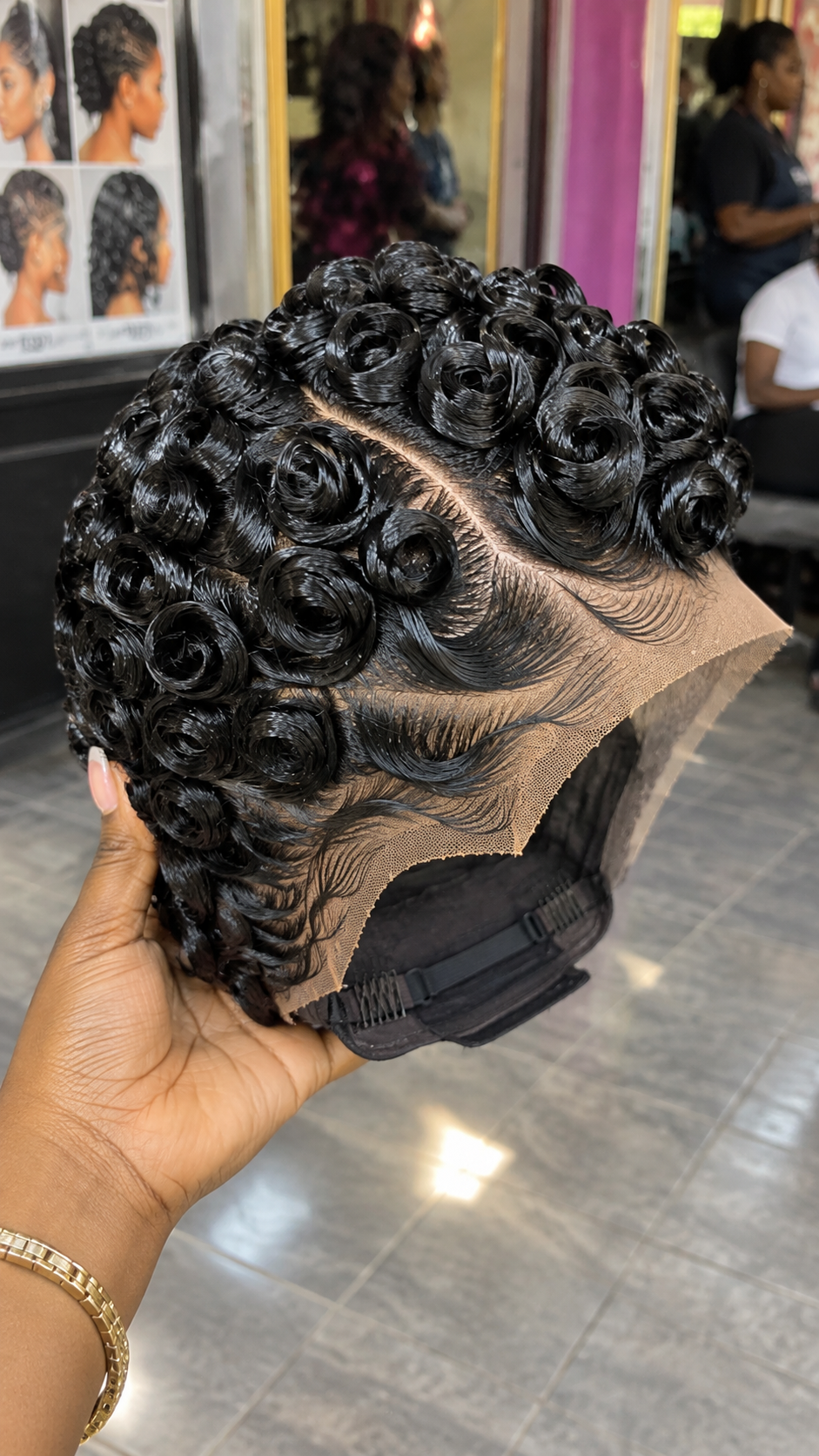
Some hairstyles are designed to be admired from a distance, while others become more fascinating the closer you look. This glossy black pixie wig belongs to the second category. Its crown is covered with beautifully arranged circular rose coils, but the real artistry emerges where those raised curls meet a diagonal side part and a series of delicate, sweeping finger waves. The combination creates an expressive hairstyle that feels both glamorous and carefully balanced.
The photograph shows a compact black wig being held outside a neighborhood beauty salon. Large circular curls dominate the upper and rearward sections, while the exposed front-side area contains flowing waves arranged across beige-toned lace. The diagonal parting creates a clear division between the decorative upper curls and the lower wave pattern. Unlike many sculpted pixie designs, this particular wig does not rely on multiple carved temple stripes. Its visual appeal comes primarily from circular coil placement, carefully directed strands, and the graceful movement of the hairline.
The hair appears predominantly jet black, with reflective highlights following the curved surfaces of the individual coils. Several larger curls have visible openings, while smaller spirals fill the spaces between them. Near the lower side, fine strands form elongated waves that travel toward the front edge rather than standing upright like the crown curls.


The wig is presented before installation, with an extended lace border and part of its black interior cap visible. This makes the photograph especially useful for examining the hairline arrangement and preparing questions for a potential seller. However, it does not establish the fiber composition, exact lace grade, manufacturer, or complete construction.
The Circular Crown Creates a Beautiful Floral Impression
The most eye-catching aspect of this hairstyle is the arrangement of large, glossy circular curls. Their shapes resemble tightly rolled rose petals, giving the upper hair a floral appearance without requiring accessories or additional decoration.
Several curls near the central crown form prominent rings with dark openings at their centers. Others curl inward at different angles, creating overlapping layers of hair that contribute to the rounded silhouette.
The curls are not perfectly identical. Some are broader and more open, while others appear tighter and smaller. This variation helps maintain a lively appearance across the crown.
Near the visible rearward section, the coils become more closely grouped. Their overlapping arrangement gives the hairpiece considerable fullness while preserving a compact pixie shape.
The glossy black surface makes the individual curl formations particularly noticeable. Reflections trace the outer edges of each spiral, while deeper shadows remain inside the rolled sections.
For women seeking a black rose curl pixie wig, this combination of varied curl diameters and compact volume is one of the most important characteristics to reproduce.
The Difference Between Rose Coils and Ordinary Ringlets
Loose ringlets typically form continuous spirals that extend downward or outward from the head. The curls in this hairstyle are arranged more compactly, with many forming nearly complete circular shapes.
Instead of hanging freely, the curls appear positioned close to neighboring formations. Their openings remain visible, but their overall arrangement creates a rounded, sculpted surface.
This distinction matters when ordering a custom wig. A supplier may offer a curly pixie that has approximately the correct length and color but uses conventional spiral curls rather than the broad circular formations shown in the photograph.
Ask the maker to reproduce the rose-like circular coils with a mixture of medium and large diameters. The upper hairstyle should maintain visible curl openings without becoming excessively tall or bulky.
A Diagonal Side Part Gives the Hairstyle Its Direction
A noticeable diagonal parting travels through the upper front-side section, separating two groups of curls. The exposed channel appears pale against the dark hair and provides a clear visual pathway across the hairstyle.
On the upper side of the separation, the hair gathers into raised circular coils. Below it, the strands become flatter and follow coordinated curves toward the front hairline.
The parting is not positioned exactly in the middle of the hairstyle. Its diagonal placement introduces asymmetry and gives the upper curl arrangement a distinct direction.
Several smaller curls sit close to the separation, creating a transition between the prominent crown rosettes and the flowing lower sections.
The photograph does not establish the precise technique used to create the exposed parting. It should not automatically be described as a shaved line or evidence of a particular lace construction.
For custom production, the parting angle should be established before the surrounding curls are arranged. Moving the channel to a different position would noticeably change the overall appearance.
The Finger Waves Bring Movement to the Front Hairline
Beneath the diagonal separation, several carefully directed sections form broad finger-wave patterns across the front-side lace.
These waves contrast beautifully with the circular coils above. Instead of rising into prominent rings, the strands follow elongated curves that remain relatively close to the supporting mesh.
One wave sweeps downward from the parting before bending toward the front edge. Another follows a lower path, creating a layered arrangement of dark strands.
The front styling also includes finer curved ends that extend across the lace. These small sections contribute to the decorative hairline without introducing long hanging curls.
The photograph shows the wig before fitting, so the exact position of these waves against a wearer’s forehead cannot be established.
A professional stylist should preserve the existing strand direction when positioning the unit. Excessive brushing or careless manipulation could disturb the delicate wave arrangement.
Preserving the Relationship Between Coils and Waves
The hairstyle works because its two main styling structures remain visually distinct. The raised circular coils create height and fullness, while the flatter finger waves provide flowing movement closer to the hairline.
If the front waves were replaced with ordinary curls, the hairstyle would lose much of its directional character. If the upper coils were flattened into waves, the crown would no longer have its pronounced floral appearance.
For an accurate reproduction, the buyer should identify both elements separately when communicating with a wig maker.
The goal is not simply to request a curly black pixie. It is to request circular rose coils above a diagonal parting with carefully sculpted finger waves beneath it.
The Side Silhouette Remains Compact and Rounded
The visible side contains smaller curls that continue from the crown toward the lower perimeter. Their density creates a relatively full appearance without long strands extending far beyond the overall shape.
Some curls near the lower side appear narrower and more closely arranged than those positioned near the crown. This helps the hairstyle transition gradually toward the edge.
The side does not show an obvious bare skin fade or an arrangement of multiple parallel razor lines.
Instead, the styling remains focused on the interplay between circular curls and sweeping front waves.
This distinction is important when searching for comparable units. A wig described as a curly pixie with shaved sides may have a completely different appearance.
The photograph does not reveal the entire opposite side or the complete rear. Requesting additional photographs can help establish whether the curl arrangement continues in the same way around the head.
The Jet Black Color Highlights the Sculpted Shapes
The hair appears predominantly jet black, with subtle differences in brightness caused by light reflecting from the strands.
The outer surfaces of the circular coils show glossy reflections, while their inner openings appear darker. This contrast emphasizes the rolled shapes.
The finger waves produce a different reflection pattern. Their strands are arranged in elongated groups, creating continuous bands of light across the curved sections.
No clearly established blonde, burgundy, copper, or caramel highlights are visible in the wig.
The photograph therefore supports describing the color as predominantly black rather than suggesting an intentional multicolor blend.
When ordering, ask whether the supplier offers natural black, jet black, or blue-black options. These labels may refer to different shades depending on the manufacturer.
The photograph cannot establish whether the color is naturally occurring, dyed, or manufactured into synthetic fibers.
The Untrimmed Lace Deserves Careful Attention
A broad section of beige-toned lace extends beyond the decorated front hairline. The mesh remains visible around the forehead and temple area, indicating that the unit has not been fully prepared for installation.
The front lace supports the visual presentation of the carefully arranged waves. Fine strands extend over portions of the mesh, creating curved patterns that may require careful positioning during fitting.
The photograph does not establish whether the lace is HD lace, Swiss lace, or another commercial type. Such information must be confirmed by the manufacturer or seller.
Buyers should also ask about the available lace shades and whether the chosen option is appropriate for their intended installation.
Any lace trimming should take place only after the cap has been positioned correctly. Removing too much mesh may reduce fitting flexibility or disturb sections close to the decorative hairline.
The Visible Interior Offers Important Buying Clues
The lower opening reveals part of a black fabric cap with stitched sections. A dark adjustment band and a fastening component are also visible near the lower edge.
These details suggest that the unit includes some form of cap adjustment hardware, but the image does not reveal the complete securing system.
The presence of an adjustment component does not automatically mean the wig is suitable for adhesive-free wear.
Before purchasing, request a complete photograph of the interior. Ask the seller to identify all combs, straps, elastic bands, and other securing components included with the unit.
It is also important to confirm the cap circumference, front-to-back measurement, and ear-to-ear dimensions.
A properly sized cap can help the diagonal parting and finger-wave sections remain in their intended positions during installation.
Choosing a Suitable Installation Method
Similar sculpted pixie wigs may be offered with lace-front, frontal, closure, or glueless construction options. These terms refer to different aspects of wig design and should not be treated as interchangeable.
A closure generally provides a more limited lace area, while a frontal may extend across a broader portion of the front hairline. Exact dimensions vary between manufacturers.
For this hairstyle, the decorative finger waves occupy a noticeable part of the front-side area. The chosen construction should provide suitable support for their intended placement.
If adhesive-free wear is preferred, ask the supplier whether the particular cap is designed for that method. Proper fitting and adequate securing components remain important.
A professional wig stylist can help determine which installation approach suits the actual unit and the wearer’s measurements.
Finding a Wig Maker Who Can Reproduce the Rose Coils
Not every wig maker specializes in sculpted circular curls. Some salons primarily work with loose waves, straight wigs, or conventional curly units.
For this design, look for professionals who have experience arranging compact rosette curls and creating decorative finger waves on lace hairpieces.
Specialized wig boutiques, local beauty salons, and custom wig makers are appropriate places to begin searching.
When reviewing portfolios, examine the curl openings, their placement across the crown, and the direction of the front waves.
A similar hairstyle should contain large circular coils rather than uniformly tiny ringlets.
Likewise, the front should include flowing wave sections rather than an ordinary straight hairline.
The photograph does not identify the original seller or confirm current product availability.
How To Order This Style
When placing a custom order, send the reference image and explain which details are essential.
Begin with the jet black color and compact pixie silhouette. Ask for broad circular rose coils arranged across the crown, with smaller curls filling the surrounding sections.
Next, identify the diagonal side parting and the sweeping finger waves positioned beneath it.
Explain that the hairstyle should not include additional shaved temple stripes, contrasting hair colors, or excessive crown height.
Ask whether the supplier can provide photographs of the finished crown and front hairline before shipping.
Confirm the fiber material, cap size, lace coverage, and included adjustment components in writing.
If the order involves a custom-made unit, request an itemized quotation explaining whether curl styling, lace preparation, and cap customization are included.
Comparing Ready-Made and Custom Options
A ready-made wig may be convenient when a seller already offers a comparable rose curl pixie in the required size.
It may also involve less production time and a lower initial cost.
However, generic curly pixie wigs often differ in curl diameter, parting direction, or hairline styling.
A custom unit provides greater control over those details, particularly when the buyer wants the large circular curls and decorative finger waves reproduced accurately.
The trade-off may include additional labor, higher cost, and the need for more detailed communication.
Before making a purchase, decide whether a similar overall appearance is acceptable or whether the individual curl formations must closely match the reference.
Illustrative Pricing for Black Rose Coil Pixie Wigs
The cost of producing a comparable hairstyle may depend on the fiber material, cap construction, lace coverage, and the amount of labor involved in arranging the circular curls and finger waves.
The photograph does not establish the manufacturer, material composition, or actual retail price. The following figures are illustrative planning ranges in US dollars, not verified live quotations.
| Wig Category | Illustrative USD Range | Possible Purchase Scope |
|---|---|---|
| Premium Custom | $335–$795+ | Individual cap measurements, carefully arranged rose coils, customized diagonal parting, and specialist finger-wave styling. |
| Standard Custom | $180–$430 | Selected adjustments to circular curl placement, hairline waves, cap sizing, and overall proportions. |
| Basic Human Hair | $105–$285 | A human-hair base wig that may require professional rosette setting and additional front-wave customization. |
| Premium Synthetic | $75–$210 | A higher-grade synthetic alternative with potentially prearranged circular curls and decorative waves. |
| Basic Synthetic | $30–$110 | A budget option where the accuracy of curl diameter and finger-wave placement may vary. |
These categories represent possible purchasing approaches rather than confirmed versions of the photographed wig.
Shipping, installation, lace preparation, cap alterations, and future curl restoration may involve additional expenses.
Request a detailed quotation before making payment, especially when ordering a custom hairstyle.
Preparing for a Professional Salon Fitting
Once the wig arrives, inspect the rose coils, diagonal parting, finger waves, and cap before making any alterations.
When booking an appointment, explain that the hairstyle contains compact circular curls and carefully arranged front waves.
Ask whether the stylist has experience working with sculpted pixie wigs and decorative lace hairlines.
The fitting should begin with checking cap comfort and positioning the hairpiece correctly.
Only after the desired placement is established should excess lace be trimmed where necessary.
The stylist should avoid disturbing the grouped front strands or flattening the raised coils.
If minor styling corrections are required, the method should be appropriate for the confirmed fiber material.
Maintaining the Circular Curl Structure
The upper rosettes depend on grouped strands retaining their rolled shapes. Aggressive brushing may separate these groups and reduce the visibility of the circular openings.
Before washing, ask the supplier whether the curls are designed to retain their arrangement or require professional resetting afterward.
If the wig contains synthetic fibers, heat tools should only be used within manufacturer-confirmed limits.
If it contains human hair, professional resetting may be possible, but the technique should account for previous processing and the original curl-setting method.
Avoid applying excessive styling products inside the coils. Product buildup can alter their reflective appearance and may make future maintenance more difficult.
During storage, protect the rounded crown from pressure that could flatten the circular formations.
Keeping the Finger Waves in Place
The front waves require a different maintenance approach from the raised crown coils.
Their appearance depends on fine strands continuing to follow specific curved paths across the hairline.
Repeated brushing against the wave direction may disturb the arrangement.
Ask the supplier which products were used to create the waves and whether localized restyling is possible.
If the decorative sections begin to lose their original shape, professional correction may be preferable to aggressive home styling.
Any trimming near the front lace should be approached cautiously because hair removal and excessive lace cutting can be difficult to reverse.
Additional Photographs Worth Requesting Before Purchase
The reference provides a clear view of the circular crown, diagonal parting, and front-side waves, but several important areas remain unseen.
A direct front photograph would show how the decorative waves frame the forehead.
An opposite-side view would establish whether the curl arrangement continues in the same direction.
A rear photograph would reveal how the smaller coils extend toward the nape.
A complete underside photograph would help verify the cap construction and attachment components.
A short video under neutral lighting could also provide a more reliable impression of the black shade and overall silhouette.
These additional views are particularly valuable for remote purchases and custom orders.
A Striking Choice for Women Who Appreciate Sculpted Pixies
This hairstyle offers several appealing qualities. Its compact length provides a distinctive alternative to longer curly wigs, while the oversized rose coils create noticeable crown volume.
The diagonal parting introduces asymmetry, and the sweeping finger waves add decorative movement across the hairline.
The predominantly black color keeps the focus on the shape of the curls rather than contrasting highlights.
However, the carefully arranged coils may require more delicate handling than ordinary loose curls. The front-wave design may also need professional attention if its strand placement becomes disturbed.
Buyers should consider the level of maintenance they are comfortable with, the intended frequency of wear, and the availability of a stylist experienced in sculpted wig designs.
With accurate cap measurements and a suitable installation method, a comparable wig can provide an elegant, compact hairstyle with considerable visual detail.
Where Circular Curls Meet Beautiful Hairline Artistry
The strongest appeal of this black pixie lies in the contrast between its large rose-shaped coils and its flowing front waves. The upper curls create fullness and depth, while the diagonal parting provides a clear directional division across the hairstyle.
Smaller curls continue along the lower perimeter, maintaining a compact rounded silhouette without relying on a visibly shaved temple.
The extended beige lace and partially exposed black cap offer useful information about the pre-installation presentation, although the exact material and construction require seller confirmation.
For anyone seeking a similar wig, the most important considerations are the size and placement of the circular curls, the direction of the side parting, the arrangement of the finger waves, and the accuracy of the cap fit.
A carefully selected ready-made unit or a well-planned custom order can preserve the hairstyle’s distinctive character without introducing unnecessary colors or unrelated decorative patterns.
With appropriate professional fitting and material-specific maintenance, this sculpted black pixie offers a beautiful combination of glossy rose coils, graceful hairline movement, and compact elegance.
Search Terms
Glossy black rose coil pixie wig · Diagonal part circular rosette curls · Jet black sweeping finger wave hairpiece · Beige lace sculpted forehead waves · Black oversized circular coil crown · Compact pixie with floral spiral curls · Dark rosette curls and curved hairline · Black lace pixie with side swept waves