
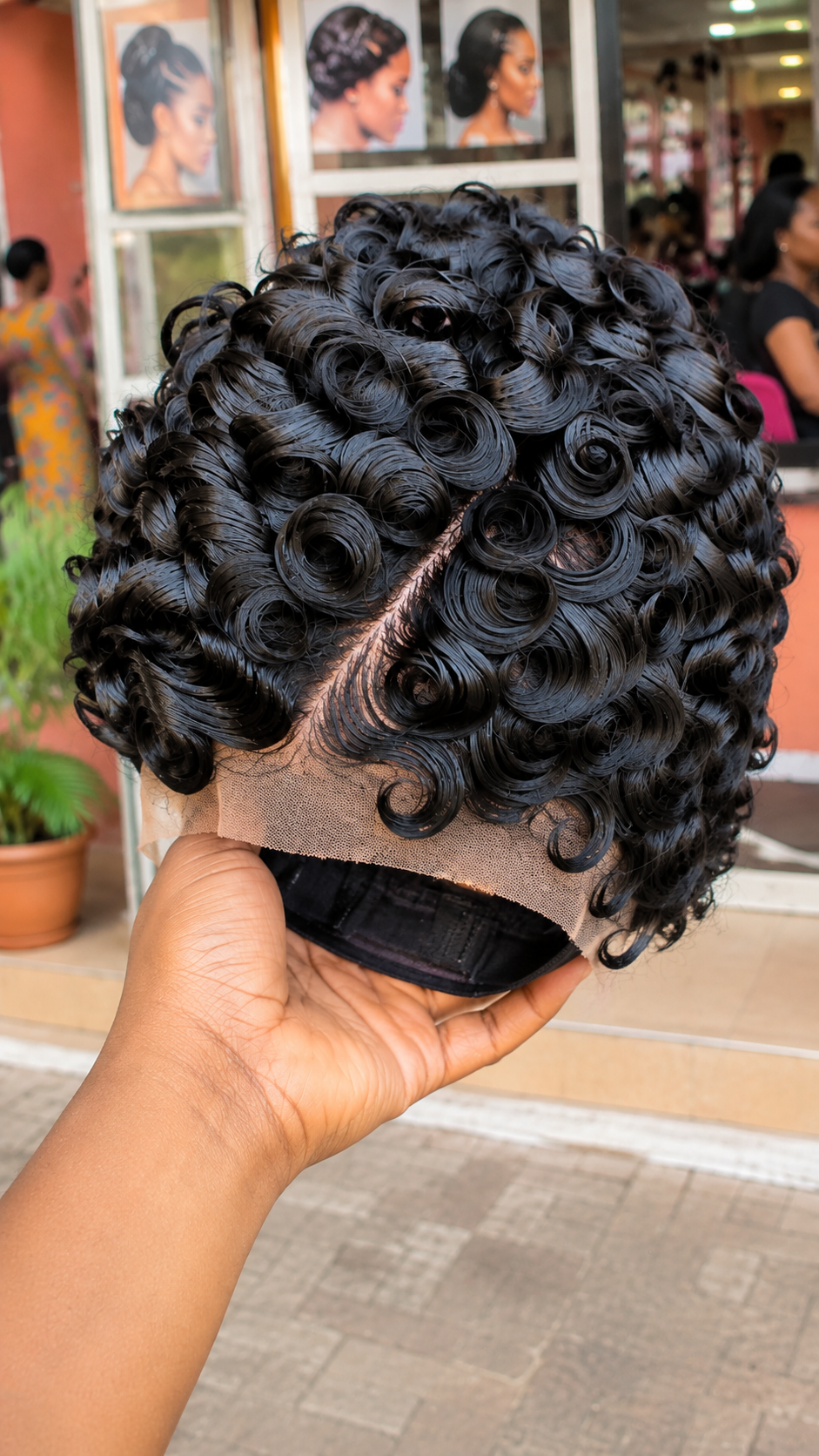
Broad black curls fill the crown of this short wig, turning inward like ribbons rolled around an open center. The biggest circles sit near the front and through the top, where their layered ridges catch the light. A side part runs diagonally through the set, making a narrow opening between two groups of curls. Follow it toward the forehead and the styling changes. The hair lies flatter, sweeps across the lace and turns back into a distinct hook at the edge.
That last turn gives the black barrel curl pixie wig its character. Several smaller hooks continue around the visible front, each with a little space around its tip. The outline is deliberately uneven in a way that flatters the curls. Some stop close to the crown, while others reach down toward the hairline. There is a clear difference between the rounded silhouette of the whole piece and the more intricate shapes you notice when you look closely at the front.
The wig is held from below, showing the brown lace and a section of the dark cap interior. The angle offers a close look at the styling before installation. How much of the flourish sits above your brow, how close the smallest curls fall to your temple and how much of the part you see straight on will depend on the fit. Those are the details to take into a consultation if you want to commission a similar piece or find a ready-made wig with the same character.


Where the Front Curl Turns Back
Look at the hair just below the narrow end of the part. Several fine strands travel together in a low curve, then gather into a thicker turn with a rounded tip. The hook has enough weight to cast a small shadow against the lace, giving it more presence than the fine hairs around it. A second curl sits farther along the edge and repeats the movement on a smaller scale. The space between the tips is part of what makes the detail readable.
If you are fitting a version for yourself, decide where you would like that first hook to land. A curve placed closer to the brow becomes a prominent part of the front view. One placed farther to the side appears more clearly when you turn your head and leaves more of the forehead open. Ask your stylist to show you both placements while the wig is resting at your intended hairline. Then look at the result from an ordinary distance as well as close to the mirror.
The shorter loops near the temple allow some flexibility. You may like every little turn in the reference, or you may want only one or two visible below the larger curl. Tell the stylist which one you would keep if the front needs to be simplified. This is especially helpful if you wear glasses. Their arms can cross the smallest curves even when the main hook stays clear. Bring the frames you reach for most often so you can check the contact point during the fitting.
The Crown Looks Different as It Turns
Some curls face outward and show nearly complete circles. Others lie at an angle, with the wide outer surface catching more light than the opening. Several broad curls overlap through the crown, and a few fine strands are visible across their ridges. The variety makes the set feel less rigid. A ready-made wig with perfectly even circles might give you a similar outline, but it will have a different surface. Look for a mix of broad turns and smaller loops if you want the irregular rhythm shown here.
The darkest areas are inside the curls and where they overlap. In the light, the hair shows a blue-black sheen on some edges, while the rest reads as black. To judge a comparable unit in person, step away from a bright display light and turn it slightly. You should be able to see whether the curl shape still appeals to you once the shine softens. A short daylight video offers a similar check if you are buying remotely. Ask the seller to show a complete turn because the crown can look quite different from the other profile.
The visible lower side stays full of curls, although some of them become smaller near the perimeter. The exact nape finish is harder to see from the angle shown. If you want a wig for frequent wear, ask for a straight rear view and check where the lowest curls would meet your usual collar. A closer nape gives more clearance, while a few longer loops can carry the crown pattern farther down. Agree on that choice when you choose the cut, since it will affect the view from behind.
Get the Length Right Before Choosing the Fullness
Short barrel curls use most of their length in the turn itself. A base unit can look longer than you expect in its unstyled state and still give the right outline after setting. Ask a maker for both the strand length and the finished height at the crown. If the wig has already been styled, an eye-level side photograph will help you see whether the curls sit close or stand away from the head. The height of the biggest curl is more useful here than a single overall length on a label.
For a version that sits closer, ask whether the larger barrels can be turned at a shallower angle. That allows the face of the curl to remain broad while lowering the top. If you want more lift, discuss which area will carry it. Raising a group through the upper crown can keep the curl by the brow readable. Lifting the whole front may change how the little hooks appear in relation to your face. Choose the amount of height you like with the part already positioned.
Too much density can hide the centers of the curls, especially where the black hair is arranged in layers. Too little can leave a wide gap between the upper circles and the smaller turns around the side. Ask the maker to describe how they will distribute the hair around the part and front edge. A lightly filled hairline can support separate curls while the upper crown carries more volume. A photo from above and a profile taken at the same fitting will show whether that distribution suits the look you had in mind.
Where To Buy This Wig
Start with specialist wig boutiques, beauty supply shops that stock short styled units and custom wig makers who show open barrel curls in their portfolios. Look through photographs that include close views of the lace and the side of the crown. A shop may have a black unit with a similar curl set that needs only fitting and edge work. A custom studio is more likely to be able to place the individual hooks where you want them and set the larger curls around a chosen part.
Send the photograph with a brief that mentions the broad circles, diagonal side part and separate curved tips at the front. Mark the largest front hook so the maker can identify it easily. Specify the preferred part side from your own perspective and include your measurements, the crown height you like and how much forehead you want visible. Ask for a view of the proposed opposite side. This step is particularly useful if you plan to show both profiles in photographs or wear your hair with an open neckline.
Before paying, request pictures of the actual finished piece if it already exists. Ask to see the front straight on, both sides, the back and the entire interior. Confirm the fiber, lace shade, cap size, usable parting area and the condition in which the lace will arrive. On a custom order, agree on when you can approve the set, which alterations are included and how long the maker expects the work to take. Get the delivery cost and the terms for changes after fitting in writing.
If you want the style done locally, book a consultation with a wig stylist or short-hair salon that shows examples of molded edges and barrel sets. Send the photo and tell the salon what you plan to bring. An already styled wig may need a cap fitting, a lace trim and a few adjustments to the front. A plain base may require cutting, setting and more appointment time. For a version on your own hair, ask the stylist whether your existing cut provides enough length for the wide turns and enough fine hair to shape the edge.
Fit the Part and the Flourish Together
The image shows lace along the front and part of the inner cap. Ask for a complete interior view before selecting a construction. A lace-front wig can suit this style if its usable area extends along the full side part and leaves enough space for the curved hairline. A frontal may give a stylist more room across the forehead and at the temples, depending on its dimensions. The amount of usable lace matters because the flourish extends beyond the first row of large curls.
A closure can serve a fixed part when the intended line stays within its usable area. Ask the maker to show how a closure version would handle the small curves beyond that area. A full-lace piece gives you more scope to change the direction later, provided the cut and curl set allow it. For someone who plans to wear the part in one place, a comfortable cap with suitable space around the edge may be the most useful consideration. An inset parting panel or a cap seam should sit well away from the visible line you want to keep.
For a glueless installation, ask whether the unit uses an elastic band, adjustable straps or other components to hold it in position. Follow the seller’s measuring instructions, including circumference and any requested ear-to-ear or front-to-nape dimensions. Check the fit by looking down, turning your head and putting on your glasses. A comfortable cap should settle back into the same position so the smallest curves land where the stylist placed them. Have the cap adjusted before the lace is trimmed if the edge shifts during that check.
An adhesive installation is another option for a compatible lace unit when you want extra hold along the front. Agree on the placement before the edge is secured, then ask how the product should be removed. If you usually remove your wigs at the end of the day, mention that when you book. A frequent removal routine puts more handling around the front hooks, so practice lifting the unit by the cap and releasing the edge as your stylist demonstrates. That gives you a clearer idea of the time you will need between wears.
Budgeting for the Curl Set and Edge Work
Use the following USD ranges as budgeting examples. Supplier, location, cap construction, fiber and salon labor affect actual quotes. Delivery, fitting, lace finishing and any later reset may be billed separately. Ask whether the quotation includes the large crown curls and the individual hooks at the front. Those are two distinct styling tasks, and a listing for a pre-styled curly pixie may cover only the first.
| Tier | Illustrative Price Range | Potential Scope |
|---|---|---|
| Budget | USD 20–45 | Ready-made synthetic pixie with fixed curls and a simple front edge. |
| Value | USD 45–115 | Pre-styled synthetic piece with broader curls, a visible part or shaped front detail. |
| Mid | USD 95–190 | Short human-hair base with cutting, barrel setting and fitting potentially quoted separately. |
| Premium | USD 175–325 | Custom styling on a standard cap with an agreed side part and individual curves along the hairline. |
| Salon-Grade | USD 325–650+ | Made-to-measure construction and a full set with the crown height and hairline placement checked at a fitting. |
Compare quotes using the feature you care about most. If you mainly want the crown, a ready-made wig with wide open curls may give you enough of the look to justify a simpler edge. If you chose the reference for the curve over the forehead, confirm that the proposed base has enough lace and suitable hair in that exact area. When buying the wig and booking the stylist separately, get the stylist’s assessment before ordering so you know whether the work falls within your planned budget.
A Care Schedule for a Set With Open Curls
After each wear, check the hooked tips along the edge and the outer rim of the largest barrel. A scarf or the arm of a pair of glasses can move a tiny curl even when most of the style still looks fresh. Hold the cap at a sturdy area and touch only the section that shifted. If a tip has opened slightly, follow its existing curve with your fingers. Sweeping across the whole front with a brush can pull separate tips together and change their spacing.
If you wear the wig frequently, inspect the inside of the cap and the lace about once a week. Wash according to the manufacturer’s care directions, taking wear and product buildup into account. When cleaning is due, support the lace and avoid rubbing the curls together. Blot the piece and let it dry with the cap supported on a stand. Leave space for the lowest front curl to keep its shape. If adhesive was used, follow the directions for the compatible remover before cleaning residue from the underside.
Ask the stylist which parts of the set can be restored at home. A human-hair wig may allow a wet reset or another method selected for its condition. With synthetic fiber, follow the manufacturer’s guidance on water temperature, steam and heated tools. Ask about the finish chosen for the hairline as well as the crown. Heavy product around the smallest hooks can obscure the fine strands and create a visible layer over the lace. Book a professional reset when several barrels start to open or the main flourish loses its curve.
Keep the wig on a stand that supports the cap without stretching it. Leave room around the sides and above the tallest curls so they can rest without being pressed. Store it out of prolonged direct sunlight, and use a firm case if you travel with it. Before closing the case, check that the lace lies unfolded and the front curl clears the lining. Take a straight-on photo and a profile after the first fitting. Those pictures will show a stylist exactly where the main curl landed on you if you later bring it in for a reset.
Trying the Pixie With Your Everyday Routine
This set offers the open neckline of a short wig with enough fullness to give black hair a visible shape in photos. The side part helps you find the correct position when you put it on, while the front flourish adds detail at eye level. For an occasion, check the crown against the lighting and neckline you plan to wear. For regular use, try the wig with the glasses, headphones or head covering you use most. Those few minutes in a fitting will tell you how much of the original front you can wear comfortably.
The main trade-off is the care needed to preserve the small turns and the open barrels at the same time. Pressure at the crown can flatten several curls at once. Friction at the edge can change a single tip, which is noticeable when the rest of the front stays in place. A fixed part also gives the style a preferred direction. Before leaving the salon, put the wig on yourself and check whether the main hook returns to the spot you liked. If it does and the cap feels comfortable as you move, you have a practical starting point for wearing and maintaining the set.
Search Terms
black barrel curl pixie wig · short black wig with hooked hairline curls · glossy barrel curls with diagonal part · open barrel curl crown · sculpted forehead curl pixie · lace front wig with curled tips · short black wig with overlapping barrel curls · side part pixie with curved temple detail