
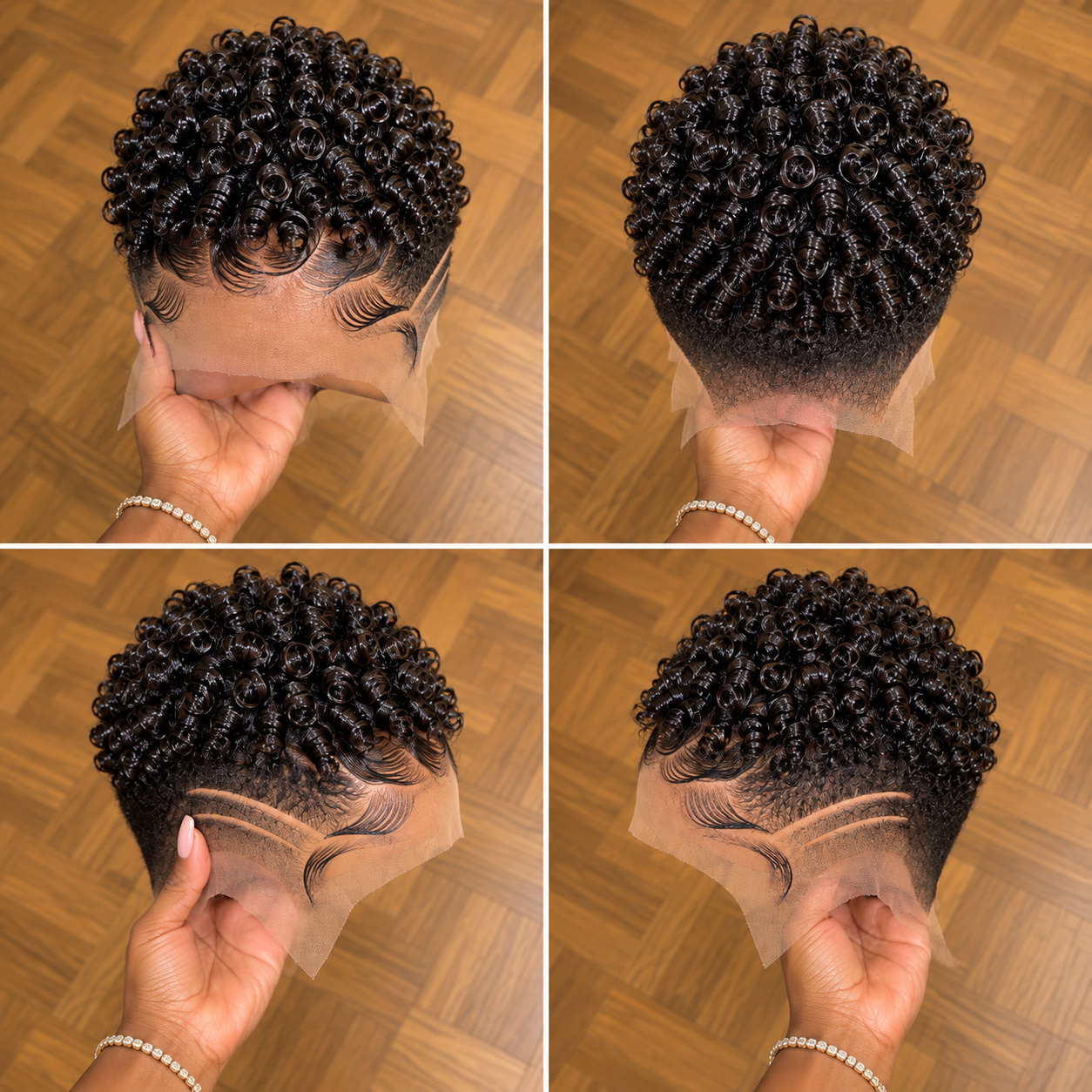
A wig shown from four different directions offers something more useful than a single glamorous product photograph: the opportunity to examine whether the styling remains coherent around the entire head. This four-panel display presents a compact raven-black spiral wig from the front, back and both sides. Large tubular coils cover the upper crown, fine finger-wave sections frame the front, and curved side markings create a decorative transition into the closely arranged lower hair. The four views make it possible to appreciate the design as one complete hairpiece rather than judging only its most attractive angle.
The strongest visual characteristic is the dense crown of glossy black spiral coils. Many have open circular centers, while others form elongated tubular sections that point forward or backward depending on their location. The front incorporates several sweeping finger-wave arcs, and the side photographs reveal paired carved channels beneath the curled upper hair. The rear photograph shows a compact, gradually tapered lower section beneath the dense spiral crown.
The unit is photographed before installation, held above a parquet floor. Excess lace remains visible around the perimeter in several panels. That detail matters because the wig has not yet been fitted and trimmed for an individual wearer. The photograph supports describing the piece as a lace-based wig, but it does not establish a specific lace grade, human-hair composition or adhesive-free wearing method. Those characteristics must be verified through the seller’s actual specifications.
The Four Photographs Answer Different Purchasing Questions
The upper-left image provides the most useful front view. It shows how the largest spirals approach the forehead and how the finer directional strands create curved accents beneath them. The upper-right image reveals the rear, including the density of the crown and the reduction in hair length toward the lower perimeter.
The lower-left and lower-right panels show the side construction. They reveal that the wig does not rely exclusively on large crown curls. The side areas contain carefully arranged fine hair, sweeping finger-wave movements and paired exposed pathways.
These views should be considered together when commissioning a similar unit. A maker might reproduce the front convincingly while simplifying the back or changing the side geometry. Examining the complete set helps identify those differences before the order is approved.
The Front Is Designed Around Spiral Height and Hairline Movement
The front photograph shows a rounded crown with circular coils concentrated above the forehead. Several of the larger spirals extend slightly forward, creating a sculpted edge rather than a conventional straight fringe.
Beneath the raised curls, thin black strands curve toward the forehead in repeated finger-wave motions. These movements are flatter than the spiral crown and create a gradual transition into the front perimeter.
The combination matters because the upper hair and fine front sections perform different jobs. The spirals create volume and structure, while the smaller curved strands control the shape around the face.
A custom maker should not replace this arrangement with one continuous row of tight curls. The contrast between large open spirals and flatter front movement is central to the reference.
The Back Reveals a Fully Populated Spiral Crown
The rear view is particularly valuable because many wig listings focus on front and side photographs while concealing the back. In this image, the upper and middle rear remain densely covered with glossy tubular spirals.
The coils gradually become smaller and sit closer to the foundation as they approach the lower perimeter. This creates a rounded silhouette without making the back project excessively.
The dark lower section appears more compact than the crown above it. That change in height is important because it creates a controlled taper rather than an abrupt ending.
For a custom order, a rear photograph should be treated as a necessary approval view. The buyer should confirm that the spiral arrangement continues naturally around the back and that no large unfinished area has been concealed by the front styling.
The Side Views Reveal Precision Beyond Ordinary Curl Setting
The two lower panels demonstrate why this wig should not be described simply as a black curly hairpiece. Beneath the spiral crown, the side hair becomes flatter and more directional. Narrow exposed paths create parallel curved markings through the compact section.
These markings follow the contour of the wig rather than forming simple horizontal stripes. Long finger-wave arcs also extend toward the temple and contribute to the decorative profile.
The relationship between these elements is important. The upper spirals remain dense and rounded, while the side patterns use elongated movement and negative space.
For buyers seeking an exact recreation, the side photographs should accompany the ordering instructions. A generic request for shaved lines may produce a different number, width or curvature of markings.
Double Temple Lines Create a Layered Side Appearance
The side detailing includes two closely related exposed channels beneath the upper styling. The channels follow sweeping paths and remain separated by a narrow section of dark hair.
This retained hair gives the markings their individual outlines. Without it, the channels could merge visually into a single broad opening.
Creating the design therefore requires a balance between removing and preserving hair. The goal is not to carve the deepest or widest lines possible, but to maintain the spacing that makes both paths recognizable.
For initial customization, the pattern should be mapped before cutting. During later maintenance, the original side photograph can help preserve the established line width and curvature.
The Fine Temple Strands Have Their Own Direction
Near the temple, several fine strands form elongated curves that differ substantially from the circular crown coils. Some sweep forward before turning downward, while others follow the exposed side division.
These details soften the transition between the decorative channels and the face. They also prevent the lower side from looking like a simple shaved section placed beneath a curly crown.
A stylist recreating the design should preserve those directional strands rather than automatically turning them into additional ringlets.
The fine temple work may require a separate setting technique from the crown, making it important to work with a professional experienced in sculpted wig styling.
Raven Black Keeps the Focus on Curl Geometry
The visible hair appears predominantly raven black, with bright reflections across the raised spiral surfaces. There is no clear evidence of separately applied blonde, copper or burgundy highlighting.
This monochromatic palette places emphasis on the arrangement of the curls. The outer surfaces catch light while the open centers and recessed spaces remain very dark.
Because the individual coils have different orientations, some reflect more light than others. This produces depth without requiring additional color.
For buyers, the most important quality measure is not maximum shine alone. The spirals should remain individually recognizable, with enough separation to preserve their hollow centers.
The Spiral Diameter Changes Across the Crown
The crown contains a mixture of larger and smaller spirals. Several prominent circular openings appear near the front and upper center, while tighter sections occupy the rear and outer areas.
This variation allows the hair to adapt to the rounded foundation. It also prevents the crown from resembling a rigid pattern of identical curls.
A custom wig maker should therefore avoid using one uniform spiral size across every section unless that is specifically requested.
An elevated approval photograph can reveal whether the diameter variation is balanced and whether the larger openings remain visible.
Why the Spiral Centers Should Not Be Filled
Many of the curls contain dark hollow centers. These openings are an important part of the visual identity.
If additional hair is packed into every space, the crown may appear fuller but the individual spiral shapes become less obvious. The result can shift toward a conventional dense curly hairstyle.
For this construction, controlled density is more valuable than indiscriminate fullness.
The maker should arrange the curls so that the larger openings remain visible while smaller supporting sections provide enough coverage around them.
The Lower Rear Uses a Gradual Taper
The back photograph shows that the hair becomes progressively closer toward the lower perimeter. The upper rear remains filled with spirals, but their projection decreases as the construction approaches the base.
This keeps the wig compact and prevents the rear from appearing excessively bulky.
The taper also creates continuity with the side areas, where fine close hair supports the exposed markings and temple waves.
A recreation should preserve this balance rather than leaving the lower back as full as the central crown or removing so much hair that the foundation becomes unnecessarily exposed.
The Lace Perimeter Has Not Yet Been Trimmed
Visible lace extends beyond the hair-bearing areas in the four-panel display. This indicates that the final installation stage has not yet been completed.
The additional material can provide flexibility during fitting. A professional can establish the cap position and assess how the front and side designs align with the wearer before selecting the trimming route.
The photograph does not verify the commercial grade of the mesh. Although some sections appear fine, visual appearance alone does not establish HD lace.
Buyers should request the supplier’s actual lace specifications and available shades when those details affect the purchasing decision.
Cap Position Changes How the Side Markings Appear
The decorative paths are fixed to the wig foundation. If the cap sits too far forward, the markings move closer to the face. If it sits too far backward, the side design shifts away from the intended temple area.
Correct sizing therefore matters for appearance as well as comfort.
For a custom unit, follow the maker’s measurement guide. Depending on the cap, measurements may include circumference, front-to-nape distance and ear-to-ear width.
A wig stylist can assist with these measurements before ordering, particularly when precise side positioning is important.
Using the Four-View Reference to Place a Custom Order
The strongest way to use this collage is to treat each panel as a separate quality checkpoint.
The front should establish the raised spiral crown, fine forehead movement and hairline shape. The rear should confirm consistent curl coverage and a compact lower taper. The side views should document the paired carved channels, temple waves and retained hair between the markings.
The color requirement is straightforward: deep raven black without obvious contrasting highlights.
After agreeing on the appearance, discuss cap size, lace material, attachment preferences and whether the lace will arrive untrimmed for local installation.
This approach gives the maker a more precise specification than a single reference image or generic style name.
Choose a Wig Maker Who Can Work Across the Entire Head
A successful recreation requires consistent styling from all four directions. Someone who produces excellent frontal curls may not necessarily complete the back with the same care.
Look for portfolio examples showing sculpted curls from above, from behind and from both sides.
The maker should understand compact spiral construction, directional perimeter waves and conservative precision cutting on a wig foundation.
If different professionals handle the crown and side markings, they should work from the same reference set and agree on the cap position before any permanent side cutting occurs.
Where to Buy a Four-Angle Spiral Wig
Custom lace-wig studios, specialist wig makers and salons experienced in sculpted finger-coil work are practical sources for a comparable design.
Ready-made black curly wigs may offer a suitable starting foundation, but reproducing the exact spiral diameter and side geometry could require additional professional customization.
When contacting a seller, provide all four reference views and ask which parts of the styling are included in the quoted price.
Confirm whether the unit is already completed or will be made to order. A finished product and an unfinished base can involve very different amounts of work after delivery.
The Seller Should Supply Matching Approval Views
Before shipment, request photographs corresponding to the reference: front, rear, right side and left side.
These images allow the buyer to compare the finished construction without relying on one flattering angle.
Look for consistency in crown height, spiral diameter, lower rear density and side markings.
If the wig includes a particular lace or cap construction, request an additional underside photograph. The exterior collage does not establish every internal component.
Price Comparison Should Include All-Around Styling Labor
The compact dimensions of the wig do not necessarily make it inexpensive to construct. Dozens of spiral sections require placement, and the side markings add precision work that must remain consistent with the overall shape.
Professional preparation of the lace and cap can further influence the final quotation.
Estimated Pricing for a Four-View Raven Black Spiral Wig
| Category | Illustrative Price Range | What May Be Included |
|---|---|---|
| Premium Custom | $330–$590+ | Higher-grade hair, individualized cap measurements, all-around spiral crown construction, matching side channels, sculpted temple waves, rear taper refinement and lace preparation. |
| Standard Custom | $200–$350 | Prepared black spiral crown, established side detailing and more standardized cap and fitting options. |
| Basic Human Hair | $120–$215 | A human-hair foundation that may require additional spiral setting, side cutting, rear shaping and professional fitting. |
| Premium Synthetic | $80–$155 | A quality pre-set option with potential curl-retention advantages and more limited future styling flexibility. |
| Basic Synthetic | $40–$90 | A budget interpretation where curl consistency, side precision, rear construction or cap quality may be simpler. |
These ranges are illustrative budgeting estimates rather than verified prices for the photographed wig. Actual quotations vary according to the seller, location, hair or fiber, cap construction, customization labor, shipping and installation.
Ask whether the quote includes the completed rear, both sides and the front spiral crown. A foundation requiring several separate salon appointments may cost more overall than a finished custom unit.
Human Hair and Synthetic Fiber Offer Different Maintenance Options
A human-hair version may allow greater flexibility when individual spirals need professional resetting. If several sections lose their shape, a stylist can potentially reconstruct those areas while preserving the rest of the crown.
A premium synthetic version may retain a pre-set curl arrangement with less frequent intervention, although heat tolerance and future modification options depend on the fiber.
Neither material can be confirmed from the collage alone. Buyers should obtain the actual product specification before selecting a maintenance routine.
Use the Four Photographs as a Maintenance Map
One of the practical advantages of this collage is that it records the hairstyle from several directions. These images can help a stylist restore the original arrangement after washing or transport.
The front view documents the direction of the forehead waves. The rear view shows the lower taper and curl distribution. The side views record the curved markings and temple details.
Keeping this reference set available can prevent maintenance appointments from gradually changing the hairstyle.
Wash Without Mixing the Spiral Sections
The crown should be handled as a collection of separate sculpted coils rather than one loose curly mass.
Avoid vigorous circular rubbing that can intertwine neighboring spirals and obscure their hollow centers.
Follow the washing method appropriate for the confirmed hair or fiber, and allow the unit to dry without compressing the crown.
Afterward, use the four photographs to identify which sections have shifted and restore only those areas.
Keep the Temple Waves Distinct From the Crown Curls
The front and side contain elongated directional waves that should not be treated in the same way as the tubular spiral crown.
When a wave loses its route, guide it back into its original curve rather than rolling it into another circular coil.
This preserves the contrast between the different styling zones.
Use styling products conservatively, especially around the finer perimeter strands, where heavy buildup can cause separate curves to merge.
Preserve the Paired Side Channels Through Minimal Cutting
The exposed paths are permanent design elements. They do not need to be widened according to a routine haircut schedule.
If fine hairs shift into a channel, repositioning may restore the original appearance without additional cutting.
When professional refinement is necessary, use the side photographs to preserve the width and spacing of the markings.
Because wig hair does not naturally regrow, repeated aggressive cutting can eventually reduce the dark sections separating the paths.
Shine Should Support the Spirals, Not Hide Them
The crown already has a glossy appearance. Excessive oils or holding products can cause neighboring coils to stick together and reduce their individual openings.
Use only what the confirmed material requires. If buildup becomes noticeable, appropriate cleansing may restore the reflective surface more effectively than adding another layer of shine product.
The objective is to preserve visibly separate black spirals rather than produce one heavily coated curl mass.
The First Installation Appointment Should Prioritize Fit
When the wig arrives, inspect the front, rear, both sides and lace before any permanent alteration.
The stylist should position the cap and evaluate whether the side markings align comfortably around the temple and ear.
Only after establishing the final wearing position should excess lace be trimmed and optional adjustments considered.
If the curl arrangement and side geometry already match the reference, unnecessary restructuring should be avoided.
Storage Should Protect the Whole Crown, Not Only the Front
A suitable wig stand or mannequin head can help preserve the rounded spiral arrangement between wears.
The rear and sides also need clearance. Compression can flatten smaller coils even when the forward curls remain intact.
Make sure the lace and cap are fully dry before storage and avoid stacking other hairpieces on top.
For transport, use packaging with enough depth to retain the crown’s raised circular forms.
The Four-Angle Presentation Gives Buyers a Stronger Quality Standard
This collage demonstrates why wig quality should be assessed from several directions. The front reveals the relationship between raised spirals and fine hairline waves. The rear shows whether the curl construction continues consistently. The side images expose the paired carved channels and the compact hair that supports them.
For buyers, the most important checkpoints are curl diameter, open spiral centers, crown density, rear taper, temple-wave direction, side-channel spacing, untrimmed lace and cap suitability.
For wig businesses, this type of four-angle presentation provides a useful foundation for accurate product listings. It allows customers to understand the overall construction rather than making decisions from one carefully chosen portrait.
A successful custom order should preserve the same cohesive styling across every visible angle. When the front, back and both sides are treated as equally important, the finished wig is more likely to retain the recognizable identity of the reference after fitting and through future maintenance.
Search Terms
four angle raven black spiral wig · black tubular coil crown · paired temple line lace wig · front finger wave spiral wig · tapered rear curl hairpiece · black sculpted side channels · untrimmed lace coil wig · all around spiral crown wig