
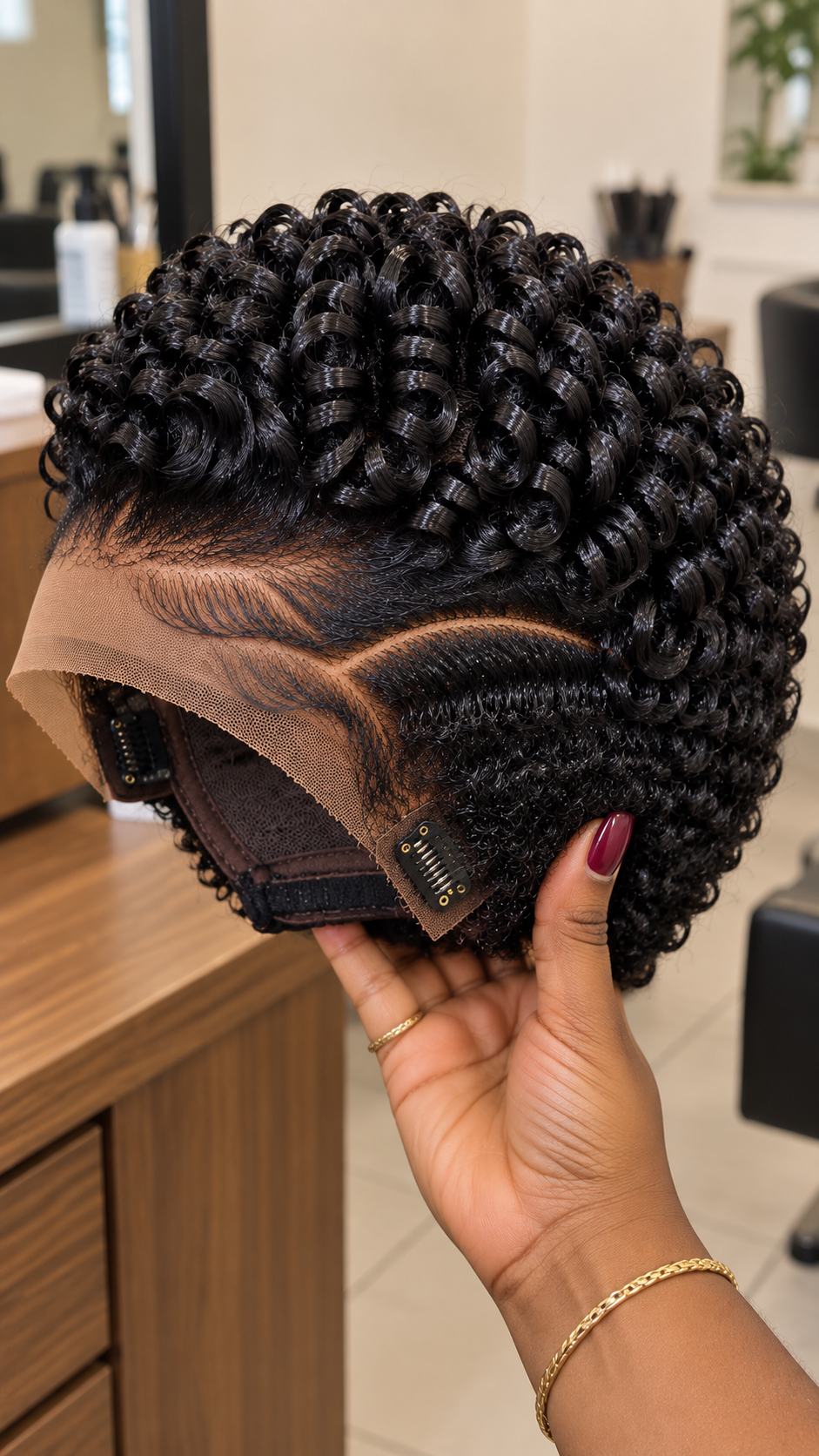
The most revealing part of this raven-black wig is the area where the circular crown meets the sculpted temple. Large, glossy spiral coils occupy the upper surface, while the hair beneath them changes into elongated directional waves and a sharply curved side separation. The lower portion then becomes a dense field of much smaller curls. These changes in curl size, height and direction create a complex silhouette without requiring contrasting colors, bright highlights or numerous decorative razor lines.
The photograph shows the wig being held from underneath before installation. Its front lace remains untrimmed, portions of the interior cap are exposed, and comb-style attachments are visible near the lower edges. This makes the image especially informative for customers interested in both appearance and construction. The visible material supports describing the piece as a lace-front wig, but the photograph cannot establish whether the mesh is HD lace, whether the hair is human or synthetic, or whether the unit is suitable for adhesive-free wear.
Unlike a conventional curly wig, this piece relies on a deliberate relationship between different styling zones. The crown contains raised tubular spirals with dark openings. A broad front section follows the hairline in a flatter sweep. Beneath it, a distinct curved division separates the directional upper side from smaller close curls. The result is a style that needs to be evaluated as a complete construction rather than simply as a black curled hairpiece.
The Front Wave Is the Key to Understanding This Construction
Before examining the spiral crown, look at the front transition. Fine black strands sweep across the lace area in an elongated curve, creating a broad directional section beneath the larger curls. This hair sits considerably flatter than the crown above it.
The curve has a functional visual purpose. It creates space between the exposed lace perimeter and the heavy upper spirals, preventing the curl field from beginning as an abrupt wall of dense hair.
Near the temple, the strands change direction and travel backward toward the side. Their movement introduces an asymmetrical element into an otherwise rounded crown.
For a custom order, this sweeping front should be specified independently from the spiral curls. A stylist who simply fills the entire upper area with coils may reproduce the overall hair density while losing one of the reference’s most important characteristics.
The Crown Contains Raised Tubular Spirals Rather Than Loose Ringlets
The upper hair is arranged into numerous closely positioned circular formations. Several spirals have prominent openings, while others overlap and create narrower interior spaces.
The curls rise from the foundation and turn inward instead of hanging freely. Their compact placement produces a rounded upper silhouette without adding long lengths around the neck or shoulders.
Large spirals are particularly noticeable through the central crown. Smaller formations occupy the outer sections, helping the pattern adapt to the rounded head shape.
This variation is important. A wig made entirely from identical circular pieces could look mechanically repeated. The photographed crown uses related forms with enough difference in diameter and orientation to retain visual interest.
When commissioning a similar unit, request open tubular spirals with a mixture of sizes. The phrase curly black wig does not communicate this construction accurately.
Raven Black Makes Every Curl Opening Important
The hair appears predominantly raven black, with reflective charcoal and blue-black highlights created by the salon lighting. There is no clear evidence of a separately applied second color.
Because the palette is monochromatic, visual depth comes from light and shadow. Raised strands catch bright reflections, while recessed portions and the centers of the spirals remain considerably darker.
The openings are therefore part of the styling rather than empty areas requiring more hair.
Increasing crown density indiscriminately could hide those spaces and turn the carefully arranged spirals into one continuous curly surface. Buyers should judge a custom reproduction by the clarity of its individual sections, not merely by the total amount of hair.
The Curved Side Division Creates an Asymmetrical Profile
A prominent exposed pathway begins near the front side and bends backward through the compact hair beneath the crown. Its shape is not a straight horizontal stripe. The division rises and curves with the contour of the unit, producing a sweeping border between two different styling areas.
Above the line, the hair forms a flatter directional panel that connects visually with the front wave. Below the line, the curls become much smaller and closer to the foundation.
This creates an intentional contrast. The upper area moves through long arcs and large spirals, while the lower section contains compact curls.
A buyer should request this specific curved side separation rather than a generic shaved line. Moving the curve or changing its width could substantially alter the appearance of the wig.
The Dense Lower Curls Are Not a Conventional Shaved Fade
One important observation is that the lower side retains a substantial amount of hair. The strands are much smaller than the upper spirals, but they remain visibly curled rather than disappearing into a bare or closely shaved surface.
This dark lower curl field helps support the crown and gives the side a continuous appearance below the exposed division.
A stylist who replaces the lower curls with an extremely close fade would create a different design. The reference depends on a transition between large raised spirals, directional waves and compact lower curls.
The density should therefore be preserved carefully during customization. Wig hair cannot naturally grow back after cutting, making conservative refinement particularly important.
One Main Curved Channel Provides Enough Side Detail
The side contains a pronounced curved division, but it does not rely on numerous parallel carved stripes or elaborate angular artwork.
That restraint gives the upper spirals room to remain the dominant element. Additional decorative lines would introduce another focal point and potentially crowd the lower profile.
The curved channel already provides a visible boundary against the black hair. Its purpose is to organize the side rather than compete with the crown.
For customers who want to reproduce this reference accurately, additional razor designs should not be introduced automatically. The single principal curve is part of the unit’s identity.
The Hair Above the Side Curve Uses a Different Direction
The section immediately above the exposed pathway is relatively flat and follows the curve of the head. Its strands appear combed in an elongated direction rather than curled into open rings.
This is a necessary transition between the spiral crown and the lower curl field.
Without this intermediate section, the two curl sizes would meet more abruptly and the side could appear less organized.
A professional recreation should therefore use distinct styling techniques for each area. The crown spirals should retain their open centers, the middle wave panel should remain elongated, and the lower curls should sit close to the foundation.
Why Crown Density Needs Careful Distribution
The crown appears richly populated with spirals, yet the hair does not project equally in every direction. Larger formations dominate the elevated upper area, while smaller curls occupy the sides and rear-facing sections.
This allows the wig to remain compact despite its substantial curl count.
For custom construction, density should be distributed according to the intended silhouette. Too much hair near the front could make the crown appear oversized. Too little hair at the rear could leave the hairstyle incomplete from certain angles.
An elevated crown photograph and rear three-quarter view can help a buyer inspect whether the curl distribution remains balanced.
The Lace Front Is Still at the Pre-Installation Stage
The photograph reveals a broad mesh perimeter extending beyond the front hair-bearing area. The lace has not yet been trimmed to a final wearing outline.
This can be useful because the installer retains flexibility when positioning the wig. The cap can be placed on the wearer before the final trimming line is selected.
Fine strands near the front edge should be assessed during fitting. Their role is different from the dense crown spirals, and automatically removing them could create a harsher transition.
The mesh appears light beige-brown in the photograph, but its exact shade should be confirmed through the seller’s available options. Lighting and camera processing can influence how lace looks against nearby skin.
Specific material claims, including HD lace, should be verified rather than inferred from apparent transparency.
The Open Interior Reveals Useful Attachment Details
The angle of the photograph exposes part of the cap interior. Dark construction material is visible beneath the lace, along with comb-style attachments near the inside perimeter.
These components matter because customers have different preferences for securing wigs. Some use internal combs, while others prefer alternative attachment methods.
The photograph does not reveal the complete cap system, so the exact number of attachments and full adjustment configuration cannot be confirmed from this view alone.
A buyer should request a full underside photograph before purchasing if interior construction is an important part of the decision.
Comb Attachments Do Not Automatically Mean Adhesive-Free Wear
A common misunderstanding is assuming that any wig with internal combs can be worn securely without adhesive. The presence of combs alone does not establish this.
Wearability depends on cap fit, attachment position, construction and the wearer’s hair and comfort preferences.
For a customer seeking a glueless unit, the seller should explicitly confirm that the particular wig is intended for that method of wear.
If adhesive-free use is a priority, it should be included in the order specification rather than inferred from the photograph.
Cap Sizing Affects the Position of the Curved Side Design
The front wave and side division are fixed to the wig foundation. When the cap shifts, those styling details shift as well.
A cap positioned too far forward may move the curved side section toward the face. A unit that sits too far backward can change the relationship between the side curve and the temple.
Accurate sizing therefore influences appearance as well as comfort.
For made-to-order construction, follow the supplier’s measurement instructions and provide all requested dimensions. Depending on the cap, these may include circumference, front-to-nape and ear-to-ear measurements.
A professional wig stylist can help with sizing before the order is placed.
A Custom Order Should Identify the Three Styling Zones
The most effective way to describe this wig to a maker is to divide its construction into three distinct areas.
The first is the raised raven-black spiral crown, containing open tubular curls with varied diameters.
The second is the directional front and side-wave panel, which moves in elongated curves rather than circular coils.
The third is the compact lower curl field beneath the pronounced curved separation.
After these visible requirements are agreed upon, the buyer can specify cap measurements, lace shade, interior attachment preferences and whether the lace should arrive untrimmed.
This approach reduces the risk of receiving a generic black curly wig with a conventional shaved side.
Finding a Professional Who Can Reproduce the Curl Architecture
Creating this unit requires more than general experience with curly wigs. The stylist must understand how to arrange raised tubular spirals while maintaining the flatter front-wave section and dense lower curls.
Custom wig studios, lace-wig specialists and salons offering sculpted finger-coil work are relevant starting points.
When evaluating a maker, ask to see photographs of completed wigs from above and from the side. Look for open curl centers, balanced density and intentional changes in strand direction.
A professional who specializes only in loose curly extensions may need additional experience before attempting this specific construction.
Where to Buy a Similar Raven Black Wig
Online wig retailers may offer compact black curly foundations, but the complete sculpted arrangement could require custom work.
A specialist maker can reproduce the crown and side styling from a reference image, provided the requirements are clearly discussed before production.
Another option is to source a suitable base locally and book a wig stylist to create the spiral crown and directional side details.
Before choosing the second route, request a complete styling estimate. The labor needed to construct the finished appearance can represent a substantial part of the total cost.
Customers should also ask whether the seller’s price refers to the completed design or only the foundation unit.
Approval Photographs Should Include the Entire Side
A direct side photograph is particularly important because the curved separation and lower curl field are major elements of the design.
The buyer should inspect the curvature of the exposed pathway, the width of the flatter hair panel and the density of the smaller curls beneath it.
An elevated photograph should reveal the size and distribution of the upper spirals.
A rear three-quarter view can confirm that the curl construction continues appropriately around the back.
Finally, an underside photograph should document the actual cap and attachment configuration before shipment.
Estimated Pricing for a Sculpted Black Spiral Wig
The price of this style is influenced primarily by hand-arranged coil construction, directional front styling, side-density control and cap preparation. There is no obvious multi-color processing requirement, but the intricate curl arrangement can still involve considerable labor.
| Category | Illustrative Price Range | Potential Construction Level |
|---|---|---|
| Premium Custom | $320–$570+ | Higher-grade hair, individualized sizing, hand-arranged open spirals, curved temple-wave construction, controlled lower curls and detailed lace preparation. |
| Standard Custom | $190–$335 | Prepared black spiral crown, established curved side division and standardized cap options. |
| Basic Human Hair | $115–$205 | A human-hair foundation requiring additional spiral setting, directional side styling and professional fitting. |
| Premium Synthetic | $75–$150 | A quality pre-set alternative designed to retain its spiral arrangement with less frequent professional rebuilding. |
| Basic Synthetic | $35–$85 | A budget interpretation where curl spacing, front-wave detail, lower density or cap construction may be simpler. |
These figures are illustrative budgeting estimates rather than confirmed retail prices for the photographed wig. Actual quotations vary according to hair or fiber, cap construction, seller location, customization labor, shipping and installation.
A customer comparing sellers should ask whether the crown and side-wave construction are already completed. A cheaper unfinished foundation may require enough additional styling work to make its final cost higher than expected.
Human Hair Offers More Options for Targeted Repair
A human-hair version may be useful for wearers who expect periodic professional curl resetting.
If only several spiral sections become displaced, a stylist may be able to reconstruct those curls without disturbing the entire crown.
The hair’s quality and processing history should guide heat use. Human hair does not automatically tolerate unlimited high temperatures.
Selective maintenance may preserve the original curl map better than repeatedly rebuilding every section.
Synthetic Fiber May Offer Stronger Pre-Set Shape Retention
A premium synthetic version may be practical for a customer who wants to preserve the original sculpted appearance with relatively limited intervention.
Pre-set fibers can retain circular formations effectively, although this depends on the product’s construction.
The tradeoff is reduced flexibility for major changes. Heat tolerance varies, and conventional coloring methods should not be assumed suitable.
Material choice should reflect the wearer’s intended maintenance routine rather than simply the purchase price.
The First Maintenance Step Should Be a Crown Photograph
Before washing, photograph the wig from above and from the side. These images record the position of the largest spirals, smaller supporting curls and curved temple division.
During cleansing, avoid rubbing all the curls together. Excess friction can intertwine neighboring coils and reduce their visible openings.
After drying, compare the result with the reference photographs and restore only displaced sections.
This reduces unnecessary handling and helps preserve the original construction over time.
The Front Wave Needs Different Care From the Spirals
The flatter hair near the forehead should remain elongated and directional. It should not be treated in exactly the same way as the circular crown.
If a section lifts away from its intended position, the stylist should guide it back along the existing curve rather than automatically rolling it into another spiral.
Maintaining the distinction between these areas is essential to the wig’s appearance.
Heavy product application can also cause neighboring wave ridges to merge, so styling aids should be used conservatively.
Protect the Curved Separation From Excessive Cutting
The exposed side path does not need to be widened routinely. Unlike a natural haircut, wig hair does not grow back after cutting.
If fine strands move across the separation, repositioning them may restore its visibility without removing additional hair.
When professional refinement becomes necessary, use the original side photograph to preserve the curve and its width.
The dark hair above and below the channel should remain substantial enough to keep the design readable.
Heavy Shine Product Can Hide the Coil Openings
The raven-black crown already reflects light strongly. Excess oil, wax or holding product can make neighboring strands adhere together, reducing the open circular shapes.
Product buildup may also make the surface appear dull or excessively coated.
Use only what the confirmed material requires. When residue becomes noticeable, appropriate cleansing may restore definition more effectively than adding another layer of product.
Fit the Unit Before Making Permanent Perimeter Changes
When the wig arrives, inspect the curls, lace, cap and visible attachment components before alteration.
The installer should first establish where the unit naturally sits, then examine the front wave and curved side division in that position.
Only after those details are approved should the excess lace be trimmed.
If the side and crown already match the reference, further cutting or restyling may be unnecessary.
Storage Should Protect the Raised Spiral Crown
The large upper spirals need space to retain their openings. A suitable wig stand or mannequin head can help prevent compression between wears.
Avoid stacking other wigs or objects on top and keep the side clear of hard surfaces that might flatten the directional wave panel.
The cap and lace should be fully dry before storage.
For travel, use packaging deep enough to protect the crown without pressing the curls inward.
The Value of This Wig Lies in Changing Curl Scale and Direction
This raven-black unit demonstrates how a single-color wig can contain substantial styling complexity. Large tubular spirals dominate the crown. Fine strands create a sweeping front transition. A pronounced curved separation establishes the side, and smaller compact curls complete the lower profile.
For buyers, the essential quality checks are the size of the spiral openings, crown density, diagonal parting, front-wave direction, curved side separation, lower curl scale, lace condition and interior attachment components.
For wig businesses, photographing these elements separately gives customers a clearer understanding of the craftsmanship. An overhead crown view, a side profile and a complete underside image are more informative than one attractive front photograph.
The strongest reproduction preserves the relationship among these zones rather than adding unrelated color or carving. When the spiral crown, directional front and compact lower curls remain proportional, the finished unit retains the distinctive character of the reference while allowing fitting and maintenance decisions to be made with accurate construction information.
Search Terms
raven black tubular spiral wig · curved temple part lace wig · glossy open coil crown · black directional front wave wig · compact lower curl hairpiece · sculpted spiral lace front · black side separation wig · interior comb curly wig