
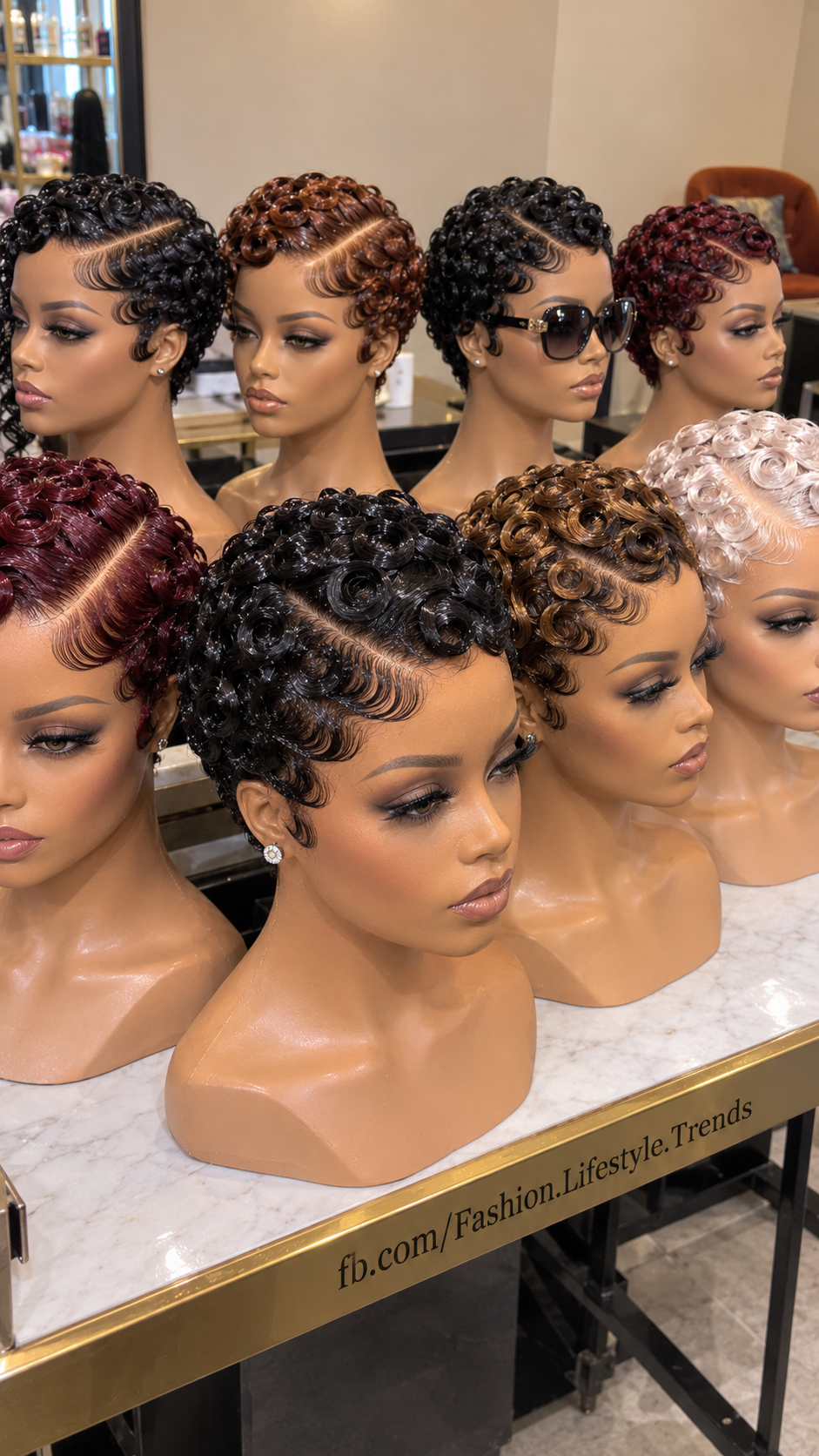
A display like this is useful because it answers a question that individual wig photographs often cannot: how much does color change the appearance of the same broad styling concept? The visible collection moves through glossy black, wine burgundy, copper-brown, golden bronze and pale pearl blonde, while several units share a recognizable construction language of circular crown coils, deep diagonal parting and elongated finger-wave work near the forehead. The colors are immediately different, but a closer look shows that the curl maps are not exact copies either.
The black unit in the foreground offers one of the clearest views of the underlying styling logic. Large circular coils occupy most of the upper crown. A deep diagonal part cuts through that curl field, and a sequence of long parallel strands follows the exposed route before bending toward the temple. Smaller curled sections complete the side. The burgundy, bronze and copper versions demonstrate how a warmer palette changes the visibility of those same kinds of movements, while the pale unit at the right makes every individual strand direction much easier to see.
The photograph is a finished mannequin display rather than a construction view. The undersides of the wigs are not visible, so the exact cap system and lace specifications cannot be verified from this image. A scalp-like parting is visible on several units, but that alone is not enough to classify the material as HD lace. Buyers should obtain the construction details for the exact wig they intend to order.


Deep Side Parting Changes How the Circular Crown Is Read
The diagonal division is one of the strongest recurring ideas in the collection. Instead of placing circular coils evenly around a central point, the part creates an asymmetrical boundary. A large curl field occupies one side while flatter directional work develops along the other.
This has a major effect on the apparent density of the crown. The side carrying the rings looks fuller because there is no corresponding curl field on the opposite side. The exposed route also creates visual breathing room between areas that would otherwise be densely populated with glossy loops.
For customers, part placement should therefore be treated as a primary design decision. A center part with the same curls would not frame the face in the same way. Likewise, a shallower side part would reduce the dramatic separation between the crown and forehead waves.
The Foreground Black Crown Prioritizes Large Open Rings
The central black wig contains a high concentration of circular sections with clearly visible centers. Several are relatively large, while smaller rings fill the spaces between them. This mixture prevents the crown from becoming mechanically repetitive.
Deep black also creates substantial shadow inside every opening. Narrow reflected highlights travel around the outer surfaces, allowing each ring to remain visible without a second color.
This construction is useful for customers who want the hairstyle itself to attract attention rather than relying on a vivid shade. The quality of the curl placement, spacing and directional part becomes the primary visual information.
The Burgundy Options Produce Their Own Light-to-Dark Variation
Burgundy appears in more than one position in the display, and the shade interacts particularly well with circular curls. Recessed portions become dark wine, while the raised surfaces catch brighter cherry-red reflections. A single color family can therefore create considerable visual depth.
The foreground burgundy unit also shows a pronounced diagonal part. Long red strands follow the exposed pathway before sweeping toward the forehead. This allows the buyer to see that changing from black to burgundy affects more than overall brightness: it changes how clearly the direction of each strand can be followed.
Burgundy is sensitive to lighting, so a custom buyer should request an additional neutral-light photograph of the actual color. Salon illumination can make deep wine hair appear significantly brighter and redder than it will outdoors.
Copper Brown Makes the Perimeter Work More Noticeable
The copper-brown wig in the rear row has a warmer and brighter appearance than the deepest burgundy pieces. Light catches its circular crown and long front arcs, producing rich auburn and copper reflections.
This increased visibility means the perimeter styling becomes a larger part of the design. Individual parallel strands around the forehead can be followed more easily than on black hair, where some of the finer movements disappear into shadow.
Customers requesting a copper version should use the photograph rather than depending solely on a color label. Cinnamon, auburn, copper and reddish brown can overlap considerably between suppliers.
Golden Bronze Gives the Rings More Visual Separation
The bronze unit in the foreground creates another warm option, but its color balance differs from copper. Golden-brown reflections appear on the raised rings while deeper brown remains inside them and around the roots.
This naturally outlines the circular formations. Even where neighboring coils sit close together, differences in reflected brown make their individual shapes easier to distinguish.
For buyers who want visible color without moving into very pale hair, this kind of bronze palette can preserve both warmth and depth. The exact shade should still be approved from the seller’s available hair or fiber because color names are not standardized.
Pearl Blonde Puts the Entire Curl Map on Display
The pale wig at the right creates the least shadow-dependent version of the style. Its rings, parting and perimeter strands remain visible because the light hair contrasts strongly with the mannequin and exposed part area.
This makes construction accuracy particularly important. Uneven ring placement or an inconsistent front transition may be more noticeable when the strands are pale.
The material cannot be identified confidently from the image. If the unit is human hair, buyers should ask about its processing history before planning heat or further color work. If it is synthetic, the fiber specification should be confirmed before heated tools are used.
One Black Wig Is Not Automatically the Same as Another
Several black units appear in the collection, but the display should not be interpreted as duplicates. Curl diameter, part placement and the balance between rings and perimeter waves can vary from one mannequin to another.
This is actually useful for a salon consultation. A customer who already knows they want black can compare construction without color distracting from the decision. They may prefer one mannequin’s larger rings but another mannequin’s front-wave arrangement.
If the salon offers customization, those preferences can become separate parts of the order rather than forcing the buyer to choose one stock design unchanged.
The Long Forehead Arcs Are a Major Styling Component
Several mannequins show substantial sweeping sections along the exposed part. These strands are longer and flatter than the circular coils above them. They travel in parallel before turning toward the temple.
Calling all of this work baby hair would understate its role. These arcs occupy a meaningful area and create the transition from crown to face. They are part of the hairstyle’s architecture.
When requesting a recreation, customers should show the stylist how broad they want this wave section to be. Some may prefer the dramatic extended arcs shown here, while others may want a narrower transition and more circular coils near the front.
Smaller Temple Curls Complete the Directional Change
After the long forehead arcs reach the side, several wigs transition into smaller curls around the temple and ear area. These pieces keep the long waves from ending abruptly.
The progression therefore moves through several scales: broad ring coils at the crown, elongated parallel waves near the part and smaller curved sections around the side.
This scale change should remain intact during maintenance. Turning every perimeter strand into the same small curl would remove the sweeping middle stage that gives the hairstyle much of its character.
Choose Construction Before Color When Ordering Custom
A practical way to shop this display is to ignore color for the first comparison. Identify the preferred crown first. Look at ring diameter, density, placement of the largest circles and the amount of visible spacing.
Next, select the parting and forehead-wave arrangement. Once those structural choices are clear, decide whether black, burgundy, bronze, copper or pearl blonde creates the preferred final effect.
This method makes custom ordering considerably easier. Instead of asking the maker to interpret several complete inspiration images, the buyer can explain exactly which element is being taken from each one.
Ready-Made Stock and Made-to-Order Work Need Different Expectations
A ready-made unit may come with a fixed combination of color, crown pattern and parting. Altering one component substantially can require rebuilding another. Customers should therefore ask what can realistically be changed before buying stock.
A made-to-order unit offers greater freedom, but the customer should expect additional labor and production time. The advantage is the ability to specify curl density, color and front direction before construction is completed.
For either route, request photographs of the exact unit before irreversible salon alterations begin.
A Group Display Is for Discovery; Individual Images Are for Approval
Once a favorite mannequin has been selected, ask the seller to photograph that unit separately. A direct front view can show face framing, but additional angles are necessary for evaluating construction.
An elevated crown photograph should reveal the full diagonal part and circular coil distribution. Both side views can show the perimeter work, while a rear image can reveal how the ring pattern continues around the back.
If lace or a particular cap system is part of the sales description, request an off-mannequin photograph showing the underside. Construction should be verified separately from the finished styling.
Color Approval Should Use More Than Salon Lighting
Warm salon lighting is attractive for product photography, but it can alter how burgundy, bronze and copper appear. Red may become brighter, while golden brown may look more orange.
For custom color orders, ask for a second photograph near neutral daylight or under neutral indoor light. This provides a better understanding of the shade before the unit ships.
Pale blonde should also be checked because warm illumination can make a cool pearl shade appear more creamy or golden than it actually is.
Salon Booking Depends on How Much Styling Has Already Been Completed
A finished unit from this display may need only fitting and small corrections after transport. If the rings, parting and forehead arcs already match the reference, preserving that work should be the priority.
A basic human-hair foundation intended to become this design requires a much longer service. The stylist may need to create the ring map, establish the diagonal division and build the entire perimeter-wave sequence.
Tell the salon what condition the wig is in when booking. This helps the stylist reserve enough time and avoids treating a construction appointment like a routine installation.
Pricing Should Follow the Amount of Completed Hand Work
The wigs are compact, but length alone does not explain their potential cost. Individual ring placement, directional parting, perimeter styling and custom color can all add significant labor.
| Category | Estimated Price Range | What the Buyer May Receive |
|---|---|---|
| Premium Custom | $325–$585+ | Higher-grade hair, individualized sizing, custom color selection, hand-arranged mixed-size coils, planned side part and detailed forehead-wave work. |
| Standard Custom | $195–$345 | Prepared finger-coil crown, selected shade and directional perimeter styling with more standardized sizing. |
| Basic Human Hair | $115–$210 | A restylable foundation requiring additional professional coil setting, part creation, color adjustment or face-framing work. |
| Premium Synthetic | $75–$150 | A higher-quality pre-set option designed to retain circular coils and sweeping front sections with less frequent resetting. |
| Basic Synthetic | $35–$85 | A budget interpretation where ring variation, perimeter detail, color depth or cap construction may be simpler. |
These figures are broad planning estimates rather than confirmed prices for the displayed wigs. Hair source, fiber type, color processing, cap construction, seller location, labor, shipping and installation can all change the final amount.
The best comparison is based on what remains to be done after purchase. A lower-priced foundation requiring several hours of specialist styling can ultimately cost more than a finished custom unit.
Human Hair Offers More Freedom for Rebuilding the Ring Pattern
Human hair can be useful for customers who expect periodic professional restyling. When individual coils loosen, a stylist has greater freedom to rebuild their direction if the hair is suitable for the chosen technique.
Processing history matters, particularly with burgundy, copper and pearl-blonde units. The safe heat level for highly processed hair may be different from that of a dark minimally processed unit.
Care recommendations should therefore come from the maker or stylist familiar with the actual hair rather than from generic human-hair advice.
Premium Synthetic Can Suit Buyers Who Want to Preserve the Display Shape
A high-quality synthetic option can make sense when the buyer wants the crown to remain close to its original pre-set arrangement. Circular coils may hold their shape with less frequent professional rebuilding.
The tradeoff is reduced freedom for major restyling. Heat tolerance varies, and conventional coloring methods may not be suitable.
Confirm the exact fiber before purchasing when future modifications are part of the plan.
Maintenance Starts With Photographing the Original Crown
Before washing or major manipulation, photograph the wig from above. Record the diagonal part, location of the largest rings and direction of the long forehead arcs.
Those photographs provide a reconstruction map if the hair loosens during cleansing. They are also useful to show another stylist later if the unit is maintained at a different salon.
A clear original reference reduces the temptation to improvise and gradually change the design after every service.
Clean the Rings Without Combining Them
During washing, avoid vigorous circular rubbing across the entire crown. That movement can intertwine neighboring rings and close their visible centers.
Work according to the confirmed material and allow the wig to dry without compression. Once dry, identify which individual sections have shifted and address them separately.
The goal is to preserve the existing arrangement rather than recreate the hairstyle from zero after every cleaning session.
Use Product Sparingly Around the Circular Crown
Glossy coils can tempt the wearer to add frequent shine products, but buildup can reduce separation. Heavy oil or wax may cause several rings to merge visually.
Use only what is required for the actual fiber or hair. When the surface becomes dull from residue, proper cleansing may restore its reflective quality more effectively than adding additional product.
This is particularly relevant to black wigs, where the contrast between bright reflections and dark coil centers creates much of the visual depth.
Preserve the Long Front Waves Instead of Repeatedly Shortening Them
The forehead arcs require enough strand length to travel through their full curve. Repeated trimming can gradually reduce that length and transform broad sweeps into smaller curls.
If a section lifts or shifts, reposition it first. The original product photograph should remain available as a directional reference.
Cutting should be reserved for actual damage or necessary correction rather than being included automatically in every maintenance appointment.
Store the Crown With Space Around Every Side
These compact wigs still require adequate storage volume because the rings project from the crown. A suitable stand or mannequin head prevents the top from being flattened.
Side clearance is equally important. Pressing the wig against a wall can disturb the long perimeter arcs even if the crown remains intact.
Store the unit fully dry and protect pale hair from surfaces that may transfer pigment. For travel, use packaging deep enough to avoid compressing the circular formations.
A Strong Wig Order Begins With the Curl Map, Not the Color Swatch
The most useful lesson from this collection is that shade and construction should be treated as separate choices. Black makes ring depth dramatic, burgundy introduces wine-red tonal variation, bronze creates warm contrast, copper increases visibility around the face and pearl blonde exposes almost every strand direction. None of those colors replaces the need for accurate coil placement and parting.
For buyers, start by selecting the crown architecture, then the diagonal part and perimeter movement, and finally the preferred color. Ask for individual photographs of the exact unit and verify any material claims separately before purchasing.
For wig businesses, presenting the collection this way can turn a group of mannequins into a practical ordering system. Customers can identify the crown they prefer, choose an available color, understand which services are included and book the appropriate level of customization. That creates a clearer path from visual inspiration to a finished wig that actually matches the customer’s chosen construction.
Search Terms
deep side part finger coil wig · glossy black ring crown wig · burgundy sculpted coil wig · bronze brown circular curl wig · copper finger wave wig · pearl blonde coil crown · sweeping forehead wave wig · mixed diameter finger coils