
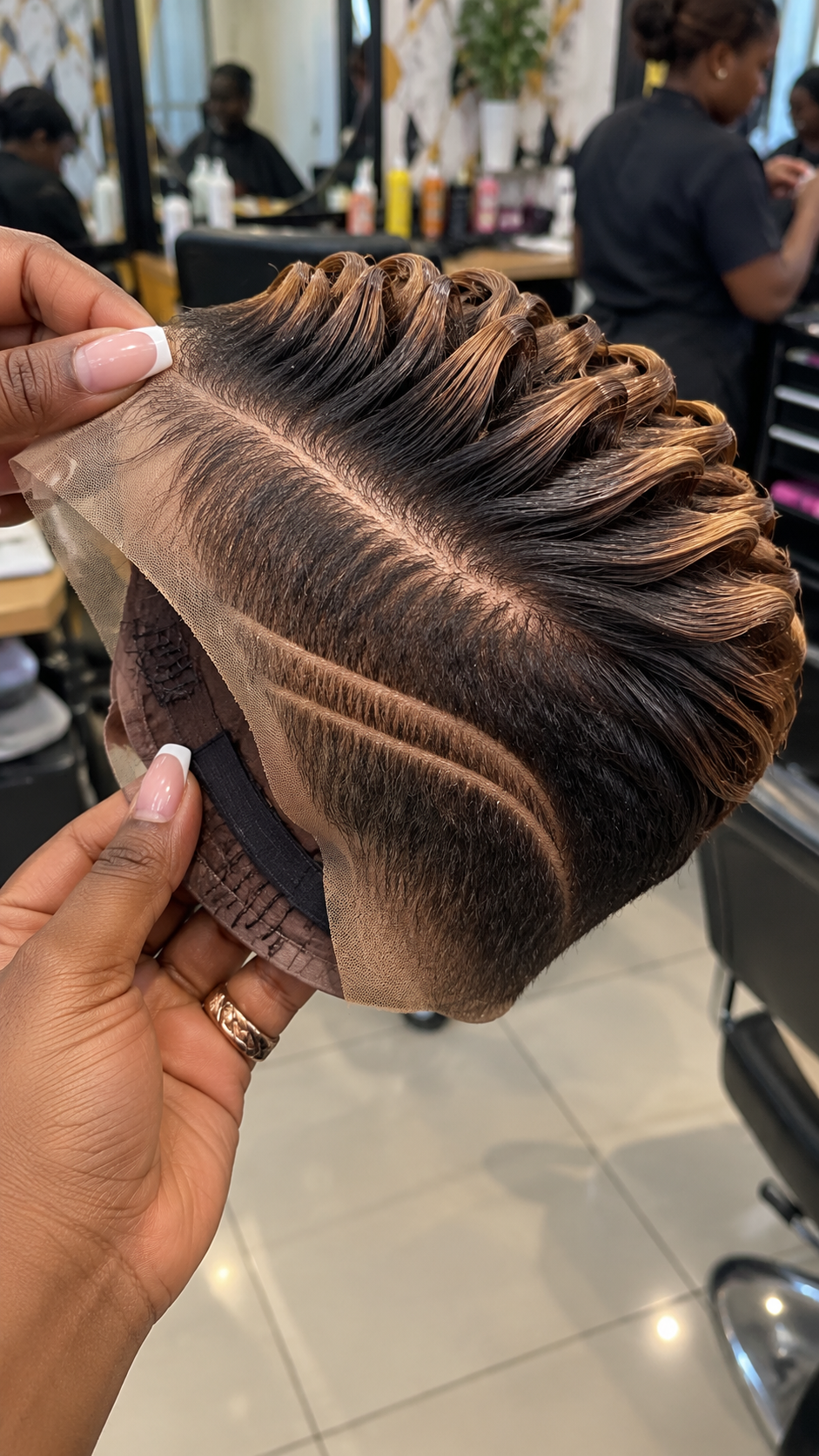
This deep-brown unit proves that a restrained palette can still look highly customized. The stepped loop rows, diagonal part and layered side work become the main story. For buyers who prefer brown to black but still want a strong salon finish, craftsmanship matters more than color drama.
Tonal brown puts craftsmanship under a microscope
Deep chocolate does not create the instant contrast of silver or copper, so the viewer notices spacing, parting and surface direction first. That makes this reference ideal for clients who want something understated but still custom. The loop rows should look intentional from the first section to the back, and the side lines should remain visible without being exaggerated. For the stylist, the challenge is precision; for the seller, the advantage is versatility. Brown can pair easily with workwear and formal clothing while still showing a distinctive salon-built shape.
Loop rows should step down, not pile up
The front sections are taller and more pronounced, while the back compresses closer to the head. This stepped change keeps the crown from becoming bulky. When ordering, ask for a front-to-back reduction in loop height rather than a uniform curl size. A maker who repeats the same large loop across the entire cap may create too much volume at the rear. The reference depends on controlled progression, which is why a top-view approval photo is valuable before shipping.
Graphic lines need empty space around them
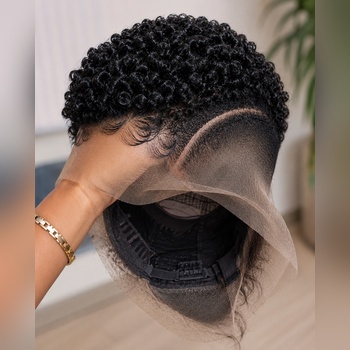
The side pattern is readable because the channels are separated by enough dark hair. The design should not be packed with extra marks. If a client requests more lines, explain that additional detail can reduce clarity and make the panel harder to maintain. A premium result often comes from restraint. Map the main diagonal first, then place secondary lines so they support it. The side should still look balanced when seen from several feet away, not only in a macro photograph.
Brown sheen should look polished rather than wet
Dark brown hair reflects salon light beautifully, but too much finishing product can flatten the tonal variation and make the surface look coated. Use lightweight products sparingly and keep the part free of residue. For photographs, move the unit slightly until the loops catch light along their curves; do not increase digital contrast so much that the brown becomes black. Accurate tone is part of the product description and helps customers understand why this unit differs from a standard natural-black option.
A compact crown can still feel heavy if the cap is poorly balanced. During fitting, check pressure around the temples, ears and nape. The wearer should be able to move naturally without the unit shifting. Ask about adjustable adjustments inside the cap and whether they can be positioned away from sensitive areas. A beautiful side pattern is not useful if the cap has to be rotated or tightened excessively to stay in place. Good fit preserves both comfort and the intended geometry.
Market this version to clients who value detail over loud color
The strongest audience for a deep-brown unit may be clients who want a noticeable shape but do not want vivid red, blue or silver. Build the listing around craftsmanship: structured loop rows, directional parting, close side work and a rich chocolate tone. Include a short care note and realistic service schedule. This makes the article useful to a buyer rather than turning it into another generic color post. The more specific the copy is to the actual reference, the less repetitive the page will feel across a larger wig catalog.
Fitting a tonal brown design
The deep-brown version needs a fit-focused consultation. Since the color is subtle, the eye will notice any tilt in the loop rows or side lines. Center the cap, check the diagonal part from above and make sure the layered motif clears the ear. Discuss sheen last. A well-fitted chocolate unit with moderate shine will look more premium than an over-glossed unit whose geometry is off.
What to request for deep brown
For deep brown, insist on a top view because tonal hair can hide uneven sectioning in front-facing photos. A slow rotation video should show the loop rows stepping down toward the back. Also request the inside cap and exact measurements. Brown is forgiving in color but not in construction; proof should focus on shape.
Maintaining chocolate loop rows
Deep-brown loop rows need clean separation more than intense shine. Use minimal product and keep residue out of the part. When storing, support the crown so the front rows do not lean sideways. A maintenance appointment can focus on alignment and side-line clarity rather than adding more gloss.
Budget Guide for a Precision Brown Unit
| Option | Typical Range (USD) | Planning note |
|---|---|---|
| Premium Custom | $320–$520+ | High-grade hair, advanced color or detailing, fitting and precision shaping |
| Standard Custom | $220–$320 | Salon-built unit with controlled styling and moderate customization |
| Basic Human Hair | $150–$230 | Human-hair base with simplified finishing |
| Premium Synthetic | $95–$170 | Quality fiber with pre-shaped form and selected custom work |
| Basic Synthetic | $55–$95 | Entry interpretation with fewer custom stages |
These figures are planning ranges rather than fixed retail prices. Final cost depends on hair material, cap construction, color processing, labor, fitting and the complexity of the visible side work. Ask for a written breakdown before paying a non-refundable custom deposit.
Search Terms for the Deep-Brown Reference
deep brown loop wig · graphic side part wig · chocolate sculpted hair · layered side lines · structured loop rows · brown lace wig · compact molded crown · salon custom unit
Final deep-brown standard
A deep-brown unit has nowhere to hide weak workmanship. That is why it can be premium: the client is paying for construction, balance and finish rather than a loud color effect.
Chocolate versus natural black
Before paying the balance, ask to see the inside cap and confirm the exact adjustment system, cap circumference and lace specification. The exterior reference is built around stepped chocolate loop rows, but comfort depends on what is underneath. A cap that is too large can rotate and move the layered graphic line work out of position; one that is too tight can distort the front edge. Record the measurements on the invoice so a future remake starts from verified fit data rather than memory. If the seller cannot confirm a technical detail, leave it out of the public product description instead of guessing.
Checking loop-row alignment
If another stylist will maintain the unit later, give that person a short technical brief. Note the deep chocolate brown palette, the direction of the part, the scale of stepped chocolate loop rows and the location of the layered graphic line work. Include two or three unfiltered reference photographs. This is more useful than simply saying “make it like before,” because a sculpted wig can change quickly when a new stylist interprets the loops differently. A written brief also prevents accidental changes to the side design during a routine refresh.
Business photos for tonal hair
For social content, shoot one image that prioritizes construction rather than glamour. Use neutral light, keep the camera close enough to show the part and layered graphic line work, and include a second angle that reveals stepped chocolate loop rows. Then capture a wider salon image for context. This combination gives buyers both proof and inspiration. Avoid filters that shift deep chocolate brown, because the post may later be used as a color reference by a customer. Accurate images reduce repetitive questions and make the article’s search terms match what people can actually see.
Comfort checks at the nape
Before wearing the unit for a long event, test it for at least an hour at home. Check pressure near the ears, movement at the nape and whether the sculpted top changes when the wearer turns the head. The layered graphic line work should remain in its intended position without over-tightening the cap. If adhesive will be used, follow the product instructions and do not make the event day the first fitting. A short wear test gives time to correct comfort or placement issues while the lace and styling are still easy to adjust.
A conservative-office version
If this design is remade, protect its identity by deciding which elements are fixed and which can change. Keep the part direction, the relationship between stepped chocolate loop rows and the side, and the recognizable layered graphic line work. Color within the deep chocolate brown family can be adjusted for the client, and loop scale can be tuned for head size. Treat those as controlled variations rather than redesigning every feature at once. This approach creates a recognizable salon signature while still allowing each order to feel personal.
Rebuilding one softened row
At collection, inspect the unit in ordinary light before leaving the salon. Look at the part from above, check the layered graphic line work from a true profile, and make sure stepped chocolate loop rows remains separated rather than compressed. Confirm care instructions for the actual hair material and ask when the first maintenance visit should happen. Take one final photo of the finished unit on the wearer or a correctly sized head form. That image becomes the baseline for future refresh work and makes any later change in shape or color easier to diagnose.