
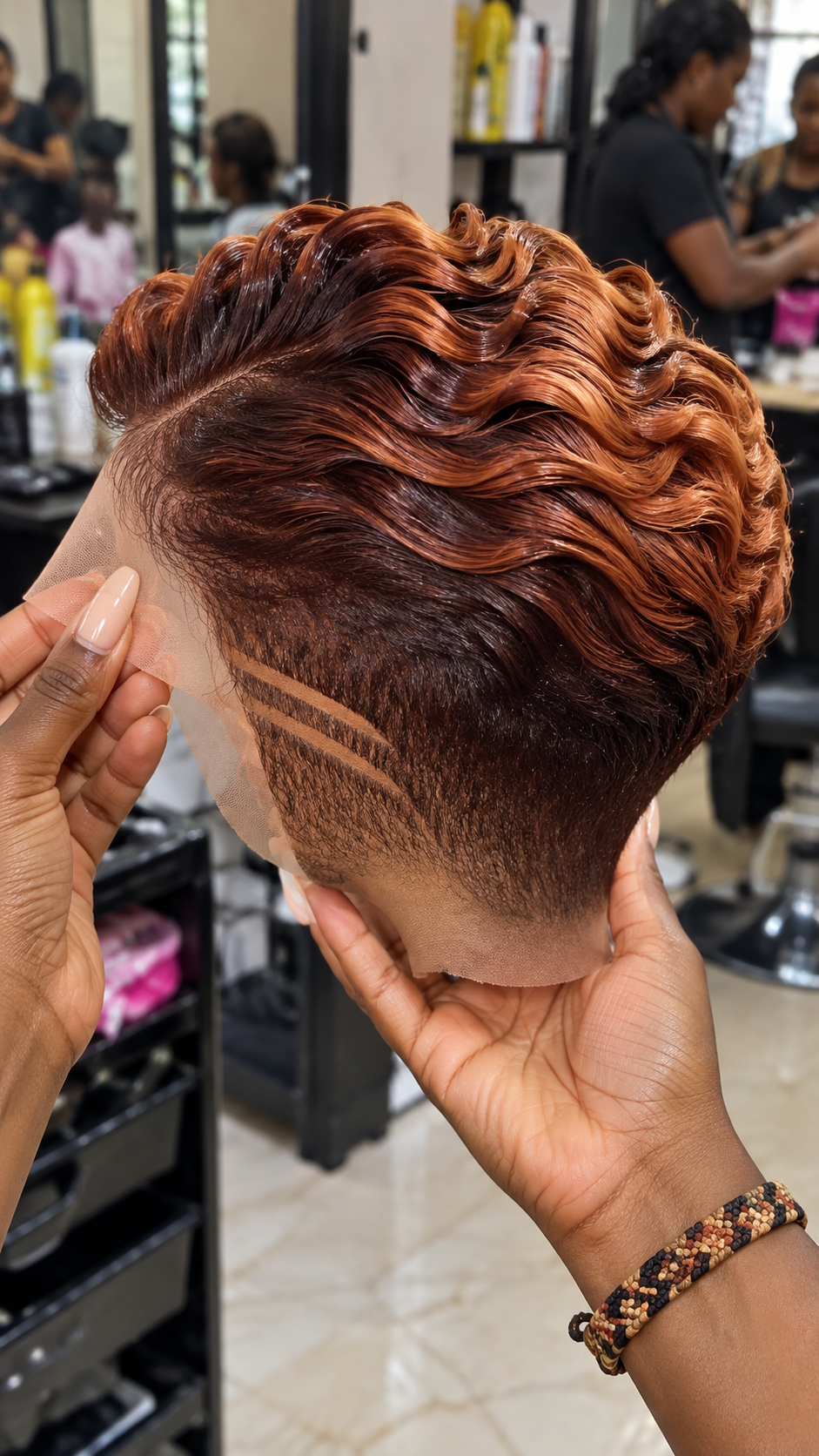
The espresso-caramel version is about flow. Wide polished sweeps carry the lighter tone around the crown, and the broad curved side boundary keeps the silhouette from feeling rigid. It suits clients who want visible color without tiny streaks or a busy multicolor effect.
Long caramel sweeps need a color map
The highlighted ribbons in this reference travel with the hair instead of cutting across it. Before coloring, a stylist should decide which sweeps will carry caramel and which will remain espresso. This is especially important near the front because the first highlighted section influences the whole face-framing effect. A random foil pattern would not reproduce the reference. For a synthetic custom unit, ask the maker to blend the colors during construction so the lighter fiber emerges in the same directional bands.
The side curve softens an otherwise architectural wig
The broad close panel could look severe on its own, but the long curved boundary introduces a softer line. That curve should follow the head rather than appearing as a rigid stripe. During fitting, check where it begins near the temple and where it disappears toward the back. A curve that is too low can shorten the side of the face; one that is too high may be hidden by the upper sweeps. The best placement is the one that keeps the motif visible while preserving the wearer’s natural proportions.
This palette can be customized without changing the structure
Clients may want a warmer honey, a cooler caramel or a deeper espresso base. Those color adjustments are easier to personalize than the construction itself. Keep the sweep width, part direction and compact back consistent, then modify tone within a controlled range. This is a useful salon strategy because it allows several clients to wear the same design concept without receiving identical color. Photograph each variation separately and write its own color description rather than copying one listing across all versions.
Broad ribbon sections require controlled product use
Wide polished sweeps can quickly look greasy if too much serum or wax is added. The goal is reflection along the surface, not saturation. When refreshing, separate one ribbon, restore its curve and move to the next. Avoid coating the entire crown first. If human hair is used, moderate heat and a setting product can rebuild the shape; if synthetic fiber is used, follow the manufacturer’s heat limit. A light touch preserves the visible spaces between ribbons, which is what makes the caramel placement easy to read.
Use a mirror test before trimming the lace
Place the untrimmed unit on the wearer and view it from both sides in a full mirror. The long part and sweeping top can make a wig appear balanced from one angle while the opposite side sits too high. Check the front edge, ears, nape and side curve before making any permanent cut. Ask the wearer to turn the head slowly. If the cap shifts or the curve disappears, adjust the fit first. This practical test is more valuable than trying to perfect the lace while the unit is still on a stand.
Sell the caramel version as a color-placement service
For a wig business, this design is a good candidate for tiered customization. The base unit can be offered in espresso, while directional caramel placement, lace fitting and molded sweep styling are separate upgrades. That pricing model explains why two units made from similar hair can have different final costs. It also lets clients simplify the order if they have a smaller budget without forcing the salon to discount the labor-heavy version. Show examples of each tier so the difference is visual, not just described in text.
Setting caramel placement on the wearer
With long caramel sweeps, ask the stylist to show where the first light ribbon will begin. That front placement affects the face-framing effect. Next, check the broad side curve on the wearer and make sure it remains visible without sitting too low. Finish with a color photo in neutral light, because warm salon décor can make caramel appear more golden.
Remote checks for long caramel sweeps
An online caramel order needs color references not taken under gold salon lights. Ask for the espresso base and caramel ribbons in the same neutral-light frame. Then request a side view showing the broad curve and a rear three-quarter view showing how the long sweeps settle. This reveals whether the unit is dimensional or simply striped.
Keeping caramel sweeps separated
Caramel sweeps should be refreshed one ribbon at a time so the lighter paths stay organized. Too much serum can make the broad sections merge visually. Store the unit without pressure on the crown and keep the side curve away from rough fabric. A light professional reset can restore movement without recoloring the whole wig.
Pricing an Espresso-Caramel Sweep Build
| Option | Typical Range (USD) | Planning note |
|---|---|---|
| Premium Custom | $320–$520+ | High-grade hair, advanced color or detailing, fitting and precision shaping |
| Standard Custom | $220–$320 | Salon-built unit with controlled styling and moderate customization |
| Basic Human Hair | $150–$230 | Human-hair base with simplified finishing |
| Premium Synthetic | $95–$170 | Quality fiber with pre-shaped form and selected custom work |
| Basic Synthetic | $55–$95 | Entry interpretation with fewer custom stages |
These figures are planning ranges rather than fixed retail prices. Final cost depends on hair material, cap construction, color processing, labor, fitting and the complexity of the visible side work. Ask for a written breakdown before paying a non-refundable custom deposit.
Search Terms for the Espresso-Caramel Reference
espresso caramel wig · caramel ribbon sweep · curved side panel wig · brown highlighted sculpted wig · long loop crown · lace perimeter wig · honey brown accents · custom side curve wig
Final caramel-sweep standard
The caramel version should feel fluid rather than striped. Follow each light ribbon with the eye; if it travels with a sweep, the color placement is doing its job.
Choosing caramel warmth
Before paying the balance, ask to see the inside cap and confirm the exact adjustment system, cap circumference and lace specification. The exterior reference is built around long espresso-caramel sweeps, but comfort depends on what is underneath. A cap that is too large can rotate and move the broad curved side boundary out of position; one that is too tight can distort the front edge. Record the measurements on the invoice so a future remake starts from verified fit data rather than memory. If the seller cannot confirm a technical detail, leave it out of the public product description instead of guessing.
Scaling the sweep for face size
If another stylist will maintain the unit later, give that person a short technical brief. Note the espresso with caramel-honey palette, the direction of the part, the scale of long espresso-caramel sweeps and the location of the broad curved side boundary. Include two or three unfiltered reference photographs. This is more useful than simply saying “make it like before,” because a sculpted wig can change quickly when a new stylist interprets the loops differently. A written brief also prevents accidental changes to the side design during a routine refresh.
Video angles that show movement
For social content, shoot one image that prioritizes construction rather than glamour. Use neutral light, keep the camera close enough to show the part and broad curved side boundary, and include a second angle that reveals long espresso-caramel sweeps. Then capture a wider salon image for context. This combination gives buyers both proof and inspiration. Avoid filters that shift espresso with caramel-honey, because the post may later be used as a color reference by a customer. Accurate images reduce repetitive questions and make the article’s search terms match what people can actually see.
Avoiding product-heavy shine
Before wearing the unit for a long event, test it for at least an hour at home. Check pressure near the ears, movement at the nape and whether the sculpted top changes when the wearer turns the head. The broad curved side boundary should remain in its intended position without over-tightening the cap. If adhesive will be used, follow the product instructions and do not make the event day the first fitting. A short wear test gives time to correct comfort or placement issues while the lace and styling are still easy to adjust.
Turning one design into color variants
If this design is remade, protect its identity by deciding which elements are fixed and which can change. Keep the part direction, the relationship between long espresso-caramel sweeps and the side, and the recognizable broad curved side boundary. Color within the espresso with caramel-honey family can be adjusted for the client, and loop scale can be tuned for head size. Treat those as controlled variations rather than redesigning every feature at once. This approach creates a recognizable salon signature while still allowing each order to feel personal.
Final fitting before a long wear
At collection, inspect the unit in ordinary light before leaving the salon. Look at the part from above, check the broad curved side boundary from a true profile, and make sure long espresso-caramel sweeps remains separated rather than compressed. Confirm care instructions for the actual hair material and ask when the first maintenance visit should happen. Take one final photo of the finished unit on the wearer or a correctly sized head form. That image becomes the baseline for future refresh work and makes any later change in shape or color easier to diagnose.