
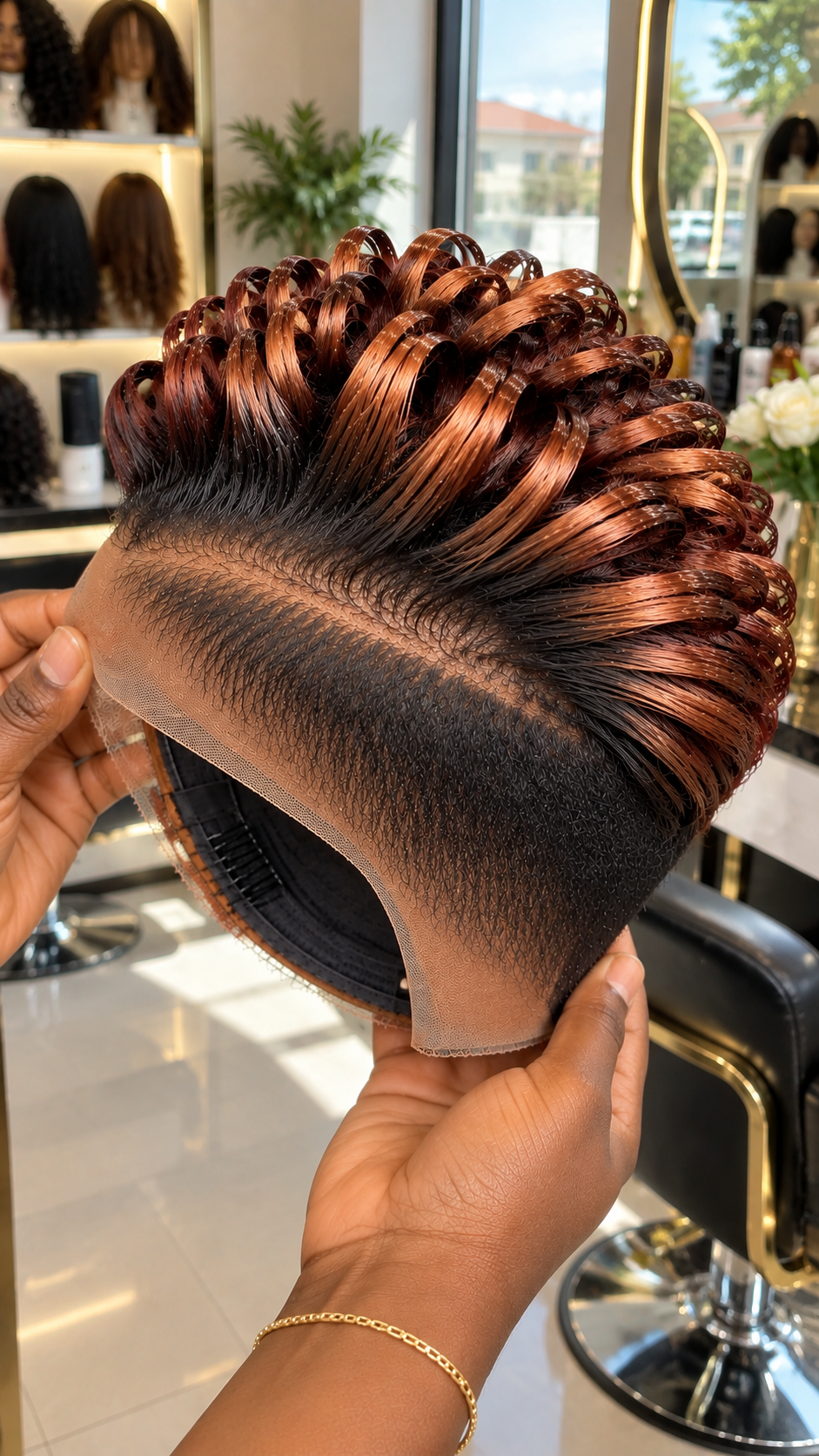
This copper-and-espresso wig is built around a very different idea from the circular finger-coil gallery pieces. Instead of covering the crown with compact ringlets, the upper hair is divided into broad ribbon-like loops that rise from dark roots, arch backward and gradually tighten as they travel toward the rear. Warm copper occupies much of the visible upper surface, while an espresso-to-natural-black foundation remains clearly present underneath. The lower side is deliberately restrained: it stays close, dark and uninterrupted rather than introducing decorative carved lines. That simplicity gives the copper crown room to become the entire focal point.
The pre-installation view is particularly valuable because several practical details remain visible. The lace extends well beyond the hair-bearing perimeter, the close side can be examined without a wearer’s skin underneath it, and part of the dark interior cap is exposed. What can be confirmed visually is that this is a lace-based unit with a structured interior. What cannot be established from the photograph is a specific lace grade. There is not enough evidence to label the mesh HD lace, so that specification should be confirmed directly with the maker or seller.
The Color Placement Begins With Darkness Rather Than Copper
The foundation of this wig is not bright copper. At the roots and throughout the close lower side, the color is substantially deeper—an espresso-to-near-black brown. Copper appears as the strands rise into the sculpted crown, creating a strong transition from dark anchoring color into warm reflective surfaces.


This distinction is crucial for anyone trying to reproduce the unit. A uniform copper wig would create a much flatter visual result. Here, the dark roots provide shadow beneath every raised ribbon and visually connect the colorful crown with the compact side.
The copper itself appears to move through several warm values under the salon light. Some sections read as cinnamon or auburn, while the brightest reflected areas approach polished copper. That variation appears to come largely from lighting, strand direction and the dark foundation rather than from random pale streaking.
The Forward Loops Establish Height Without Creating a Bulky Crown
Near the front, several broad sections rise almost vertically before folding backward. The strands inside each section travel closely together, creating a ribbon-like surface rather than a fluffy curl. Open spaces remain between neighboring loops, allowing the darker interior to show through.
Those spaces are part of the architecture. If additional hair were packed into every opening, the crown could become heavier and the individual ribbons would be harder to distinguish. The reference relies on separation rather than maximum density.
A custom stylist should therefore reproduce the relationship between loop width and open space instead of simply making the top fuller. The strongest front silhouette comes from controlled elevation, not excessive volume.
The Copper Ribbons Change Direction Across the Middle Crown
After the upright forward sections establish the profile, the middle crown begins leaning farther backward. The ribbons become more directional and start following the rounded contour of the cap. This creates a visual sequence rather than a row of identical loops.
The color makes that directional progression particularly easy to follow. Copper reflections travel over the top of each bend while espresso roots remain visible beneath. Every loop therefore has a brighter exterior and darker interior.
For a made-to-order wig, an elevated side photograph should be included in the approval process. That angle reveals whether the maker has created this changing loop direction or simply repeated one formation from front to back.
The Rear Compresses Into Tighter Interlocking Forms
The rear does not maintain the same height as the forward crown. The loops become smaller, tighter and more numerous as they approach the back. Some sections overlap closely, allowing the silhouette to settle naturally around the rounded rear of the wig.
This reduction in scale is important because the copper color already attracts considerable attention. Large bright loops continuing around the entire back could make the unit look unnecessarily bulky. The smaller rear work provides a controlled endpoint.
When purchasing remotely, request a rear three-quarter photograph of the exact unit. The front may look excellent even when the rear construction has been simplified, so the back deserves its own inspection.
The Dark Side Is Intentionally Free From Decorative Carving
The lower visible side is one of the quietest areas of the wig. Fine dark strands remain close to the foundation, and there are no obvious double lines, lightning motifs, nested curves or other carved patterns competing with the crown.
This restraint is important to the overall balance. The copper loops already provide substantial movement and color. Adding elaborate geometry below them would create another focal area and change the identity of the unit.
For customers ordering this exact construction, “no carved side design” should be stated explicitly. Similar sculpted wigs are often customized with razor lines, but this reference gains much of its character from leaving the lower side continuous.
The Crown-to-Side Transition Relies on Density Rather Than a Graphic Line
There is a clear visual change between the long copper crown and the close espresso side, but it is created primarily through length, direction and density. The upper strands rise and bend; the lower strands remain close and follow the cap.
This makes the transition softer than a design built around a strongly exposed carved channel. The viewer’s eye moves naturally from copper loops into the darker foundation without encountering a competing graphic element.
A stylist should preserve that relationship during fitting. Cutting an artificial line into the transition simply because other units use one would alter the original design unnecessarily.
The Close Side Needs Enough Density to Support the Crown
Although the side is compact, it is not visually empty. Fine dark strands create a substantial field beneath the colorful top. This density anchors the crown and prevents the lower half from appearing unfinished.
Leaving the side too long could blur the separation between compact and raised sections. Removing too much hair could expose the foundation excessively. The reference sits between those extremes.
This is another reason maintenance should be conservative. Wig hair does not grow back after repeated trimming, so preserving the original density can extend the useful life of the unit.
The Copper Tone Should Be Ordered From a Visual Reference
Color terminology is especially unreliable within this warm family. Depending on the supplier, similar hair may be called copper, cinnamon, auburn, burnt orange, warm chestnut or reddish brown.
The photograph shows a copper that remains connected to a deep brown base rather than becoming extremely orange or bright red. A customer should send the image and ask for a photograph of the available hair before confirming the order.
For higher-priced custom work, request a neutral-light color check as well. Warm salon lighting can intensify copper and make the hair appear brighter than it will in daylight.
The Untrimmed Lace Leaves Useful Space for Final Placement
A broad lace perimeter remains visible around the front and side. This indicates that the final installation has not yet been completed. For a customer who plans to work with a local wig stylist, retaining that excess lace can be beneficial.
The stylist can first establish where the cap naturally sits, check how the copper crown aligns with the wearer’s head and only then determine the final perimeter. Cutting the lace while the wig is loose removes some of that fitting flexibility.
The apparent mesh color should not be treated as a guaranteed lace shade. Lighting and camera exposure can change its appearance. Ask the seller which lace colors are actually available for the unit.
The Interior Cap Should Be Inspected Before Purchase
Part of the dark interior foundation is visible through the open underside. This confirms that the wig has a structured cap, but the photograph does not reveal every internal component clearly enough to describe the full construction.
Before ordering, ask for an underside photograph of the exact wig. Confirm cap sizing, adjustment options, attachment components and the amount of lace included around the relevant perimeter.
This is particularly important for customers who have specific preferences about internal combs, straps or other anchoring methods. Those practical details can matter as much as the exterior styling during regular wear.
Fit Determines Where the Copper Crown Begins on the Wearer
The transition between the dark side and raised crown is fixed to the cap. If the wig sits too far forward or backward, that transition moves with it. Correct sizing therefore influences the final silhouette.
A custom buyer should follow the maker’s measurement instructions carefully. Depending on the cap, circumference may be accompanied by front-to-nape and ear-to-ear measurements.
When the unit represents a substantial investment, having a wig stylist assist with measurements before ordering can reduce the need for corrective fitting later.
The Order Brief Should Protect the Simplicity of the Lower Side
A useful specification can begin with the crown: broad open loops at the front, progressively backward movement through the middle and smaller interlocking forms toward the rear. The color request should describe deep espresso roots transitioning into rich copper across the raised sections.
The side instruction is equally important even though it is simpler: close dark density with no prominent carved lines or decorative side geometry. That prevents a maker from adding a popular customization that is absent from this reference.
After the exterior design is established, discuss cap measurements, lace shade, interior attachment preferences and whether the lace should remain untrimmed for local installation.
Choose the Maker Based on Sculpting Skill, Not Just Copper Coloring
A stylist who produces beautiful copper color is not automatically experienced with this type of crown. The difficult part is maintaining broad ribbon sections with controlled openings while gradually changing their angle and scale.
Ask potential makers for examples of sculpted loop crowns. Pay attention to whether individual sections remain separated and whether the rear is completed with the same care as the front.
If the colorist and wig stylist are different professionals, both should work from the same reference so the copper placement supports the intended crown direction.
Approval Photography Should Emphasize the Crown Progression
For this design, the most useful approval sequence begins with a slightly elevated side photograph. It should show the tall forward loops, backward middle sections and darker foundation beneath them.
A rear three-quarter image should reveal the smaller interlocking forms. A neutral-light photograph should then be used to judge the actual copper shade without relying exclusively on warm salon illumination.
If the wig is custom-made, confirm that these images show the actual unit being shipped rather than an earlier example from the maker’s portfolio.
Pricing Is Concentrated in Crown Work, Color and Construction
The absence of carved side geometry may reduce one category of labor, but the crown itself remains highly detailed. Broad loops must be formed individually, their scale has to change toward the rear, and the copper transition needs to remain coordinated with the dark root base.
| Category | Estimated Price Range | Potential Scope of Work |
|---|---|---|
| Premium Custom | $315–$555+ | Higher-grade hair, personalized sizing, custom espresso-to-copper placement, hand-arranged ribbon loops, rear sculpting and detailed lace preparation. |
| Standard Custom | $190–$325 | Prepared copper loop crown with dark-root depth, controlled side density and more standardized cap options. |
| Basic Human Hair | $115–$205 | A human-hair foundation requiring professional coloring, crown formation, density refinement and fitting. |
| Premium Synthetic | $75–$150 | A pre-colored and pre-set alternative that may retain the loop architecture with less frequent professional rebuilding. |
| Basic Synthetic | $35–$85 | A budget interpretation where copper depth, loop separation, rear construction or cap quality may be simpler. |
These are broad budgeting references rather than confirmed prices for the photographed wig. Hair source, fiber, coloring process, cap construction, seller location, labor, shipping and installation can all change the final amount.
When comparing quotations, ask whether the sculpted crown and copper placement are included. A basic dark foundation that still needs extensive professional coloring and loop construction is not financially equivalent to a finished custom unit.
Human Hair Offers Greater Freedom for Future Crown Repair
A human-hair version can be useful when the wearer expects professional resetting over time. If individual loops loosen, a stylist may be able to rebuild those sections without changing the entire crown.
The copper areas may have undergone color processing, so future heat should be selected according to the condition of the hair. Human hair does not mean unlimited heat tolerance.
If the shade eventually fades, a colorist should preserve the dark root depth. Turning the entire unit into one flat copper color would remove much of the dimensional relationship visible in the original.
Pre-Colored Synthetic Fiber Can Reduce Tonal Maintenance
A premium synthetic version may be practical for a customer who wants stable copper color and strong shape retention. A well-made pre-set fiber can preserve the loop arrangement without frequent heat reconstruction.
The compromise is flexibility. Heat limits vary, and conventional permanent dye should not be assumed suitable. The exact fiber should be confirmed before attempting major alterations.
The choice should therefore depend on whether the wearer values future restyling freedom or preservation of the original crown.
Wash With the Direction of Each Ribbon
Before cleansing, photograph the crown from the side and above. These images should record where the tallest loops sit, how they lean backward and where the rear begins tightening.
Avoid rubbing all of the crown sections together during washing. That can intertwine neighboring ribbons and close the open spaces between them. Use products appropriate for the confirmed material and handle the lace gently.
After drying, restore only the sections that have moved. Selective repair helps preserve the original architecture while limiting unnecessary heat and manipulation.
Copper Color Care Should Preserve the Dark Foundation
On a human-hair unit, cleansing and styling choices can influence how long the warm copper remains rich. Color-safe products may be appropriate depending on the maker’s recommendations, while repeated excessive heat should be avoided.
If tonal refreshing becomes necessary, evaluate the crown before applying color. The roots should remain deeper than the exposed upper surfaces if the original relationship is to be preserved.
A professional colorist can also prevent the copper from drifting too far toward bright orange or red when the intended result is a richer cinnamon-copper brown.
The Close Side Requires Preservation Rather Than Barber Reconstruction
Because the visible side contains no prominent carved artwork, there is little reason for repeated precision cutting. Maintenance should focus on keeping the fine dark strands close and consistent.
If some hairs begin projecting outward, controlled setting may be enough. Removing additional density at every visit can gradually make the side thinner than the reference.
This relatively quiet lower construction can be an advantage for wearers who like sculpted crowns but do not want ongoing maintenance of razor-line patterns.
Book the Installation Around Crown Preservation
When the wig arrives, inspect the copper placement, loop progression, close side, lace and interior construction before making permanent changes. If a custom unit differs substantially from the approved reference, contact the seller before trimming.
Once the wig is accepted, the installer can establish cap position and prepare the lace. Crown work that has survived shipping intact should be preserved rather than routinely dismantled.
If only a few loops have shifted, book targeted correction instead of a complete restyle. This saves time and reduces unnecessary manipulation.
Storage Needs More Vertical Space Than the Compact Length Suggests
The overall wig is compact, but the forward loops rise substantially from the foundation. A suitable stand or mannequin head should give those sections enough vertical clearance to remain open.
The rear also needs space so its smaller loops are not pressed against a wall. Store the unit completely dry and avoid stacking other wigs or objects on top.
For travel, choose packaging that protects the crown rather than forcing it into a shallow space. Preventing compression is much easier than rebuilding every sculpted ribbon later.
The Design Works Because the Copper Crown and Dark Side Have Different Jobs
This wig does not need elaborate side lines or multiple highlight colors to create visual interest. Its strength comes from division of roles. Deep espresso roots and a close dark side provide the foundation. Copper ribbons rise from that base and form the main movement. Large forward loops establish height, middle sections travel backward and tighter rear forms complete the silhouette.
For buyers, the most useful quality checks are therefore proportion and placement: how much dark root remains, whether the copper follows the raised sections, whether open spaces separate the loops, whether the rear becomes smaller, and whether the side stays compact without unwanted carved details. Lace and cap specifications should then be confirmed directly with the seller.
For wig businesses, showing this unit before installation is particularly effective because customers can see both the craftsmanship and the unfinished fitting stage. Clear crown photographs, verified construction information, realistic price categories and guidance about professional fitting create a stronger sales presentation than generic claims. The copper attracts attention, but the controlled progression from dark foundation to sculpted warm ribbons is what gives the wig its distinctive identity.
Search Terms
copper ribbon loop wig · espresso root copper wig · cinnamon copper crown wig · dark close side lace wig · open sculpted loop crown · auburn backward loop wig · untrimmed lace copper hairpiece · copper brown dark root wig