
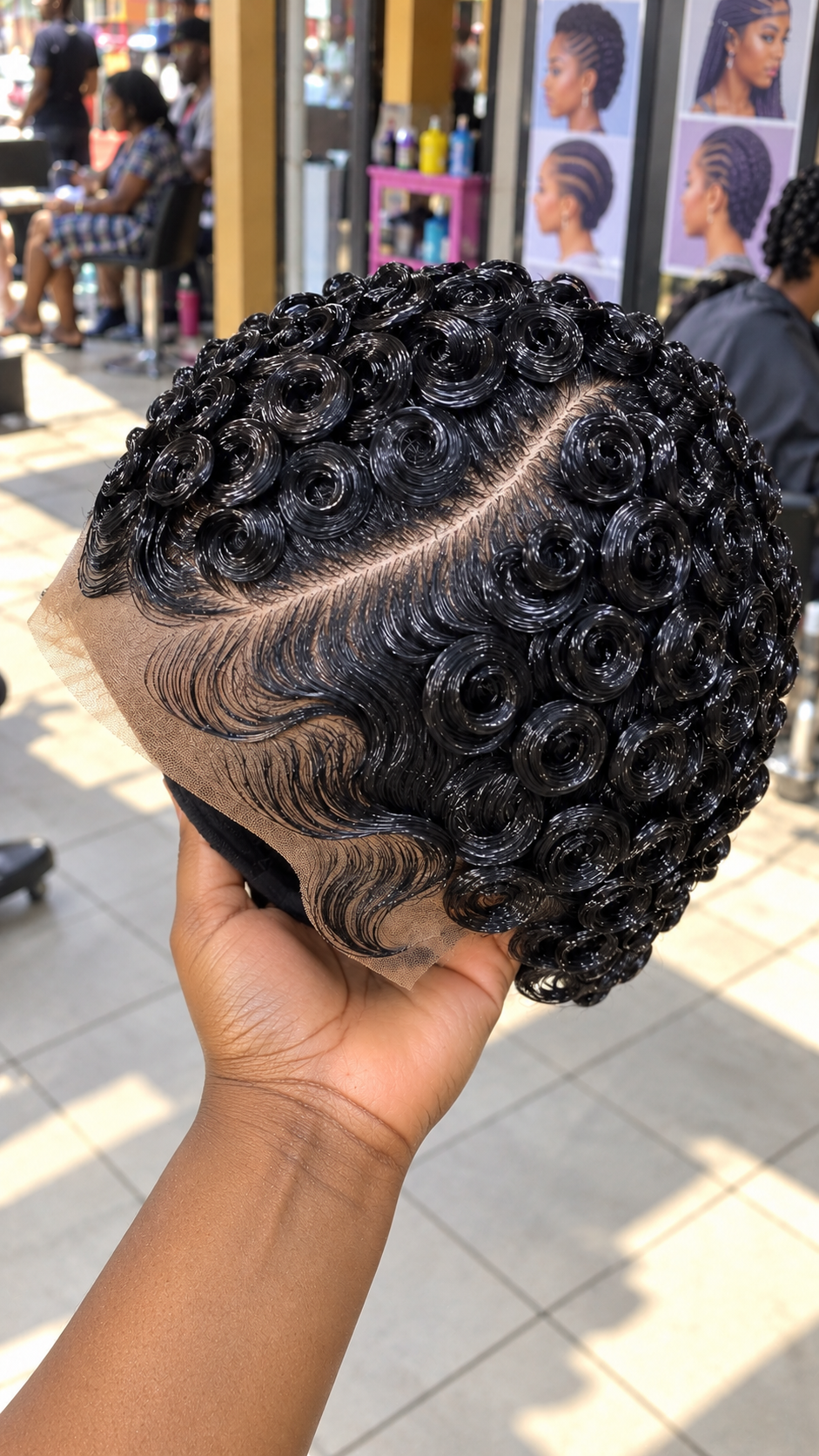
A beautifully sculpted short wig can make a powerful impression without relying on bright highlights, extra length, or excessive volume. The black rosette curl wig shown here demonstrates how carefully arranged circular curls and flowing finger waves can transform a compact hairstyle into an eye-catching design. With glossy black ringlets covering the crown, a prominent diagonal parting, and finely shaped waves along the front and side, this hairpiece offers an appealing combination of vintage salon artistry and practical wig styling.
The wig is photographed in one hand inside a neighborhood beauty salon. Its tightly arranged circular curls create a rounded crown, while a clearly visible scalp-toned part travels diagonally across the upper section. Beneath this division, fine strands sweep across the forehead in elongated S-shaped movements. Smaller rosette curls continue along the opposite side and toward the back, creating full coverage without long hanging hair.
The photograph also reveals an extended beige-toned lace perimeter. A portion of the dark interior foundation is visible beneath the front, indicating that the unit is being presented before final lace trimming and fitting. Although the hair appears glossy and carefully styled, the photograph alone cannot establish whether it is human hair, synthetic fiber, or a blend. Buyers should confirm the actual material and cap specifications before purchasing.


The Beauty of a Compact Rosette Curl Crown
The main attraction of this hairstyle is its collection of circular curls. Unlike ordinary loose curls that hang naturally around the face, these ringlets are arranged in compact rolled formations across the upper head.
Many of the curls resemble small rosettes, with individual strands following circular paths toward their centers. Some formations have broad openings, while others are rolled more tightly.
This variation creates depth across the crown. The larger circles form visible focal points, while smaller ringlets fill the spaces between them.
The overall result is a rounded silhouette with noticeable volume but relatively little length. For women who enjoy short curly wigs, this balance can provide a distinctive appearance without the additional hair associated with longer styles.
Glossy Black Hair Makes Every Curl Stand Out
The wig appears predominantly deep black, with reflective charcoal highlights created by the lighting and the curved surfaces of the strands.
No separate blonde, copper, burgundy, or brown color sections are visible. The hair’s appearance depends primarily on the arrangement of the curls rather than a contrasting color palette.
Each rosette reflects light along its outer surface, while the circular opening remains darker. This contrast helps individual curls remain recognizable, even when they are closely arranged.
For a custom order, buyers should request a rich natural-black or jet-black shade. Adding contrasting highlights may create a different attractive hairstyle, but it would change the monochromatic appearance of this reference.
Why the Circular Curl Openings Matter
One of the distinctive characteristics of the crown is the presence of visible openings inside the ringlets. These small circular spaces contribute to the hairstyle’s sculpted appearance.
Without them, neighboring curls could blend into one continuous mass of hair. Their separation allows the viewer to distinguish each rolled section.
A wig maker should therefore avoid adding excessive hair between the curls simply to increase density. More hair does not automatically create a better result.
Instead, the goal should be consistent crown coverage with individually recognizable circular formations.
Customers commissioning a similar hairstyle can request an overhead photograph before delivery to check whether the major curl openings have been preserved.
The Crown Has a Carefully Balanced Shape
The rosette curls cover much of the upper head, creating a rounded profile rather than a tall, upright crest.
The largest formations appear across the upper and forward sections, while smaller curls continue toward the side and rear.
This distribution keeps the hairstyle proportional. Excessive height could make the crown appear oversized, while flattening every curl would remove its distinct sculpted character.
A successful reproduction should preserve the overall rounded shape and compact length.
A Diagonal Part Adds Structure to the Hairstyle
A pronounced diagonal parting separates groups of circular curls across the upper hair. This scalp-toned division begins near the front and travels toward the side and rear.
The parting gives the hairstyle an asymmetric arrangement without requiring dramatic differences in hair length.
It also establishes where the circular crown transitions into the flatter finger-wave section.
For custom production, the stylist should position the part before completing the individual curls. Changing it later may require rebuilding sections of the crown and adjusting the direction of the front waves.
The Parting Should Remain Narrow and Visible
The exposed division is clearly recognizable, but it is not excessively wide. Dark strands remain on both sides, emphasizing its diagonal route.
This proportion is important because a wider part could alter the balance between the curls and the flatter front styling.
A wig maker should reproduce the route and approximate width of the division rather than creating a generic straight side part.
If fine strands move across the part during wear, careful repositioning may restore its appearance without removing additional hair.
The Sweeping Finger Waves Create Beautiful Movement
Beneath the diagonal part, long black strands travel across the front and side in carefully arranged S-shaped waves.
These waves lie considerably flatter than the circular curls above them. Their movement creates a contrast between the raised crown and the closely directed hairline.
The largest wave sweeps across the forehead before bending toward the lower side, where smaller curves continue the pattern.
This arrangement recalls traditional finger-wave styling, in which closely aligned strands are directed into repeated curves to produce a sculpted surface.
The Front Waves Are More Than Ordinary Baby Hairs
The delicate strands along the forehead occupy a noticeable portion of the hairstyle. They are not simply a few short hairs brushed around the perimeter.
Instead, several elongated sections follow coordinated paths, creating broad curls and smaller inward movements.
These details connect the front lace to the more substantial rosette curls above.
A professional recreating the style should preserve the wave direction and length rather than trimming the strands into a conventional straight hairline.
Layered Waves Create a Gradual Transition
The finger-wave arrangement changes scale as it moves across the side. Broad curves occupy the upper area beneath the diagonal part, while smaller movements appear closer to the lower perimeter.
This gradual reduction creates continuity between the raised rosettes and the compact side hair.
The waves should not be treated as disconnected decorative sections. Their relationship gives the hairstyle its flowing character.
When commissioning a similar design, buyers should select a stylist experienced with both pin curls and finger waves.
The Side Remains Curly Rather Than Fully Shaved
Unlike pixie wigs with extensive exposed barber artwork, this design keeps circular curls across a substantial portion of the side.
The lower edge becomes more compact, but the visible hair is not presented as a completely shaved section.
This is an important distinction for buyers who want the same appearance.
Adding multiple razor-cut lines or geometric undercut patterns would change the hairstyle. The design already has enough visual detail through the diagonal part, finger waves, and densely arranged circular curls.
Small Rosettes Complete the Outer Silhouette
Along the outer side and toward the rear, smaller curls continue the circular pattern established across the crown.
These formations help maintain full coverage without making the lower section as bulky as the upper hair.
Their scale also allows the prominent diagonal part and front waves to remain visible.
For custom styling, the maker should maintain this change in curl size rather than extending the largest rosettes across every part of the wig.
The Rear Should Maintain Consistent Curl Coverage
The photograph provides a detailed view of the upper and visible side but does not show the complete rear of the wig.
Before purchasing or commissioning a similar unit, customers should request a rear photograph to check how the rosette curls continue toward the nape.
The back should have sufficient coverage while maintaining a compact profile.
A maker should avoid leaving the rear unexpectedly sparse or extending oversized ringlets too far down the nape.
The Lace Perimeter Has Not Yet Been Trimmed
Beige-toned mesh extends beyond the hair-bearing front and side sections. The lace remains visible because the unit is being presented before its final fitting.
This extra material allows an installer to position the wig and assess the decorative hairline before trimming.
The photograph does not establish a particular commercial lace grade. Although the mesh appears fine, it should not automatically be described as HD lace.
Buyers should ask the seller to confirm the actual lace type, available shades, and recommended installation method.
The Interior Cap Requires Individual Verification
A portion of the dark interior foundation is visible beneath the lace, but the complete cap construction cannot be examined from this angle.
The photograph does not establish every fastening component or available adjustment.
Before ordering, ask for an underside photograph showing the actual cap, including any straps, combs, elastic components, or other attachments.
The seller should also confirm whether the wig is designed for adhesive-free installation. A lace perimeter alone does not establish glueless suitability.
Correct Cap Size Protects the Decorative Hairline
The diagonal part and sweeping finger waves are fixed to the wig foundation. If the cap sits too far forward or backward, the entire arrangement shifts relative to the wearer’s forehead.
This can affect the appearance of the hairline even when the curls have been constructed accurately.
For custom orders, follow the manufacturer’s measurement instructions. Circumference, front-to-nape, and ear-to-ear measurements may be required depending on the foundation.
A professional wig stylist can help determine the correct size before installation.
Who Might Prefer This Short Curly Wig?
This design is particularly relevant to women who enjoy compact hairstyles with elaborate curl placement.
The rounded rosette crown offers noticeable visual interest, while the flatter finger waves prevent the front from appearing excessively bulky.
Its monochromatic black color also allows the hairstyle to work with a variety of clothing and accessory choices.
However, the carefully sculpted curls may require more deliberate maintenance than an ordinary loose-curly wig. Buyers should consider whether they prefer preserving a set style or frequently changing their hairstyle.
Where To Buy This Wig Style
Specialist wig makers, custom lace-wig studios, beauty supply retailers, and salons experienced with pin-curl hairstyles are appropriate places to begin looking for comparable units.
Search for compact black rosette curl wigs, sculpted pin-curl pixies, and black finger-wave lace wigs.
When contacting a supplier, provide the reference photograph and explain that the crown contains rolled circular curls rather than ordinary loose spirals.
Ask whether the displayed unit is available as finished stock or must be made to order.
Before paying a deposit, confirm the material, cap size, lace specification, styling services, shipping terms, and return policy.
Choosing a Wig Maker With the Right Skills
Producing this hairstyle requires experience with two different techniques.
The crown uses individually arranged circular pin curls, while the forehead contains elongated finger waves.
A stylist experienced only with ordinary loose curls may not automatically reproduce the rolled rosettes and directional hairline accurately.
When evaluating a professional, look for close-up portfolio photographs showing circular curl openings and detailed finger-wave styling.
Custom wig studios offering reference-based work may be particularly useful when precise curl placement is a priority.
How to Book a Styling Appointment
The service required depends on whether the wig is purchased fully styled or as an unfinished foundation.
A finished unit may need only fitting, lace preparation, and small adjustments after transportation.
An unfinished wig may require complete pin-curl setting, diagonal part construction, hairline styling, and professional installation.
When booking, send the photograph and describe the desired result as a short black rosette curl wig with sweeping finger waves.
Ask the salon whether it provides both wig customization and installation or whether separate appointments are necessary.
Preparing a Clear Custom Production Brief
The wig should have a compact rounded crown filled with mixed-size black circular rosettes and visible open centers.
A diagonal scalp-toned part should separate the main curl sections and guide the direction of the front styling.
The forehead should contain long, finely arranged S-shaped finger waves that gradually transition into smaller curls.
The lower side should retain compact black curls rather than decorative shaved channels.
The design should remain consistently black without contrasting highlights.
Finally, specify cap dimensions, verified lace material, attachment preferences, and installation requirements.
Request Several Product Photographs Before Purchasing
A single photograph can reveal the main styling but cannot establish every construction detail.
For a finished custom order, request front, side, rear, and elevated crown photographs.
The overhead view should reveal the curl openings and diagonal part. The frontal image should document the finger waves, while the rear image should confirm complete curl coverage.
An underside photograph should show the cap construction and actual attachment components.
What Influences the Cost of a Sculpted Rosette Wig?
The wig has a compact length and a single black color, but that does not necessarily make it inexpensive.
Forming numerous rolled pin curls, preserving their circular openings, and arranging the forehead waves may require substantial professional labor.
The hair material, foundation type, lace preparation, and installation services can also influence the final price.
Estimated Price Comparison for Black Rosette Curl Wigs
| Category | Illustrative Price Range | Potential Scope |
|---|---|---|
| Premium Custom | $320–$590+ | Higher-grade hair, personalized cap measurements, individually styled rosette curls, precision diagonal parting, decorative finger waves, and professional lace preparation. |
| Standard Custom | $190–$350 | Prepared black pin-curl crown, sculpted front-wave styling, and standard cap options. |
| Basic Human Hair | $110–$215 | A human-hair foundation requiring additional curling, hairline styling, and professional fitting. |
| Premium Synthetic | $75–$155 | A quality pre-set alternative that may preserve its circular curls with comparatively limited routine styling. |
| Basic Synthetic | $35–$90 | A budget alternative where curl arrangement, parting detail, hairline styling, or cap construction may be simpler. |
These figures are illustrative budgeting estimates rather than verified retail prices for the photographed wig. Actual prices depend on material, supplier, location, customization labor, shipping, and installation.
Customers should compare the cost of fully completed units rather than assuming an inexpensive curly wig includes the elaborate rosette crown and finger-wave styling.
Human Hair May Offer Greater Restyling Flexibility
A human-hair version may allow selected circular curls to be professionally reset when they loosen, depending on the condition of the strands.
The front waves may also be restored separately from the crown.
However, not every human-hair wig can tolerate unlimited heat or repeated styling. The hair’s processing history and current condition should determine the appropriate techniques.
Synthetic Hair May Preserve Pre-Set Curls
A quality synthetic wig may retain its circular curl arrangement with relatively little daily manipulation.
This can be useful for customers who want to maintain the original style rather than frequently restyle the hair.
However, heat tolerance and future modification options vary by fiber.
Conventional permanent coloring should not be assumed suitable for synthetic hair without manufacturer confirmation.
Washing Without Disturbing the Rosette Pattern
Before washing, photograph the crown from above. This provides a reference for the original placement of the individual curls.
Use a cleansing method appropriate for the confirmed hair or fiber, and avoid aggressive rubbing that could intertwine neighboring ringlets.
The wig should be allowed to dry without pressure flattening the crown.
Any displaced curls can then be restored individually using suitable techniques.
The Finger Waves Need Separate Maintenance
The forehead waves should remain elongated rather than being rolled into additional circular curls.
If a wave loses its direction, guide the strands back along the original path using material-appropriate products and tools.
Heavy styling gels or waxes may cause the fine strands to merge, reducing the visible wave detail.
The goal should be preserving the direction and separation of the existing strands.
Avoid Excessive Product on the Black Curls
The glossy ringlets already reflect light strongly. Applying heavy oils or waxes can make adjacent curls adhere together, concealing their individual openings.
Product buildup can also affect the appearance and feel of the hair.
Use only products suitable for the actual material and apply them conservatively.
Preserving the Diagonal Part
The parting is an important structural element and should not be widened unnecessarily during maintenance.
If fine strands move across the division, careful repositioning may restore its appearance without cutting.
Because wig hair does not naturally grow back, unnecessary trimming can permanently alter the balance between the curled crown and the front-wave sections.
Protect the Wig During Installation
When the unit arrives, inspect the rosette curls, diagonal part, finger waves, lace, and cap before making permanent alterations.
The installer should establish the intended wearing position and confirm the placement of the forehead waves.
Only after the alignment is correct should excess lace be trimmed and optional styling adjustments considered.
Avoid pulling directly on delicate curls while securing or repositioning the foundation.
Storing the Wig Between Uses
A suitable wig stand or mannequin head can help maintain the rounded curl arrangement.
Avoid placing heavy objects against the crown or stacking the wig beneath other hairpieces.
The front finger waves should also remain free from compression.
Make sure the hair and cap are completely dry before storage.
For transportation, choose packaging with enough space to prevent the circular curls from being flattened.
The Lasting Appeal of a Black Rosette Pixie
This hairstyle demonstrates how a compact black wig can offer elaborate visual detail through carefully arranged curls and directional strands. Its circular rosette crown creates fullness, the diagonal part introduces asymmetry, and the sweeping finger waves provide an elegant transition around the forehead.
For buyers, the most important quality checks are curl diameter, visible circular openings, crown coverage, parting accuracy, finger-wave direction, material verification, and cap fit.
For wig businesses, clear close-up photographs and accurate specifications are essential. Customers need to understand whether the product is a fully styled sculpted unit or a foundation requiring professional customization.
A successful reproduction should preserve the black color, rolled crown, and flowing hairline without unnecessary highlights, excessive volume, or unrelated side artwork. The design’s strongest quality is the careful arrangement of its existing details.
Search Terms
black rosette curl pixie wig · sculpted pin curl lace wig · diagonal part circular crown · black sweeping finger waves · short glossy ringlet wig · vintage black rosette hairpiece · untrimmed lace pixie curls · black spiral crown wig