
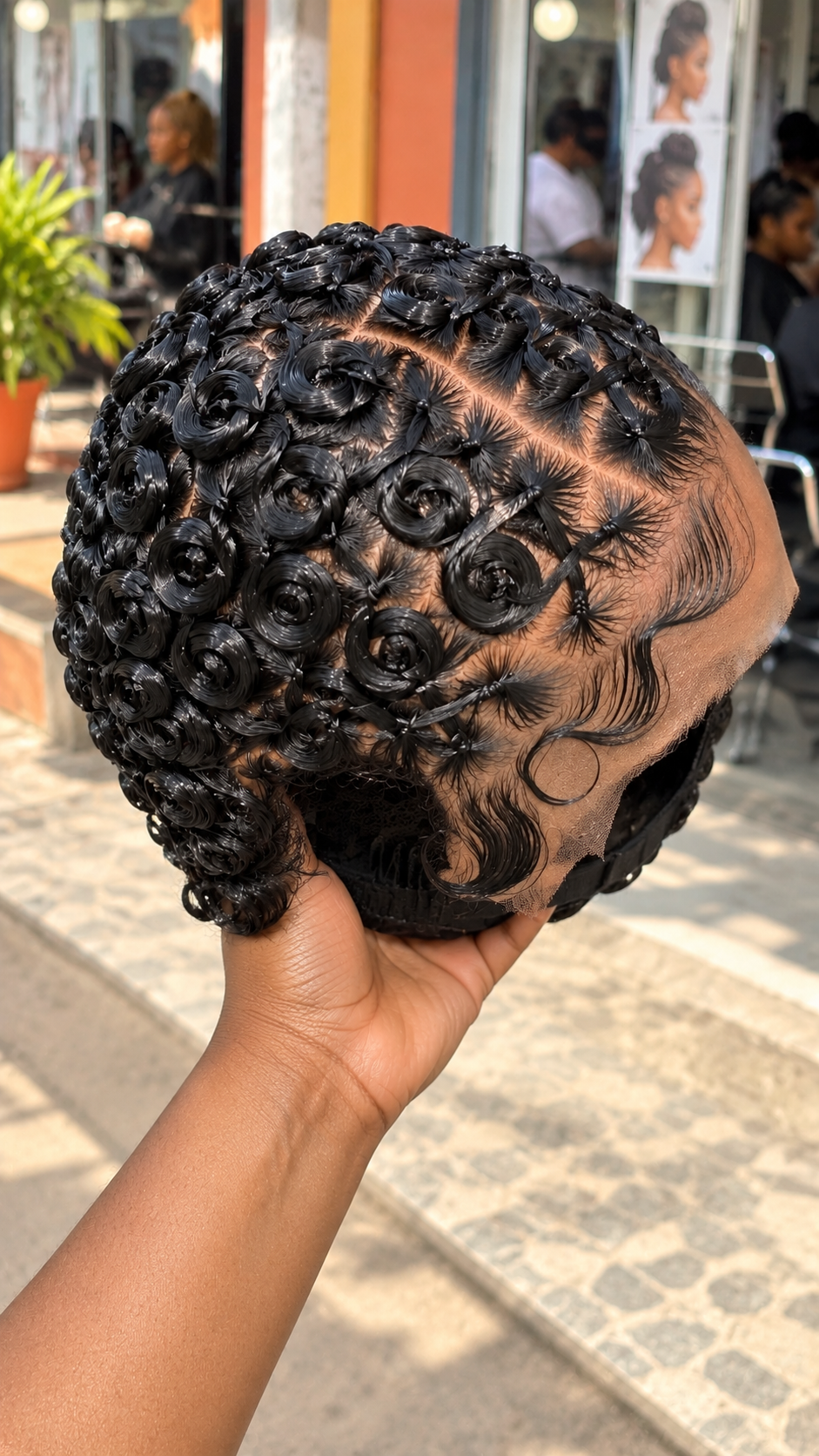
Some hairstyles are designed around the shape of the curls. Others begin with the arrangement of the scalp sections beneath them. This striking black lace wig combines both ideas, presenting dozens of glossy, rose-shaped coils connected through an intricate network of exposed partings and small anchored hair sections. The result is a sculptural hairstyle that looks equally interesting from the side, crown, and front hairline.
Unlike a conventional curly pixie wig, the design does not conceal its underlying parting structure. The lighter scalp-like surface remains visible between the dark coils, revealing diagonal divisions, small starburst formations, and carefully controlled hair placement. The front and temple areas introduce another technique: fine strands are swept into elongated curves and decorative baby-hair loops along the lace.
The wig is photographed before installation, supported in one hand outside a salon. An extended beige lace area remains around the front, and a portion of the dark cap is visible beneath the lower edge. Although the photograph provides substantial information about the hairstyle, it does not establish the hair fiber, lace grade, manufacturing method, or actual supplier.


For buyers searching for a distinctive black coil wig, this piece is particularly relevant because its design requires more than selecting an ordinary curly unit. The circular formations, exposed parting network, and decorative temple styling must work together to reproduce the photographed appearance.
Why the Parting Network Deserves Attention First
The most unusual aspect of the hairstyle is not simply the number of curls. It is the deliberate arrangement of visible sections beneath them. Across the front and upper side, the hair is divided into numerous small areas, with narrow exposed channels separating neighboring sections.
Several of these sections contain fan-shaped strands gathered into small central points. Their outward direction creates a starburst appearance around the anchors. Other sections feed into rounded coil formations, producing a pattern that alternates between compact curled shapes and exposed scalp-like spaces.
The layout is not a basic straight-row braid pattern. Some divisions run diagonally, while others intersect or branch around the circular coils. This variation creates an interconnected arrangement that remains visible even where the curls become densely concentrated.
Near the front, the sections are comparatively open and easy to distinguish. Toward the crown and visible rear, the circular coils become more numerous, partially covering the underlying divisions.
That gradual change in coverage gives the hairstyle depth. The exposed front sections emphasize the construction, while the denser rear curls provide a rounded silhouette.
Starburst Sections Versus Ordinary Scalp Partings
A conventional lace wig may include a central part, side part, or relatively uniform rows of hair. This design is more intricate because several small sections appear to radiate outward from gathered points.
These starburst formations are especially noticeable around the upper temple and forward crown. The strands extend in different directions before joining nearby coils or decorative arrangements.
The photograph suggests carefully organized anchoring, but it cannot confirm whether the style was constructed through tying, twisting, knotting, hand placement, or another manufacturing process.
Buyers should therefore describe the visible appearance rather than making assumptions about how the hair was attached.
A custom wig maker should receive a close photograph showing the starburst sections and their relationship to the surrounding coils. Without that reference, the maker may substitute simple straight partings and produce a substantially different hairstyle.
The Rose-Shaped Coils Create a Sculpted Surface
Across the upper and rear-facing areas, numerous black coils are arranged into compact circular formations. Many resemble small roses, with overlapping curved strands creating layered, petal-like shapes.
The curls vary in size. Some are relatively large and display recognizable central openings, while others are smaller and more tightly arranged.
The larger coils are particularly visible across the central crown and side. Their dark glossy surfaces catch the light, making the direction of individual strands noticeable even within the densely curled sections.
Several formations appear flattened into rosette-like circles rather than standing as ordinary upright ringlets. Their layered construction distinguishes the hairstyle from a conventional finger-coil pixie.
At the visible rear, smaller circular curls cluster more closely together. This increases the apparent hair density without requiring the hairstyle to extend far away from the cap.
The result is a rounded, compact silhouette with a decorative surface made from individually recognizable coil formations.
What Makes a Rosette Different From a Spiral Ringlet?
A spiral ringlet typically follows a corkscrew-like path, often extending outward or downward. A rosette-shaped coil is arranged more like a compact circle, with strands curving around a central area.
In the photographed wig, many curls appear layered into rounded formations. Their overlapping curves create an appearance closer to small hair rosettes than loose hanging spirals.
This difference matters when ordering. A seller offering a standard curly pixie may provide the correct length and color while using an entirely different curl pattern.
Customers should request actual photographs showing the individual coil construction. A close view of the crown is more informative than a distant portrait.
It is also useful to ask whether the coils are intended to remain in their arranged positions or whether they must be recreated after washing.
The answer depends on the hair fiber and construction method, neither of which can be established from the photograph alone.
The Black Color Allows Every Formation to Stand Out
The visible hair is consistently deep black, with glossy reflections along the curved strands. There are no clearly visible blonde, copper, burgundy, or other contrasting color sections.
Although the hair appears almost uniformly black, its surface does not look visually flat. Differences in strand direction and reflected light reveal the individual loops, rosettes, and fine sections.
Where the curls overlap, the black becomes deeper. Where strands curve toward the light, brighter reflections emphasize their circular shape.
This natural variation is particularly important because the hairstyle relies on visible construction rather than contrasting hair colors.
The darker strands also create a noticeable contrast against the beige lace and lighter scalp-like areas visible between the sections.
It would be inaccurate to interpret those reflections as silver highlights or to assume that a particular shine-enhancing treatment was used.
The photograph also cannot establish whether the material is human hair or synthetic. Both categories may produce a glossy appearance under suitable lighting.
The Front Hairline Introduces a Different Styling Technique
Along the front edge, the hairstyle transitions from compact circular coils into much finer, elongated strands. These strands are arranged close to the lace, creating curved patterns that frame the forehead and temple.
The visible baby-hair styling includes a prominent loop near the lower temple and several longer sweeping curves above it. These decorative strands differ from the tightly arranged rosettes covering the rest of the wig.
Near the upper front, the hairline follows a gentle curve before joining the exposed sectioning pattern.
The fine strands appear carefully positioned to complement the larger hairstyle without completely covering the lace.
This contrast between miniature hairline curves and larger coil formations is one of the design’s most distinctive characteristics.
Why the Temple Loop Should Not Be Enlarged
The decorative temple loop is noticeable but remains proportionate to the surrounding hairline. Its circular shape creates a focal point near the front side without extending far beyond the wig’s compact outline.
Making the loop substantially larger could change the balance between the hairline and the crown.
Likewise, replacing it with ordinary loose baby hairs would reduce the carefully arranged appearance of the reference.
A wig stylist reproducing this section should consider the available lace area, strand length, and the intended position relative to the wearer’s temple.
Hairline styling should be finalized only after the cap has been fitted correctly. A design that looks properly positioned on an unattached wig may sit differently when worn.
Why This Design Requires More Than a Standard Curly Wig
A ready-made curly lace wig may offer black hair, a compact silhouette, and small spiral curls. However, those characteristics alone do not reproduce the photographed design.
The exposed parting network is an essential component. Without it, the hairstyle would lose much of its distinctive structure.
The circular coils must also be arranged in relation to the parting sections rather than placed randomly across the crown.
Finally, the temple styling introduces decorative curved strands that require separate attention.
These details suggest that a close reproduction may benefit from specialist customization, although the precise manufacturing approach should be discussed with the wig maker.
Where to Find a Wig Maker for Rosette Coils
Customers seeking a similar hairstyle should look for professionals experienced in sculpted pixie wigs, decorative coil arrangements, and intricate lace styling.
Some wig makers specialize in conventional straight or curly units, while others work with more elaborate hair placement and artistic styling.
When comparing suppliers, request examples of previous work involving individually arranged curls and visible scalp sectioning.
Local wig boutiques may offer opportunities to inspect lace and cap construction in person. Independent custom wig makers may provide more control over the placement of the rosettes and starburst sections.
Online sellers can also be considered, but actual product photographs and clear construction information are particularly important for a hairstyle of this complexity.
Preparing a Useful Custom Order Brief
Send the original photograph and identify the details that must remain unchanged.
Describe the hairstyle as a compact black lace wig with numerous rose-shaped coils, exposed diagonal partings, small starburst-like sections, and decorative curved baby hairs around the temple.
Explain that the circular coils should remain individually recognizable rather than forming one continuous mass of ordinary curls.
Ask whether the supplier can reproduce the visible sectioning arrangement and how it will be maintained after washing.
Confirm the fiber, lace specifications, cap measurements, and intended installation method.
Before payment, request information about production time, revision conditions, and whether photographs of the completed unit will be available for approval.
Buying From Photographs Without Misreading the Construction
The reference photograph provides a strong side and upper view, but it does not reveal every part of the wig.
The opposite side is not visible in sufficient detail to determine whether the sectioning arrangement is symmetrical.
The complete rear also cannot be inspected, although smaller coils continue around the visible lower edge.
Only part of the dark interior cap is visible, so the complete attachment system remains unknown.
When evaluating a similar product, request a front photograph, a full rear view, a crown photograph, and an image showing the underside.
A short rotation video may also help establish whether the curl arrangement continues consistently around the head.
These additional views can prevent misunderstandings caused by relying on one carefully selected presentation angle.
The Visible Lace and Interior Cap
The wig is displayed with an extended beige lace section around the front and temple. The lace remains untrimmed, indicating that final fitting has not yet been completed.
The mesh is visible beneath the styled baby hairs and along the lower front perimeter.
Near the bottom, a dark cap structure can be seen, including black fabric and a band-like edge. However, the photograph does not clearly reveal every seam or fastening component.
No specific claim about the number of combs, adjustable straps, or clips can be made from this view alone.
The lace appears relatively fine, but its exact grade is unverified. Buyers should request the manufacturer’s specification instead of assuming a particular premium lace type.
Cap Sizing for an Intricate Front Design
Cap fit is especially important when the hairstyle includes decorative temple loops and exposed scalp sections.
If the wig sits too far forward, the baby-hair arrangement may extend lower than intended. If the cap shifts backward, the upper sectioning pattern may appear at a different angle.
Provide the measurements requested by the supplier, including head circumference and any additional dimensions needed for the selected cap.
Ask whether the lace area and front styling can be adapted to the wearer’s proportions.
If adhesive-free installation is preferred, obtain explicit confirmation that the cap is constructed for that method.
The presence of lace alone does not establish glueless compatibility.
Illustrative Pricing for Sculpted Black Coil Wigs
This hairstyle may involve more specialist styling than an ordinary curly pixie because of its visible sectioning, individual coil arrangement, and decorative front hairline. The following USD figures are illustrative planning ranges, not verified current prices or quotations for the photographed unit.
| Wig Category | Illustrative USD Range | Possible Cost Considerations |
|---|---|---|
| Premium Custom | $350–$850+ | Personalized cap sizing, intricate starburst partings, individually arranged rosette coils, and detailed temple hairline styling. |
| Standard Custom | $190–$450 | Selected cap options with decorative scalp sections, organized circular coils, and partial hairline customization. |
| Basic Human Hair | $110–$290 | A human-hair starting unit that may require extensive coil setting, parting work, and professional styling. |
| Premium Synthetic | $85–$210 | A manufactured curly unit with prearranged compact coils, depending on the available construction. |
| Basic Synthetic | $30–$95 | A lower-cost black curly pixie that may not reproduce the exposed partings or individual rosette formations. |
The photograph does not establish the material category of the displayed wig. These classifications describe possible purchasing options rather than confirmed product characteristics.
The visible sectioning arrangement may increase labor requirements because the placement of the coils must be coordinated with the exposed channels.
Creating numerous compact rosettes can also require careful work, particularly when their sizes and positions must resemble a specific reference.
The decorative baby-hair loops introduce another styling consideration, as they must be positioned without disturbing the surrounding lace.
Additional costs may include cap customization, shipping, taxes, installation, and future professional resetting.
Ask the seller whether the quoted price includes the complete finished hairstyle or only a base wig requiring additional work.
Booking a Stylist for the First Installation
The first appointment should focus on establishing the correct cap position before altering the lace or decorative hairline.
A professional wig stylist can examine the front fit, temple placement, and how the exposed parting network appears when the unit is worn.
The extended lace should remain intact until the correct position has been established.
Trimming too close to the fine front strands may damage the decorative hairline or reduce the available fitting margin.
Once the cap is positioned, the stylist can determine whether the baby-hair loops need minor adjustments.
The circular coils should not be disturbed unnecessarily during installation. Pulling on individual formations may alter their shape or position.
If the wig has been compressed during shipping, ask the supplier how the coils should be restored.
Any resetting technique should be selected according to the confirmed fiber and manufacturer instructions.
Protecting the Exposed Parting Network
The visible partings are central to the hairstyle’s appearance. Strands that move across the exposed channels can obscure the organized sectioning pattern.
Frequent brushing or pulling through the crown may disturb the relationship between the coils and their underlying sections.
Instead of treating the entire hairstyle as ordinary loose curls, handle each area according to its construction.
If a section begins to loosen, consult a professional familiar with decorative coil styling before attempting to retighten or reshape it.
Excessive pulling may place unnecessary tension on the attached hair or lace.
The photograph does not reveal the exact anchoring method, so maintenance should be based on verified product information.
Why the Starburst Sections Should Stay Visible
The small radial formations contribute to the design’s distinctive visual character. If loose strands cover them, the upper front may begin to resemble an ordinary curled wig.
Keeping these sections visible does not mean aggressively widening the partings. Removing hair or cutting into the sections can permanently alter the unit.
Any adjustment should preserve the existing placement rather than create larger exposed areas.
When necessary, a stylist can evaluate whether the strands can be repositioned safely using methods appropriate for the material.
Care for the Circular Rosette Formations
The rounded coils depend on retaining their layered shape. Brushing through them may stretch the circular formations and separate the overlapping strands.
Heavy styling products may also accumulate between neighboring coils, reducing the visibility of their individual shapes.
If the wig contains human hair, a professional stylist may be able to reset displaced rosettes using suitable techniques. The appropriate method will depend on the hair’s processing history and construction.
If the wig contains synthetic fibers, conventional heat styling may be inappropriate. The manufacturer’s recommendations should determine whether steam, heated tools, or other resetting methods are permitted.
Do not assume that the glossy appearance means the fibers can tolerate high temperatures.
Keeping the Decorative Hairline Intact
The front and temple contain finer strands than the densely curled rear sections. These delicate formations require particular care during handling and installation.
Avoid pulling on the large temple loop or repeatedly brushing the small decorative curves.
When cleaning the lace, follow the supplier’s instructions and avoid aggressive rubbing that could displace the fine strands.
If the baby-hair styling loses its arrangement, ask a qualified wig stylist how to restore it without creating excessive tension along the hairline.
Unnecessary cutting should be avoided because the original strand lengths contribute to the decorative loops.
Storage for a Wig With Numerous Small Coils
A suitable wig stand can help preserve the rounded silhouette between wears.
The stand should support the cap without compressing the rosette formations or pressing against the decorated temple.
When placing the wig on the stand, hold the cap securely rather than lifting the unit by its coils.
For travel, choose packaging that allows the curled sections to retain their shape.
A tightly packed bag may flatten the circular formations or disturb the front sectioning network.
Protect the extended lace from snagging on accessories, sharp edges, and other objects.
If the wig will be stored for an extended period, follow the manufacturer’s recommendations for cleanliness, humidity, and environmental exposure.
Choosing Between a Decorative Coil Wig and an Ordinary Pixie
This hairstyle may appeal to customers who appreciate intricate hair construction and visible scalp-inspired patterns.
Its compact length provides a relatively contained silhouette, while the numerous rosette coils create substantial visual detail.
The exposed starburst sections distinguish it from wigs where the curls cover the entire scalp-like surface.
The decorative temple loop adds another recognizable element without requiring a contrasting hair color.
For occasional wear, the intricate construction may be particularly appealing when the hairstyle itself is intended to be a major part of the overall presentation.
For regular wear, the buyer should consider the maintenance required to preserve the coils and partings.
A simpler curly pixie may offer greater styling flexibility, while this design places more emphasis on maintaining a specific arrangement.
Evaluating Craftsmanship Before Making a Final Decision
The strongest characteristic of this wig is the relationship between its visible parting network and circular coil formations.
The black color allows individual curls and fine strands to remain visually prominent through changes in direction and reflected light.
The starburst sections introduce an intricate scalp-like arrangement, while the dense rosette coils create a compact, rounded crown.
At the front, elongated baby-hair curves provide a separate decorative element that frames the lace without covering the entire hairline.
Before purchasing, verify the fiber, cap size, lace specifications, fastening method, and whether the hairstyle arrives fully arranged.
Request photographs of the opposite side, rear, crown, and complete interior. These additional views are important because the reference shows only part of the construction.
For a custom commission, prioritize a wig maker who can demonstrate experience with decorative partings and individually arranged coils rather than relying on general curly-wig expertise.
A successful reproduction should preserve the deep black rosettes, exposed diagonal divisions, small starburst formations, and sculpted temple loops. Those details establish the identity of this hairstyle and provide practical criteria for comparing ready-made options, commissioning a custom unit, and planning appropriate maintenance.
Search Terms
Black rosette coil lace wig · Starburst scalp parting hairstyle · Glossy black circular hair rosettes · Decorative temple baby hair loop wig · Intricate diagonal sectioned coil crown · Black sculpted curl lace front unit · Exposed scalp pattern pixie wig · Untrimmed beige lace with spiral coils