
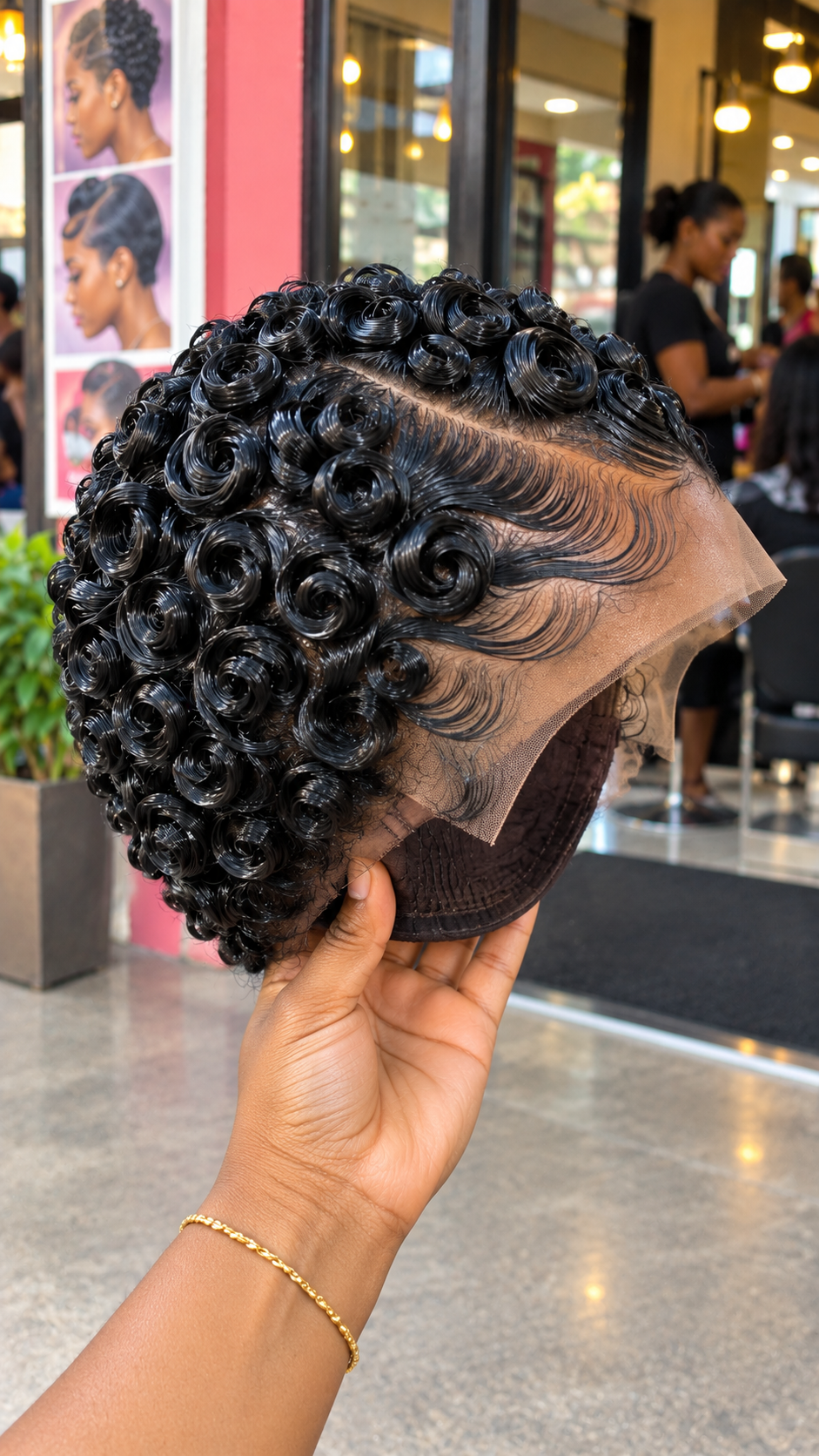
Not every curly pixie needs a traditional rounded front or an even distribution of curls. Some of the most memorable hairstyles create their appeal by placing two contrasting hair arrangements next to one another. This black pixie wig does exactly that, combining dozens of glossy rose-shaped coils with elongated finger waves that sweep across the front and visible temple.
The photograph shows a lace wig being held outside a neighborhood beauty salon. The upper and rear-facing sections are filled with compact circular curls, while a broad section of beige lace extends beyond the sculpted front hairline. The dark interior cap remains exposed beneath the mesh, making this a useful reference for anyone interested in the hairstyle before installation.
What immediately distinguishes this design is the placement of its curls. Large circular formations occupy the upper-left and central portions of the visible wig, while smaller coils continue toward the lower edge. On the opposite side, the hair transitions into long, flowing strands arranged in several graceful curves. A diagonal parting separates the raised curls from the flatter hairline styling.


The hairstyle appears predominantly deep black, with cool charcoal reflections along the curved strands. There are no clearly identifiable contrasting color highlights. Instead, the combination of circular coils, directional waves, and exposed parting creates the visual interest.
For women considering a similar pixie wig, the main challenge is finding a stylist who can reproduce the curl arrangement and hairline details without changing the proportions. The finished result depends less on overall length and more on the careful positioning of individual sections.
Where the Circular Curls Meet the Flowing Hairline
The defining characteristic of this hairstyle is the transition between raised circular coils and flatter, sweeping strands. The two sections are clearly different, yet they connect through the same glossy black hair.
Across the crown, the curls resemble small rolled roses. Several have open centers surrounded by strands that travel around the opening in tightly controlled circles. Others are more compact, with their centers partly concealed by neighboring curls.
Near the front, a few larger coils sit close to the diagonal parting. Their rounded shapes create a noticeable boundary above the finger-wave section.
The side waves begin beneath this boundary and extend toward the front lace. Their elongated shapes contrast with the compact circular curls, making the transition particularly striking.
Rather than styling the entire wig into identical spirals, the maker has arranged different curl shapes in separate areas. This is one of the most important details to preserve when requesting a similar design.
Recognizing the Difference Between Rosettes and Ordinary Ringlets
Traditional ringlets often hang downward from the hair, creating vertical movement. The curls in this photograph remain positioned close to the foundation and form rounded openings that face different directions.
Several resemble circular rosettes rather than hanging corkscrews. Their outer strands create reflective rings around darker centers.
When searching for a similar hairstyle, descriptions such as rose curls, circular finger coils, and sculpted spiral pixie may be more useful than a general search for curly black wigs.
However, terminology varies between salons. Showing the actual photograph is more reliable than depending on a single hairstyle name.
The Diagonal Parting Changes the Entire Composition
A narrow exposed separation runs diagonally between the circular crown and the finger-wave section. The parting begins near the upper central area and travels toward the visible front-side hairline.
The foundation beneath the separation appears beige-brown, creating a noticeable contrast against the surrounding black strands.
The curls on one side rise into rounded formations, while the hair on the opposite side follows flatter directional curves.
This difference creates a natural visual division without requiring a large shaved area.
The parting also helps establish the direction of the front waves. Several strands follow its general angle before bending into broader curves near the forehead.
For a custom wig, the separation should be planned before the surrounding curls are finalized. Moving it afterward could require repositioning several neighboring sections.
Parting Placement and Face Framing
The appearance of a diagonal parting can change depending on where the wig sits on the wearer’s head. A channel that looks balanced on a display form may appear differently when placed on another head shape.
Before trimming the lace, the installer should position the wig correctly and evaluate how the parting relates to the forehead and temple.
If the buyer wants the same asymmetrical appearance, the stylist should preserve the intended direction rather than moving the separation toward the center.
Ask for a front-facing fitting photograph before approving permanent customization.
Broad Finger Waves Create a Dramatic Front Detail
The front and visible side contain several elongated finger-wave-inspired sections. These strands lie close to the lace and follow sweeping curved paths.
The upper wave begins near the diagonal parting and travels toward the forehead before bending back toward the denser curls.
Beneath it, another curved section follows a related direction, creating a layered appearance.
Smaller tapered strands extend toward the lower lace edge, giving the front hairline a softer transition.
The individual strands are closely aligned, making the waves appear glossy and continuous.
Unlike the raised circular coils, these sections depend on their directional flow rather than open curl centers.
Why the Front Waves Need Their Own Maintenance Routine
The finger-wave section may require different care from the circular crown. Brushing the strands apart could disturb their carefully arranged direction.
The buyer should ask how the waves were formed and which products are suitable for maintaining them.
If the hair begins losing its shape, a professional stylist may need to reposition the strands using a method appropriate for the confirmed fiber.
Applying excessive styling product could cause buildup along the lace and reduce the clarity of the wave pattern.
The Rear-Facing Curls Maintain a Rounded Silhouette
The visible lower-left and rear-facing areas contain numerous compact curls that continue downward from the crown.
Several are smaller than the prominent central rosettes, creating a gradual change in curl size.
The curls remain closely grouped, contributing to a rounded silhouette rather than a sharply squared outline.
Near the lower visible edge, the formations become particularly compact.
This continuity matters because a wig with beautiful front curls can still appear unfinished if the rear styling lacks sufficient coverage.
The photograph shows a substantial portion of the curled side, but it does not provide a complete direct rear view. Buyers should request additional photographs before assuming the entire back has an identical arrangement.
Deep Black Hair With Reflective Charcoal Highlights
The hair appears consistently deep black, with lighter charcoal reflections along the raised circular curls and sweeping waves.
These lighter areas appear to result from light striking the glossy hair surfaces rather than from clearly identifiable colored highlights.
The darkest areas occur inside the circular openings and between tightly grouped coils.
This contrast gives the curls depth while preserving a single-color appearance.
When ordering, request a deep black shade and ask whether the seller describes it as natural black or jet black.
The photograph alone cannot establish the exact color code or whether the hair has been dyed.
What the Shine Cannot Tell You
A glossy surface does not confirm that a wig contains human hair. Synthetic fibers, blends, styling products, and lighting can create similar reflections.
Ask the supplier to identify the material before purchasing.
Human hair may offer certain restyling possibilities, but previous processing and the techniques used to create the curls can influence its behavior.
Synthetic hair may have restrictions involving heat, coloring, and washing methods.
Do not assume that the visible curl arrangement can be recreated with heat until the fiber specifications have been confirmed.
Understanding the Untrimmed Lace and Interior Cap
The photograph clearly shows a broad section of beige lace extending beyond the styled front hairline. The mesh has not yet been trimmed to match an individual wearer’s forehead.
Fine black strands are visible near the boundary between the styled hair and the exposed lace.
The mesh extends across the front and toward the visible temple, providing material that may be adjusted during installation.
Its apparent beige color is influenced by the lighting and background. The photograph does not establish whether the lace will blend with a particular skin tone.
The exact lace grade is also unknown. Visible lace should not automatically be described as HD lace.
Beneath the front opening, the dark cap contains fabric and mesh-like sections with visible stitching. The complete attachment system cannot be established from this view.
What to Verify Before Trimming the Lace
The buyer should confirm the cap circumference, front-to-back length, and ear-to-ear measurements before installation.
Ask the seller for a complete underside photograph showing any combs, adjustable bands, clips, or other attachment components.
If the wig is advertised as glueless, request specific information about its intended fastening system.
During installation, the stylist should first position the wig and examine the front waves. Cutting too close to the styled strands could damage their attachment area.
Only after the correct position has been established should the excess lace be trimmed.
Where to Buy This Wig Style
Similar black rosette pixie wigs may be available through specialist wig makers, local beauty supply shops, lace wig boutiques, and online hair marketplaces.
However, an ordinary curly pixie listing may not include the same elaborate front waves or circular curl arrangement.
For a closer match, contact a wig maker who has experience creating sculpted finger coils and precision hairline designs.
Provide the reference photograph and explain that the circular curls should remain concentrated across the crown and rear-facing section, while the front should retain the flowing finger-wave arrangement.
Ask whether the seller offers a ready-made version or would need to create a custom unit.
Exact stock, pricing, and supplier details are not established by the photograph and should be confirmed directly.
Planning a Custom Order Without Unnecessary Changes
A successful custom order begins with identifying the elements that should remain unchanged.
For this hairstyle, those elements include the deep black color, compact rose-shaped curls, diagonal parting, and broad front waves.
The buyer should also specify the desired overall height and rounded silhouette.
Ask the maker to provide examples of previous work involving circular rosettes and finger-wave styling.
Before production begins, confirm the cap measurements, fiber material, lace specifications, and intended attachment method.
Request progress photographs if the stylist offers them. A close view of the parting and front waves is particularly useful because those details may be difficult to correct after completion.
Before shipping, ask for front, side, rear, and underside photographs of the finished unit.
What Different Wig Budgets May Cover
The following USD figures are illustrative planning ranges rather than verified live prices for the photographed wig. They represent possible purchasing categories and may vary significantly by location, material, construction method, and styling labor.
| Wig Category | Illustrative USD Range | Potential Inclusions and Limitations |
|---|---|---|
| Premium Custom | $360–$900+ | Personalized construction, detailed rosette curls, sculpted finger waves, lace preparation, and potentially individual fitting |
| Standard Custom | $190–$470 | Selected cap options, custom circular curls, and professional front-wave styling |
| Basic Human Hair | $100–$290 | Human-hair base unit with possible additional charges for curl setting and hairline customization |
| Premium Synthetic | $70–$210 | Pre-styled compact curls, selected cap construction, and fiber-dependent care restrictions |
| Basic Synthetic | $30–$115 | General black curly pixie resemblance with potentially simpler curls and less elaborate front styling |
The photograph does not establish which of these material categories applies to the displayed wig.
The largest styling expense may come from arranging the individual circular curls and creating the flowing front waves.
Cap customization, installation, lace trimming, shipping, and taxes may be charged separately.
Ask the supplier to identify which services are included in the quotation before paying.
Keeping the Circular Curls Beautiful Between Wears
The raised rosettes should be protected from unnecessary pulling, compression, and aggressive brushing.
Their circular openings are an important part of the hairstyle, so flattening the curls could noticeably change the appearance.
Ask the seller whether the curls are intended to retain their shape after washing or whether professional resetting is required.
Use only cleansing and styling products suitable for the confirmed material.
If the wig contains synthetic fiber, follow the manufacturer’s temperature restrictions. If it contains human hair, consider any previous chemical processing before applying heat.
A properly sized wig support can help maintain the rounded silhouette during storage.
Protecting the Lace and Sculpted Hairline
The lace should be handled carefully during installation, removal, and storage.
Pulling directly on the mesh may cause stretching or damage, particularly near the fine front strands.
The finger waves should not be repeatedly combed apart. If they become displaced, a stylist can assess whether careful repositioning is sufficient.
Avoid cutting additional hair from the front or side unless the intended change has been carefully planned.
Who Will Appreciate This Hairstyle Most?
This design is especially appealing to women who enjoy compact hairstyles with elaborate curl arrangements.
It offers a rounded curly silhouette without long hanging hair, making it visually different from traditional bob and shoulder-length wigs.
The rose-shaped curls provide noticeable detail, while the sweeping front waves create a distinctive face-framing arrangement.
The deep black color also allows the styling itself to remain the main attraction.
For buyers who prefer simpler hairlines, the elaborate waves may require more attention than a conventional curly pixie. Anyone considering this style should therefore discuss maintenance expectations with the wig maker before ordering.
The most successful reproduction will preserve the relationship between the circular crown and the flowing hairline. Changing the front into ordinary baby hairs, enlarging the curls excessively, or adding unrelated shaved patterns would produce a noticeably different hairstyle.
With accurate measurements, a suitable cap, and professional styling, this black rosette pixie can offer a distinctive combination of compact curls and artistic hairline movement. Its appeal lies in the precision of the individual coils and the graceful contrast created by the sweeping waves.
Search Terms
black rose coil pixie wig · glossy black circular rosette curls · sweeping finger wave lace front · diagonal part black coil hairstyle · open center spiral pixie hairpiece · sculpted forehead waves black wig · beige untrimmed lace rosette unit · compact black curls with side waves