
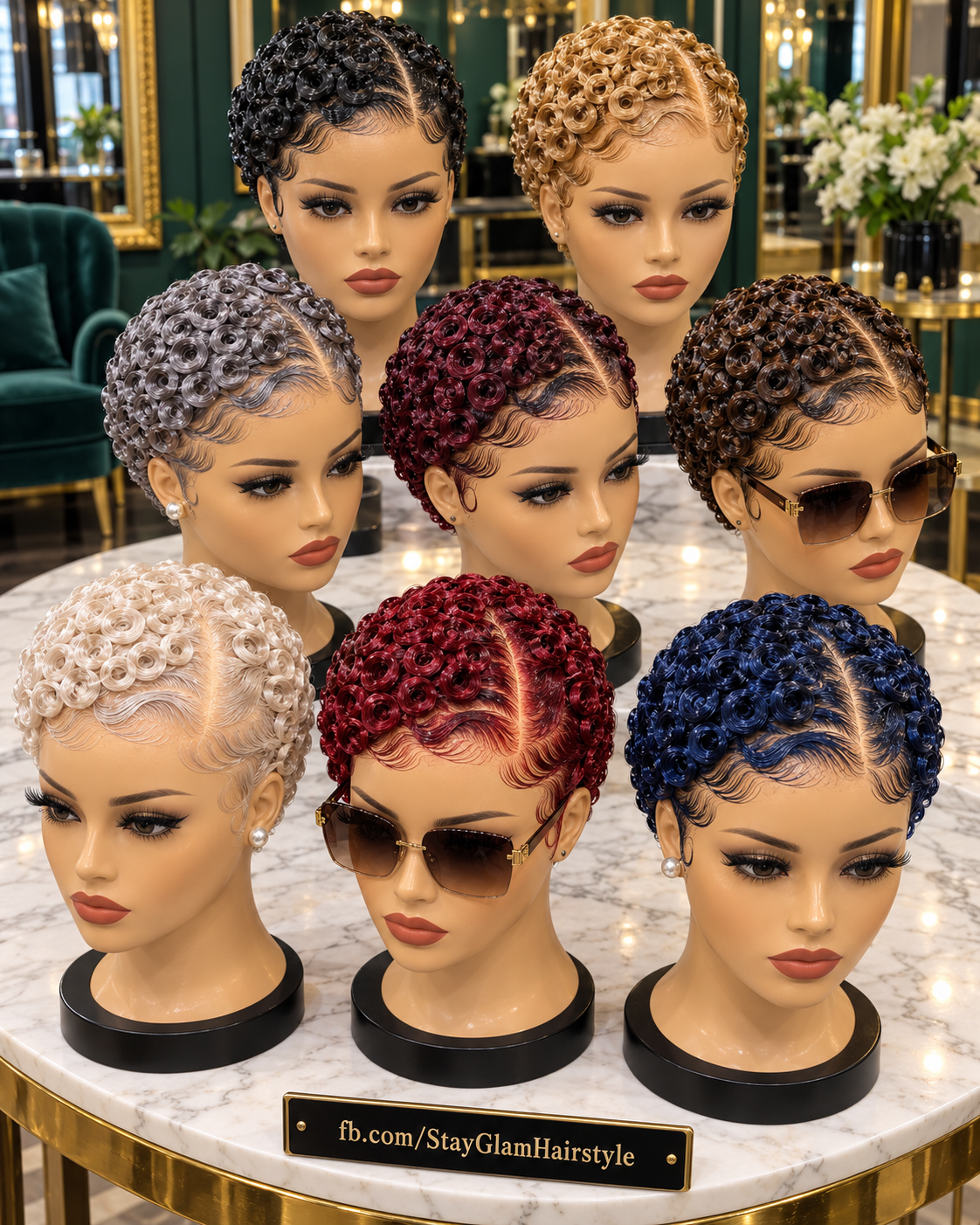
A collection of closely sculpted ringlets becomes especially striking when each color reveals a different side of the same styling idea. This display brings together eight pixie wigs, moving from black and honey gold to silver, burgundy, brown, pale blonde, vivid red, and deep blue. Their appeal comes from the relationship between rounded curls and carefully arranged forehead waves. Rather than relying on length, each look creates interest through small circular openings, directional styling, and a compact outline that leaves the mannequin faces clearly visible.
The photograph is useful as a color comparison, but it also rewards a closer look at construction details. The wigs share a similar design language without appearing identical in every curl or part placement. Some have more conspicuous scalp-colored channels, while others carry curls farther across the front. For someone ordering from this reference, those differences matter: choosing a shade alone will not guarantee the particular silhouette or front arrangement that first caught your attention.
Eight Shades, Several Different Impressions
At the back left, the black wig presents a strong contrast between its dark circular curls and the lighter visible part. The front waves remain easy to distinguish because their direction catches the light. Beside it, the honey-gold version creates a warmer impression, with bright edges around the ringlets and a lighter-looking forehead arrangement. These two provide a useful starting comparison for buyers deciding between a dark everyday shade and a more conspicuous golden option.
The middle row introduces silver-gray, deep burgundy, and warm brown. The silver version has darker shadows between its loops, helping the individual shapes remain legible. Burgundy concentrates a wine-colored richness across the upper curls while retaining dark-looking areas around the front waves. The brown wig shows amber reflections under the display lighting. Its sunglasses partly obstruct the temple area, so that section needs another photograph before it can serve as a complete customization reference.


Across the front sit pale creamy blonde, saturated red, and deep navy blue. The blonde is lighter and less golden than the honey shade behind it. The red has a brighter appearance than the middle burgundy, particularly along the part and forehead waves. Blue appears darkest between curls and brighter along their illuminated edges. These distinctions are more useful than treating the display as several interchangeable versions of one color chart.
Compare the honey and pale blonde separately, and do the same with burgundy and red. Ask a seller to photograph the preferred pair together under neutral daylight. Warm bulbs, reflective marble, and gold surroundings can influence how a shade appears. A daylight comparison will not eliminate every screen difference, but it gives a better basis for choosing than a color name alone.
The Circular Openings Are the Main Design Detail
These are not loose curls hanging away from the head. Much of the visible hair is arranged into compact, open-centered rings that sit close together. Their circular openings create a decorative surface across the top and upper sides. Some rings face the camera directly; others tilt away or overlap neighboring curls. That variation gives the arrangement depth without requiring a tall or oversized crown.
The forehead styling follows a different rhythm. Narrow waves travel along the hairline beneath the larger curls, creating a transition from exposed forehead to the ringlet-covered upper section. A stylist recreating this look needs to understand both scales. Making every front section into a large ring would change the expression of the hairstyle, while flattening the entire upper section would remove its most recognizable quality.
There are also visible differences in the way the parts travel through the wigs. Several show a pale channel extending backward from the front, but the amount visible changes with the mannequin angle and curl placement. The photograph does not establish the underlying part construction. A scalp-like appearance could involve different materials or techniques, so request a close photograph before assuming the channel can be moved or restyled.
Choose a Particular Mannequin Before Placing an Order
Sending the full photograph with a message such as “make this in brown” leaves several decisions unresolved. A more precise request identifies the reference by position: middle-right brown, front-right blue, or back-left black. Then explain whether that mannequin supplies the color, the curl arrangement, or both. This helps prevent a seller from combining the shade of one piece with a noticeably different front from another.
For example, someone drawn to the front-center red version might particularly like its conspicuous part and sweeping forehead waves. Another buyer may prefer the softer visual contrast of the pale blonde piece. These preferences should become written order details. Ask the maker to confirm the intended part direction, approximate crown height, amount of forehead coverage, and whether the ears will remain exposed after fitting.
Also distinguish between an existing item and a commissioned reproduction. A ready-made wig should be shown as the actual unit available for dispatch. A custom order requires agreement on what the maker will reproduce and which details may vary. If exact ring placement is important, request approval photographs before shipment. Small differences are easier to discuss while the wig is still with the person responsible for styling it.
What the Boutique Photograph Cannot Establish
The eight pieces are displayed on mannequin heads, with no cap interiors or loose lace edges clearly presented. Their neat appearance does not verify human hair, synthetic fiber, a particular lace grade, or adhesive-free wear. The reflective curls also cannot identify the material: styling products, lighting, and fiber type can all affect surface shine.
Request an underside photograph showing the complete cap, along with written information about fiber composition, cap size, and any adjustment system. If the seller describes a lace front, ask where the lace begins and ends and whether it arrives trimmed. If a unit is advertised as ready to wear, clarify what preparation that phrase includes. It may refer to styling alone rather than a personalized fit.
The rear profiles remain another important gap. The photograph shows the fronts and portions of the sides, but it does not fully reveal how every wig sits at the nape. Ask for a slow turn of the actual piece, including a rear view taken at head level. This is particularly helpful for a close-fitting pixie, where an unexpected bulky back or exposed cap edge can change the overall result.
Finding the Right Person to Recreate the Look
Look for a wig maker or salon stylist whose portfolio includes sculpted ringlets, finger waves, and fitted pixie wigs. Experience with long curled units does not automatically demonstrate skill with this compact arrangement. Useful search phrases include “ringlet pixie wig stylist” and “finger wave wig customization,” followed by your city or region. Examine close photographs of completed work rather than relying only on distant salon images.
For local appointments, ask whether the stylist can assess an already styled unit before altering it. The first consultation should establish fit and placement, especially around the ears and forehead. Bring the reference and identify the exact mannequin you prefer. If you already own the wig, provide its care instructions and material information so the stylist can judge which adjustments are appropriate.
When purchasing online, the plaque in the photograph is a visual reference rather than proof of stock, ownership, or order terms. Confirm the seller independently, request current footage of the selected item, and read the return and customization policies. Establish whether the quoted service includes the wig itself, styling, fitting, or only a restyling appointment. Keeping those items separate makes competing offers easier to compare.
Budget Around the Work Included
The table below compares five purchasing categories without assigning unverified live prices. Each is a possible route to a similar appearance; none identifies the material of the displayed wigs. Obtain an itemized quote for the selected shade and front arrangement, because detailed ring placement, color work, and personal fitting can change the total.
| Purchase Category | Potential Scope | Quote Details to Confirm |
|---|---|---|
| Premium Custom | A commissioned unit with closely specified color, ring placement, forehead waves, and individualized fitting. | Cap construction, material, approval stages, fitting appointments, and subsequent styling support. |
| Standard Custom | An existing base adapted to the chosen pixie outline and selected display color. | Extent of restyling, available base shades, measurement adjustments, and revision limits. |
| Basic Human Hair | A verified human-hair unit that may require separate cutting and sculpted styling. | Hair condition, previous processing, suitability for the intended set, and salon labor. |
| Premium Synthetic | A synthetic option selected for a convincing close-fitting silhouette and established curl arrangement. | Fiber specifications, care restrictions, cap comfort, and whether professional restyling is supported. |
| Basic Synthetic | A lower-cost interpretation with potentially less precise ring placement or fewer fitting options. | Actual item photographs, coverage around the temples, return eligibility, and replacement availability. |
Request separate amounts for delivery, color customization, initial fitting, and any later reset service. A less expensive base may require substantial salon work to approach this reference. Conversely, paying for elaborate customization may be unnecessary if an existing unit already has the preferred shape and fits correctly. Compare the complete route to a wearable result rather than the purchase price in isolation.
Keep the First Fitting Focused on Position
When the wig arrives, inspect it before adding products or making alterations. Compare the color, front arrangement, and overall size with the agreed photographs. Check the inside for the construction details the seller promised. Place it on carefully and assess whether the front sits where intended, whether both ear areas feel comfortable, and whether the back remains secure during ordinary head movement.
Only after placement is settled should a professional consider trimming exposed lace, if present, or changing the perimeter. This image does not show a need for shaved side patterns or added razor lines. Introducing them would create a different hairstyle. Likewise, removing curls near the temples simply to imitate a mannequin angle could leave insufficient coverage on the wearer. Fitting should account for the individual head rather than reproduce the display position mechanically.
Preserve the Ring Arrangement Between Wears
The maintenance priority is preventing individual rings from being pulled apart or compressed. Handle the unit by its cap or supported base whenever possible, rather than lifting it by the upper curls. Once positioned, avoid repeatedly running fingers through the circular openings. If one ring becomes displaced, ask the maker whether it can be repositioned locally or requires a professional reset.
Follow material-specific instructions for washing and drying. Until the fiber is confirmed, do not apply hot tools, permanent dye, or a chemical treatment. A visibly structured style may change substantially after washing, so obtain a demonstration or written reset guidance before the first wash. Ask whether the forehead waves and upper rings need different handling and whether the salon offers maintenance appointments for that exact unit.
Between uses, support the wig without stretching its cap or pressing the curls against a shelf. Keep the display shape clear of tight packaging and avoid resting sunglasses across the styled front. The photograph uses accessories on two mannequins, but a wearable unit still needs unobstructed inspection around those areas. The best purchase is the one whose color, fit, and upkeep requirements are understood before the first outing.
Search Terms
jewel tone ringlet pixie wigs · honey gold circular curl wig · silver gray sculpted ringlets · burgundy pixie with forehead waves · warm brown side parted curl wig · creamy blonde ring curl pixie · ruby red waved hairline wig · navy blue compact ringlet hairstyle