
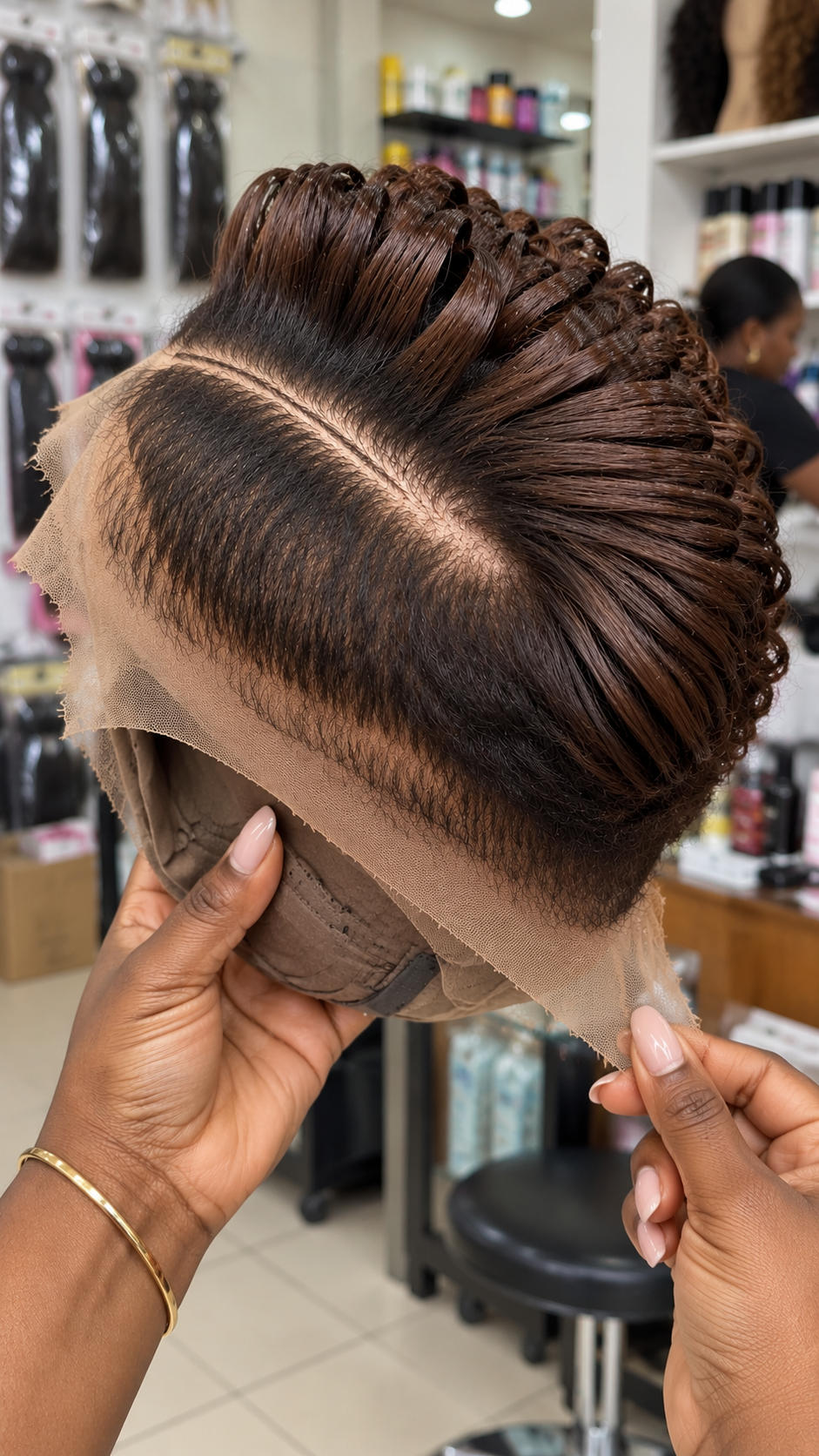
Not every sculpted wig needs carved lines, bright highlights or a complicated color transition to make an impression. This espresso-brown lace wig takes a more restrained direction by concentrating nearly all of its styling detail in the crown. Long folded sections rise from dark roots, bend backward through glossy loops and become progressively more compact toward the rear. Beneath them, the side remains closely arranged and largely uninterrupted, creating a dark foundation that makes the upper construction more prominent.
The photograph shows the wig before installation, held with its lace perimeter extended outward. This provides a useful view of the hair density, crown direction, lower side and partially visible interior cap. The exposed lace has not yet been trimmed for a specific wearer, so the final hairline and placement remain installation decisions. Although lace is clearly present, the photograph does not establish whether it is HD lace, a particular lace grade or a confirmed adhesive-free construction.
The strongest characteristic of this piece is its simplicity below the crown. There are no prominent decorative razor lines or repeated carved channels on the visible side. Instead, the design relies on a broad, dark, closely arranged section that follows the rounded shape of the foundation. That contrast between sculpted upper hair and restrained lower density gives the wig its distinctive profile.
A Crown Designed Around Backward Direction
The upper sections begin relatively upright near the front before folding backward. Several broad pieces resemble elongated ribbons whose strands travel together, forming open bends rather than tight circular ringlets.
These sections create movement without requiring excessive length. The hair rises enough to establish a recognizable shape but remains compact around the head. This gives the crown height while avoiding the bulk of a much longer hairstyle.
A stylist reproducing the construction should pay particular attention to the direction of the folds. Simply curling the upper hair would not be enough. The strands need to rise from the foundation and travel backward as coordinated sections.
The spaces between the larger folds also matter. Dark recessed areas are visible underneath them, allowing individual pieces to remain distinguishable despite the single brown color family.
The Espresso Shade Gains Dimension Through Reflection
The hair appears primarily within a rich espresso-to-dark-chocolate brown range. Raised crown sections catch slightly warmer brown reflections, while roots, inner folds and the lower side remain noticeably deeper.
There is no clearly established second highlight color that needs to be reproduced independently. Much of the tonal variation comes from the way the hair bends and reflects salon lighting.
This is important when commissioning a similar unit. Asking for bright caramel highlights could produce a more contrasting result than the reference. A deep espresso foundation with subtle brown warmth is the more appropriate visual target.
Customers should request a neutral-light photograph of the actual available hair when color accuracy matters. Warm shop lighting can make dark brown appear more reddish or golden than it will in daylight.
Broad Front Loops Establish the Highest Point
The forward portion of the crown carries some of the most upright folded sections. Their height gives the wig its main silhouette and creates an obvious transition from the close lower hair.
The folds are not tightly closed. Several contain visible inner spaces that allow darker strands to appear between the reflective outer surfaces.
This open arrangement helps prevent the crown from looking like a single solid mass. It also produces a more deliberate result than simply combing the hair backward.
For custom work, crown height should be approved from the side. Too much elevation would change the proportions, while pressing the folds too close to the foundation would remove much of the sculpted effect.
The Middle Crown Relies on Overlapping Ribbons
Moving backward, the hair sections become more inclined and begin to overlap. Their surfaces remain aligned enough to resemble broad ribbons, but their widths and angles vary.
This variation prevents the crown from appearing mechanically repeated. Some sections bend earlier, while others travel farther before curling back.
The overlapping arrangement also produces deeper shadow beneath the upper ribbons. That shadow is especially useful on a dark-brown wig because it distinguishes individual folds without requiring contrasting highlights.
A custom stylist should preserve this changing relationship between the sections rather than using one identical curl size across the entire crown.
The Rear Uses Smaller Loops to Reduce Projection
Toward the back of the wig, the larger folds gradually give way to tighter curved pieces. These smaller forms follow the rounded foundation and keep the rear from becoming excessively bulky.
This transition is one of the reasons the overall silhouette remains controlled. The front establishes elevation, the middle develops backward movement and the rear brings the hair closer to the cap.
The supplied photograph does not show every angle of the back, so a buyer commissioning a custom reproduction should request a rear three-quarter image before approving the finished unit.
That photograph can confirm whether the smaller curls have been completed carefully and whether the crown maintains a balanced outline.
The Side Is Intentionally Free of Decorative Carving
The close side is one of the most important identifying details precisely because it is not filled with elaborate line work. Fine dark strands extend across the visible lower section without obvious decorative channels interrupting them.
This gives the wig a quieter profile than sculpted units with lightning marks, curved stripes or geometric barber designs.
Customers who want to reproduce the reference accurately should tell the maker to preserve the uninterrupted side. Adding carved lines might create a different attractive wig, but it would no longer be the same design.
The absence of side artwork also changes future maintenance. There are fewer exposed channels requiring careful width preservation, although the compact hair still needs to retain its intended density.
Side Density Creates the Transition Without a Razor Line
The relationship between crown and side is established primarily through length and direction. The upper hair rises into open folded loops, while the lower strands remain close to the foundation.
The contrast creates a clear division even without a strongly exposed carved boundary. The eye naturally recognizes where the larger crown construction begins.
This is a useful approach for buyers who appreciate precision styling but do not want decorative side markings.
The stylist should avoid removing too much side hair during refinement. Excessive thinning could expose more of the foundation than intended and weaken the dark area supporting the crown.
The Lower Perimeter Becomes Progressively Finer
Near the visible lower edge, the hair becomes more delicate and close to the lace. The density decreases rather than ending abruptly in a heavy line.
This graduation gives the lower side a tapered appearance without relying on exposed razor channels.
Maintaining that density requires restraint. Wig hair does not naturally grow back, so repeated trimming can gradually make the lower section too sparse.
When a few strands lift away from the foundation, controlled repositioning may be more appropriate than cutting them immediately.
Untrimmed Lace Gives the Installer Room to Work
The photograph clearly shows excess lace extending beyond the hair-bearing perimeter. This indicates that the unit has not yet been finally fitted or trimmed.
A professional installer can position the cap, examine the front and side alignment and then determine where the lace should be cut.
This is particularly important when the crown has a fixed directional shape. Moving the unit too far forward or backward changes where the raised sections begin relative to the wearer’s head.
The lace appears beige-brown under the shop lighting, but its exact shade and material specifications should be confirmed directly with the seller.
The Front Transition Contains Fine Directional Strands
Near the lace edge, thinner strands lead toward the heavier upper crown. These finer hairs contribute to a gradual transition rather than placing the broad loops directly against the front perimeter.
During installation, the stylist should assess these strands after the wig is positioned. Automatically removing them could change the balance between the front and crown.
The goal is to preserve the existing arrangement wherever it contributes positively to the final wearing position.
A photograph of the untrimmed wig can be useful during future maintenance because it documents the original front density.
The Partially Visible Cap Needs Separate Inspection
A portion of the brown interior foundation is visible beneath the extended lace. This confirms that the sculpted hair is attached to a structured wig base.
However, the photograph does not reveal every attachment component or the complete cap construction. A buyer should therefore request an underside photograph rather than assuming the unit includes specific combs, straps or other securing mechanisms.
For custom orders, cap material and attachment preferences should be discussed independently from the exterior hairstyle.
Someone who prefers a particular fit or securing method should communicate that before production begins.
Accurate Sizing Protects the Crown’s Proportions
A wig can have beautifully arranged loops and still look different from the reference if the cap is positioned incorrectly. Moving the unit forward changes how the crown approaches the forehead, while shifting it backward changes the relationship between the upper hair and side.
For made-to-order construction, follow the supplier’s measurement guide. Circumference may be accompanied by front-to-nape and ear-to-ear measurements depending on the cap design.
Customers who are uncertain about sizing can book a measurement consultation with a wig stylist before ordering.
Correct fit should be established before any irreversible trimming or restructuring takes place.
Choose a Maker Experienced With Folded Crown Construction
This hairstyle is not simply an ordinary curly wig. Its upper sections require directional setting, controlled width and a gradual change in elevation from front to rear.
A suitable wig maker should have examples of comparable folded or ribbon-loop crowns in their portfolio.
Examine their work from the side and above. Look for open spaces between the major sections and a rear that settles naturally instead of projecting at the same height as the front.
A seller who specializes only in loose curls may have difficulty reproducing the precise arrangement without additional professional styling.
Ordering Instructions Should Protect the Simple Side
A useful custom brief begins with deep espresso-brown hair and a sculpted crown made from elongated backward-folding loops.
Specify that the front sections should rise more prominently, the middle should contain overlapping ribbons and the rear should transition into smaller curled forms.
The side instruction is equally important: retain dark, compact, closely arranged hair without adding decorative razor lines.
Finally, include cap measurements, desired lace shade and whether the lace should remain untrimmed for professional fitting.
These specifications help prevent a maker from adding elements commonly found on similar wigs but absent from this particular reference.
Ask for Construction Photographs Before Shipping
A direct side photograph should show the relationship between the raised crown and compact lower section.
An elevated view should reveal the spaces between the folded ribbons, while a rear three-quarter image should demonstrate the transition into smaller curls.
If the supplier advertises a particular lace or attachment system, request a separate interior photograph of the actual unit.
For expensive custom work, the buyer should approve these construction details before the wig is shipped whenever that service is available.
Where to Buy a Comparable Espresso Sculpted Wig
Specialist wig studios, custom lace-wig makers and salons offering structured crown styling are practical sources for this kind of piece.
Ready-made wigs with similar dark-brown color may be available through online wig retailers, but the distinctive folded crown could require professional customization.
Before purchasing a base, ask whether it can support the required directional styling and whether sufficient length and density are available across the crown.
A local wig stylist may be able to perform the final sculpting and fitting, but the cost of that work should be included in the purchasing decision.
Buy a Finished Unit or Commission the Crown Locally?
Buying a fully arranged custom unit can be convenient when the seller has demonstrated experience with this precise construction. The customer receives the main crown styling already completed and can concentrate on fitting.
Commissioning locally offers more direct control over the final silhouette because the stylist can evaluate the cap and crown proportions on the wearer.
The local route may require more than one appointment, particularly if the base needs extensive reshaping.
Neither approach is automatically less expensive. A complete comparison should include the base unit, professional setting, fitting, delivery and any future maintenance services.
Price Considerations for an Espresso Ribbon-Crown Wig
The absence of decorative side carving may reduce some customization labor, but the crown still requires individual sectioning and directional shaping.
Color matching, density control, lace preparation and cap fitting can also influence the price.
Estimated Pricing by Construction Category
| Wig Category | Illustrative Price Range | Likely Scope |
|---|---|---|
| Premium Custom | $290–$525+ | Higher-grade hair, individualized sizing, rich espresso coloring, hand-arranged folded crown sections, controlled side density and detailed lace preparation. |
| Standard Custom | $175–$305 | Prepared brown ribbon crown, compact tapered side and more standardized cap options. |
| Basic Human Hair | $110–$195 | A human-hair foundation that may require additional crown setting, density refinement and professional fitting. |
| Premium Synthetic | $70–$140 | A higher-quality pre-set option designed to retain its folded crown with less frequent professional reconstruction. |
| Basic Synthetic | $35–$80 | A budget interpretation with potentially simpler crown separation, side-density control or cap construction. |
These are general budgeting estimates rather than verified prices for the photographed unit. The final cost varies according to hair or fiber, seller, labor, cap construction, shipping and installation.
Ask whether the quoted price includes completed crown styling. A less expensive base that still needs several hours of professional shaping may cost more overall than a prepared custom wig.
Human Hair Offers More Future Styling Flexibility
A human-hair version may be practical for someone who expects occasional professional crown resetting. Individual folded sections can potentially be restored when they lose their direction.
The hair’s processing history should guide the use of heat. Even dark human hair can be affected by repeated excessive temperatures.
If the espresso shade eventually changes, professional refreshing should aim to preserve the deep brown character rather than introduce unrelated bright highlights.
Premium Synthetic May Reduce Shape Maintenance
A carefully manufactured synthetic unit can retain a pre-set folded crown with less frequent salon work.
This may suit customers who intend to preserve the original hairstyle rather than change it regularly.
However, heat resistance varies by fiber, and conventional coloring methods may not be suitable. The material should be confirmed before attempting major adjustments.
Maintenance Should Focus on the Crown’s Direction
The large folded ribbons should not be brushed together as though they were loose hair. Doing so can eliminate the spaces between sections and flatten the sculpted arrangement.
When one loop loses its direction, isolate that section and restore it according to the original pattern.
Photographs taken before the first wash can help preserve the placement of the largest folds and the tighter rear curls.
Selective maintenance reduces unnecessary manipulation and helps retain the original silhouette.
Clean Without Disturbing Every Fold
During washing, avoid aggressive circular rubbing across the crown. Neighboring sections can become intertwined and lose their original separation.
Use products appropriate for the confirmed material and handle the lace carefully.
After drying, assess which loops actually require attention. Reconstructing only displaced sections is generally preferable to rebuilding the entire crown after every cleansing session.
Dark Brown Hair Still Needs Product Restraint
The reflective crown does not require constant heavy oil or wax application. Excess styling product can make neighboring ribbons adhere together and reduce the dark spaces that create dimension.
Product buildup may also alter the perceived brown shade, making the surface appear darker or less reflective.
Use only what is appropriate for the hair or fiber. When buildup becomes visible, suitable cleansing may be more effective than adding further shine product.
The Uninterrupted Side Offers a Maintenance Advantage
Unlike a wig with multiple carved lines, this design does not require frequent attention to exposed geometric paths.
The lower side should mainly be maintained for consistent density and direction. If a few strands lift away from the foundation, repositioning may be sufficient.
Repeated cutting should be avoided because it gradually reduces the hair available to create the close tapered appearance.
This relatively quiet side can make the wig appealing to buyers who prefer sculpted crown styling without elaborate barber maintenance.
Installation Should Preserve the Original Profile
Before trimming the lace, the stylist should establish where the cap naturally sits and evaluate how the crown rises above the side.
The visible reference depends on that proportion. If the upper sections are pressed down excessively during installation, the wig may lose its sculptural character.
Likewise, unnecessary side thinning could weaken the dark foundation that makes the brown crown stand out.
The best installation adapts the unit to the wearer while retaining the original styling whenever possible.
Store the Wig Without Crushing the Forward Loops
The forward crown contains the largest raised sections, making them vulnerable to compression during storage.
A suitable wig stand or mannequin head should provide enough vertical space to keep those folds open. The rear also needs clearance so its smaller curls are not flattened against a hard surface.
Make sure the cap and lace are completely dry before storage.
For travel, use packaging deep enough to protect the hairstyle rather than pressing the crown into a shallow container.
A Restrained Espresso Wig Can Still Carry Substantial Craftsmanship
This wig demonstrates that elaborate carving and contrasting highlights are not necessary for a distinctive custom unit. Its strongest feature is the organized crown: upright front folds, overlapping middle ribbons and progressively tighter rear curls, all sitting above a compact dark side.
For buyers, the essential quality checks are crown direction, loop spacing, rear compression, espresso color depth, continuous side density, lace condition and correct cap sizing.
For wig businesses, this design provides an opportunity to explain the value of professional shaping rather than relying on dramatic visual extras. Detailed crown photographs, honest material information and clear customization pricing help customers understand what they are buying.
When the construction is reproduced accurately and the unit is fitted with care, the deep brown palette becomes an advantage: it allows the sculpted crown to remain the main attraction while the quieter side completes the hairstyle without competing for attention.
Search Terms
espresso brown ribbon crown wig · dark chocolate folded loop wig · uninterrupted tapered side wig · deep brown lace front hairpiece · backward sculpted crown wig · compact espresso side wig · untrimmed lace brown wig · layered brown loop crown