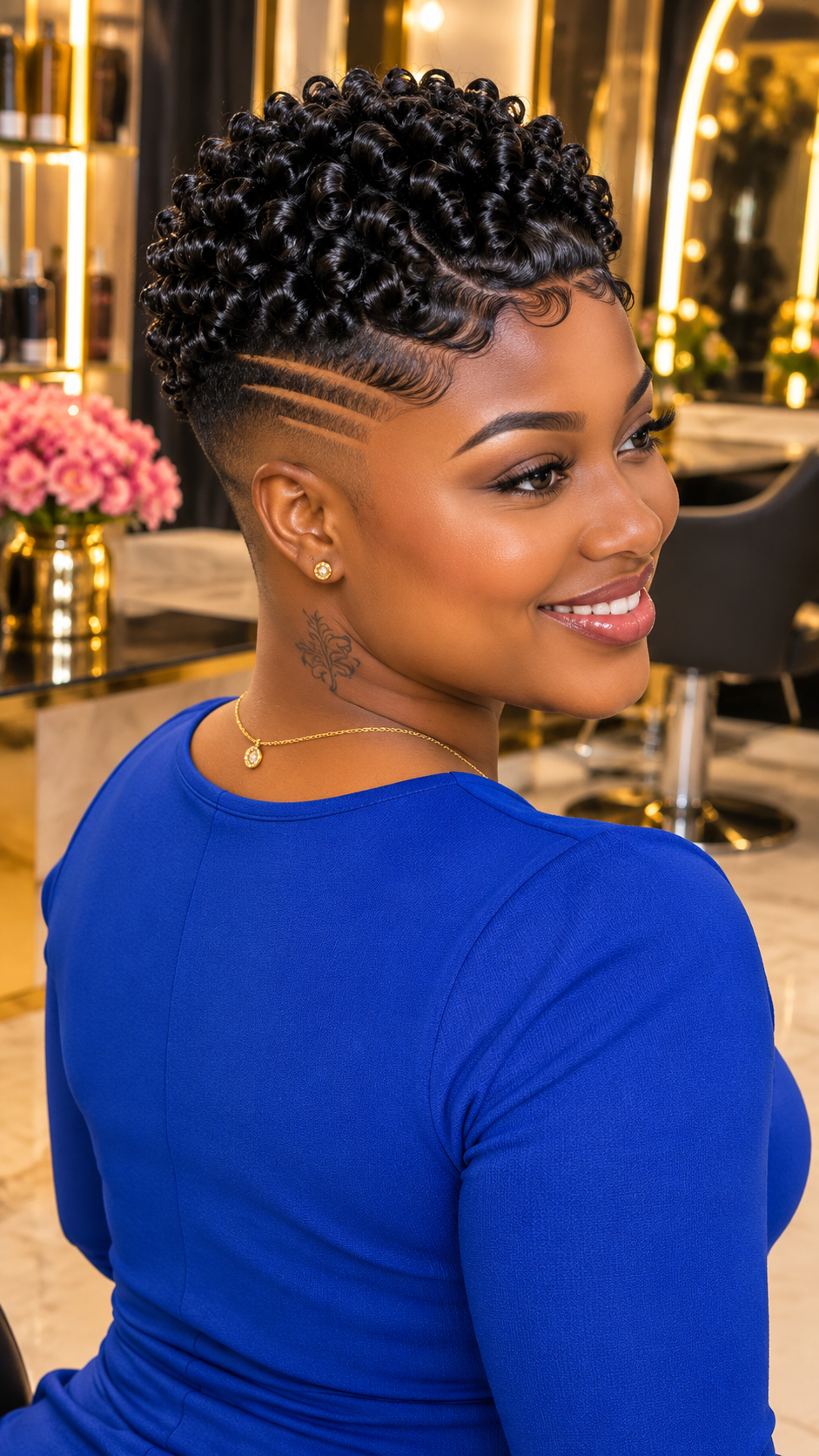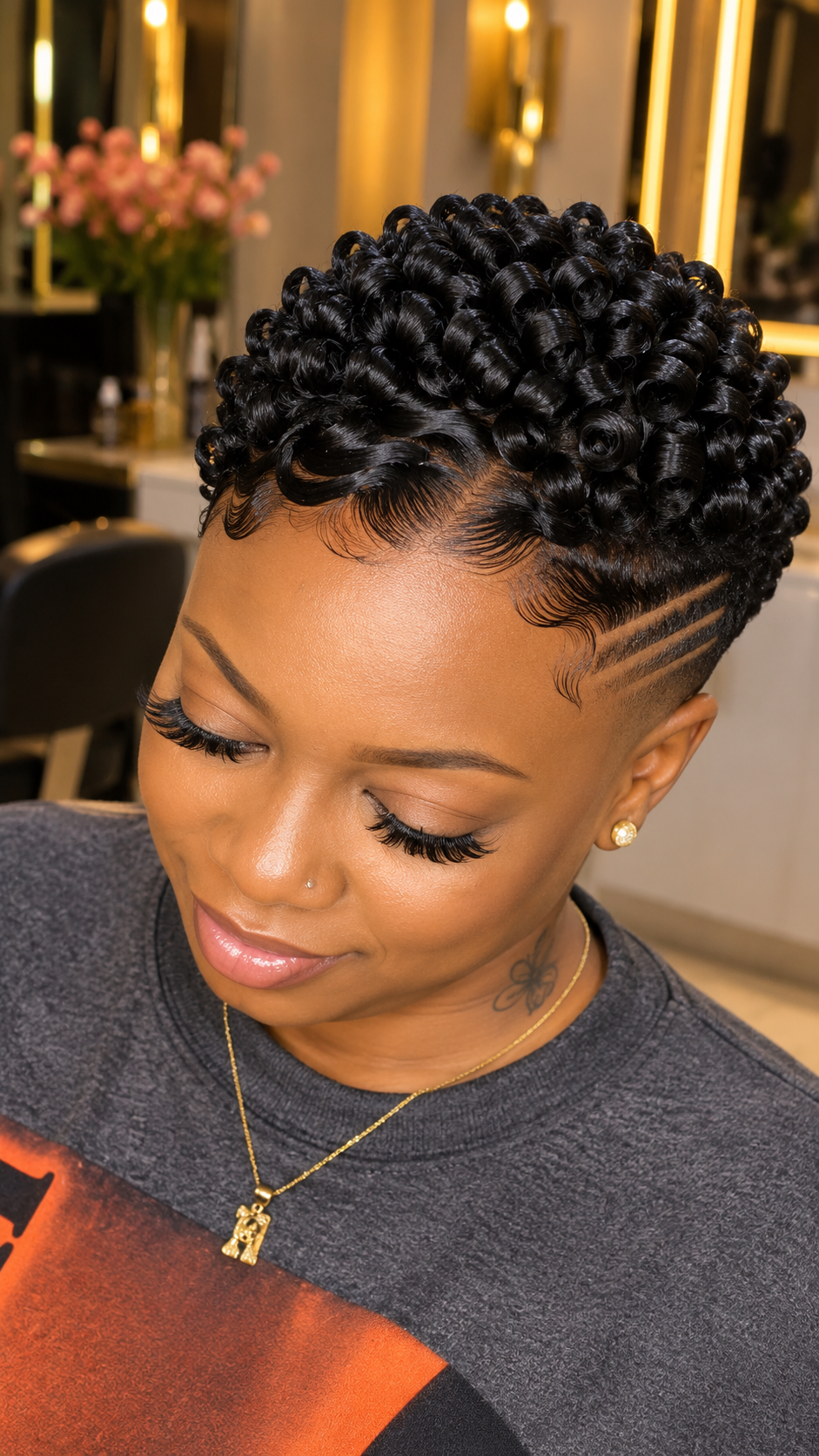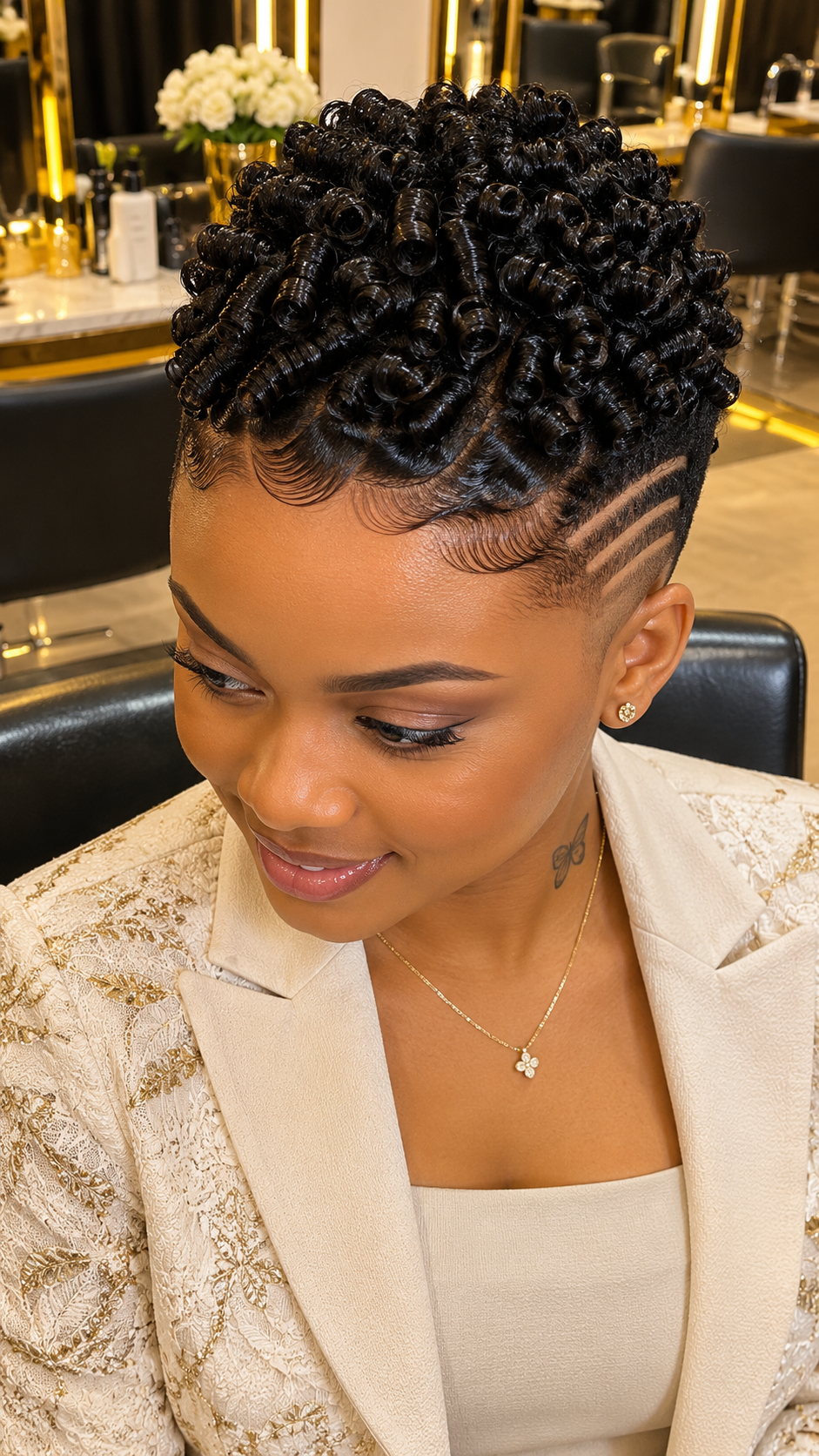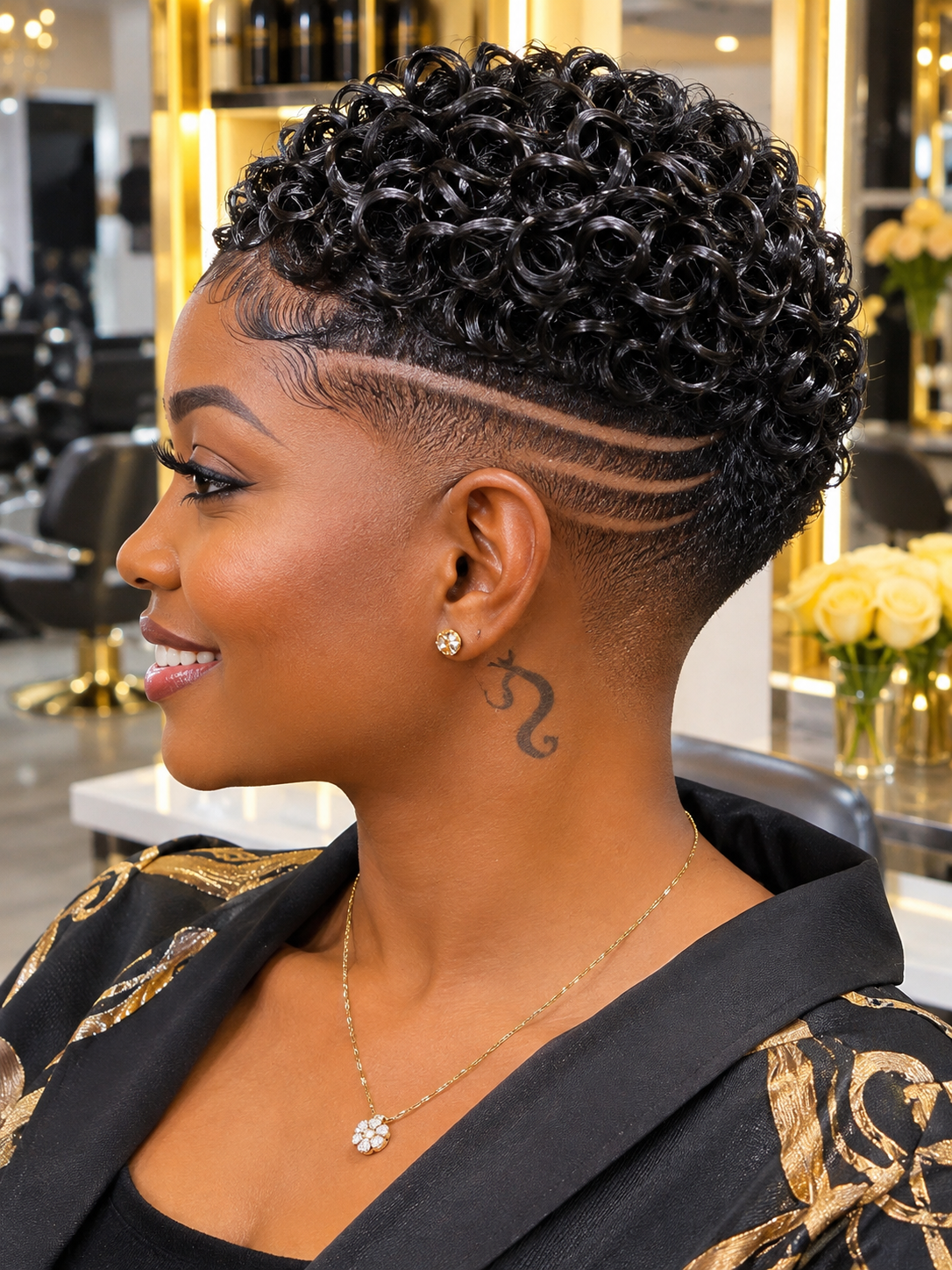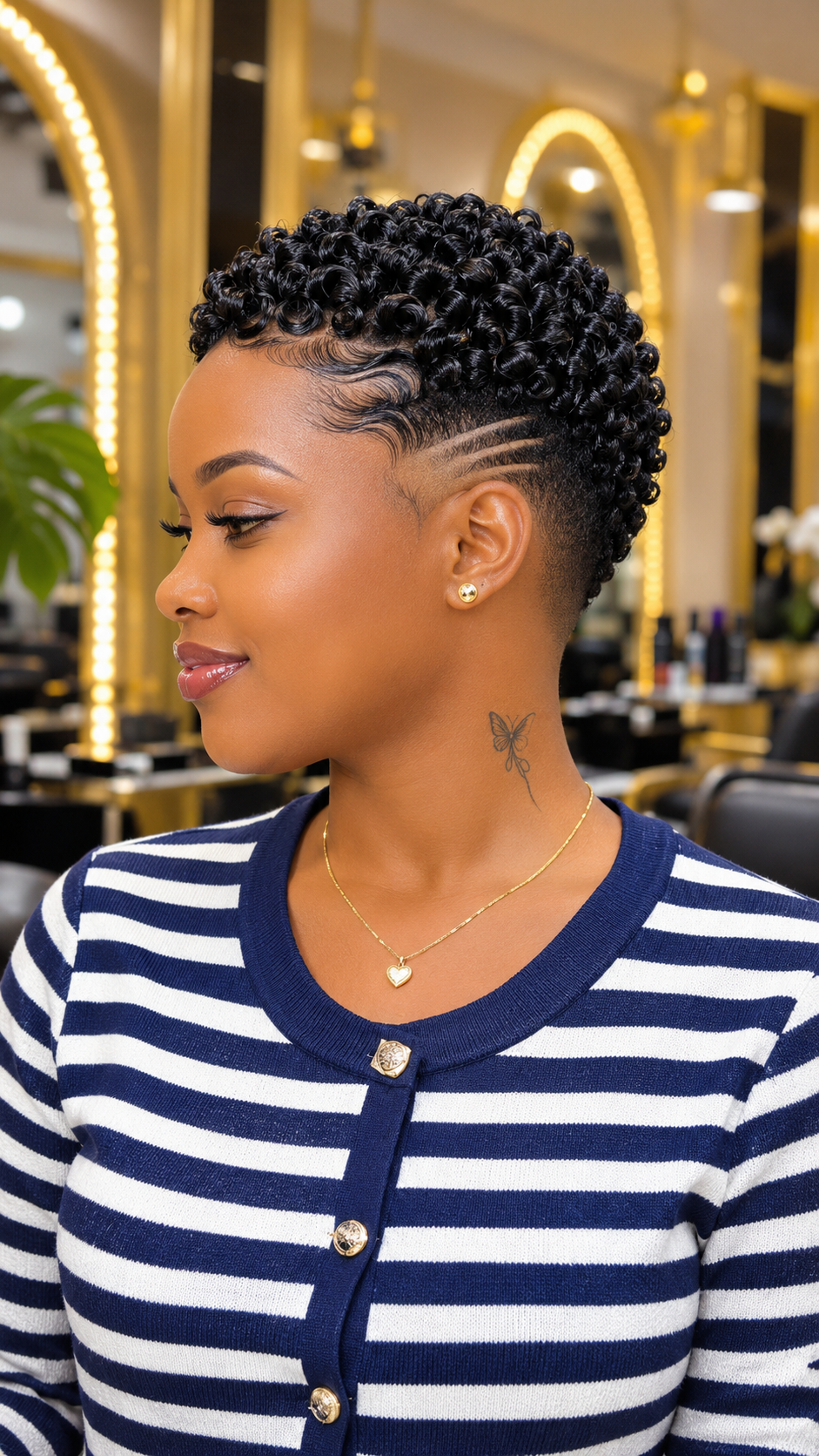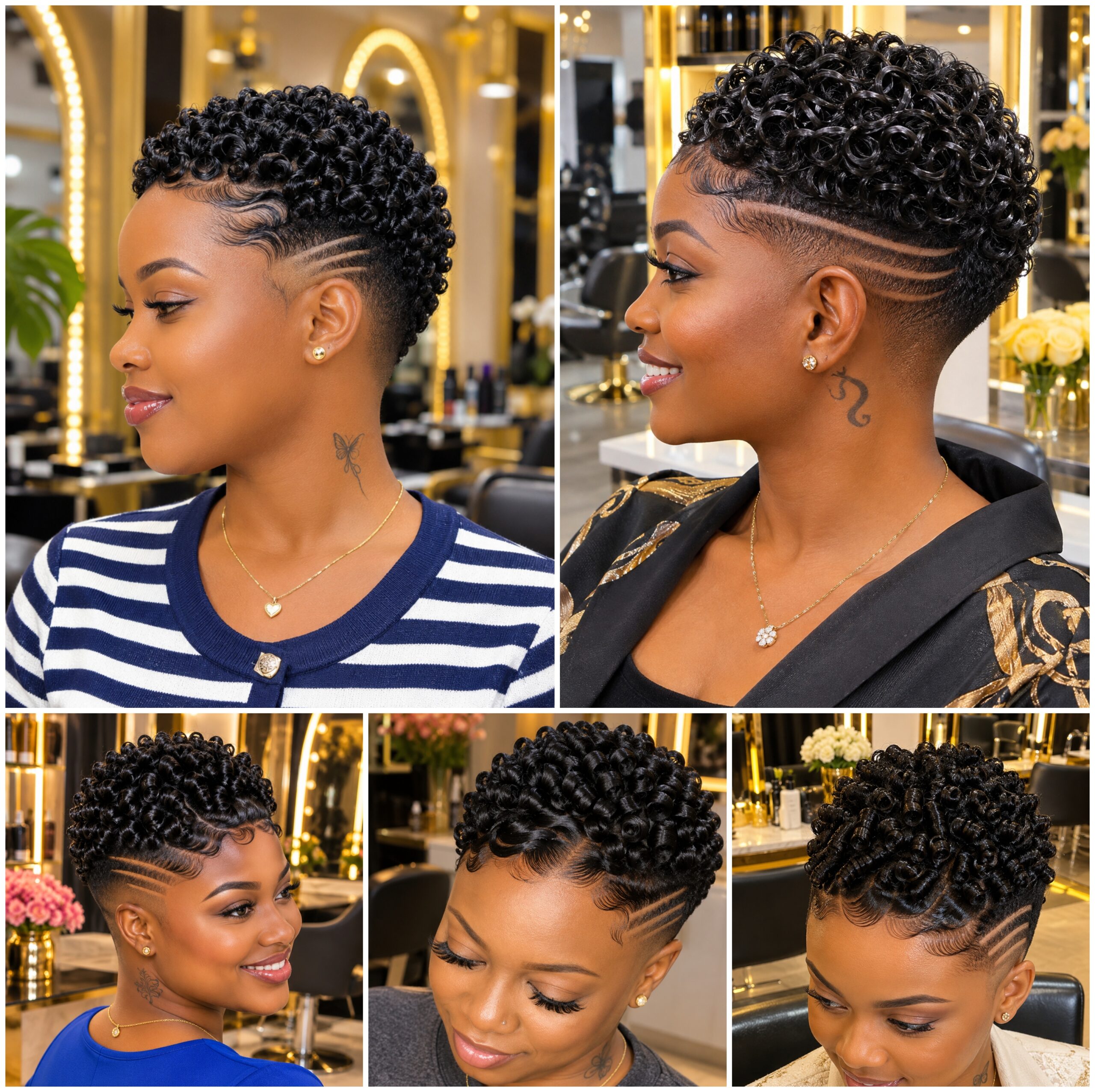
Short coily pixies with sleek wave fronts bring together two beautiful approaches to short hairstyling: a full crown of closely arranged curls and a carefully sculpted hairline that lies close to the forehead. The combination creates an attractive contrast between rounded volume and flowing movement, making it an appealing choice for women who enjoy short hairstyles with distinctive finishing details.
The beauty of this hairstyle comes from its proportions. The upper section contains compact coils that create fullness without requiring long hair, while the frontal section features delicate waves arranged in soft, sweeping directions. Instead of allowing the curls to cover the entire forehead, the stylist creates a more controlled hairline that frames the face and emphasizes the shape of the pixie.
For African women who appreciate short, practical hairstyles, this combination offers an opportunity to enjoy curly volume alongside carefully finished edges. It can be explored as a natural-hair salon style or recreated through a customized short curly wig, depending on hair length, texture, preferences, and the desired installation method.


The hairstyle can be interpreted in several ways. Some versions feature very small finger coils, while others use slightly larger spiral ringlets. The front may contain broad S-shaped waves, fine sweeping strands, or softly curved baby hairs. A tapered side can help emphasize the crown, although the amount of tapering should suit the individual design.
What matters most is maintaining the relationship between the curly upper section and the flatter frontal waves. When these elements complement one another, the finished hairstyle feels balanced, expressive, and elegant without depending on excessive length or elaborate accessories.
The Appeal of Compact Coils and Sweeping Hairlines
The most distinctive characteristic of this hairstyle is the difference between the crown and the forehead. The upper curls create a rounded, raised surface, while the front is arranged into smooth-looking waves that follow the contour of the hairline.
This contrast allows each section to contribute something different. The coils bring fullness and movement, while the frontal waves provide a more deliberate decorative effect.
Short pixies are especially suitable for this type of styling because the limited length keeps the curls relatively close to the head. The overall silhouette can remain compact even when the crown contains numerous individual coils.
The frontal waves also create an attractive transition between the hair and the face. Their direction can be adjusted to complement the forehead, temples, and preferred side of the hairstyle.
Women who enjoy intricate styling may prefer a more elaborate arrangement of overlapping curves. Those who appreciate simpler looks can choose a smaller number of softly sweeping waves.
Neither approach requires the hairstyle to become excessively complicated. The best result comes from selecting a clear visual direction and maintaining it throughout the styling process.
Choosing the Right Coil Pattern
Not every coily pixie has the same curl pattern. Some styles contain tiny, tightly wound spirals, while others use more open circular curls that create a softer appearance.
The size of the coils influences the overall silhouette. Very small curls can create a densely packed crown, while larger ringlets may appear more separated and sculptural.
For women who prefer a compact hairstyle with noticeable curl detail, medium-small spirals can offer an attractive balance. They provide visible curl formations without creating excessive height.
Natural hair texture also influences the available styling options. Coily hair may respond well to finger-coiling techniques, but the finished result depends on moisture, length, density, products, and the stylist’s method.
For wigs, the curl pattern may be manufactured into the fibers or professionally set after the unit has been constructed.
Before ordering a wig, ask how the curls were created and whether they will retain their appearance after cleaning.
This information is particularly important when the hairstyle depends on numerous individually arranged coils.
Creating a Beautifully Rounded Pixie Crown
A rounded crown gives the hairstyle its recognizable pixie silhouette. The curls are concentrated across the upper portion of the head, while the lower sections can remain comparatively compact.
The crown should have enough fullness to display the curl pattern without becoming unnecessarily bulky.
For natural hair, a stylist may shape the haircut before creating the coils. This establishes the foundation for the finished silhouette.
Hair around the temples and nape may be trimmed more closely, allowing the curls above to become the main attraction.
For a wig, the maker must consider cap shape, hair density, strand length, and curl placement.
Excessive density can make individual coils difficult to distinguish, while insufficient density may create gaps across the crown.
A carefully balanced arrangement produces a rounded surface that feels full but remains proportionate to the wearer’s head.
Photographs from the front, sides, and rear are useful when assessing the finished shape.
The Elegance of Sleek Forehead Waves
The frontal waves provide a beautiful finishing element because they contrast with the raised curls above.
Instead of forming upright spirals, the hair near the forehead is arranged into flatter, flowing shapes.
These curves may travel from one side of the hairline toward the other, creating a soft sweeping movement.
Some versions feature broad S-shaped formations, while others contain smaller curved strands that follow the forehead more closely.
The wave pattern should complement the upper coils rather than compete with them.
Heavy frontal styling can make a short pixie appear crowded. Delicate waves often create a more balanced result because the crown already contains considerable visual detail.
For natural hair, the stylist may use appropriate setting products and controlled brushing techniques to arrange the waves.
For wigs, the process depends on whether the hair is human hair or synthetic fiber and how the frontal section has been constructed.
Soft Baby Hairs and the Finished Hairline
Baby hairs can contribute to the hairstyle’s appearance when they are arranged carefully and proportionately.
Fine strands near the forehead may be guided into delicate curves that complement the broader frontal waves.
These smaller details can soften the transition between the hairline and the skin.
However, baby hairs are not necessary for every variation. Some women prefer a more understated frontal arrangement with fewer decorative strands.
For natural hair, avoid placing excessive tension on delicate edges. Repeated pulling and aggressive styling can place unnecessary stress on the hairline.
For lace-front wigs, the stylist should arrange the frontal strands without damaging the lace foundation.
The goal is to create an attractive hairline that remains comfortable and appropriate for regular wear.
Black Coily Pixies for a Classic Look
Black is a popular color choice for short coily hairstyles because it emphasizes the relationship between curls, waves, and shadow.
Natural black offers a rich appearance that complements many skin tones and clothing colors.
Jet black can create a deeper, more dramatic effect, particularly when the curls have a reflective finish.
Under daylight, the curved surfaces of the coils may catch small highlights that make the curl pattern easier to distinguish.
The frontal waves can also reflect light along their flowing direction, giving them a polished appearance.
Women who prefer understated hairstyles may appreciate an entirely black pixie because its visual interest comes from the styling rather than contrasting colors.
For wig orders, confirm the exact shade before purchasing. Manufacturers may use different descriptions for natural black, off-black, and jet black.
Brown and Burgundy Color Options
Warm brown shades can create a softer interpretation of the hairstyle.
Chocolate brown, coffee brown, and chestnut tones may highlight the individual curls while maintaining a natural-looking overall appearance.
Burgundy provides another option for women who want a richer color statement.
A deep burgundy crown paired with darker sides can emphasize the contrast between the upper coils and the flatter lower sections.
Color placement should be planned carefully. Excessive variation may distract from the frontal wave pattern.
For natural hair, professional coloring should take into account the condition of the hair and any previous chemical treatments.
For wigs, determine whether the fibers can be colored safely. Most conventional synthetic fibers cannot be treated like human hair with standard permanent dyes.
Choose the color based on personal preference, maintenance expectations, and the intended appearance of the curls.
Blonde Coils with Darker Roots
Golden blonde, honey blonde, and caramel shades can create an attractive contrast when paired with darker roots.
The lighter curls draw attention toward the crown, while the darker frontal and side sections provide visual depth.
This arrangement may be particularly effective when the upper curls are raised and the forehead waves remain close to the hairline.
For women who prefer a more subtle combination, caramel highlights can be distributed through selected curls instead of covering the entire crown.
Platinum and pearl blonde offer a brighter appearance but may require different maintenance considerations.
For human hair, repeated bleaching and coloring can affect strand condition, so a professional assessment is advisable.
When buying a wig, request photographs showing the actual highlight placement in neutral lighting.
The chosen color should complement the hairstyle without obscuring the small curl formations.
Tapered Sides and Short Nape Styling
A closely styled lower section can make the crown appear fuller while preserving the compact pixie shape.
The sides may be softly tapered or cut more closely depending on the desired silhouette.
A gradual taper creates a gentle transition between the curls and the lower hair.
A more pronounced taper introduces stronger contrast, making the upper coils appear more elevated.
The nape should also be considered because it influences the shape from behind.
For natural hair, a barber or hairstylist can recommend an appropriate taper based on hair density, growth direction, and head shape.
For wigs, the maker should ensure that the lower hair covers the foundation appropriately while maintaining the intended short appearance.
A tapered design should not expose cap materials or compromise the structure of the hairpiece.
Decorative Temple Lines as an Optional Accent
Some women enjoy adding decorative temple lines to coily pixie hairstyles.
These accents may consist of one narrow diagonal line, paired curves, or a small group of closely arranged channels.
They can introduce a barber-inspired appearance that contrasts with the rounded curls above.
However, temple lines are optional. A hairstyle with a plain tapered side can be equally attractive.
For natural hair, the design should be created by someone experienced in precision cutting.
For wigs, the stylist must consider the cap construction before making any alterations.
Cutting directly into a finished wig without understanding its foundation may expose the cap or damage the hairpiece.
Custom orders should specify whether temple accents are wanted and how they should be positioned.
Where To Get This Hairstyle Done
A professional salon specializing in short natural hairstyles, finger coils, and sculpted frontal waves is a suitable place to begin.
Women who want tapered sides may benefit from a salon with experienced barbering services.
Before booking, share reference photographs showing the preferred coil size, crown shape, and frontal wave arrangement.
Explain whether the hairstyle should be recreated using natural hair or a customized wig.
For natural hair, ask the stylist to evaluate the current length and condition before confirming that the desired result is achievable.
For wigs, select a professional familiar with short lace-front styling and detailed hairline work.
Ask whether the salon offers curl setting, wig customization, installation, and maintenance appointments.
Booking methods vary by business, but many salons accept appointments through telephone calls, messaging applications, social media pages, or online booking systems.
Confirm the appointment duration, estimated price, and services included before visiting.
Where To Buy Similar Coily Pixie Wigs
Specialized wig boutiques, professional beauty supply stores, independent wig makers, and online hair retailers are useful places to search for comparable hairstyles.
Product descriptions may include short coily pixie wig, finger coil lace-front wig, sculpted curly pixie hairpiece, and short curly wig with frontal waves.
When comparing products, examine the actual curl pattern and hairline arrangement.
Some wigs advertised as curly pixies contain loose ringlets rather than compact coils.
Others may have suitable curls but lack the flatter frontal section needed for sculpted waves.
Ready-made wigs can be convenient when the available design closely resembles the desired appearance.
Custom production may be preferable when the exact coil size, front waves, color placement, and side proportions are important.
Before ordering, request recent product photographs and confirm the hair material, cap size, lace construction, and return conditions.
Find Out Where To Buy This
Women who want a customized version should begin by contacting wig makers with experience in short curly hairstyles and precision frontal styling.
Send clear reference photographs that show the desired crown, hairline, and side profile.
Specify the preferred curl size, overall color, and finished hairstyle height.
Explain whether the frontal waves should be broad and dramatic or soft and delicate.
Discuss the desired cap construction and whether the wig should support glueless installation.
Ask the maker to explain which hair materials are suitable for the proposed curl pattern.
Before approving the order, request images showing the front, both sides, rear, crown, and interior cap.
Confirm the full price, production terms, shipping arrangements, and any available adjustment policy.
Clear communication can help reduce misunderstandings and make the final result more consistent with the chosen reference.
Choosing Between Human Hair and Synthetic Fibers
Human-hair wigs may provide flexibility for professional washing, curling, and selected styling changes.
However, intricate coil patterns may need resetting after cleaning, depending on how they were created.
Some synthetic wigs are manufactured with permanent-looking curls that retain their shape after appropriate washing.
These units can appeal to women who prefer more consistent styling without frequent professional resetting.
Nevertheless, synthetic fibers differ in quality, heat tolerance, and product compatibility.
For women who want to change colors or restyle the hair frequently, suitable human-hair options may offer greater flexibility.
For those who prefer a stable curl pattern, a high-quality synthetic unit may be worth considering.
Ask the supplier for specific care instructions rather than assuming that all wigs can be maintained in the same way.
Glueless Wigs for Convenient Daily Wear
Glueless wigs can be appealing to women who prefer to install and remove their hairpieces without using adhesive products.
However, a wig should be specifically constructed for secure adhesive-free wear.
Correct cap sizing and suitable securing components are essential.
Some units include adjustable straps, elastic bands, internal combs, or other attachment features.
The presence of an adjustable strap alone does not necessarily mean a wig will remain secure without adhesive.
Ask the seller to confirm whether the specific model supports glueless wear and how it should be fitted.
The frontal waves should remain correctly positioned when the wig is installed.
A secure, comfortable fit is particularly important for short hairstyles because movement around the hairline may be more noticeable.
Closure and Frontal Construction Options
Closure and frontal wigs offer different approaches to lace placement and styling flexibility.
A closure generally provides a smaller lace area, while a frontal extends across a wider portion of the front hairline.
For hairstyles with elaborate frontal waves, the available lace area can influence how the hair is arranged.
Some designs may benefit from a frontal construction, particularly when the waves extend toward the temples.
Other variations can be created using smaller lace areas or specialized cap designs.
The most appropriate option depends on the finished hairstyle, hairline requirements, and intended installation method.
HD lace should not be assumed simply because a product photograph appears to show fine mesh.
Ask the supplier to confirm the actual material, lace dimensions, and available colors.
Finding the Right Cap Size
Cap sizing is an important consideration for short curly wigs because the hairstyle depends on the front waves and side sections remaining in their intended positions.
A cap that is too large may shift during wear, affecting the hairline.
A cap that is too small may create uncomfortable pressure around the forehead and temples.
Measure the head according to the supplier’s instructions and compare the results with the available size chart.
Ask whether the cap includes adjustable components and how much adjustment is possible.
For custom production, accurate measurements can help the maker position the hairline and crown more appropriately.
Comfort should remain a priority, especially for women planning to wear the wig for extended periods.
Understanding Hair Length and Density
Hair length can be difficult to judge once strands have been shaped into compact coils.
Short-looking curls may require noticeably longer strands before styling.
The finished length therefore depends on the curl diameter and setting method.
For wig orders, ask about the completed crown height rather than relying solely on the uncurled hair length.
Density also influences the overall appearance.
A full crown requires enough hair to create closely grouped curls, but excessive density may make the hairstyle bulky.
The frontal waves generally benefit from a more controlled arrangement so that the individual strands remain visible.
A professional maker should recommend suitable density based on the intended curl pattern and finished silhouette.
Illustrative Price Ranges for Short Coily Pixie Wigs
The price of a short curly wig depends on the hair material, cap construction, curl-setting method, lace specifications, and degree of customization.
The following US dollar amounts are illustrative budgeting estimates, not verified current retail quotations.
| Wig Tier | Illustrative Price Range | Possible Features |
|---|---|---|
| Budget | $35–$110 | Basic synthetic short curly wigs with standard cap construction and simplified frontal styling. |
| Value | $90–$220 | Higher-grade synthetic pixie wigs with compact coils and selected wave-front detailing. |
| Mid | $175–$400 | Selected human-hair or premium alternative wigs with professional curl setting and partial hairline customization. |
| Premium | $350–$800 | Custom coily crowns, carefully arranged frontal waves, selected lace construction, and individual fitting adjustments. |
| Salon-Grade | $650–$1,350+ | Specialist custom construction with detailed curl placement, precision hairline styling, individual measurements, and professional fitting preparation. |
Actual prices can vary significantly according to the seller, location, hair material, and included services.
Shipping, professional installation, coloring, and maintenance may involve additional charges.
Request a detailed quotation before committing to a custom order.
Preparing Natural Hair Before Styling
Healthy preparation helps create a suitable foundation for short coily hairstyles.
Before the appointment, the stylist may recommend washing and conditioning based on the current condition of the hair.
Detangling should be performed gently to minimize unnecessary breakage.
For natural-hair pixies, the haircut may need shaping before the coils and frontal waves are created.
The stylist should consider the direction of growth, hair density, and desired side proportions.
If decorative temple lines are requested, their placement should be planned before cutting.
Women with sensitive scalps or fragile edges should communicate these concerns before styling.
The aim is to achieve the desired appearance without placing excessive tension on the hair or scalp.
Preparing a Wig for Installation
Before installing a short coily wig, inspect the cap, lace, curl pattern, and frontal waves.
Check that the hairpiece fits correctly and that the hairline is positioned naturally.
If the wig includes excess lace, it should be trimmed only after the unit has been aligned.
Premature trimming can affect the final fit, particularly when the front waves extend close to the lace edge.
Handle the curls gently during installation to avoid disturbing their shapes.
For adhesive installations, follow the manufacturer’s recommended application and removal procedures.
For glueless units, confirm that the cap remains secure without excessive pressure.
Before leaving the salon, ask how the frontal waves should be maintained between appointments.
Maintaining the Coily Crown
Compact curls require gentle care because their appearance depends on retaining the individual coil formations.
Aggressive brushing can separate the strands and create unwanted frizz.
Before washing a wig, determine whether the curls are manufactured into the fibers or professionally set afterward.
Human-hair curls may require resetting depending on their styling method.
Some synthetic curls may retain their original pattern after suitable cleaning.
Use products recommended for the specific hair material.
Excessive styling product can create buildup and make the curls appear heavy.
For natural hair, maintain appropriate moisture and avoid repeatedly manipulating the same sections.
The best routine is one that preserves the curls while supporting healthy hair and scalp care.
Keeping the Frontal Waves Neat
The forehead waves require particular attention because their appearance depends on the direction and alignment of fine strands.
Repeated rubbing or heavy-handed styling may disturb their curves.
For natural hair, a stylist can recommend suitable techniques for gently refreshing the waves.
For wigs, the appropriate method depends on the fiber material and how the front was styled.
Avoid applying excessive amounts of gel or other products, particularly near delicate lace.
Product buildup may make the waves appear stiff and can complicate cleaning.
If the original arrangement becomes difficult to restore, a professional maintenance appointment may be preferable to repeated experimentation.
Maintaining the frontal waves helps preserve the hairstyle’s contrast between raised curls and flatter decorative sections.
Protecting the Hairline During Regular Wear
The natural hairline deserves careful attention whether the hairstyle is worn directly on natural hair or through a wig.
Repeated tension, aggressive brushing, and unsuitable adhesive removal can irritate or damage delicate edges.
A wig should fit comfortably without pulling the natural hairline.
When adhesive products are used, follow the manufacturer’s instructions and remove them gently.
For natural hairstyles, avoid repeatedly forcing the same fine strands into tight arrangements.
Women experiencing irritation or discomfort should stop the aggravating styling practice and seek appropriate professional advice.
A beautiful hairstyle should remain comfortable and should not require unnecessary stress on the scalp.
Storing a Short Curly Wig Correctly
Proper storage can help preserve the rounded crown and carefully arranged frontal waves.
A suitable wig stand may provide support without unnecessarily stretching the cap.
Avoid placing heavy objects on the curled sections.
For travel, choose protective packaging that minimizes friction and compression.
Keep the wig away from unsuitable heat and environmental conditions identified by the manufacturer.
After cleaning, allow the unit to dry according to the supplier’s instructions before storing it.
Before the next installation, inspect the curls and hairline for sections requiring attention.
These simple precautions can reduce unnecessary handling and help maintain the intended hairstyle.
Daily Styling for Work and Casual Outfits
The compact silhouette can make this hairstyle attractive for everyday wear.
Short curls do not extend around the shoulders, and the shaped crown provides a finished appearance without requiring long lengths.
For work settings, a black or dark-brown version can offer an understated, coordinated look.
For casual outfits, warmer colors or slightly fuller coils may create a more expressive appearance.
The frontal waves add detail that can make the hairstyle feel intentionally styled even when the overall length remains short.
However, the amount of daily maintenance depends on the curl-setting technique and whether the style is worn as natural hair or a wig.
Women seeking a quick morning routine should discuss realistic upkeep with their stylist before choosing a highly sculpted version.
Jewelry and Fashion Pairings
Short coily pixies can complement a wide range of jewelry and clothing styles.
Because the hair remains relatively compact, earrings may become more noticeable.
Small gold hoops, pearl studs, and simple silver earrings can complement the hairstyle without distracting from the frontal waves.
Black hairstyles pair beautifully with white, cream, beige, and colorful fabrics.
Warm brown or blonde versions can complement chocolate, caramel, and earthy clothing tones.
African print dresses and tailored outfits can provide an expressive fashion combination.
The curls already introduce considerable visual detail, so additional hair accessories are optional.
For women who prefer a minimalist appearance, simple jewelry may be all that is needed.
Advantages of This Short Hairstyle
One important advantage is the combination of compact length and visible crown volume.
The coily upper section creates fullness while the frontal waves add an elegant finishing element.
The hairstyle can be adapted to different colors, curl sizes, and side proportions.
It can also be recreated through natural-hair styling or customized wigs, offering options for women with different preferences.
The short silhouette may be convenient for those who dislike long hair around the neck and shoulders.
Another advantage is the ability to introduce personality through small details rather than dramatic length changes.
Carefully arranged forehead waves can make even a simple black pixie look distinctive.
Potential Limitations to Consider
Although the hairstyle is short, elaborate coils and frontal waves may require professional styling and ongoing maintenance.
Some curl-setting techniques need refreshing after washing.
Detailed frontal arrangements may become disturbed by friction, humidity, or repeated handling.
For wigs, intricate customization can increase the purchase price.
For natural hair, achieving a particular coil size depends on the existing texture, length, and condition.
Not every hairstyle can be reproduced identically on every person without extensions or other adjustments.
Discuss these considerations with a professional before committing to the design.
Choosing a version that suits the wearer’s routine is more practical than selecting an elaborate style without considering its maintenance requirements.
How to Communicate the Desired Style to a Hairdresser
Clear reference photographs are one of the most useful tools when requesting a short coily hairstyle.
Choose images showing the preferred curl pattern, frontal waves, side profile, and rear silhouette.
Explain whether the curls should appear small and tightly grouped or slightly larger and more separated.
Describe the desired crown height and how closely the lower sides should be styled.
Specify the direction of the forehead waves and whether decorative temple accents are wanted.
If the hairstyle involves a wig, discuss cap measurements, lace type, and installation preferences.
Ask the stylist to explain which parts of the reference can be reproduced and whether modifications may be necessary.
This preparation helps establish realistic expectations before styling begins.
A Beautiful Balance of Coils and Frontal Artistry
The appeal of this short hairstyle lies in its carefully balanced contrast. Compact coils create fullness across the crown, while gracefully arranged frontal waves introduce softness and direction near the forehead.
The result can be understated or expressive depending on the chosen curl size, color, and side styling. Rich black versions emphasize the intricate curl pattern, while warm brown, blonde, and burgundy variations offer additional color possibilities.
For women who prefer natural hair, professional shaping and curl setting can help achieve an attractive short silhouette. For those seeking flexibility, a customized wig may provide an alternative that does not require changing their current haircut.
Before ordering or booking a salon appointment, it is important to consider the desired curl pattern, hairline design, construction, fit, and maintenance requirements.
A successful result does not depend on excessive volume or complicated additions. It comes from maintaining a harmonious relationship between the rounded crown and the softly sculpted front.
With suitable professional styling and appropriate care, this elegant combination of coily curls and flowing forehead waves can provide a memorable short hairstyle that celebrates confidence, individuality, and beautifully crafted hair.
Search Terms
Short coily pixies with sleek wave fronts · Black finger coil pixie with swooped edges · Short spiral curl wig with sculpted forehead waves · Tapered coily pixie with S shaped front waves · Burgundy short coil pixie with styled baby hairs · Honey blonde coily crown with dark wave front · Lace front coily pixie with sweeping hairline · Compact finger coil haircut with sleek frontal waves