
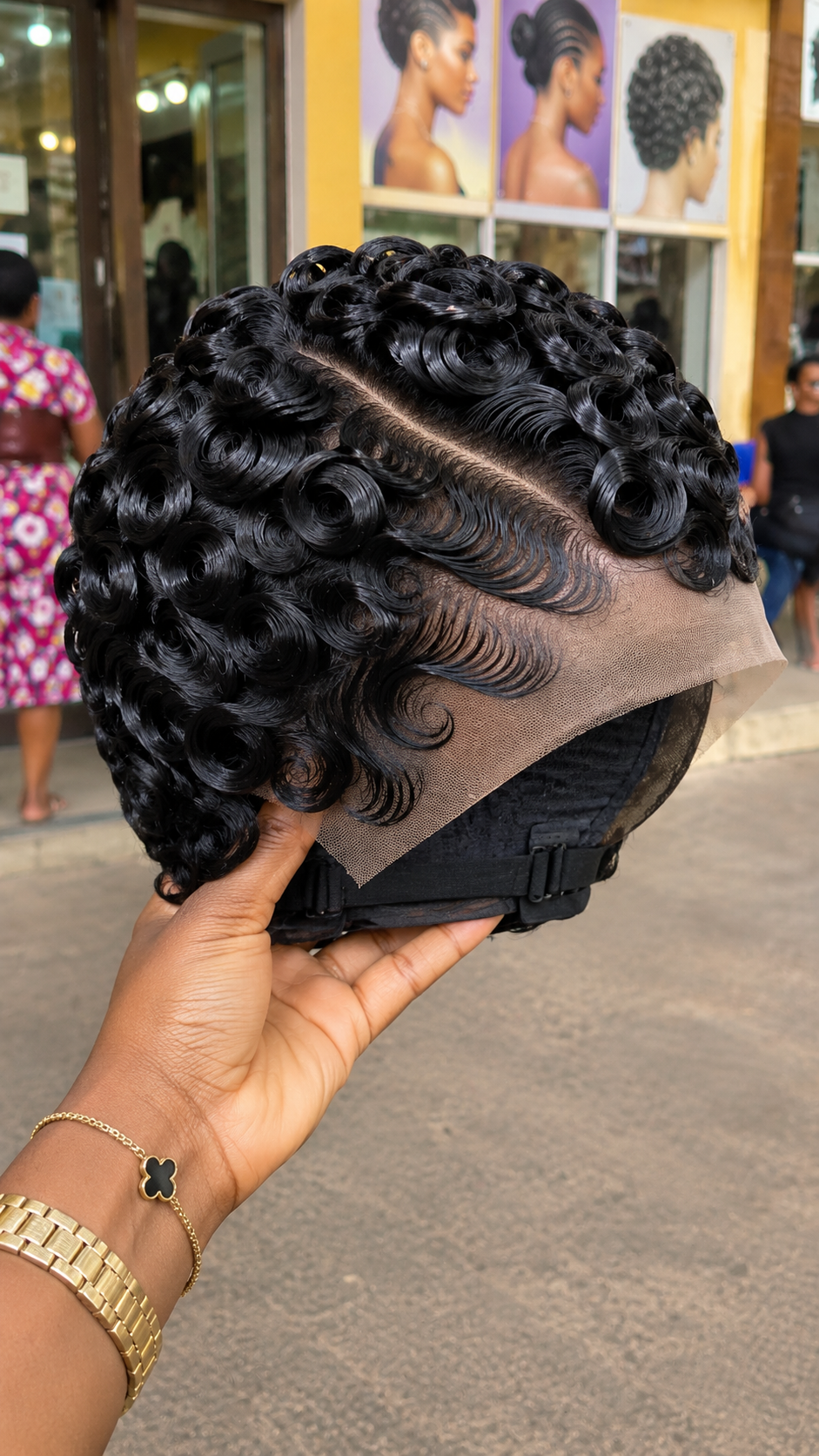
A beautifully crafted short hairstyle can create a remarkable impression without relying on dramatic colors or long extensions. This luxurious black pixie wig combines an abundant collection of glossy ringlets with graceful finger waves and an elegant diagonal side part. The result is a richly detailed hairstyle that celebrates the artistry of precision curl setting while maintaining the convenient proportions of a short pixie. Its rounded crown, carefully arranged forehead waves, and softly curled temple accents give it an expressive appearance that is both feminine and distinctive.
The wig is photographed outside a neighborhood African beauty salon, supported in one hand to reveal its elaborate styling and part of its interior construction. The crown features numerous circular black ringlets, each formed from carefully arranged strands that curl inward into recognizable loops. Some ringlets are relatively large, with open centers, while smaller curls fill the spaces between them. A prominent diagonal part separates sections of the upper hair and introduces a flowing finger-wave arrangement across the front and visible side.
The photograph also reveals a broad section of beige-toned lace extending beyond the styled hairline. Fine black strands sweep across this mesh area, forming beautiful curved patterns that complement the circular curls above. Beneath the wig, the dark cap construction and an adjustable fastening strap are visible. These details provide a useful glimpse of the unit before its final fitting and installation.


For women interested in short black curly wigs, this design offers a striking alternative to ordinary loose curls. The carefully rolled ringlets create fullness across the crown, while the flatter finger waves introduce movement and contrast. The hairstyle may appeal to women seeking a sophisticated short hairpiece for celebrations, professional portraits, social occasions, or everyday wear when they are comfortable caring for structured curls.
The Beauty of a Crown Filled with Circular Ringlets
The upper crown is the most prominent feature of this hairstyle. Numerous circular curls cover the hairpiece from the upper front toward the visible side and rear, creating a rounded silhouette with substantial fullness.
Each ringlet is made from closely aligned black strands that form a circular opening. The outer surfaces catch the light, while the interior portions remain darker, giving the hairstyle remarkable visual depth.
Unlike naturally falling spiral curls, these formations appear deliberately rolled and arranged. Their carefully positioned shapes produce an ornamental effect similar to miniature hair rosettes.
The ringlets vary slightly in size and orientation. Larger curls provide the main visual structure, while smaller formations fill the surrounding spaces and help maintain consistent coverage.
This variation prevents the crown from appearing excessively uniform. Instead, the hairstyle has a rich, layered quality that rewards close attention.
When commissioning a similar wig, customers should request sculpted circular ringlets rather than ordinary loose curls. This distinction is important because the two styles require different preparation and setting techniques.
Deep Black Hair Creates an Elegant Monochromatic Finish
The hair appears consistently black throughout the crown and lower sections. Natural daylight creates reflective highlights along the individual strands, revealing subtle charcoal tones without introducing a separate color.
This monochromatic appearance allows the intricate curl arrangement to become the primary attraction.
The raised ringlets reflect light differently depending on their direction. Their outer curves appear brighter, while the recessed areas between them remain dark.
The resulting contrast emphasizes the circular construction of each curl without requiring blonde or copper highlights.
Customers seeking a similar appearance should compare natural-black and jet-black color samples before purchasing. Different manufacturers may describe closely related shades using different names.
For the closest resemblance to the photograph, the wig should maintain a deep, consistent black color with natural-looking reflective shine.
Large Ringlets Create Dimension Across the Upper Hair
Several curls near the crown feature relatively broad circular openings. These larger formations attract attention because their rounded shapes remain clearly visible against the surrounding hair.
They are not stretched into long hanging spirals. Instead, their ends turn inward, creating compact rolled loops that sit close to the head.
The broader curls give the upper hair a decorative appearance and help establish the hairstyle’s rounded shape.
When arranging a similar wig, a stylist should consider the relationship between curl diameter and crown coverage.
Very large curls could make the hairstyle appear bulky, while extremely small curls might change the intended visual pattern.
A balanced mixture of medium and larger ringlets preserves the distinctive appearance shown in the photograph.
Smaller Curls Complete the Rounded Silhouette
Between the prominent circular ringlets, smaller curls occupy the remaining spaces. These formations help maintain the fullness of the crown without creating an excessively crowded surface.
They also contribute to the gradual transition toward the lower side and back.
As the hairstyle approaches the lower perimeter, the curls become more compact and follow the foundation closely.
This arrangement helps maintain the proportions of a short pixie.
A professional should avoid adding unnecessary length to the lower sections because it could alter the rounded silhouette.
The hairstyle depends on the relationship between the fuller upper crown and the compact lower hair.
The Diagonal Side Part Creates a Graceful Division
A prominent diagonal parting travels across the upper front section, separating groups of circular curls from the carefully arranged waves beneath them.
The exposed line follows a slightly curved direction rather than an entirely straight path.
This creates an elegant separation between the two principal styling techniques.
On one side of the part, the hair rises into sculpted ringlets. On the other, strands are guided into flowing finger-wave formations.
The parting also helps establish the direction of the curls around it.
For custom production, the stylist should position this division before completing the upper styling. Moving it afterward could disturb the surrounding curls and change the appearance of the front.
Flowing Finger Waves Bring a Classic Salon Influence
The flatter hair beneath the diagonal part is arranged into graceful curved waves. These strands travel across the forehead area and toward the temple, forming elegant S-shaped patterns.
Their flowing movement creates a beautiful contrast with the rounded ringlets above.
Where the crown contains raised circular formations, the finger waves remain close to the foundation.
This difference in height gives the hairstyle a carefully layered appearance.
The waves also introduce an element associated with traditional professional hair styling. Their controlled strand direction is particularly attractive when combined with short sculpted curls.
Women who enjoy vintage-inspired hairstyles may appreciate this combination, even though the overall wig has a contemporary pixie silhouette.
Fine Hairline Strands Enhance the Front
Along the forehead, delicate black strands curve into the wider finger-wave arrangement. These fine hairs create a gradual transition from the lace foundation to the fuller hairstyle.
Several strands follow parallel paths, producing an attractive flowing pattern.
Their placement appears intentional rather than randomly arranged.
This is an important consideration during installation because trimming the lace too aggressively could disturb the decorative hairline.
A professional should first establish the correct wearing position and then determine where the excess lace should be removed.
The fine strands should be preserved wherever possible to maintain the intended appearance.
The Temple Curls Add a Delicate Finishing Detail
Near the visible temple, several strands curve inward into smaller decorative loops. These accents connect visually with the longer finger waves and circular crown curls.
Some ends form compact spirals, while others extend into sweeping curved shapes.
The arrangement softens the transition between the front and side sections.
These details are relatively small, but they contribute significantly to the hairstyle’s finished appearance.
When restoring or installing the wig, the stylist should avoid repositioning them into unrelated patterns.
Preserving the original direction of the temple curls helps maintain consistency throughout the design.
The Side Ringlets Create Additional Fullness
The visible side contains numerous circular curls that continue from the crown toward the lower perimeter.
Some of these curls are smaller than those near the top, helping the hairstyle follow the rounded shape of the foundation.
The curls overlap slightly without losing their individual circular forms.
This produces fullness while maintaining separation between neighboring sections.
The side therefore looks richly styled without requiring long strands that extend toward the shoulders.
A similar wig should preserve this compact curl arrangement instead of introducing oversized loose spirals around the lower edge.
The Short Silhouette Maintains Beautiful Proportions
Although the hairstyle contains numerous sculpted curls, its overall length remains short.
The crown creates volume through the raised ringlets, while the lower sections follow the foundation more closely.
This balance gives the wig a recognizable pixie-inspired shape.
The rounded outline also complements the elaborate finger-wave details along the front.
Excessive height could make the hairstyle appear unnecessarily bulky, while reducing the crown too much would diminish its ornamental character.
For custom orders, customers should emphasize the compact silhouette rather than focusing exclusively on the volume of the upper hair.
The Lower Hair Completes the Curly Shape
At the visible lower side, smaller curls continue toward the base of the hairpiece. Their compact arrangement gives the hairstyle a neat finish.
The lower curls maintain the deep black shade of the crown and contribute to the overall rounded appearance.
The photograph does not provide a complete direct view of the nape, so the exact rear finish cannot be established with certainty.
Customers requesting a faithful recreation should ask the supplier for a back photograph before approving the finished wig.
This helps confirm that the lower curls and nape match the intended short hairstyle.
How the Wig Combines Different Curling Techniques
The hairstyle brings together two visually distinct approaches to hair arrangement.
The circular crown ringlets emphasize rounded, three-dimensional forms. The forehead finger waves emphasize smooth directional movement.
Combining these techniques creates contrast without requiring multiple hair colors.
The diagonal part acts as a boundary between the sections, allowing each technique to remain recognizable.
Successful styling depends on maintaining this relationship.
If the finger waves become too bulky, they may compete with the ringlets. If the circular curls are flattened, the crown may lose its decorative appearance.
Professional attention to both areas helps preserve the intended balance.
Understanding the Visible Lace Construction
The front of the wig contains beige-toned lace extending beyond the styled hairline.
This excess mesh provides room for positioning and final preparation before installation.
The lace remains untrimmed in the photograph, making the front foundation clearly visible.
However, the image does not verify the commercial lace grade. It would therefore be inappropriate to identify the material as HD lace without confirmation from the seller.
Buyers should ask about the lace type, color options, coverage area, and recommended installation method.
These details influence the final appearance and should be considered before purchasing.
The Interior Cap Includes Adjustable Components
The photograph reveals part of a dark interior foundation and an adjustable fastening strap beneath the lace.
These elements help illustrate how the wig is constructed before being placed on the head.
However, the complete fastening arrangement is not visible.
The presence of an adjustable strap does not independently establish that the hairpiece is designed for fully adhesive-free installation.
Customers should request an underside photograph showing the cap, adjustment features, elastic sections, and any included combs.
Understanding the internal construction can help buyers select a wig that suits their comfort and installation preferences.
Choosing Between Lace Front, Closure, and Frontal Wigs
Similar short hairstyles may be created using different types of wig foundations.
A lace-front construction generally provides lace around the front hairline, while a closure typically includes a smaller lace area.
Frontal and full-lace constructions may offer broader styling possibilities, depending on their design.
For this hairstyle, the foundation should support the diagonal parting and the elaborate finger waves near the forehead.
A professional wig maker can recommend the appropriate construction based on the intended styling and installation requirements.
Customers should not assume that the most expensive foundation is necessary. The correct choice depends on the desired appearance, cap fit, and wearing routine.
Can This Pixie Wig Be Made Glueless?
Some short wigs are designed for glueless installation using properly fitted caps, adjustable bands, and suitable securing components.
Other units may require adhesive or additional attachment methods.
The visible fastening strap does not independently confirm that this particular wig can be worn securely without glue.
Women who prefer a removable wear-and-go hairstyle should discuss this requirement with the supplier before ordering.
A properly fitted glueless foundation should remain secure during normal movement without causing excessive pressure along the hairline.
The supplier should explain the intended attachment method and any limitations before purchase.
Correct Measurements Help Preserve the Hairline
The position of the decorative finger waves depends on how accurately the foundation fits the wearer’s head.
An oversized cap may shift during movement, causing the diagonal part and forehead waves to sit incorrectly.
An undersized cap may feel uncomfortable and distort the wig’s shape.
For custom production, the manufacturer may request head circumference, ear-to-ear distance, and front-to-nape measurements.
Accurate sizing supports comfort and helps the hairstyle maintain its intended proportions.
Customers should follow the supplier’s measuring instructions rather than estimating cap size from a handheld photograph.
Choosing the Right Hair Density
The crown requires enough hair to create numerous sculpted ringlets while maintaining visible circular openings.
Excessive density may make the curls appear crowded and obscure their individual structures.
Insufficient density could leave unwanted gaps between the formations.
The ideal amount depends on curl diameter, fiber composition, and foundation construction.
Although manufacturers may describe density using percentages, similar numerical values do not always produce identical finished hairstyles.
Buyers should examine photographs of completed wigs with comparable ringlet patterns before making a decision.
Hair Length Influences the Circular Curl Formation
Short sculpted curls may require more starting hair length than their finished appearance suggests.
Creating rounded ringlets involves arranging the strands into loops, which reduces their apparent length.
The required starting length depends on the intended curl size and the technique used.
Hair that is too short may not form the desired circular openings, while excessive length could increase bulk.
The flatter finger-wave section may also require different length considerations from the raised crown.
A professional should recommend the appropriate starting lengths for the different styling areas.
Human Hair and Synthetic Fiber Options
The photograph does not establish whether the wig contains human hair, synthetic fiber, or a blend.
Human-hair versions may provide greater flexibility for professional restyling, depending on the quality and processing history of the strands.
Some synthetic fibers retain pre-set circular curls with relatively limited daily manipulation.
However, synthetic materials differ in heat tolerance and styling compatibility.
Customers should confirm the actual fiber before using heated tools or attempting additional chemical processing.
The best material depends on budget, maintenance expectations, and the desired level of styling flexibility.
Where To Buy This Wig
Customers interested in this hairstyle can explore specialist wig makers, custom lace-wig studios, professional beauty supply retailers, and salons experienced with sculpted pixie wigs.
A ready-made black curly pixie may provide a suitable starting foundation, but it might not include the elaborate circular ringlets and flowing forehead waves.
Custom production offers greater control over curl placement, parting direction, hairline details, and cap specifications.
Before purchasing, request actual product photographs, material information, cap measurements, construction details, and return policies.
Buyers should also confirm whether the quoted price includes the fully completed hairstyle or an unfinished wig requiring additional salon work.
Finding a Professional Stylist for This Look
The hairstyle requires experience with sculpted circular curls and traditional finger-wave techniques.
These methods demand careful control over strand direction, curl diameter, and the placement of decorative sections.
A stylist who specializes only in ordinary loose curls may not automatically reproduce the design accurately.
When reviewing salon portfolios, look for clear photographs showing circular crown curls, prominent side partings, and carefully arranged finger waves.
A consultation using the reference photograph can help establish whether the professional has the appropriate skills and tools.
Booking a Wig Styling Appointment
The appointment requirements depend on whether the wig arrives fully styled.
A completed unit may need fitting, careful lace trimming, and minor curl restoration after transportation.
An unfinished foundation may require extensive ringlet setting, parting preparation, hairline styling, and installation.
When contacting a salon, describe the desired appearance as a short black pixie with glossy circular ringlets, a diagonal part, and flowing front finger waves.
Ask whether customization and installation are provided together or billed separately.
Customers should also discuss future maintenance services before confirming the appointment.
Preparing a Custom Order for This Hairstyle
A clear production brief should specify a deep black pixie wig with medium and large circular curls covering the upper crown.
The ringlets should retain recognizable open centers and create a rounded, compact silhouette.
A prominent diagonal parting should separate the upper circular curls from the flatter front styling.
Fine strands should form sweeping finger waves across the forehead and toward the temple.
Smaller curls should continue around the visible lower side.
The hairstyle should not include contrasting highlights, exaggerated crown height, or unrelated shaved patterns.
Customers should also specify their preferred fiber, cap measurements, construction type, density, and installation method before production begins.
Photographs to Request Before Purchasing
A frontal photograph should reveal the complete hairline and the direction of the finger waves.
An elevated crown image should show the circular ringlets and diagonal parting.
Side photographs can demonstrate how the flatter waves connect with the raised curls.
A direct rear photograph should confirm the nape and lower silhouette.
An underside image should reveal the cap construction, adjustment features, and securing components.
These views provide a more complete understanding of the actual product than a single promotional image.
Estimated Prices for Sculpted Black Pixie Wigs
The cost of a short sculpted wig depends on hair quality, cap construction, curl-setting labor, lace preparation, and the complexity of the decorative hairline.
The following ranges are illustrative US-dollar budgeting estimates rather than verified retail prices for the photographed wig.
| Price Tier | Illustrative Price Range | Typical Considerations |
|---|---|---|
| Budget | $45–$100 | Basic synthetic construction with simplified circular curls and limited personalized styling. |
| Value | $100–$185 | Improved synthetic or blended options with more carefully arranged ringlets and decorative front finishing. |
| Mid | $185–$315 | Selected human-hair or higher-grade alternative foundations with professional curl setting and finger-wave styling. |
| Premium | $315–$510 | Extensive custom styling, carefully sculpted circular ringlets, refined parting preparation, and detailed hairline work. |
| Salon-Grade | $510–$810+ | Personalized measurements, specialist construction, extensive hand styling, professional lace preparation, and fitting services. |
Actual prices vary by supplier, country, hair material, customization labor, shipping, taxes, and installation requirements.
Customers should confirm whether the price includes the completed hairstyle or only the wig foundation before styling.
Daily Care Should Protect the Circular Ringlets
The sculpted curls require gentle handling to preserve their carefully rolled shapes.
Aggressive brushing can separate the strands and cause neighboring ringlets to merge.
After wearing the wig, inspect the crown for flattened curls or displaced formations.
When only a small section has changed, targeted restoration may be more appropriate than disturbing the entire hairstyle.
For extensive damage to the curl arrangement, professional attention may be useful.
The objective is to maintain recognizable circular formations while minimizing unnecessary manipulation.
Washing Without Disturbing the Crown
Before washing, photograph the curls from above and from the side to document their original arrangement.
Use cleansing products appropriate for the verified hair material and avoid vigorous rubbing that could disturb the rolled formations.
Allow the wig to dry without pressing the crown against a flat surface.
Washing frequency should depend on wear, product buildup, environmental exposure, and manufacturer guidance.
After drying, inspect the curls and restore displaced sections using suitable methods.
A professional stylist may be helpful when several ringlets require resetting.
Maintaining the Decorative Finger Waves
The front finger waves require a different approach from the circular curls above them.
The strands should remain aligned and follow their original sweeping direction.
Heavy styling products may cause fine hairs to adhere together, reducing the visibility of the individual wave patterns.
If several sections lose their shape, a professional familiar with finger-wave styling can recommend appropriate restoration techniques.
The reference photograph can help guide the original spacing and curvature.
Careful maintenance preserves the contrast between the flatter front and raised crown.
Restoring Ringlets After Extended Wear
Repeated handling and compression may gradually cause individual circular curls to lose their original shape.
For suitable human-hair materials, a professional may be able to reset selected ringlets using appropriate styling tools.
Synthetic fibers require additional caution because not all types tolerate heat.
Customers should avoid experimenting with high temperatures without verified material instructions.
Targeted restoration can help preserve neighboring curls while correcting the sections that have shifted.
Keeping the Black Hair Beautifully Glossy
The deep black shade emphasizes the circular curls through natural reflections and shadows.
Excessive product buildup may reduce this effect by coating strands and making neighboring sections appear less distinct.
Use suitable cleansing products rather than repeatedly applying heavy oils to increase shine.
If a human-hair version requires color refreshing, a professional should evaluate its condition before further processing.
Synthetic wigs should not be treated with conventional permanent dye unless the manufacturer confirms compatibility.
Protecting the Lace During Installation
The lace supports the decorative hairline and should be handled carefully.
Before trimming, the installer should establish the correct cap position and inspect the finger-wave arrangement.
Fine decorative strands should not be removed automatically.
If adhesive is used, removal should follow methods compatible with the adhesive and foundation rather than pulling directly on the mesh.
Gentle installation and removal can help preserve the styling and reduce unnecessary stress on the foundation.
A Practical Maintenance Schedule
After each wear, briefly inspect the circular ringlets, decorative forehead waves, and interior foundation.
Address minor displacement when necessary without repeatedly brushing the entire hairstyle.
Clean the wig when buildup or wear conditions make washing appropriate, following the manufacturer’s recommendations.
Arrange professional maintenance when multiple curls lose their shape, the forehead waves become difficult to restore, or the foundation shows signs of wear.
The appropriate schedule depends on hair material, styling stability, and frequency of use.
Storing the Wig Between Wears
A suitable wig stand or mannequin head can help preserve the rounded silhouette.
Avoid stacking the hairpiece beneath other wigs or pressing its circular curls against hard surfaces.
The decorative forehead waves should remain free from unnecessary compression.
Ensure the hair and foundation are completely dry before storage.
For transportation, use packaging that provides sufficient space around the sculpted ringlets.
Careful storage reduces the likelihood of extensive restyling after travel.
Advantages of This Luxurious Pixie Hairstyle
The main advantages include its compact length, rich black color, abundant circular ringlets, and flowing finger-wave details.
The rounded crown creates fullness without long strands falling around the shoulders.
The monochromatic appearance allows attention to remain on the elaborate styling.
A removable wig also offers an opportunity to enjoy a carefully sculpted short hairstyle without permanently cutting natural hair.
For women who appreciate intricate salon craftsmanship, this design provides a distinctive alternative to ordinary curly pixie wigs.
Potential Limitations Worth Considering
The carefully arranged ringlets require more deliberate handling than freely styled curls.
Aggressive brushing, compression, and unsuitable heat can disturb their circular shapes.
The decorative forehead waves may also require professional restoration after repeated wear.
Custom production can involve additional labor compared with a standard short wig, increasing the overall cost.
Women who prefer frequently changing their hairstyle may find a less structured alternative easier to maintain.
The Lasting Appeal of Black Ringlets and Finger Waves
This hairstyle demonstrates how glossy circular ringlets and elegant finger waves can create a memorable short pixie design. The full crown provides depth and dimension, while the diagonal parting and flowing forehead strands introduce graceful movement.
The deep black color keeps the appearance cohesive, allowing the individual curl formations to remain the primary attraction.
For buyers, important quality checks include curl definition, crown density, parting placement, hairline-wave direction, cap measurements, and verified construction specifications.
For wig businesses, detailed photographs showing the front, crown, sides, rear, and interior foundation can communicate the quality of the craftsmanship more effectively than a generic short-wig description.
A faithful recreation should preserve the circular black ringlets, flowing finger waves, compact silhouette, and carefully arranged temple accents without introducing unrelated colors or excessive volume. The hairstyle’s greatest beauty lies in the balance between its ornamental crown and elegantly sculpted front.
Search Terms
luxurious black pixie ringlets · flowing finger wave lace wig · glossy black circular curl crown · diagonal part short curly wig · sculpted black ringlet pixie · elegant forehead wave hairstyle · short black rosette curl wig · black temple curl hairpiece