
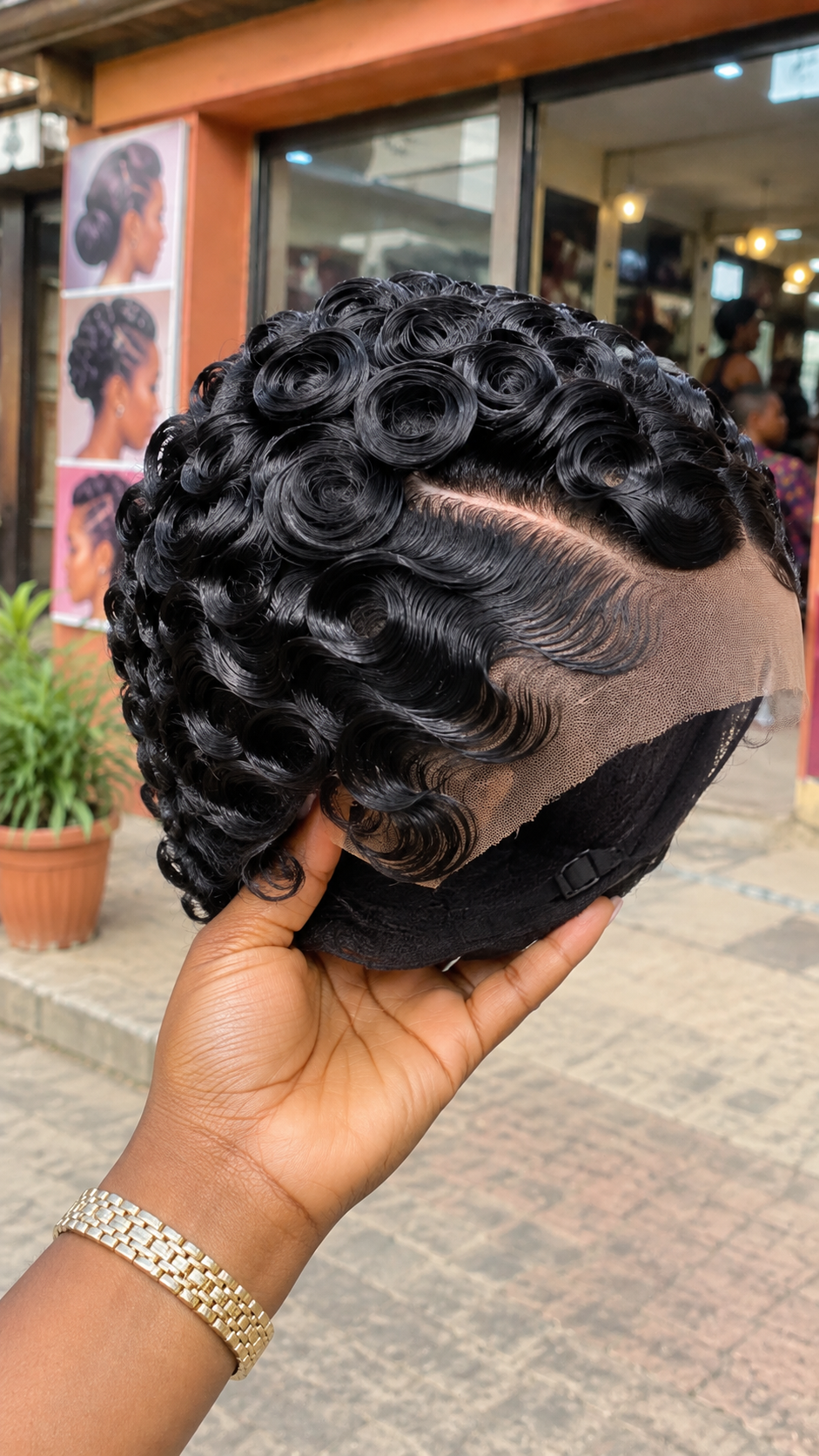
The most striking curve on this short black wig sits just below the side part. A wide section of hair sweeps toward the temple, turns back on itself and opens into a rounded curl. Smaller bends continue along the visible edge. Above the part, the hair gathers into broad circles with dark centers and glossy rims. The top has the fullness of a curly pixie, while the temple shows how much movement a short section of hair can hold.
The part itself bends gently across the visible surface. On the upper side, rounded curls sit close enough to overlap. Below it, the strands lie low at first, spreading into a wide front wave before rising into the larger side curls. The black shade keeps the arrangement cohesive. Reflected light traces the rows of strands and makes it possible to follow a single bend from its flat beginning to its curled tip.
A hand supports the black side-swept curly pixie wig from beneath. Brown lace extends beyond the hairline, and part of the dark cap and a small interior adjuster are visible. The angle makes the difference between the broad wave and the raised side curls particularly clear. If you want a similar wig, use the photograph to discuss which of those curves should frame your face and where the full side should sit in relation to your ear.


The Side View Reveals the Shape of the Set
Start at the front end of the part and look below it. The strands are combed together in narrow lines, with enough room for the first bend to spread across the lace. As the wave travels toward the side, it gains width and folds into the curls. That gradual change gives the hairstyle a recognizable profile. If the wave ends too abruptly, the front can look like a separate piece of styling attached to a curly wig. If the first curl sits too low, it can cover much of the wave.
Several of the side curls look open and round, while others show a wider sweep with only part of the opening visible. The difference comes from the way the sections turn. You can ask a maker to preserve that mix when adapting the design to your head. Show them the larger curve near the front and the smaller loops farther down. The aim is to keep the progression visible as the wig goes from the forehead to the side, even if the exact size of the curls changes.
The other side and the nape deserve a separate look. The photograph gives a good view of one profile and much of the crown. Ask for the opposite profile and a straight rear photograph when assessing a similar wig. Decide whether you want the back to continue the rounded curl pattern or sit closer around the neckline. The difference is easy to appreciate if you regularly wear collared shirts, jackets or large earrings. Check the proposed shape with the clothes and accessories you usually reach for.
Where the Part Lands Once the Wig Is On
On the pictured unit, the visible part creates space between the ringlets above and the side sweep below. Its position will change visually once the cap is fitted. A line that looks high when the wig is tilted in someone’s hand can appear closer to the temple at eye level. Ask the stylist to place the untrimmed unit where it feels comfortable and show you the result straight on. Then turn your head to see whether the part still separates the wave from the crown clearly.
Think about the amount of forehead you want framed by the front curve. A shallow sweep exposes more space above the brow. A deeper curve makes the styling more visible from straight ahead. The reference shows a wide, low bend, but you can use its shape as a starting point and adjust its placement. Have the stylist keep the widest part of the wave visible while they move its tip. This lets you judge how a change affects the frame around your face before you commit to trimming.
Bring your everyday glasses if you wear them. Put the frames on after the stylist has positioned the cap and check where the arms touch the hair. A small curl near the ear can lift when a frame slides underneath it, even if the rest of the wig fits well. You may prefer a little clearance at that point or want the curl brought closer to the face. Make that decision while looking at the full profile, since a small temple adjustment can change the apparent fullness at the side.
How To Order This Style
Look for a custom wig studio, a beauty supply shop with styled pixies or a boutique that shows short units from the front and side. When browsing a portfolio, look for examples of wide finger waves that turn into barrel curls. The way those two shapes meet is more important here than the exact name used on a listing. A shop may carry a short black wig with suitable crown curls that a local stylist can finish around the temple. A custom maker can plan the entire front and part before setting the hair.
For a made-to-order unit, send the photo with a short description that starts at the part and ends at the ear. Identify the narrow curved part, the low wave immediately beneath it and the wide curl where the wave turns. Include your head measurements, the side on which you want the sweep and the amount of height you prefer through the crown. Describe the direction from your own left or right. Mark it on the image if you are sending a mirrored selfie as an additional reference.
Before paying, ask for images of the proposed unit from the front, both sides and the back, plus a view of the entire interior. For a ready-made piece, request a video of the actual wig turning slowly under indirect daylight. Confirm the fiber, lace shade, parting area, size range and whether the front arrives trimmed. For a custom order, ask to approve the temple sweep and the crown before dispatch. Get the estimated turnaround, delivery cost and terms for alterations in writing.
To get the look done locally, book a consultation with a wig stylist who sets short curls and shapes finger waves. Tell the salon whether you are bringing a styled piece for fitting or a base that needs cutting and setting. Ask whether the appointment includes lace finishing and whether you need to drop the wig off in advance. If you want to adapt the look to your own hair, a short-hair stylist can check the length through the side and crown. Bring a clear profile of your current cut so they can assess how much of the sweep is feasible.
Choosing the Cap Around the Temple Sweep
The visible brown lace spans the area beneath the front wave. The photograph gives a partial look at the dark interior and one adjuster, so ask the seller to show the rest of the cap when choosing a similar piece. The placement of the usable lace matters because the wave extends beyond the narrow part. A lace-front cap can suit the design if the available area reaches both the end of the part and the lowest section of the sweep.
A frontal may give the maker more space across the forehead and around the temples, depending on its width and depth. Ask them to show where the widest part of the curve would sit on the proposed base. A closure can work for a fixed side part if the line fits within the closure area and the rest of the cap allows the desired temple finish. A full-lace cap may suit someone who wants more flexibility for changing direction later. The cut and curl set will still affect how freely the finished hairstyle can be rearranged.
If you want to wear the wig glueless, have the maker show you how the band, straps and other components keep the cap in position. Measure your head using the seller’s directions. Circumference gives a starting size, and ear-to-ear or front-to-nape measurements can help establish where the edge will sit. At the fitting, look down and turn from side to side. If the broad curl moves toward your ear, ask the stylist to check the fit before changing the contour of the wave.
An adhesive fitting is another option for a compatible lace unit when you want extra hold at the front. Ask to see the intended placement and the amount of lace to be trimmed before the stylist secures it. Confirm which remover goes with the adhesive and have the stylist demonstrate how to release the edge. If you plan to remove the wig most evenings, mention that when booking. A routine that involves frequent removal should be practical to repeat without pulling on the fine hair near the longest wave.
Picking Length and Density for Different Areas
The barrel curls take up a surprising amount of strand length even when the finished cut sits close. Ask for the height of the styled crown alongside the listed hair length. If you like the wide circles but want a lower silhouette, discuss angling a few of the larger sections toward the back. The stylist may be able to keep the broad surface of each curl visible while reducing the lift above the part. Use an eye-level profile to judge that change.
The hair immediately below the part needs enough length to make the first wide bend. Farther down, there needs to be enough hair for the curl to turn without leaving a bulky edge around the ear. When a salon proposes cutting a base unit, ask them to show which areas need to retain length for setting. A shorter trim everywhere can leave too little hair for the longer sweep. A discussion about those areas early on gives you a better chance of getting the side shape you chose the reference for.
Density affects the spacing between the circles and the visibility of the part. Too much hair near the line can cover it, while a thick front edge can make the separate wave ridges difficult to see. If you want a fuller look, ask where the maker would add hair through the crown or side. Have them show you the result from slightly above as well as from the front. The upper view reveals whether the part stays open, and the front view shows whether the sweep still sits clearly below the ringlets.
Set a Budget for Both the Wig and the Wave Work
The ranges below are illustrative examples in USD. Actual quotes can vary with the fiber, cap, supplier, location and amount of custom work. Ask whether the quoted total includes the finished side wave and the first fitting. A curly pixie that comes with a simple front can need additional styling to reproduce the sweep, even when the crown already looks close to the reference.
| Tier | Illustrative Price Range | Potential Scope |
|---|---|---|
| Budget | USD 20–45 | Ready-made synthetic pixie with a fixed curl set and a simple front. |
| Value | USD 45–110 | Pre-styled synthetic wig with broad curls, a visible side part or a molded temple wave. |
| Mid | USD 95–190 | Short human-hair base with cutting, lace finishing and setting potentially billed separately. |
| Premium | USD 175–325 | Custom set on a standard cap with an agreed part position and a tailored sweep. |
| Salon-Grade | USD 325–650+ | Made-to-measure unit with individual curl placement and temple work checked on the wearer at fitting. |
Ask for an itemized quote if you are choosing between a finished wig and a base to take to a salon. Include delivery, fitting, cutting and styling in the comparison. A base with suitable lace and enough hair at the side may give the stylist plenty to work with. A pre-styled unit can save an appointment if the front already sits where you want it. For custom work, ask whether a later reset is available and what that service would include. It is useful to know who can restore the side after the first wash.
A Care Routine That Respects the Direction of the Waves
After each wear, check the low area of the sweep and the opening of the largest side curl. Those two spots tell you how the shape has held up. If a section moved against a scarf or eyeglass frame, hold the wig by the cap and guide the strands along the path they already follow. Work on the displaced section individually. Brushing across several bends can pull them together and leave strands crossing the exposed part.
For regular wear, inspect the cap and lace about once a week for perspiration and residue. Wash when warranted by actual wear and the care instructions for the fiber. Support the lace during cleaning and avoid rubbing the wide curls against each other. Blot excess moisture gently and let the wig dry on a stand that supports the cap without pressing on the temple. If adhesive was used, follow the compatible removal directions before cleaning residue from the underside of the lace.
Ask the stylist what they used to set the crown and the flatter hair below the part. Human hair may allow a wet reset or another method chosen for its condition. Synthetic fibers vary in how they respond to steam and heated tools, so check the maker’s instructions before attempting either. If the widest wave loses its direction or several large curls open, book a reset. Repeated layers of finishing product can collect along the part and hide the fine lines that make the sweep visible.
Store the wig on a form with enough clearance around the curved side. Leave room above the crown so a closet shelf or nearby object cannot press the circles down. For travel, use a firm case and lightly support the cap from the inside. Check that the lace rests unfolded and that the largest side curl clears the lining. Take a front photo and a profile after the first fitting. Save both for the stylist, since the exact position of the sweep on your head may be hard to infer from an image of the wig held in a hand.
Deciding Whether This Pixie Fits Your Week
The short length leaves the neck clear, and the full side gives the style a distinct profile even from across a room. Black keeps the color easy to pair with everyday clothes, while the broad wave can feel dressy enough for an event. A well-fitted cap also makes the part a reliable reference when you put the wig on. Practice placing it yourself during the fitting and see whether that first curve returns to the same spot above the temple.
The shaped side takes a little attention if you wear glasses, headphones or a close head covering. Pressure near the ear can change the smaller turns while leaving the crown looking intact. A fixed part also commits most of the fullness to one direction. Think about which of the two views you care about most as you try it on. If you enjoy the wave from the front and can wear your usual accessories without disturbing the side, you have a good basis for deciding whether to keep the full set or ask the stylist for a slightly shorter finish near the ear.
Search Terms
jet black pixie with temple waves · black barrel curls with curved side part · short wig with ribbon curls · molded side sweep pixie wig · glossy black curls above finger waves · brown lace short sculpted wig · black curly pixie with full sides · open crown curls with wide temple sweep