
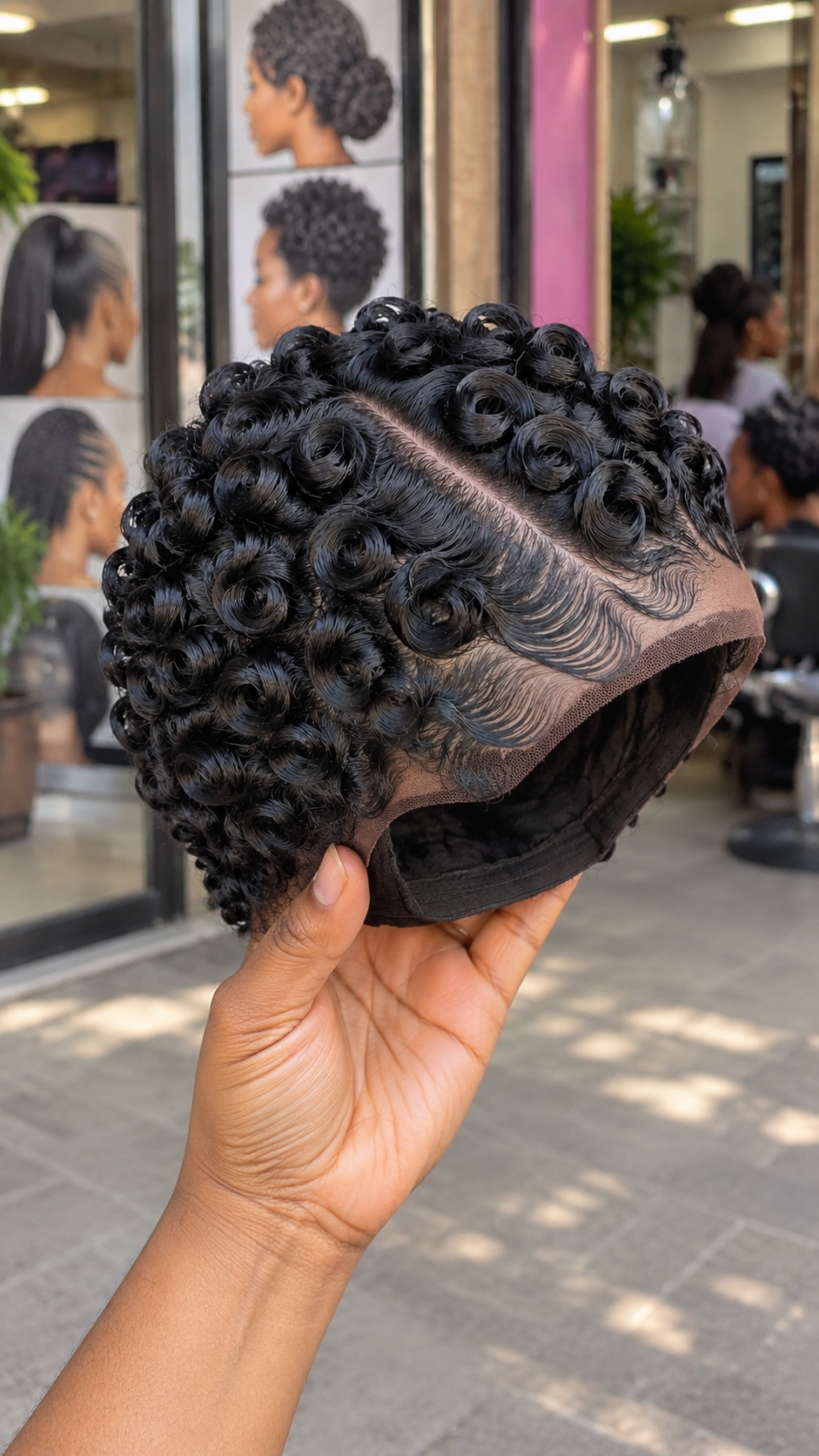
When a hairstyle combines beautifully arranged circular curls with flowing strands along the hairline, the result can feel almost like a piece of handcrafted art. This gorgeous black pixie wig captures that effect through a crown of glossy, open curl rings and an intricate arrangement of sweeping finger waves. The contrast between the rounded upper curls and the delicate strands beneath them creates a feminine hairstyle with remarkable detail, all within a compact silhouette.
The photograph presents a single black wig held in one hand outside a neighborhood beauty salon. Its upper and visible rear sections contain numerous tightly arranged circular curls, while a prominent diagonal parting separates the raised crown from the flowing waves near the forehead and temple. A broad section of beige-tan lace remains visible beneath the styled hairline, and a dark interior cap can be seen through the opening.
What distinguishes this wig from an ordinary curly pixie is the deliberate combination of different hair movements. The upper curls form rounded rings with visible openings, while the strands beside the parting sweep downward in elongated curves. The styling follows a coordinated direction without making every curl identical.


For women considering a similar hairstyle, the important details are the circular curl arrangement, the placement of the diagonal separation, and the direction of the delicate side waves. Reproducing those characteristics matters more than choosing a wig that simply matches the black color.
The Appeal of Circular Curls Against a Flowing Hairline
The most attractive element of this hairstyle is the relationship between the compact ringlets and the softer hairline styling. The circular curls occupy most of the visible upper and rearward sections, giving the wig a rounded shape with noticeable depth.
Beneath them, the hair changes direction. Instead of forming complete circles, finer strands travel across the front and side in elongated waves. Several curves follow the diagonal parting before bending toward the lower hairline.
This creates a graceful transition between raised curls and flatter styling. The two arrangements complement each other without competing for attention.
The hairstyle also maintains considerable curl coverage around the visible side and back. It does not rely on a shaved-looking temple or an exposed geometric carving to create interest.
That distinction is worth understanding when shopping. A wig with closely cropped sides and a small curly crown would produce a different impression, even if its overall length appeared similar.
Open Ring Curls Create the Crown’s Beautiful Shape
The upper hair contains numerous rounded curls resembling compact rosettes. Many have visible circular openings, with individual black strands curving inward around a central space.
Several prominent rings sit near the upper parting, while smaller curls appear toward the sides and rear. The curls overlap naturally, creating fullness without requiring long hanging strands.
The arrangement is particularly interesting because the ringlets do not all have the same diameter. Larger circles establish recognizable shapes, while smaller loops fill spaces and maintain the rounded silhouette.
The glossy black strands reflect daylight along their curved surfaces. These bright reflections make the circular styling easier to appreciate but do not establish the presence of dyed highlights.
A successful custom reproduction should preserve the mixture of open rings and supporting curls rather than replacing the entire crown with identical small spirals.
How Curl Diameter Influences the Finished Hairstyle
The size of the curl openings can make a substantial difference. Large circular rings create a more sculptural appearance, while smaller coils produce a denser, closely arranged crown.
This wig combines both characteristics. The upper curls have enough space to reveal their rounded construction, but they remain compact enough to preserve the overall pixie silhouette.
When consulting a wig maker, ask about the intended curl diameter and finished crown height. The measurements should be considered together because larger loops may increase the apparent volume.
Ask for a photograph of the upper hairstyle before approving a custom order. An overhead view can reveal whether the circular curls are distributed appropriately and whether large unwanted gaps appear between them.
The Diagonal Parting Gives the Hairstyle Its Direction
A clearly visible diagonal separation travels across the upper front-side area of the wig. It creates a division between the surrounding circular curls and the more closely arranged strands below.
The parting is particularly noticeable against the black hair because the underlying foundation appears lighter than the strands.
Its angle contributes to the hairstyle’s directional appearance. The curls sit around the exposed channel, while the finer strands beneath it flow toward the forehead and temple.
The separation should not automatically be described as a shaved razor line. The photograph shows a wig, and the technique used to form the exposed channel cannot be verified from appearance alone.
For a custom recreation, the position and direction of the parting should be established before the surrounding curls are completed. Moving it substantially could change the relationship between the crown and the front waves.
Beautiful Finger Waves Along the Temple
Beneath the diagonal parting, fine black strands form a series of elegant sweeping waves. They lie relatively close to the lace and travel along the visible side in gentle, elongated curves.
Some sections resemble broad S-shaped movements, with neighboring strands following similar paths. This creates a flowing surface rather than a collection of disconnected baby hairs.
The waves become especially prominent near the front, where they bend toward the lower perimeter beneath the raised curls. Their placement allows the hairstyle to frame the forehead without creating a heavy fringe.
The finger waves are a central part of the design. If the crown curls were extended too far downward, these delicate sections could become hidden.
A wig maker recreating the reference should therefore preserve sufficient space for the finer strands and avoid replacing them with unrelated decorative spirals.
Why the Side Sweeps Need Careful Placement
The appearance of the side waves depends heavily on their direction. Even relatively small adjustments can change how the hairline looks once the wig is worn.
During fitting, the stylist should consider the position of the wig on the forehead and temple. A cap positioned too far forward may place the waves unnaturally low, while one positioned too far backward may expose more of the hairline than intended.
The waves should also retain their relationship with the diagonal parting. Pulling strands across the separation could obscure the original design.
Any adjustments should be made conservatively, particularly when the styling method and fiber composition have not yet been confirmed.
Deep Black Hair That Emphasizes Every Curve
The hair appears predominantly deep black, with cool reflective highlights following the surfaces of the curls and waves. No separate blonde, copper, burgundy, or silver-dyed areas are clearly visible.
This consistent dark appearance places greater emphasis on the hairstyle’s construction. The circular openings create shadow and depth, while the flatter waves reveal their movement through narrow reflective lines.
For buyers, an important distinction is the difference between natural black, off-black, and jet black. Commercial color descriptions can vary by manufacturer, and photographs may appear darker or lighter depending on the lighting.
Request a daylight photograph of the actual product before ordering. The wig’s glossy appearance should also not be used to identify its material, since human hair and synthetic fibers can both have reflective surfaces.
The Rounded Rear Section Adds Balance
Unlike a style with a tall curly crown and closely shaved lower back, the visible rearward area retains many circular curls. Smaller rings continue downward, maintaining a rounded outer shape.
This arrangement helps the wig appear full without extending into long hair. The curls remain close to the overall silhouette, contributing to a compact finish.
The visible lower curls are more closely grouped than some of the prominent rings near the upper parting. This variation creates a gradual progression in curl size.
The photograph provides a strong view of one side and part of the rear, but it does not reveal the entire back. Buyers should request a direct rear photograph before assuming that the same curl distribution continues uniformly around the nape.
Evaluating the Wig Before Spending Money
One of the most useful ways to evaluate a sculpted curly wig is to compare its construction with the intended styling result. A beautiful promotional photograph alone does not establish whether the actual product will arrive with the same curl arrangement.
Start by examining the crown. The circular curls should have recognizable openings, with variations in diameter that resemble the reference. Next, assess the diagonal parting and determine whether the surrounding hair follows the appropriate direction.
The finger waves deserve particular attention. A wig with the correct circular crown but a plain front hairline would not reproduce the photographed appearance.
Finally, examine the lower side and rear. The curls should continue in a way that preserves the rounded silhouette rather than introducing an unrelated close fade.
This approach can help shoppers distinguish a genuinely similar wig from one that merely belongs to the broader curly pixie category.
The Untrimmed Lace and Interior Foundation
A noticeable section of beige-tan lace extends beyond the visible front hairline. The mesh remains untrimmed, indicating that the wig has not yet undergone its final installation preparation.
The lace follows the lower edge of the decorative waves and continues toward the visible side. Its position is important because the front strands are arranged relatively close to the mesh.
The photograph does not establish the exact lace grade, thickness, transparency, or full dimensions. Visible mesh does not independently confirm HD lace.
A dark interior cap is also partially exposed through the opening. Fabric sections and stitching can be seen, but the complete underside is not visible.
Consequently, the full number of attachment combs, adjustable straps, or other fastening components cannot be confirmed. A seller should provide an underside photograph and complete product specifications before purchase.
Choosing the Right Cap and Hair Density
Cap fit affects more than comfort. It influences where the diagonal parting sits and how the finger waves align with the wearer’s forehead.
Before ordering, request measurements for head circumference, front-to-nape length, and ear-to-ear width. Compare these measurements with the seller’s sizing information.
Different purchasing options may include standard cap wigs, closure constructions, or frontal designs. These are possible alternatives, not verified descriptions of the photographed product.
A frontal may provide more flexibility across the front hairline, while a closure generally offers a more limited styling area. The appropriate choice depends on the actual design and construction.
Hair density should also be discussed. Too little density may leave unwanted spaces between the curls, while excessive density could create a bulky crown or hide the parting.
Ask about the strand length before curling as well as the finished hairstyle height. Circular curls can make longer strands appear much more compact.
Where to Buy Similar Black Curl Ring Wigs
Women interested in this appearance can search online wig retailers, local beauty supply shops, and independent wig makers who specialize in sculpted curls and finger-wave hairlines.
Search descriptions such as black circular curl pixie, rosette curl lace wig, and compact finger curl hairstyle can help identify related products.
However, listing titles should not be treated as proof of an accurate match. Some products may use loose spirals or small spring coils instead of the open circular rings shown here.
A ready-made wig may be suitable if it already contains the desired crown arrangement, diagonal parting, and decorative hairline.
For buyers who want closer control over those elements, a custom wig maker may be the better option. Request examples of previous work and ask whether the stylist can reproduce the distinctive hairline arrangement.
Do not assume that the salon in the photograph is the verified manufacturer or supplier. No confirmed product origin or selling price is established by the image.
How to Place a Custom Order
Begin by sending the reference photograph to the wig maker. Explain that the hairstyle should feature open circular black curls, a visible diagonal front-side parting, and elongated finger waves beneath the crown.
Identify the characteristics that must remain accurate. The curl diameter, parting direction, and wave placement are particularly important.
Ask whether the wig will be supplied fully styled or require additional professional preparation after delivery. Discuss the desired crown height and how the curls should continue around the rear.
Request photographs from the front, both sides, the rear, and the underside before shipping. A short rotation video can also help reveal the overall silhouette.
Confirm the fiber composition, cap measurements, lace specifications, production schedule, shipping terms, and return conditions before paying a deposit.
Booking a Stylist for a Professional Installation
A wig specialist experienced in circular curl arrangements, decorative finger waves, and lace preparation is a suitable professional for recreating this hairstyle.
During consultation, show the photograph and discuss how the diagonal parting should align with the wearer’s head.
The stylist should inspect the delivered wig before beginning installation. Check that the curls have retained their circular openings and that the forehead waves have not become displaced during transportation.
The cap should then be positioned and assessed for comfort. If lace trimming is necessary, it should take place only after the correct hairline placement has been established.
Removing too much lace can compromise the decorative front edge and may be impossible to reverse.
The attachment method should depend on the verified cap construction and the wearer’s needs. Glueless, closure, and frontal options should not be assumed interchangeable.
Illustrative Prices for Black Circular Curl Pixie Wigs
The cost of recreating a similar hairstyle can depend on the fiber composition, cap construction, number of individually arranged circular curls, and precision of the decorative front waves.
The following USD ranges are illustrative planning estimates, not verified live selling prices or quotations for the photographed wig.
| Wig Category | Illustrative USD Range | Potential Cost Considerations |
|---|---|---|
| Premium Custom | $385–$975+ | Individual cap measurements, intricate circular curl arrangement, precise diagonal parting, detailed hairline work, and specialist fitting. |
| Standard Custom | $190–$460 | Selected cap options, personalized curl size, and adjustments to the front-side wave arrangement. |
| Basic Human Hair | $105–$295 | Human-hair base unit that may require separate curling, parting preparation, and professional styling. |
| Premium Synthetic | $70–$205 | Higher-grade synthetic alternatives with prearranged circular curls and material-dependent styling flexibility. |
| Basic Synthetic | $25–$95 | Budget alternatives that may differ in ringlet precision, front-wave styling, and cap construction. |
These categories represent possible purchasing options rather than confirmed classifications of the photographed wig. Actual prices vary by country, supplier, materials, workmanship, and included services.
A custom unit may cost more when the circular curls need to be arranged individually or when the delicate forehead waves require additional hand styling.
The absence of multicolor processing does not necessarily make a detailed black wig inexpensive. Specialized styling labor can be a significant part of the cost.
Ask the supplier for an itemized quotation covering the base wig, customization, cap fitting, lace preparation, installation, shipping, and any follow-up services.
Protecting the Circular Curls During Wear
The most important maintenance consideration is preserving the recognizable openings of the curl rings. Repeated brushing, forceful finger separation, and compression may disturb their arrangement.
Ask the seller how the curls were formed and whether they can be safely repositioned after cleaning or regular use.
Some hairstyles may require professional resetting if the circular shapes become flattened or tangled.
The forehead waves need a different approach because their appearance depends on fine strands following specific curves. Aggressive combing may disrupt the direction of those strands.
Cleaning recommendations must follow the confirmed material. Synthetic hair should not be exposed to heat unless the manufacturer explicitly permits it. Human hair may allow other styling methods, but its condition and processing history remain important.
Storage and the Risk of Flattened Ringlets
Storing a sculpted curl wig requires attention to its shape. Placing heavy items on the crown or compressing the curls into a small space may cause the circular openings to collapse.
A suitable wig support can help preserve the rounded silhouette while reducing unnecessary pressure on the hairline.
Before storage, inspect the curls for displaced strands and avoid pulling them apart without knowing the original styling method.
The lace should remain free from unnecessary stretching, particularly near the fine forehead waves.
If the wig is packed for travel, consider asking the supplier how to protect its circular styling during transportation.
The goal is to maintain the original curl arrangement rather than repeatedly rebuilding it after every wear.
The Advantages and Limitations of This Hairstyle
One appealing quality is the compact silhouette. The circular curls create noticeable fullness without requiring long hanging hair.
The hairstyle also offers considerable detail through its diagonal parting and elegant finger waves. The black color emphasizes those elements without relying on bright highlights.
For women who enjoy distinctive curly hairstyles, the combination of rounded rings and flowing front strands may offer a beautiful alternative to ordinary loose curls.
However, intricate circular styling may demand more careful handling than a casually arranged pixie. The front waves can lose their shape if repeatedly disturbed, and the crown may require professional resetting when heavily compressed.
A close reproduction may also involve additional customization costs. These practical considerations should be weighed against the intended frequency of wear and maintenance preferences.
A Beautiful Choice for Women Who Love Detailed Curls
This black pixie wig demonstrates how circular ringlets and flowing side sweeps can create a remarkable hairstyle without relying on unusual color combinations or long hair.
The rounded upper curls provide fullness, while the diagonal parting establishes direction. Delicate finger waves bring movement to the forehead and visible temple, completing the design.
For buyers seeking a similar wig, the best approach is to focus on the actual curl structure, the visible parting, and the hairline arrangement rather than relying exclusively on a generic curly pixie description.
Before purchasing, request several product angles and verify the fiber, cap, and lace specifications. If the hairstyle must closely match the reference, discuss the details with a qualified custom wig maker.
With thoughtful selection, professional fitting, and material-appropriate care, a similar design can offer an elegant compact pixie appearance that celebrates glossy black curls and beautifully flowing hairline waves.
Search Terms
Elegant black curl ring pixie wig · Flowing side sweeps with circular curls · Glossy black open rosette crown · Diagonal parting finger wave hairpiece · Black spiral ringlets with temple waves · Compact black curly lace wig · Sweeping forehead strands with black coils · Rounded black curl wig with visible tan lace