
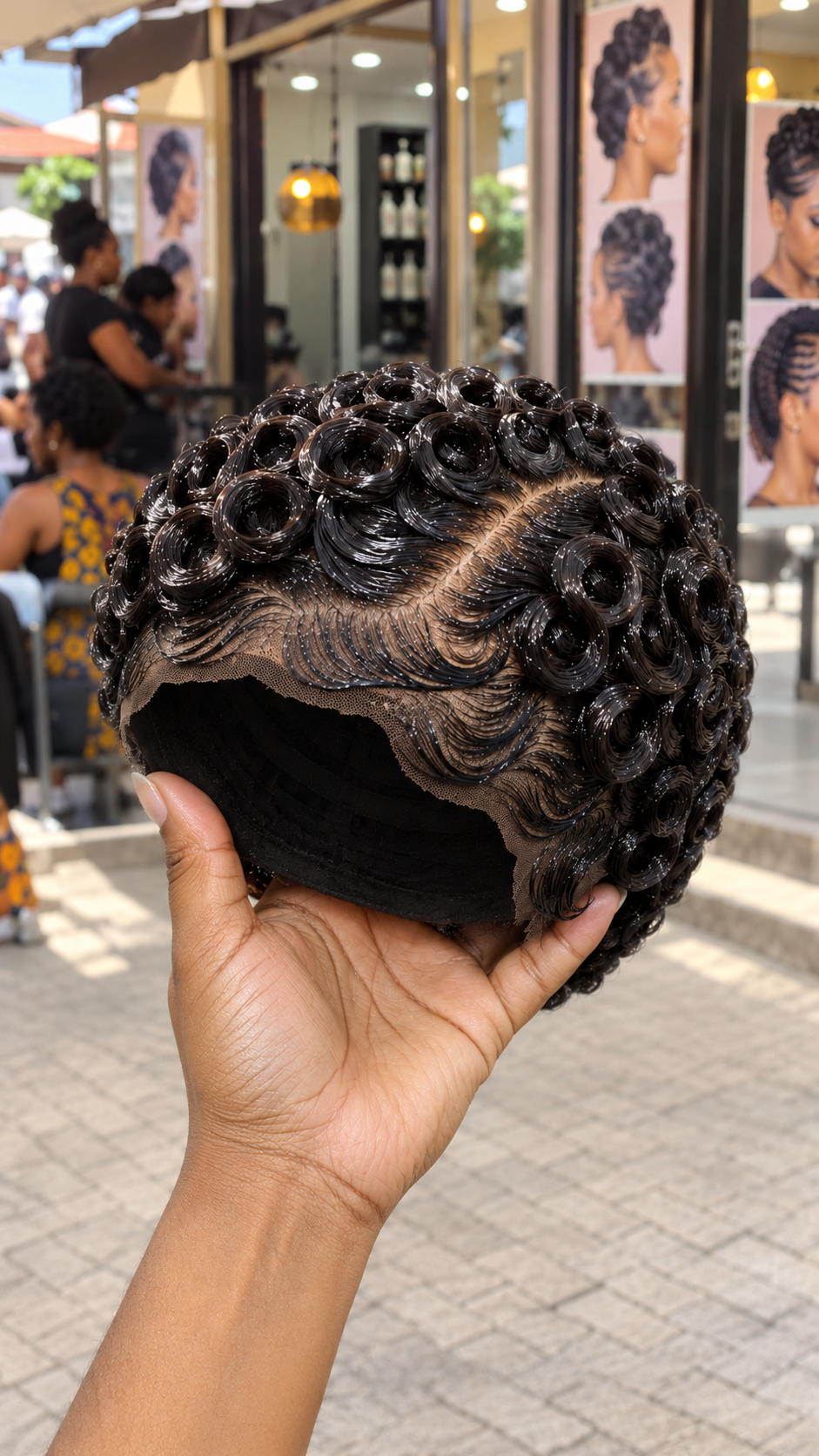
A hairstyle can be striking without relying on bright colors or dramatic length. The black pixie wig pictured here demonstrates how carefully arranged circular curls and sweeping finger waves can create an elaborate design within a compact silhouette. Its upper section is filled with glossy spiral roses, while a pronounced diagonal parting separates the curls from the flatter, flowing hair along the front and visible side.
Photographed outside a busy neighborhood salon, the wig is supported in one hand with its front edge angled toward the camera. The daylight reveals the circular openings of individual curls, the closely aligned strands within the waves, and the dark interior cap beneath the hairpiece. A narrow margin of beige-toned lace remains visible along the front, indicating that the unit is being presented before final fitting.
The most distinctive characteristic is the contrast between two different hair arrangements. Across the upper hairstyle, compact curls form rounded, hollow-centered loops. Beneath them, the strands travel in broad curves, creating flowing finger waves that follow the forehead and temple. A diagonal separation establishes the direction of both sections, giving the hairstyle a deliberately asymmetrical appearance.


Unlike a conventional curly pixie with similarly shaped curls throughout, this design depends on the relationship between raised rosettes and flatter waves. Reproducing that relationship accurately is more important than simply matching the overall length or selecting a glossy black shade.
A Diagonal Parting That Shapes the Entire Hairstyle
The exposed diagonal channel is one of the most recognizable elements of this wig. It begins near the front-side area and travels backward across the upper section, creating a clear boundary between differently directed strands.
The parting appears relatively narrow, with a pale underlying surface contrasting against the surrounding dark hair. Its path is slightly curved rather than perfectly straight, following the general direction of the sculpted hairstyle.
On one side, circular curls sit closely together. On the other, several prominent spiral roses rise above the sweeping finger-wave section.
This arrangement produces a distinctive sense of movement. The crown remains rounded, but the diagonal line directs the viewer’s attention across the hairstyle rather than toward a conventional center part.
The photograph does not establish the technique used to create this separation. It may involve a carefully constructed parting, deliberate strand placement, or another wig-styling method.
For an accurate reproduction, the position and direction of the diagonal channel should be agreed upon before the surrounding curls and waves are arranged.
Why a Different Parting Would Change the Appearance
The diagonal separation influences how much hair is available for the rosettes and front waves.
Moving the parting closer to the center could change the balance of the upper curls. Positioning it farther toward the temple might reduce the area available for the broad wave formations.
These changes could produce an attractive hairstyle, but it would no longer match the reference closely.
When contacting a custom wig maker, provide the photograph and identify the diagonal parting as an essential styling detail.
Ask for an elevated photograph of the completed unit to confirm that the separation follows the intended path.
Glossy Spiral Roses Create a Rounded Crown
The upper hairstyle contains numerous circular curls arranged closely across the crown. Many resemble miniature roses, with glossy strands curving around central openings.
Several prominent loops sit near the upper front and central sections. Others are smaller and fill the spaces between neighboring curls.
The circular openings are clearly visible in many areas, allowing the viewer to distinguish individual formations rather than seeing a continuous mass of curled hair.
Some rosettes face outward, while others turn diagonally or partially overlap nearby sections. This variation gives the upper hairstyle depth without requiring additional hair colors.
The curls remain compact despite their density. They create noticeable fullness across the crown but do not extend into long hanging spirals or an excessively tall silhouette.
Near the visible rearward section, smaller curls continue toward the lower edge, maintaining the rounded profile.
The Importance of Curl Diameter and Spacing
The size of each circular curl affects how the entire hairstyle appears.
Larger rosettes create prominent openings, while smaller curls provide density and help connect the surrounding formations.
Too much hair could conceal the openings and make the crown appear overcrowded. Too little density could create visible gaps between neighboring curls.
The reference balances these elements through a mixture of small and medium circular formations.
For custom production, ask the maker to preserve varied curl diameters and a compact upper shape.
The exact setting technique cannot be determined from the photograph. The supplier should explain whether the curls can retain their arrangement after washing or require professional resetting.
The Front Finger Waves Create a Flowing Contrast
Beneath the circular curls, the front hair follows broad sweeping paths that contrast with the raised rosettes above.
The strands are grouped into curved formations resembling sculpted finger waves. Their glossy surfaces reflect light in long, continuous bands, emphasizing the direction of each wave.
Near the front, one prominent wave curves downward before bending toward the visible side.
Additional sections follow related paths, creating a layered arrangement across the hairline and temple.
The waves sit closer to the cap than the upper curls, giving the hairstyle a distinct contrast in height.
This difference is central to the design. A wig made entirely from circular curls would lose much of the flowing appearance created by the front styling.
Likewise, replacing the rosettes with ordinary finger waves would produce a flatter hairstyle that no longer resembles the reference.
The Front Hairline Contains Delicate Curved Strands
Fine black strands follow the direction of the larger waves near the front edge.
Several sections bend across the beige lace, creating a decorative transition between the dense upper hairstyle and the exposed mesh.
The hairline is not a simple straight border. It contains flowing curves that contribute to the overall appearance.
Because the wig is shown before installation, the final position of these strands against a wearer’s forehead cannot be confirmed.
Some decorative hair may extend across lace that will need trimming during fitting.
A professional stylist should evaluate the existing wave arrangement before removing excess mesh.
Cutting the lace without considering the front styling could disturb the carefully positioned strands or reduce fitting flexibility.
Jet Black Color Makes the Curl Shapes Stand Out
The hair appears predominantly jet black, with glossy reflections across the circular curls and front waves.
There are no clearly established blonde, copper, burgundy, or other contrasting hair colors.
The brighter areas visible in the photograph are consistent with daylight reflecting from the curved strands rather than confirmed dyed highlights.
This creates a monochromatic hairstyle whose visual detail comes from curl placement and hair direction.
The openings inside the rosettes appear darker, while the outer surfaces catch brighter reflections.
The finger waves produce longer reflective bands that emphasize their sweeping paths.
For women who prefer black hairstyles without additional coloring, this design provides an attractive example of how precision styling can create depth and movement.
The photograph cannot establish whether the fibers are naturally black, dyed, or manufactured in the shade.
The Visible Side Retains Circular Curl Coverage
The wig’s visible side contains numerous circular curls extending from the upper crown toward the lower rearward area.
Several larger rosettes sit near the diagonal parting, while smaller curls continue toward the bottom edge.
This creates a compact, rounded profile rather than an extensively shaved-looking side.
The photograph does not show multiple parallel razor lines, a pronounced geometric fade, or a clearly exposed skin taper.
Instead, the hairstyle relies on the diagonal parting and flowing finger waves to provide its decorative structure.
For a custom order, ask the maker to preserve the circular curl coverage rather than introducing additional shaved-looking patterns.
The complete rear is not visible, so an additional photograph should be requested before making assumptions about the nape.
Understanding the Visible Beige Lace
A narrow section of beige-toned lace extends beyond the styled front hairline.
The mesh is visible along the lower edge, where it contrasts with the dark interior cap.
The lace appears untrimmed in the photographed area, indicating that fitting and final preparation have not yet been completed.
However, the photograph does not establish the full lace coverage or commercial classification.
It would be inappropriate to describe the material as HD lace without reliable supplier information.
Ask whether the wig uses a lace front, closure, frontal, or another construction, and request the actual dimensions of the lace area.
The available lace can influence how the decorative hairline is prepared and positioned.
The Interior Cap Should Be Inspected Before Purchase
The lower opening reveals a dark fabric cap beneath the hairstyle.
Several stitched sections and a reinforced-looking perimeter are visible, but the complete underside remains concealed.
The photograph does not establish the number of comb attachments, the full strap configuration, or the exact adjustment system.
It also does not prove that the wig is designed for adhesive-free wear.
Before purchasing, request a complete inside-out photograph showing the front, sides, and rear of the cap.
Confirm the circumference, front-to-back length, and ear-to-ear measurements.
If adjustable hardware is included, ask how it operates and whether additional sizes are available.
A visually accurate hairstyle may still be unsuitable if the cap does not fit comfortably.
Where to Find a Similar Sculpted Pixie Wig
Specialized wig boutiques, custom lace wig makers, and salons experienced in finger-wave styling are appropriate places to search for comparable designs.
Useful search descriptions include black spiral rose pixie wig, sculpted circular curl lace hairpiece, diagonal part finger-wave pixie, and glossy black rosette wig.
When browsing online listings, examine actual product photographs rather than relying entirely on hairstyle names.
A generic black curly pixie may have a similar length but lack the carefully arranged circular rosettes.
Another wig may reproduce the curls while omitting the flowing front waves.
For ready-made products, request photographs of the exact unit available for shipment.
For custom production, review the maker’s previous work involving circular curl placement and directional finger-wave styling.
Preparing a Custom Order Around the Spiral Roses
Begin by identifying the circular rosettes as the principal upper styling requirement.
Explain that the crown should contain visible openings and a combination of small and medium curls.
Next, specify the diagonal parting and its direction through the upper front-side area.
Identify the broad finger waves that extend toward the forehead and temple.
Ask the maker to preserve the predominantly jet black color without adding contrasting highlights.
Explain that the visible side should retain circular curl coverage rather than be converted into a close-cut fade.
Finally, confirm the hair material, cap measurements, lace specifications, and intended securing method.
If possible, request a progress photograph before final styling is completed. This can help identify major differences while adjustments remain feasible.
Ready-Made Convenience Versus Custom Accuracy
A ready-made wig may offer faster delivery and lower initial cost.
It can be suitable if the buyer finds a unit with comparable curl placement, parting direction, and front-wave styling.
However, the exact relationship between the circular rosettes and flowing finger waves may be difficult to locate in ordinary catalog products.
Custom production provides greater control over curl diameter, wave direction, and cap sizing.
The trade-off may involve additional styling labor and higher expense.
Before choosing either approach, determine which characteristics are essential and which minor variations would be acceptable.
For this hairstyle, the circular curls, diagonal parting, sweeping waves, and compact side coverage are the strongest identifying elements.
Illustrative Pricing for a Black Spiral Rose Wig
The cost of reproducing this hairstyle may depend on hair material, cap construction, lace coverage, curl-setting labor, and the complexity of the decorative front waves.
The photograph does not establish the manufacturer, fiber composition, or actual selling price.
The following US dollar figures are illustrative planning ranges rather than verified current retail quotations.
| Wig Category | Illustrative USD Range | Potential Purchase Scope |
|---|---|---|
| Premium Custom | $340–$815+ | Personalized cap sizing, detailed spiral rose placement, diagonal parting customization, and sculpted finger-wave styling. |
| Standard Custom | $180–$425 | Selected adjustments to curl diameter, parting direction, cap fit, and front-wave placement. |
| Basic Human Hair | $105–$280 | A human-hair base unit that may require additional professional curl setting and wave styling. |
| Premium Synthetic | $70–$205 | A higher-grade synthetic option with potentially prearranged circular curls and sculpted front sections. |
| Basic Synthetic | $30–$110 | A budget alternative where curl accuracy and wave placement may vary. |
These categories describe possible purchasing routes rather than confirmed versions of the photographed wig.
Installation, shipping, lace preparation, cap adjustments, and future curl restoration may be charged separately.
Ask for an itemized quotation and confirm which services are included before paying.
Booking a Stylist for Installation
After receiving the wig, inspect the spiral roses, diagonal parting, front waves, and cap before making adjustments.
When booking a salon appointment, explain that the hairstyle combines circular curls with flowing finger-wave styling.
Ask whether the stylist has experience fitting sculpted pixie wigs without disturbing carefully arranged hair sections.
At the appointment, the cap should be positioned and checked for comfort before trimming any lace.
The diagonal parting should align appropriately with the forehead, while the front waves should retain their intended direction.
If adjustments are necessary, the stylist should examine the underlying lace and cap before cutting or reshaping the hair.
A stylist familiar with both circular curl setting and finger-wave techniques may be particularly useful for maintaining this design.
Maintaining the Circular Curls
The upper spiral roses depend on retaining their rounded shapes and visible openings.
Aggressive brushing may separate the grouped strands and alter the hairstyle’s appearance.
Before washing, ask the supplier whether the curls are intended to retain their arrangement or require professional resetting afterward.
If the wig contains synthetic fibers, avoid heat tools unless the manufacturer confirms the permitted temperature.
If it contains human hair, professional restyling may be possible, but the method should account for previous processing and the original styling technique.
The black shade may make certain types of styling residue noticeable, depending on the products used.
During storage, avoid pressure that could flatten the circular curls.
Protecting the Sweeping Finger Waves
The front waves require different handling from the upper circular curls.
Their appearance depends on individual strands remaining grouped along specific curved paths.
Repeated brushing across the wave direction may disturb the styling and reduce the visibility of the curved ridges.
Ask the supplier which styling products were used and whether localized maintenance is possible.
If the waves begin to lose their shape, professional correction may be preferable to aggressive home styling.
The appropriate technique depends on the confirmed hair material and original setting method.
Photographs Worth Requesting Before Purchase
The reference provides a clear view of the upper spiral roses, diagonal parting, and front waves.
However, it does not reveal the complete opposite side, rear, or underside.
A direct front photograph would help establish how the waves frame the forehead.
An opposite-side image would show whether the styling is symmetrical or intentionally different.
A rear photograph would reveal how the circular curls continue toward the nape.
A complete underside image would help verify the cap construction and securing components.
A brief video under neutral lighting could also provide a more reliable impression of the black shade and overall silhouette.
A Black Pixie Where Curl Placement Makes the Difference
This wig combines glossy black spiral roses with a prominent diagonal parting and flowing finger waves across the front.
The upper curls create a compact rounded silhouette, while the flatter waves introduce movement along the hairline.
The visible side retains circular curl coverage rather than relying on decorative shaved-looking lines.
The partially visible lace and dark interior cap provide useful pre-installation information, although they do not establish the complete product specifications or fiber composition.
For buyers seeking a comparable design, the most reliable approach is to prioritize curl diameter, parting direction, wave placement, and cap fit.
A successful reproduction should preserve the circular openings and flowing front waves without introducing unrelated decorative patterns or excessive crown height.
With accurate supplier communication, appropriate professional fitting, and maintenance suited to the confirmed hair material, this hairstyle offers a distinctive alternative to conventional curly pixie wigs.
Search Terms
Glamorous black spiral rose pixie wig · Glossy circular rosette lace hairpiece · Diagonal part sculpted finger waves · Jet black flowing side wave pixie · Compact black spiral crown hairstyle · Beige lace finger curl wig · Black circular coil side coverage · Sweeping front wave rosette hairpiece