
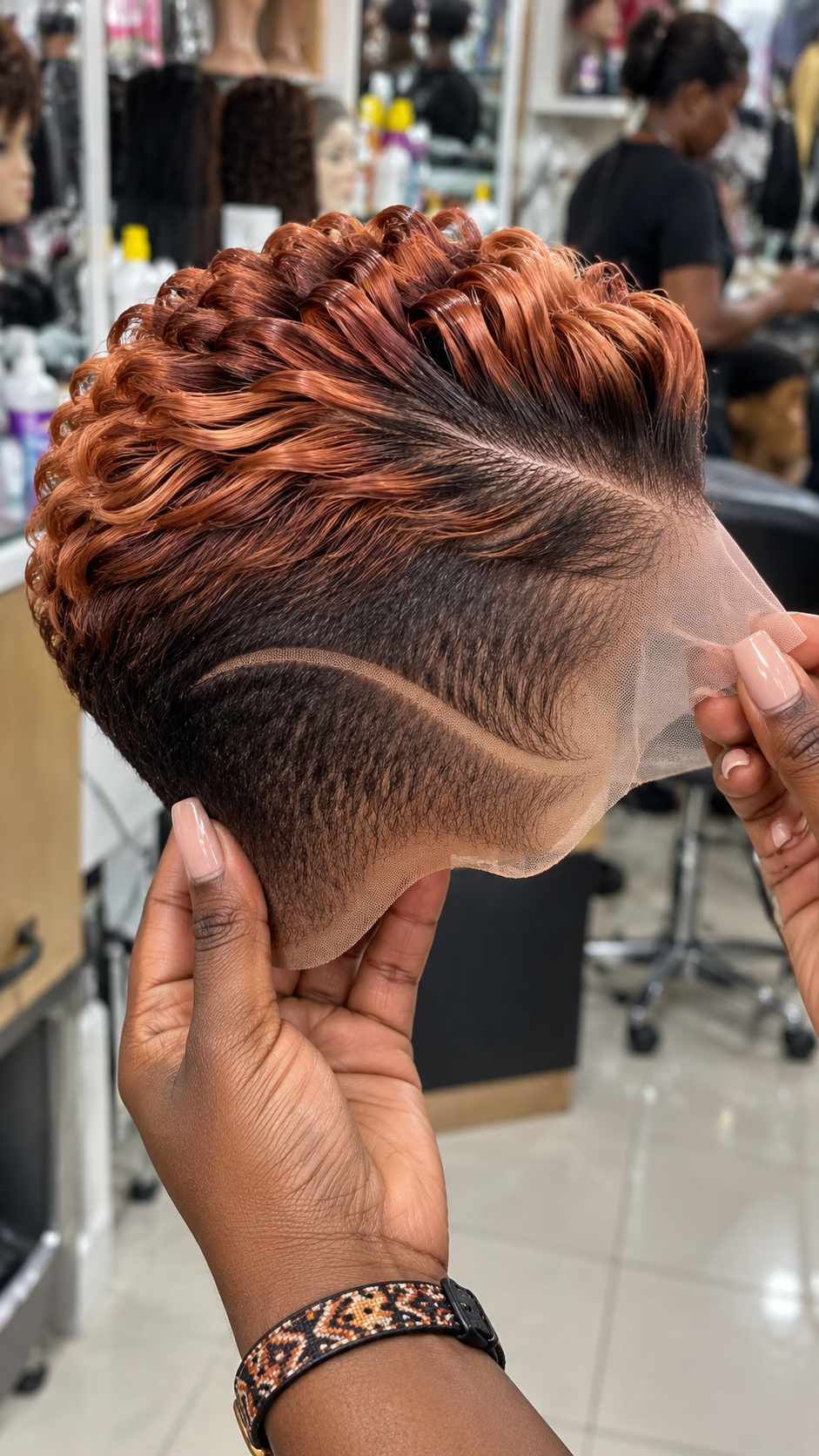
A single curved line can make a hairstyle more recognizable than an entire collection of elaborate decorations. This copper auburn pixie wig demonstrates that idea through a striking contrast between flowing upper curls and a closely cropped dark side. The most noticeable detail is a long, gently arched channel running across the lower section, creating a distinctive separation beneath the copper-colored hair.
Photographed inside a working hair salon, the wig is held between two hands before installation. Its untrimmed lace extends beyond the front hairline and lower side, allowing the viewer to examine the hairstyle’s construction and directional styling. The upper hair contains warm copper, auburn, and chestnut reflections, while the roots and closely arranged lower section appear considerably darker.
Unlike wigs dominated by compact circular ringlets, this design uses elongated ribbon curls that bend backward and gather toward the visible rear. Their arrangement creates an attractive sense of movement while preserving a relatively compact pixie silhouette. The lower side provides a contrasting surface, allowing the upper styling to stand out without excessive height or volume.


For customers interested in buying a similar wig, the important details are the single curved side channel, the transition from dark roots into warm auburn ribbons, and the direction of the raised curls. These characteristics should guide the purchasing decision rather than relying on a generic description such as copper curly wig.
One Curved Side Channel Creates the Signature Look
The most distinguishing element is the pale curved channel crossing the visible lower side. Beginning toward the rear portion of the photographed panel, the line follows a broad arc before approaching the front temple area. Its shape is continuous and gently rounded, separating two areas of closely arranged dark hair.
This is not a zigzag design, an intersecting geometric pattern, or a collection of parallel shaved lines. Only one prominent curved channel is visible. Its simplicity is precisely what makes the lower section effective.
Above the channel, the hair appears relatively dense and closely directed. Beneath it, the strands become finer and more compact, giving the side a subtle tapered appearance. The line establishes a visible boundary between these areas without introducing additional decorative intersections.
The channel appears lighter than the surrounding hair, creating contrast against the dark espresso-brown foundation. Fine hairs remain visible near its edges, suggesting careful attention to the placement of the surrounding strands.
The photograph does not establish whether the channel was created with clippers, controlled parting, specialized hair placement, or another wig-construction technique. Its appearance resembles barber-inspired curved artwork, but the actual method should be confirmed with the maker.
Why a Single Line Can Be More Difficult Than It Looks
A large curved channel leaves little room for inconsistency. With several intersecting lines, small irregularities may become less noticeable within the overall pattern. A single uninterrupted arc, however, draws attention to its width, placement, and direction.
For a custom wig, the curve should remain recognizable from the side without appearing excessively wide. A poorly placed line could sit too close to the upper curls or extend awkwardly toward the front hairline.
Customers should ask the wig maker to reproduce the broad arc instead of substituting additional decorative lines. The reference relies on restraint, and adding more artwork would change the hairstyle’s character.
The opposite side is not visible clearly enough to establish whether another channel exists there. Anyone requesting matching artwork on both sides should make that requirement explicit.
The Auburn Color Moves Through the Upper Hair
The color distribution is particularly interesting because the warm shades follow the directional movement of the curls. The raised ribbons display copper-orange, reddish auburn, and chestnut-brown reflections, with brighter areas appearing near the outward-facing surfaces.
The roots are considerably darker, especially near the visible side parting and front hairline. This darker foundation helps the copper strands appear more prominent as they rise into the curled sections.
Some ribbons contain a mixture of darker brown strands and brighter copper reflections. The photograph does not show a uniform orange crown or clearly separated blonde highlights.
Instead, the hair appears to transition visually from espresso-brown roots toward warm auburn and copper lengths. The exact coloring technique cannot be established from the photograph, but the visible effect is a relatively natural-looking dark-to-warm contrast.
This combination may appeal to customers who want a noticeable color without choosing bright red or platinum blonde. Copper auburn provides warmth, while the darker side maintains a more restrained appearance.
Choosing the Right Auburn Shade
Commercial wig colors can vary considerably. Auburn may describe a deep reddish brown, while copper often indicates a brighter orange-red influence. Chestnut generally contains more brown, and cinnamon shades may combine several warm tones.
The photographed hair sits between these categories. Its brightest sections lean toward copper, but much of the upper styling retains a rich auburn-brown appearance.
For a close reproduction, describe the desired color as warm copper auburn with chestnut reflections and deep espresso roots.
Ask for a daylight photograph of the actual hair before purchasing. Indoor salon lighting can intensify orange and golden reflections, making the color appear brighter than it would in ordinary daylight.
If the supplier offers a color chart, compare physical or clearly photographed samples rather than relying exclusively on shade numbers.
A customer should also clarify whether the darker root area is included in the proposed wig. A completely copper-colored version may look attractive, but it will not reproduce the same relationship between the upper curls and lower side.
How the Ribbon Curls Travel Across the Crown
The upper hairstyle contains broad, elongated sections that rise from the roots and bend backward. Several front ribbons form tall arches, while the curls toward the visible rear become more compact and closely gathered.
The hair is not arranged into numerous identical circular rings. Instead, its structure relies on directional movement. Some sections resemble folded ribbons, while others form soft, rounded loops that overlap near the crown.
The front portion has a noticeable upward lift. As the hair progresses backward, the strands gradually change direction and gather into a tighter arrangement.
This progression produces a swept appearance that differs from a uniformly rounded curly pixie. It also allows the copper strands to catch light along their length, creating broad reflective bands.
The visible upper silhouette is relatively controlled. Although the ribbons add volume, the hair does not appear excessively puffed out or spread equally in every direction.
A wig maker reproducing this style must understand that the direction of the curls is just as important as their shape.
Why Curl Direction Matters During Styling
If the front sections are curled downward, they may cover the hairline and change the overall silhouette. If they are arranged too vertically, the upper hairstyle could appear unnecessarily tall.
The reference shows a balance between lift and backward movement. The ribbons rise from the darker foundation before bending into overlapping curls.
During custom production, ask for a side photograph showing the direction of the front sections. The image should demonstrate how the ribbons connect to the roots and how they gather toward the rear.
A photograph from slightly above can help identify uneven curl distribution or large gaps between the sections.
The maker should also explain how the curls are formed and whether they will require resetting after washing. The appropriate method depends on the actual hair material and styling technique.
The Exposed Parting Helps Explain the Hair Movement
Near the upper side, a pale parting channel runs diagonally through the dark foundation. It separates a closely arranged section of hair from the longer strands rising into the copper ribbons.
This upper parting should not be confused with the larger curved channel lower on the side. The two divisions occupy different areas and contribute to different aspects of the hairstyle.
The upper parting organizes the direction of the longer hair. The lower curved channel serves as the main decorative side detail.
Fine strands are visible along the upper division, with the hair on either side traveling in noticeably different directions.
The longer copper sections rise away from the parting, while the lower hair remains compact and directed toward the rear.
This relationship helps establish the hairstyle’s shape without requiring dramatic changes in overall length.
For buyers, it is worth asking the maker to preserve the upper parting’s position. Moving it significantly could alter the direction of the curls and change the amount of hair visible above the side channel.
A Compact Lower Panel Balances the Raised Copper Hair
The lower side contains finely arranged dark hair that sits close to the underlying cap. Its appearance contrasts with the broad reflective ribbons above it.
The density is not perfectly uniform. The upper portion appears fuller, while the lower area becomes finer toward the exposed lace boundary.
This variation creates a tapered-looking transition without making the side completely bare.
The dark hair also provides the contrast needed for the curved channel to remain visible. If the surrounding strands were too light or sparse, the line might become less recognizable.
Customers ordering a similar unit should emphasize that the lower side must remain compact but sufficiently covered. A completely shaved-looking panel would produce a different result.
The photograph does not establish the exact hair length or production method of this section. Any proposed trimming should therefore be evaluated according to the actual wig construction.
What the Untrimmed Lace Reveals About the Wig
The photograph shows a substantial section of beige-brown lace extending beyond the front hairline and visible lower side. One hand holds the lace near the front, while the other supports the lower section.
The mesh is especially noticeable where it extends beyond the hair. Its appearance suggests that the unit is being displayed before final fitting and lace trimming.
The front hairline contains fine dark strands emerging near the mesh boundary. These hairs create a transition between the exposed lace and the darker roots leading into the copper ribbons.
The lace appears relatively fine in the photograph, but its exact specification cannot be confirmed. It should not automatically be described as HD lace or any other specialized category without reliable seller information.
The image also does not establish whether the wig can be worn without adhesive.
Before purchasing, ask the seller to identify the lace material, cap dimensions, available securing components, and recommended installation method.
Because the decorative curved channel approaches the front side, lace trimming should be performed carefully. Removing too much material may interfere with the intended hairline placement.
Construction Questions Worth Resolving Before Payment
Although part of the dark interior is visible beneath the lace, the photograph does not provide a complete view of the cap. The exact placement of adjustment straps, combs, clips, and other fastening components cannot be established confidently.
A buyer should request a photograph showing the entire underside of the actual unit.
The seller should also confirm whether the cap is available in different sizes or can be made according to individual measurements.
Common measurements include head circumference, front-to-nape distance, ear-to-ear distance, and temple placement.
For this hairstyle, temple measurements are particularly useful because the curved side channel needs to sit in a visually appropriate position.
A cap that is too large may shift the design downward or create unwanted movement. A cap that is too tight could distort the hairline or feel uncomfortable during wear.
Do not assume that a wig displayed in a hand-held photograph will automatically fit the same way when installed on a person.
Where To Buy This Wig Style
A similar hairstyle may be available through custom wig makers, specialized pixie wig boutiques, online wig retailers, or salons experienced in sculpted curly units.
However, the most effective shopping approach is to search for the actual styling combination rather than relying on a broad description such as auburn wig.
Useful search phrases include copper auburn ribbon curl pixie, swept-back curly lace wig, single curved side design wig, and caramel auburn sculpted pixie.
A custom wig maker may be the most suitable option when the precise side channel and directional upper styling are essential.
Ready-made wigs may provide a similar color and general silhouette, but their parting placement and lower side construction can differ considerably.
Before buying from an online retailer, request photographs of the exact available unit. Images from different angles will help determine whether the product matches the reference.
No particular manufacturer, shop, or current inventory can be verified from the photograph alone. Customers should avoid assuming that a visually similar promotional image guarantees an identical product.
What to Include in a Custom Wig Request
Send the reference photograph and identify the features that should remain unchanged. Explain that the wig has one prominent curved channel along the closely cropped side, an upper diagonal parting, and elongated copper auburn ribbons moving backward.
Ask whether the maker can reproduce this combination on the proposed cap and hair foundation.
Confirm the intended color distribution, including the darker roots and lower side.
Request examples of previous work involving sculpted pixie curls or barber-inspired side artwork.
Finally, ask whether the quotation includes styling, lace preparation, installation, shipping, and any later adjustments.
From Delivery to a Professional Fitting
Once the wig arrives, inspect it before cutting the lace or changing the hairstyle.
Compare the color, ribbon direction, upper parting, and curved side channel with the approved reference.
The stylist should begin by positioning the cap on the wearer’s head and evaluating whether the side artwork aligns with the temple.
If the wig sits incorrectly, the decorative channel may appear too high, too low, or too far toward the face.
Only after the cap position is established should the lace be assessed for trimming.
The installer should avoid cutting into the closely arranged lower hair or disturbing the upper parting.
Once the wig is secured using an appropriate method, the copper ribbons can be checked for any changes caused by handling.
Minor styling corrections may be possible, but the tools and products used must be compatible with the confirmed fiber.
Customers should inform the salon about the directional ribbon curls when booking. This helps the stylist understand that the appointment may require more detailed preparation than a conventional curly wig installation.
Estimated Costs for a Copper Auburn Ribbon Pixie
Pricing for this type of wig depends on the hair material, cap construction, color preparation, and the amount of professional styling required. The single curved channel may also influence the cost if it requires specialist customization.
The following USD figures are illustrative planning ranges rather than verified live prices or quotations for the photographed product.
| Wig Category | Illustrative USD Range | Possible Purchase Characteristics |
|---|---|---|
| Premium Custom | $300–$720+ | Individual cap measurements, copper auburn color placement, directional ribbon curls, precision side detailing, and personalized lace preparation. |
| Standard Custom | $160–$355 | Customized warm auburn styling with raised curls, darker roots, and a professionally arranged curved side channel. |
| Basic Human Hair | $95–$245 | A human-hair pixie base that may require additional coloring, curl shaping, and side customization. |
| Premium Synthetic | $65–$180 | Higher-priced synthetic alternatives with copper coloring and prearranged curls, depending on manufacturer specifications. |
| Basic Synthetic | $25–$95 | Budget curly pixie options that may resemble the overall color and silhouette without reproducing the precise side channel. |
The table describes possible purchasing categories. It does not establish whether the photographed wig is human hair, synthetic, or a blend.
Color preparation may increase the final price, particularly if the maker must create a specific copper auburn shade over darker roots.
The raised ribbon styling can also require additional labor. A unit with ordinary loose curls may be less expensive to prepare than one containing carefully directed upper sections.
The side channel introduces another potential expense. Depending on the method used, creating a consistent curved line may require specialized work.
Ask whether the quoted amount includes the finished wig, delivery, fitting, lace trimming, and any necessary restyling.
Comparing complete quotations is more useful than selecting a product based solely on its initial advertised price.
Maintaining the Auburn Ribbons Without Losing Their Direction
The upper curls depend on their elongated, backward-directed shape. Aggressive brushing may separate the ribbons and reduce the carefully arranged movement.
Before washing, confirm the wig’s material and obtain the maker’s recommended maintenance instructions.
If the unit is human hair, washing may loosen the original styling and require the curls to be reset. If the auburn color was produced through chemical processing, the hair’s history may influence the appropriate products and treatment methods.
If the unit is synthetic, do not assume it can tolerate heated curling tools. Heat compatibility varies between fibers and should be confirmed with the manufacturer.
Excessive styling products may also reduce strand separation, making the broad ribbons appear heavier and less distinct.
Instead of repeatedly manipulating the curls, ask the stylist which areas can be adjusted by hand and which should be professionally reset.
Preventing Damage to the Curved Side Detail
The lower channel should be handled carefully because its appearance depends on the placement of the surrounding dark strands.
Repeated brushing across the line may move hair into the exposed area and reduce its visibility.
If the side design begins losing its appearance, consult a wig stylist familiar with the construction before attempting corrections.
Do not automatically use clippers or a razor to deepen the line. Depending on how the wig was made, additional cutting could expose cap material or permanently damage the hair foundation.
The exposed lace also requires gentle handling during installation and removal. Pulling directly on fine hairline strands may place unnecessary tension on the mesh.
Storage That Protects Both the Curls and the Side
The wig should be supported in a way that maintains its compact shape without compressing the raised ribbons.
An appropriately sized wig stand can help preserve the cap’s general form. Avoid storing the unit beneath other objects or pressing the styled upper hair against a shelf.
For travel, choose packaging that provides enough clearance around the curls. Compressing the raised sections may alter their direction and make professional resetting necessary.
The lower side should also be protected from excessive rubbing, particularly near the curved channel.
Any washing, drying, or storage instructions supplied by the actual maker should take priority over general recommendations because the photograph does not establish the fiber or construction specifications.
Why This Pixie Works Without Complicated Side Artwork
The appeal of this copper auburn hairstyle comes from the relationship between its warm upper curls and restrained lower design.
The single curved channel provides a clear decorative element without overwhelming the side. The dark espresso foundation maintains contrast, while the lifted ribbons create movement and height above it.
This balance makes the hairstyle an interesting option for customers who appreciate barber-inspired details but prefer an uncomplicated geometric arrangement.
The warm auburn color adds visual interest without requiring blonde tips, silver highlights, or several contrasting shades.
Its compact silhouette also keeps the emphasis on the direction of the curls and the shape of the side channel rather than on overall hair length.
However, this is not necessarily a low-maintenance hairstyle. Customers should ask how frequently the upper ribbons need resetting and whether the lower design requires professional attention.
Choosing a Similar Wig With Confidence
The most reliable way to reproduce this appearance is to focus on four visible characteristics: the warm copper auburn ribbons, the deep espresso roots, the diagonal upper parting, and the single broad curved channel along the closely cropped side.
These details distinguish the photographed wig from ordinary copper curly pixies and from styles containing multiple geometric lines.
Before purchasing, obtain photographs of the actual unit, confirm the hair material, review the cap construction, and discuss fitting requirements with the seller or stylist.
A custom maker should demonstrate an understanding of the ribbon direction and the lower side design rather than merely promising a similar color.
With careful construction, accurate sizing, and appropriate maintenance, a similar wig can offer a distinctive combination of sculpted movement, warm auburn coloring, and understated side artwork.
The finished result should preserve the contrast that makes this hairstyle memorable: glossy copper ribbons rising above a dark, compact side, interrupted by one graceful curved line.
Search Terms
Copper auburn ribbon curl pixie wig · Single curved side channel lace wig · Espresso root auburn swept back curls · Chestnut copper sculpted pixie hairstyle · Diagonal part copper lace front wig · Dark tapered side auburn ribbon wig · Untrimmed lace copper pixie unit · Warm auburn elongated loop crown