
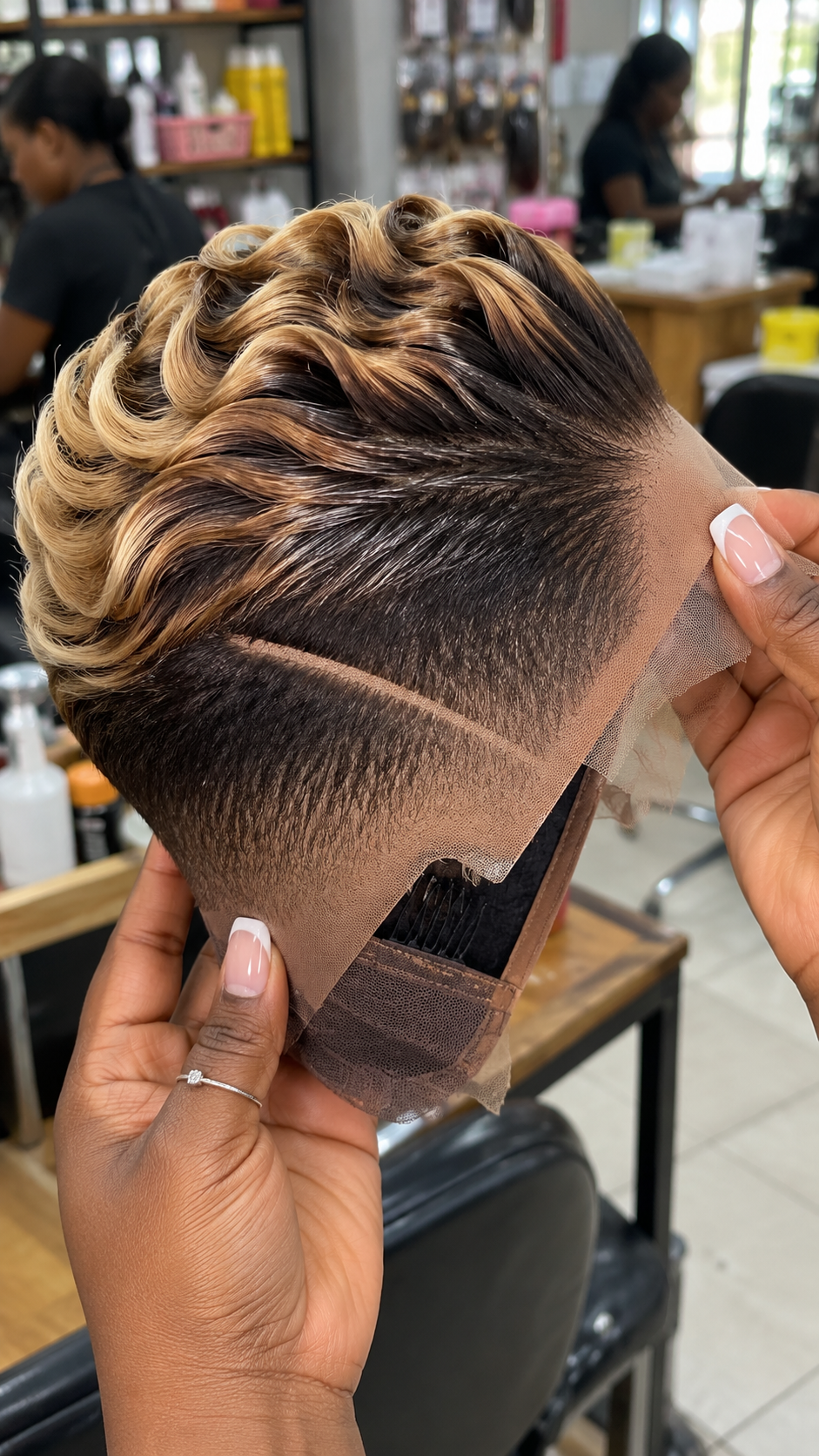
A successful pixie wig is not always the one with the most curls or the brightest color. Sometimes its appeal comes from the way carefully positioned waves create movement across a compact hairstyle. The wig shown in this photograph combines sweeping honey blonde sections, a deep espresso-brown foundation, and a closely tapered side with one long diagonal separation. The result is a layered pixie design that offers visible styling detail without relying on elaborate patterns or excessive volume.
The photograph captures the wig before installation, held with two hands inside a hair salon. The front lace remains untrimmed, and part of the interior cap is exposed. This allows a potential buyer to examine details that may be difficult to identify in a finished hairstyle photograph, including the visible comb attachment, the lace perimeter, the closely arranged side hair, and the relationship between the dark roots and blonde upper sections.
Unlike a wig filled with small circular ringlets, this hairstyle uses broad, flowing waves that travel backward from the front. The upper sections overlap in a layered formation, with lighter blonde ribbons becoming particularly noticeable around the raised curves. The darker hair beneath creates depth, while the tapered side maintains a compact silhouette.


For anyone searching for a honey blonde pixie lace wig, understanding this combination of color placement, directional styling, and side construction is essential. It helps distinguish a genuinely comparable product from a generic highlighted curly wig.
The Blonde Layers Create Movement Rather Than Extra Volume
The upper hairstyle is arranged into broad, curved sections rather than numerous tightly wound spirals. Several strands rise from the front and bend backward, forming overlapping waves that continue toward the visible rear portion of the wig.
The curves vary in height and length. Some form elevated arches near the upper center, while others lie closer to neighboring strands, creating a layered progression. This prevents the crown from appearing as a uniform collection of identical curls.
The most prominent waves are located around the upper front and middle sections. Their raised shape gives the hairstyle some elevation, but the overall silhouette remains relatively compact.
At the visible rear, the blonde sections appear more closely arranged, with the hair bending downward into a rounded continuation of the upper hairstyle. The photograph does not provide a complete rear view, so the exact shape of the back should be confirmed with additional product images.
The hairstyle’s direction is particularly important. Rather than allowing the blonde strands to fall forward over the forehead, the arrangement guides them backward, revealing the darker foundation beneath.
Why Broad Waves Are Different From Spiral Curls
Online wig catalogs frequently group different hairstyles under broad descriptions such as curly pixie, finger curl, or layered pixie. However, the differences between these curl formations can significantly affect the finished appearance.
The photographed wig displays broad, flowing waves with curved ridges and overlapping ribbon-like sections. It does not have a crown dominated by small, hollow circular ringlets.
A wig covered in tight finger coils would create a denser appearance. A unit with loose hanging spirals would introduce more downward movement, while a straight swept pixie would lack the raised wave formations.
Buyers should therefore describe the hairstyle as a layered wave pixie with backward-directed upper sections rather than relying exclusively on the term curly wig.
When comparing products, ask for a side photograph showing the height and direction of the upper waves. A front-facing image alone may not reveal how the layers are arranged.
Honey Blonde Placement Over an Espresso Brown Base
The color arrangement combines warm honey blonde with dark espresso and chocolate-brown tones. The lighter sections are concentrated around the raised upper layers, while the underlying hair remains substantially darker.
Near the front hairline, the strands appear predominantly dark brown. As they travel backward and rise into waves, honey blonde ribbons become more visible.
Several upper sections contain brighter golden blonde areas along their outer curves. Other strands display a mixture of caramel and deeper brown tones, creating variation without an abrupt two-color division.
The lower side remains predominantly dark, with little evidence of the stronger blonde coloring seen above. This contrast helps distinguish the elevated upper hairstyle from the tapered area beneath it.
Rather than a conventional ombre in which every strand gradually changes color from root to tip, the photograph shows selected blonde sections distributed through the upper waves.
This distinction is important when ordering. A uniformly blonde crown with dark roots may look different from a wig where honey blonde ribbons are interwoven with darker hair throughout the upper styling.
Choosing the Right Blonde for a Similar Wig
Honey blonde is a broad color description. Some suppliers use it for warm golden shades, while others offer more muted beige-blonde or caramel variations.
The photographed wig has a warm golden appearance, with darker brown sections remaining clearly visible beneath the lighter hair.
When contacting a seller, request actual photographs of the available shades under ordinary daylight. Strong salon lighting and camera processing can change how blonde hair appears.
Ask whether the desired color is produced through selected highlighted strands, precolored fibers, or a separate coloring process.
If the wig contains human hair, the coloring history may affect future maintenance. If it contains synthetic fibers, conventional recoloring may not be suitable.
The photograph alone cannot determine the fiber composition or coloring method.
A Single Diagonal Side Channel Establishes the Lower Shape
The visible side contains one long diagonal separation running beneath the darker upper hair. This line begins toward the front portion of the side and travels backward toward the lower rear area.
The channel is relatively narrow and exposes a lighter underlying surface, making it visible against the closely fitted dark hair.
Below the separation, the hair remains tapered and gradually becomes finer toward the lower edge. Above it, darker strands continue upward into the longer highlighted sections.
The design does not display multiple decorative razor stripes or a collection of curved temple channels. Its visual identity depends on one prominent line separating areas of different hair lengths and density.
That restraint contributes to the hairstyle’s overall balance. The upper blonde waves provide the main styling interest, while the diagonal lower channel introduces a simple structural accent.
Understanding the Side Before Requesting Additional Cutting
Customers should be cautious about asking a barber to add more lines or sharpen the existing separation without first examining the wig construction.
Unlike natural hair, wig strands are attached to a cap or lace foundation. Removing too much hair can expose the underlying materials or create permanent gaps.
The photographed channel already has a particular direction and width. Enlarging it could change the proportions of the side.
If the buyer wants the hairstyle reproduced accurately, the seller should be asked to preserve the existing single-channel arrangement.
A professional experienced in wig construction is best positioned to determine whether the side can safely be modified.
The Dark Taper Gives the Crown a Lighter Appearance
One reason the blonde waves stand out is the contrast created by the closely fitted side. The lower hair appears significantly flatter than the upper sections, which makes the raised waves more noticeable.
The visible side has a dark espresso-brown appearance, with fine strands gradually increasing in density toward the crown.
Near the lower perimeter, the hair becomes relatively sparse, allowing more of the underlying lace surface to show through.
This produces a tapered appearance without requiring an extremely abrupt boundary between the longer and shorter hair.
The diagonal separation adds definition, but the overall transition still depends on changes in hair length and density.
A wig with a heavy, bulky side would not reproduce the same compact silhouette. Likewise, a side with insufficient coverage may expose more of the cap than intended.
The Exposed Lace Offers Valuable Buying Information
The wig is displayed with a broad section of beige lace extending beyond the front hairline and side. The lace has not yet been trimmed for installation.
The fine dark strands near the front are visible against the lighter mesh. This helps illustrate how the hairline is positioned in relation to the longer upper waves.
The lace appears relatively fine in the photograph, but its exact grade cannot be established from visual inspection alone.
Buyers should request the manufacturer’s lace specifications and available color options rather than assuming that a particular premium lace category is included.
The extended lace also means that the final appearance will depend on correct fitting and careful trimming where appropriate.
Why Lace Color Should Be Checked Before Installation
The lace has a beige appearance in the image. However, its suitability for an individual wearer’s complexion cannot be determined without evaluating the material under appropriate lighting.
Some suppliers offer multiple lace shades, while others provide only a limited range.
Ask for an actual photograph of the lace against a neutral background or request a sample when available.
If additional lace customization is being considered, discuss the safest method with a professional rather than applying unsuitable products without knowing the material.
The Visible Cap Interior and Comb Attachment
One particularly useful detail is the exposed interior near the lower side. A dark comb attachment can be seen against the inner cap material.
Brown fabric edging and stitched sections are also visible, indicating that the wig contains a constructed interior rather than lace alone.
However, the image does not provide a complete view of the cap. It cannot establish the total number of combs, the presence of adjustable straps, or every fastening component.
The visible comb may contribute to securing the wig, but it does not automatically mean the unit is suitable for adhesive-free installation.
For a complete assessment, the buyer should request an underside photograph showing the entire cap opened out.
What to Ask About Cap Security
Before purchasing, ask the seller to identify all included fastening components.
Confirm whether the cap has adjustable straps, additional combs, an elastic band, or other security mechanisms.
If the buyer prefers glueless installation, request explicit confirmation that the wig is designed for that purpose.
Cap measurements should also be established before ordering. A wig that fits poorly may shift the diagonal side channel or change the position of the upper hairstyle.
It is useful to provide the head circumference and any additional measurements requested by the wig maker.
Where To Buy This Wig or Order a Comparable Design
The photograph does not establish a verified seller, brand, or product listing. However, a similar hairstyle may be sourced through custom wig makers, local wig boutiques, and online retailers specializing in sculpted pixie lace wigs.
The most productive approach is to search for sellers who display actual photographs of their finished work rather than only promotional images.
A general listing for a blonde pixie wig may not reproduce the layered wave arrangement or single diagonal side channel.
Look for suppliers experienced in highlighted pixie styling, backward-swept waves, and closely tapered lace units.
When requesting a quotation, send the photograph and explain which characteristics must remain unchanged.
Creating an Accurate Custom Order Description
Describe the hairstyle as a honey blonde and espresso-brown layered pixie lace wig with broad backward-swept waves, darker front roots, one diagonal side separation, and a closely tapered lower section.
Specify that the blonde should remain concentrated through selected upper waves rather than covering the entire side.
Ask the wig maker whether the unit will arrive fully styled or require professional setting after delivery.
Confirm the fiber, cap size, lace dimensions, fastening components, and expected production timeline.
For custom orders, establish the revision policy before payment and request photographs of the completed unit for approval.
Ready-Made Versus Custom Styling
A ready-made honey blonde pixie may be a practical choice if the buyer mainly wants the warm color combination and a compact hairstyle.
However, the particular wave arrangement in this photograph may be difficult to find in a standard product listing.
Some ready-made units have small curls, while others use straight or loosely waved hair. The side channel may also be absent.
Custom construction offers more control over the blonde placement, wave direction, and lower taper.
Before purchasing a ready-made unit for modification, ask a professional whether the existing hair and cap construction support the intended styling.
A cheaper base wig may not be economical if it requires extensive coloring, reshaping, and installation work.
Illustrative Pricing for Honey Blonde Layered Pixie Wigs
The following USD amounts are illustrative budgeting ranges, not verified current product prices. The actual fiber, supplier, and selling price of the photographed wig are unknown.
| Wig Category | Illustrative USD Range | Potential Cost Factors |
|---|---|---|
| Premium Custom | $290–$680+ | Individual cap sizing, selected honey blonde color placement, layered wave construction, and careful tapered side detailing. |
| Standard Custom | $160–$355 | Selected cap options with customized blonde sections and professional wave styling. |
| Basic Human Hair | $95–$250 | A human-hair starting unit that may require highlighting, cutting, and layered wave setting. |
| Premium Synthetic | $70–$175 | A manufactured highlighted pixie with prearranged waves, depending on available designs. |
| Basic Synthetic | $30–$90 | A lower-cost blonde and brown pixie alternative that may not reproduce the specific wave placement or side channel. |
The amount of coloring work can influence the final price, particularly when the blonde must follow selected upper sections rather than being distributed uniformly.
Styling labor may also be significant. Creating broad, overlapping waves that remain elevated requires different techniques from producing ordinary loose curls.
The closely tapered side and diagonal separation may add customization costs when the base wig does not already contain those details.
Other expenses may include lace customization, cap sizing, shipping, taxes, and professional installation.
Ask whether the quotation includes the finished hairstyle or only the base unit. Comparing complete costs provides a more realistic basis for choosing a supplier.
Planning the First Professional Fitting
Once the wig arrives, inspect the hair placement, cap interior, and lace before making permanent alterations.
The stylist should first establish the correct position of the cap. The diagonal side separation and raised upper waves need to sit at the intended angle.
Check that the cap fits comfortably and that the visible comb and any additional fastening components can be used appropriately.
Only after the position is established should the stylist consider trimming the excess lace.
Cutting too close to the hairline can damage delicate strands or reduce the available fitting margin.
The upper waves should also be examined for compression caused by shipping. If restoration is required, the appropriate technique will depend on the confirmed fiber type.
Keeping the Honey Blonde Waves in Place
The upper hairstyle relies on maintaining broad curves and visible separation between the blonde and darker strands.
Repeated brushing can disturb the layered arrangement, flatten the raised sections, and mix the lighter ribbons into neighboring dark hair.
Handle the wig by supporting the cap rather than pulling directly on the waves.
If the unit contains human hair, a professional stylist may be able to restore the arrangement using suitable setting methods. Any prior coloring should be considered before applying heat or chemical products.
If the unit contains synthetic fibers, do not assume that heated styling tools are appropriate. Some materials have specific temperature limitations, while others may be permanently damaged.
Follow the manufacturer’s instructions before attempting to reshape the waves.
Protecting the Single Side Separation
The diagonal channel should remain visible without additional hair being pulled across it.
Avoid brushing the closely tapered side aggressively, particularly near the exposed separation.
If the line appears less distinct after repeated wear, consult a wig stylist before attempting corrective cutting.
Removing additional hair may permanently change the side proportions or expose the cap.
The most appropriate maintenance method depends on whether the channel was created through hair placement, cutting, or another technique.
Color Maintenance for Honey Blonde and Dark Brown Hair
Warm blonde shades may require particular care depending on the fiber and coloring process.
If the wig is made from colored human hair, ask about the processing history and recommended washing products. Previously lightened strands may respond differently to heat and chemical treatments than untreated hair.
If the wig is synthetic, conventional dyeing products may not be suitable. The manufacturer should confirm whether any color alteration is possible.
Regardless of material, avoid excessive product buildup around the upper waves. Residue may reduce the visible separation between the lighter and darker strands.
The goal is to preserve both the color relationship and the direction of the hairstyle.
Storage That Supports the Layered Crown
When the wig is not being worn, place it on an appropriately sized stand that supports its compact silhouette.
Avoid pressing the raised upper waves against a flat surface, as this may change their shape.
Do not fold the lace tightly or allow it to become caught on sharp accessories.
For travel, choose packaging that provides sufficient room for the layered crown rather than compressing the wig into a small bag.
If the hairstyle requires professional resetting after washing, consider that maintenance cost when deciding whether it is suitable for frequent wear.
Who Will Appreciate This Layered Pixie Design?
This hairstyle may appeal to customers who prefer warm blonde highlights combined with a darker, closely fitted side.
The broad waves create a polished appearance without requiring a large crown of circular ringlets. The single diagonal side channel adds a distinctive detail while keeping the lower hairstyle relatively understated.
It can be considered for everyday styling, celebrations, professional photographs, or occasions where a compact but carefully arranged hairstyle is desired.
Its suitability for regular wear will depend on cap comfort, installation requirements, and the effort needed to maintain the upper waves.
Buyers who enjoy changing their hairstyle frequently should consider whether the sculpted wave arrangement offers enough flexibility for their preferences.
Making a Well-Informed Purchase Decision
The most important characteristics of this wig are its honey blonde layered waves, dark espresso foundation, backward-directed upper styling, single diagonal side separation, and closely tapered lower section.
These details work together to create the hairstyle’s appearance. Reproducing the color without the wave direction, or copying the side channel without the crown proportions, would produce a different result.
Before ordering, request complete photographs showing the front, opposite side, crown, rear, and full interior cap.
Confirm the hair material, lace specifications, cap measurements, fastening components, and whether the unit will arrive fully styled.
A suitable supplier should be able to explain which elements can be reproduced accurately and what maintenance the finished hairstyle will require. With those details established, buyers can compare ready-made options and custom commissions with greater confidence, focusing on the craftsmanship that gives this honey blonde pixie its distinctive appearance.
Search Terms
Honey blonde layered wave pixie wig · Espresso brown root blonde lace wig · Single diagonal side channel hairstyle · Backward swept caramel blonde waves · Tapered dark brown side pixie unit · Untrimmed beige lace with interior comb · Golden blonde overlapping crown waves · Dark root sculpted wave lace pixie