
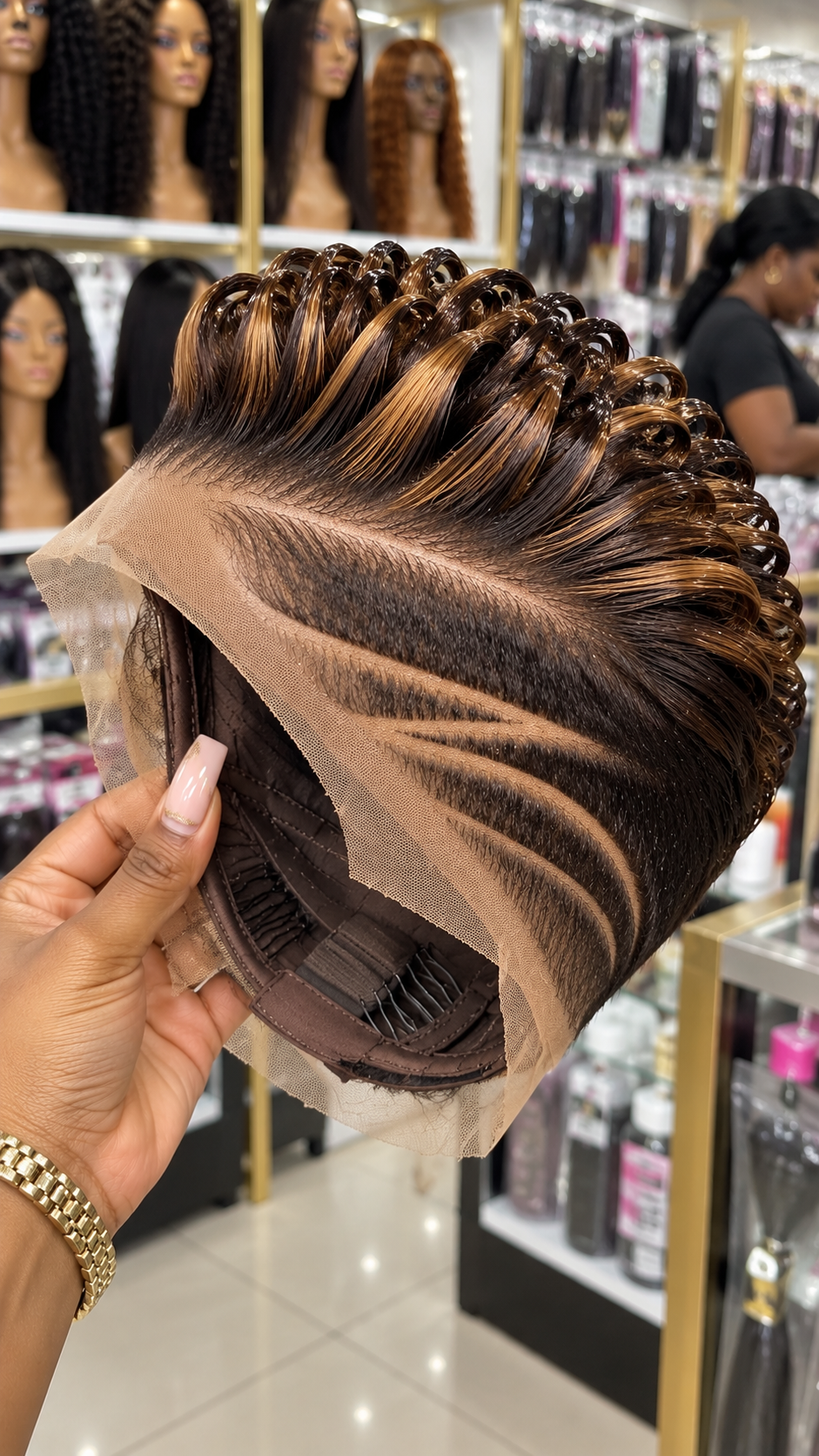
The price of a custom pixie wig should reflect more than the amount of hair used. In certain designs, the real investment lies in precisely positioned highlights, carefully arranged curls, and the ability to reproduce a distinctive side profile. This champagne honey and espresso lace wig is an excellent example of a hairstyle where craftsmanship can matter more than length.
The photograph shows a compact wig with long-looking, glossy ribbon curls rising from a dark foundation and folding backward into raised loops. Narrow champagne honey and golden caramel highlights travel through the upper strands, while the lower side remains predominantly espresso brown. Beneath a diagonal upper separation, three carved channels create an angular, descending pattern that becomes increasingly curved toward the lower rear.
The unit is being held before installation inside a wig retail shop. Its extended beige lace, brown interior cap, visible comb attachment, and adjustment hardware provide additional information that would normally be concealed once the wig is worn. These observations help establish what can be evaluated from the photograph and what must still be confirmed with a supplier.


Why This Particular Wig Requires a Detailed Purchase Specification
A generic request for a highlighted curly pixie would leave too many important decisions to the seller. The photograph contains several specific design elements that must be coordinated rather than treated as independent styling choices.
The upper hair has a directional arrangement. The lighter strands follow elongated sections that rise from the front and bend backward, rather than appearing as scattered highlights across an ordinary curly crown.
The lower side is closely fitted and contains three prominent carved channels. Their spacing and curvature contribute to the hairstyle’s identity, particularly where the lowest line bends downward toward the rear.
Between these areas, a narrow diagonal separation establishes the boundary between the longer upper strands and the closely cropped-looking side.
The most reliable way to order a similar wig is to treat these elements as a combined specification. A supplier who reproduces only the color or only the side pattern may deliver a noticeably different hairstyle.
Champagne Honey Highlights Against an Espresso Foundation
The color arrangement is more subtle than a conventional black-and-blonde contrast. The foundation appears very dark espresso brown, approaching black in the shaded areas, while the upper strands contain golden honey, caramel blonde, and lighter champagne-toned ribbons.
The brightest highlights are concentrated along selected elongated sections. They follow the direction of the hair, making the upward movement and backward curves especially noticeable.
Near the front, the roots remain predominantly dark. The lighter ribbons become more prominent as the strands rise and travel toward the crown.
Farther back, the highlights appear interwoven with darker hair as the strands form loops and overlapping curves. This produces a layered color effect without creating a uniformly blonde upper section.
The closely fitted side remains predominantly dark. It does not display the same concentration of golden highlights as the crown.
How to Avoid an Incorrect Highlight Distribution
When commissioning this hairstyle, explain that the highlights should emphasize selected upper strands rather than cover the entire crown evenly.
A wig with broad blonde sections beginning directly at the front hairline would look different. So would a unit with tiny blonde streaks scattered randomly through the dark hair.
Ask the supplier to demonstrate how the highlighted ribbons will follow the backward movement of the hairstyle.
Request actual color photographs under neutral lighting. Warm salon lights can make champagne blonde appear more golden, while dark espresso strands may appear almost black.
The photograph does not establish whether the color was achieved through chemical processing or manufactured colored fibers. The seller should confirm the material and coloring method.
The Raised Ribbon Curls Create a Directional Crown
The upper hairstyle is not composed entirely of small circular ringlets. Instead, several elongated sections rise from the front, remain relatively narrow through their middle lengths, and curve into open loops near the upper crown.
These strands resemble glossy ribbons because their surfaces appear grouped and relatively flat before bending.
The front sections have a pronounced upward direction. Moving backward, the hair becomes more curved, with several loops overlapping near the upper rear.
The curls vary in size and orientation. Some form broad arches, while others create smaller circular openings.
This variation contributes to the hairstyle’s layered appearance without requiring excessive volume. The crown remains compact relative to the cap, even though the upper strands have noticeable elevation.
Why Curl Direction Matters More Than the Number of Loops
A supplier could create numerous curls and still fail to reproduce this hairstyle if they are arranged incorrectly.
Forward-facing ringlets would change the front profile. Very small upright coils would create a denser, more uniform crown. Loose curls hanging downward would produce an entirely different silhouette.
The reference depends on elongated strands rising from the front and transitioning into loops toward the rear.
For a custom order, request a side photograph and a view from above before approving the finished unit.
These angles can reveal whether the highlighted strands maintain their intended direction across the crown.
Three Carved Channels Create a Descending Side Pattern
The visible side contains three prominent carved separations beneath the upper diagonal part.
The highest decorative channel begins toward the front and extends backward through the dark, closely fitted hair. Beneath it, a second channel follows a related direction.
The lowest channel travels farther downward and bends more noticeably toward the rear-facing lower side.
The spacing between the channels leaves dark bands of hair that help distinguish the individual lines.
The channels appear lighter than the surrounding hair because the underlying surface is exposed or more visible within the separations.
This is a barber-inspired pattern rather than a series of finger waves. The design depends on the contrast between the closely cropped-looking hair and the exposed channels.
The Lower Curve Is the Most Easily Misinterpreted Detail
When a seller hears the phrase three razor lines, they may imagine three straight, parallel stripes. That would not reproduce the photographed pattern.
The lowest channel has a more pronounced downward curve, giving the side design a tapered, flowing ending.
The upper channels remain comparatively straighter, creating a visual progression from the upper side toward the lower rear.
For accurate reproduction, provide a full side photograph and identify the direction of each channel.
Ask the wig maker whether the pattern is created during construction or added through cutting afterward. The photograph establishes the appearance but does not confirm the manufacturing technique.
Removing too much hair from a finished wig can expose the cap or create permanent gaps. Any carving should be planned around the underlying construction.
The Diagonal Upper Separation Has a Different Purpose
Above the carved channels, a separate diagonal part divides the longer crown hair from the closely fitted side.
This upper separation is not simply another decorative stripe. It establishes the boundary between two different hair lengths and styling directions.
The longer strands rise from above the part and travel backward. Below it, the hair remains much closer to the cap.
Moving this separation higher or lower would change the proportions of the hairstyle.
A custom wig maker should therefore establish the position of the upper part before finalizing the crown styling or lower side carving.
What the Interior Photograph Reveals About Construction
The wig is displayed with its underside partly exposed. A brown fabric cap is visible, along with stitched sections and a dark comb attachment near the lower interior.
Adjustment hardware is also visible within the cap area. These components provide useful information about how the unit may be secured and fitted.
However, the photograph does not establish the complete fastening system or confirm that the wig is designed for adhesive-free installation.
The beige lace extends beyond the front and side hairline. It remains untrimmed, indicating that final fitting and any necessary lace cutting have not yet been completed.
The lace appears relatively fine, but its exact grade cannot be verified from the image. Buyers should request the manufacturer’s specifications.
Questions About the Cap That Should Be Answered Before Payment
Ask the supplier for a complete underside photograph showing all seams, combs, adjustment components, and available fastening hardware.
Confirm the cap circumference and any additional measurements required for an accurate fit.
Because the side pattern extends across a relatively large area, cap placement is especially important. A wig that sits incorrectly may position the carved channels at an unintended angle.
If adhesive-free wear is a priority, obtain explicit confirmation that the cap is constructed for that method.
Also ask whether the adjustment hardware can be replaced or modified if the original fit requires correction.
Choosing a Wig Maker With Experience in Precision Side Work
Not every wig stylist specializes in barber-inspired designs. This hairstyle requires someone who understands both the placement of hair on a wig cap and the risks associated with removing strands from a constructed unit.
Look for wig makers who can demonstrate previous work involving sculpted pixie crowns, highlighted ribbon curls, and precision side carving.
Local wig boutiques may allow buyers to inspect materials and cap construction in person. Online custom suppliers may offer additional color and styling options, but detailed photographs and clear communication are essential.
Before placing an order, ask whether the supplier can reproduce the three descending channels without exposing the cap.
Request examples of comparable finished wigs rather than relying solely on general promotional photographs.
Preparing an Accurate Commission Brief
Send the reference photograph and describe the hairstyle as an espresso-based pixie lace wig with selected champagne honey ribbons, elongated backward-swept crown loops, an upper diagonal part, and three descending side channels.
Specify that the side should remain predominantly dark and that the lowest channel should curve downward more noticeably than the upper lines.
Provide the head measurements requested by the maker.
Confirm the fiber type, lace specifications, cap construction, and expected production time.
Ask whether the wig will arrive fully styled or require additional salon work after delivery.
Before payment, establish the revision policy and request photographs of the completed unit for approval.
Ready-Made Highlighted Pixies and Their Limitations
A ready-made black and blonde pixie may offer a similar color contrast at a lower initial cost.
However, the upper ribbon-curl arrangement and three descending side channels may not be included.
Some ready-made units can be customized, but the feasibility depends on their material, density, and cap construction.
Before purchasing a base wig for modification, ask a professional whether the desired cutting and styling can be performed safely.
Custom construction offers more control over the color placement, crown direction, and side geometry, although the result depends on the maker’s skill.
Illustrative Price Planning for Champagne Honey Pixie Wigs
The following USD ranges are illustrative budgeting estimates rather than verified current prices. The photographed wig’s actual fiber, supplier, and selling price are unknown.
| Wig Category | Illustrative USD Range | Potential Cost Considerations |
|---|---|---|
| Premium Custom | $340–$780+ | Individual cap sizing, selected champagne honey highlights, sculpted ribbon curls, and precision three-channel side carving. |
| Standard Custom | $185–$395 | Selected cap options with coordinated highlighting and partial crown or side customization. |
| Basic Human Hair | $105–$270 | A human-hair starting unit that may require highlighting, cutting, and specialist curl styling. |
| Premium Synthetic | $75–$190 | A manufactured highlighted pixie with preformed curls, depending on available designs. |
| Basic Synthetic | $30–$90 | A lower-cost black and blonde pixie alternative that may not reproduce the ribbon curls or descending channels. |
Highlight placement may increase costs when selected strands must be colored or arranged individually.
The raised ribbon curls can also require specialist labor, particularly when their direction must remain consistent from front to rear.
The carved side pattern introduces another potential expense because each channel must be coordinated with the underlying cap and available hair density.
Additional charges may include lace customization, cap sizing, shipping, taxes, and salon installation.
Request an itemized quotation to distinguish the base wig price from customization and fitting services.
Planning the First Fitting Around the Side Geometry
The first installation should begin with cap alignment. The upper diagonal part and three lower channels need to sit at the intended position relative to the wearer’s temple.
A professional wig stylist can assess cap comfort, hairline placement, and the suitability of the intended fastening method.
The excess lace should not be trimmed until the correct wearing position has been established. Cutting too close to the fine hairline may damage strands or reduce the available fitting margin.
Once the cap is positioned, the stylist should inspect the raised crown loops for compression caused by shipping.
Any restoration method should be selected according to the confirmed fiber type and manufacturer instructions.
Heat styling should not be applied automatically, particularly when the material and coloring history are unknown.
Maintaining the Blonde Ribbons Without Disturbing the Crown
The upper hairstyle depends on keeping the highlighted strands sufficiently separated for their direction to remain visible.
Repeated brushing may blend the blonde ribbons into neighboring dark sections and disturb the raised loops.
Handle the crown carefully, supporting the cap rather than pulling directly on the curls.
If the wig contains colored human hair, ask about its processing history and recommended color-care products. Previously lightened strands may require particular attention during washing and restyling.
If the wig contains synthetic fibers, conventional dyeing and heated styling may be unsuitable. Follow the manufacturer’s instructions before attempting changes.
Protecting the Three Carved Channels
The closely fitted side should be handled separately from the raised crown.
Brushing across the channels may move hair into the exposed spaces and reduce their visibility.
If the lines become irregular, consult a stylist familiar with wig construction before attempting additional cutting.
Store the wig on an appropriately sized stand that supports the crown without flattening the loops. Avoid placing pressure against the carved side.
For travel, use protective packaging that provides enough room for the raised upper sections and prevents the lace from snagging.
Evaluating the Finished Wig as a Complete Design
The appeal of this hairstyle comes from the coordination of its elements rather than any single detail.
The espresso foundation provides depth, the champagne honey ribbons reveal the movement of the upper strands, and the three descending side channels add a distinctive geometric character.
The compact silhouette may appeal to buyers who want noticeable styling detail without the length of a conventional curly wig.
For regular wear, cap comfort and maintenance requirements should be considered alongside appearance. For occasional styling, the precision of the upper loops and side pattern may be a higher priority.
Before purchasing, verify the fiber, cap measurements, lace specifications, fastening method, and whether the wig arrives fully styled.
A convincing reproduction should preserve the dark espresso foundation, selected champagne honey ribbons, raised backward loops, upper diagonal separation, and three descending side channels. These details provide a practical basis for comparing suppliers, approving a custom order, and planning professional installation.
Search Terms
Champagne honey ribbon curl pixie wig · Espresso roots golden blonde loop crown · Three descending carved side lines wig · Black and caramel elevated ribbon curls · Diagonal part triple channel lace pixie · Brown cap interior comb attachment wig · Golden streaked sculpted crown hairstyle · Beige lace espresso tapered side unit