
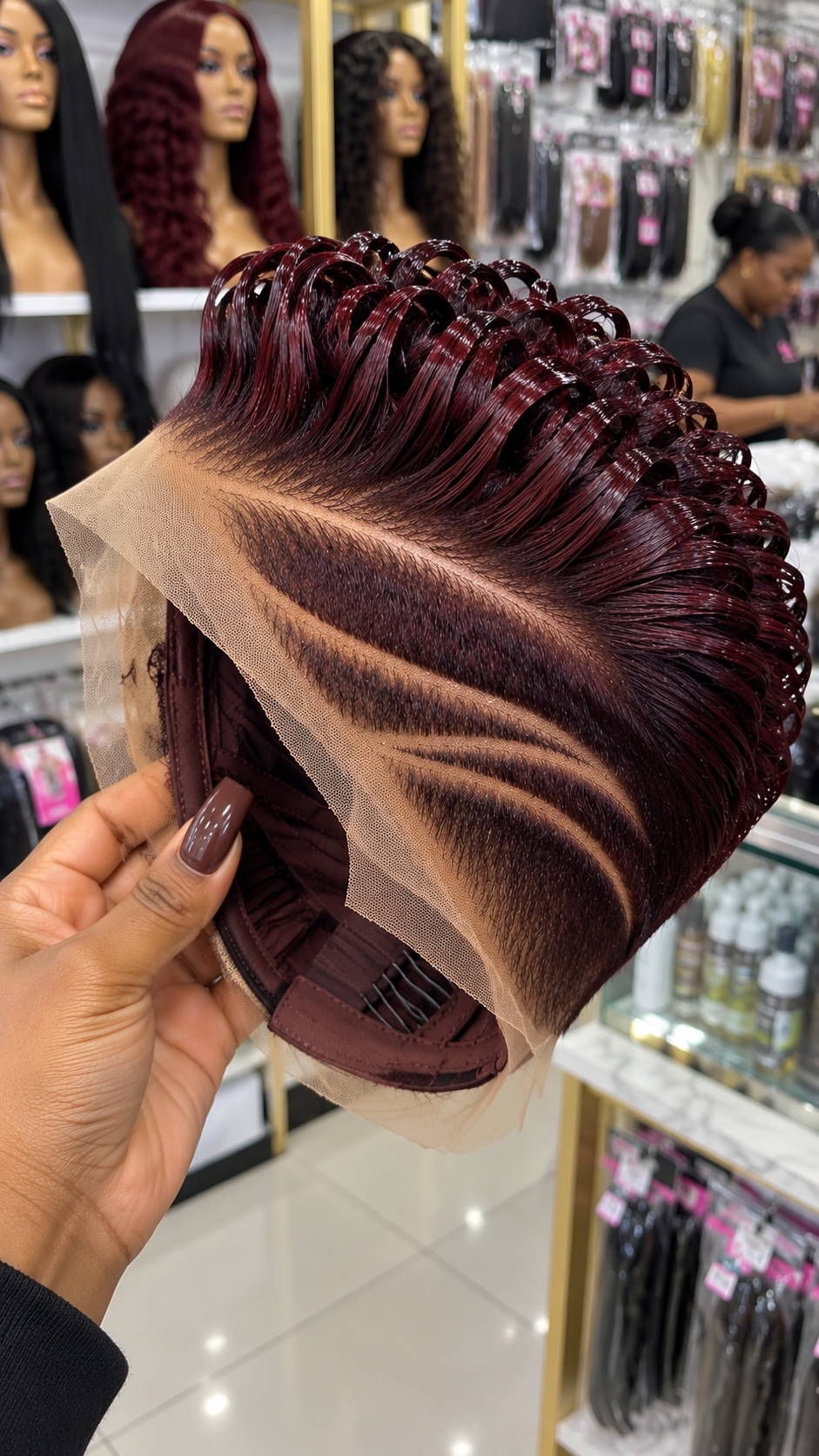
The difference between a convincing sculpted pixie wig and an ordinary curled unit often becomes apparent when the hair is viewed from the side. In this photograph, long burgundy ribbons rise from a darker foundation, fold into elevated arches, and gather into smaller loops toward the visible rear. Beneath them, a closely arranged side section is divided by several pale curved channels. The result is a striking combination of wine-red movement and carefully planned hair geometry.
Presented before installation inside a hair supply shop, the wig is held in one hand with a substantial portion of its beige lace exposed. The camera also reveals a burgundy-brown interior cap, stitched construction sections, and a dark securing comb. These details make the image particularly useful for buyers who want to understand more than the finished hairstyle.
The central attraction is the relationship between the upper ribbons and the layered side divisions. The curls are not uniformly circular across the crown, and the side is not decorated with a simple straight line. Both areas follow a deliberate direction, creating a continuous visual movement from the front toward the rear.


Three Levels of Separation Shape the Visible Side
The side contains a prominent upper parting beneath the elevated curls, followed by additional curved divisions within the closely arranged lower hair. Together, these create a layered arrangement that is more intricate than an ordinary single-line pixie design.
The uppermost channel travels diagonally from the front toward the visible rear. It separates the longer burgundy ribbons from a compact band of darker hair. Fine strands are visible along both edges, giving the parting a carefully arranged appearance.
Beneath this area, a second pale channel follows a sweeping path across the side. A shorter, narrower division is visible nearby, contributing to the layered pattern before the lower curve continues toward the rear.
The lowest prominent channel forms a broad descending arc. Its path becomes especially noticeable near the rear side, where the lighter division contrasts with the dark burgundy-brown hair.
The channels are not perfectly parallel throughout their length. Their spacing and curvature vary, producing a flowing arrangement rather than a rigid sequence of evenly spaced stripes.
The photograph does not establish exactly how the divisions were created. They resemble precision parting or carved hair channels, but the actual technique could involve cutting, controlled hair placement, or another wig-making method. A supplier should explain the construction before any alterations are attempted.
Why the Lower Crescent Deserves Its Own Inspection
The broad lower curve occupies a substantial portion of the visible side. It is not merely a small decorative mark near the temple. Its position contributes to the overall silhouette by dividing the compact lower hair into separate visual areas.
For a custom reproduction, the maker should preserve the lower arc’s direction and approximate relationship to the upper divisions. If it is positioned too high, the side may appear crowded. If it is placed too low, it could approach the lace perimeter and complicate fitting.
Ask for a close side photograph before final approval. The opposite side and complete rear are not sufficiently visible to establish whether the same pattern continues around the entire wig.
Black Cherry and Merlot Reflections Across the Upper Ribbons
The upper hair displays a rich mixture of black cherry, merlot burgundy, and deep wine-red tones. The color appears brighter where light strikes the raised ribbons, while the interior of the curls remains considerably darker.
Near the roots, the hair shifts toward a dark burgundy-brown foundation. The lower side also contains deeper shades, giving the pale parting channels stronger contrast.
The result is not a bright scarlet hairstyle. Its overall appearance is more restrained, with reddish-violet reflections and darker brown undertones.
Several ribbons show narrow bands of reflected light that emphasize the direction of the strands. These reflective areas should not automatically be interpreted as separate highlights. Their brightness may be influenced by the salon lighting and the glossy styling.
When ordering a similar unit, describe the color as deep black cherry burgundy with darker roots rather than requesting generic red hair. A vivid cherry-red product could appear substantially brighter than the reference.
How to Approve the Burgundy Shade Remotely
Ask the seller for a daylight photograph of the actual hair. Burgundy shades can shift noticeably between indoor lighting and natural sunlight, particularly when the color contains both red and violet undertones.
Request a second photograph showing the roots and lower side. This helps confirm that the darker foundation has been preserved rather than coloring every section to the same intensity.
For a custom order, ask whether the maker will use precolored hair or apply color during production. The photograph does not reveal the method, and neither approach should be assumed.
The final visual relationship between the darker base and brighter ribbons matters more than a commercial shade number alone.
Elevated Ribbons Create a Different Crown From Spiral Ringlets
The upper hairstyle is dominated by long, narrow groups of hair that rise from the roots before curving backward. Several form elongated arches with open spaces beneath them. Toward the visible rear, the ribbons become more closely packed and develop smaller looped ends.
This arrangement differs from a crown filled with compact circular finger coils. The front ribbons are taller and more directional, while the rear sections appear denser and more curled.
The strands within each ribbon travel together, producing broad reflective surfaces. Their alignment makes the upper hairstyle appear carefully sculpted rather than randomly curled.
The front portion rises relatively high above the dark foundation. Moving toward the rear, the loops overlap more closely, creating a gradual transition into a compact silhouette.
This progression gives the hairstyle movement without requiring long hanging hair. The curls remain concentrated near the head, allowing the decorative side channels to remain visible.
Preventing the Upper Hair From Concealing the Artwork
A custom maker should pay close attention to the point where the elevated ribbons begin. If they are placed too low, they may cover the upper parting and obscure the lower channels.
Conversely, raising them excessively could make the crown appear disproportionate to the closely arranged side.
Request a side photograph during production showing the relationship between the ribbon height and the exposed partings. A slightly elevated camera angle can also reveal whether the loops are distributed consistently.
The maker should explain how the ribbons retain their shape and whether they require professional resetting after washing. This depends on the confirmed material and styling technique.
The Closely Arranged Lower Hair Supports the Entire Composition
The lower side contains compact, dark burgundy-brown hair arranged close to the cap. Its apparent length is considerably shorter than the upper ribbons, creating a strong contrast in volume.
The hair is not completely absent between the channels. Fine strands remain visible within the separated bands, giving the side a dense appearance despite the lighter divisions.
This density matters because it provides the background against which the curved artwork can be seen. An excessively sparse lower panel could expose construction material or make the pattern appear incomplete.
The lower hair also follows the rounded contour of the wig, helping the side remain compact beneath the elevated crown.
Customers should avoid requesting aggressive thinning merely to emphasize the channels. The underlying cap and available hair density must be considered before any cutting or adjustment.
The Wine-Brown Interior Is a Notable Construction Detail
The exposed underside differs visually from many wigs presented with black interior caps. Here, the visible cap appears burgundy-brown, with stitched fabric sections and a reinforced perimeter.
A dark securing comb is visible near the lower opening. The comb is positioned within the cap structure and appears intended to assist with attachment, although its effectiveness and recommended use cannot be determined from the photograph.
Several stitched sections are also visible. These provide a partial view of the construction but do not establish the complete cap type or ventilation method.
The cap color should not be confused with the fiber color or treated as evidence of a particular manufacturing standard. It is simply a visible characteristic of the photographed unit.
Before purchasing, request an underside photograph showing the full perimeter, any additional combs, adjustment straps, clips, and the available lace area.
Visible securing hardware does not prove that the wig is suitable for adhesive-free wear under every condition. Cap sizing and the recommended installation method still need to be confirmed.
Untrimmed Beige Lace and the Importance of Side Placement
The wig has a broad beige lace extension along the front and visible side. The mesh remains uncut and extends beyond the closely arranged hairline, making its general shape easy to examine.
Fine strands emerge near the lace boundary, particularly around the lower side. The mesh continues beneath portions of the decorative design, providing material that may be adjusted during fitting.
However, the photograph does not establish the exact lace classification. The material should not be described as HD lace without independent product confirmation.
Because the curved channels approach the front and lower side, trimming requires care. Removing too much lace could interfere with the intended hairline or expose unwanted construction details.
A professional installer should position the wig on the wearer’s head before deciding how much material can safely be removed.
The cap must sit correctly for the layered channels to align with the temple. If the unit is positioned too far forward or backward, the artwork may appear displaced.
Commissioning the Hairstyle Without Losing Its Directional Design
When contacting a custom wig maker, begin with the side profile rather than the color. Explain that the design contains elevated burgundy ribbons above a closely arranged side with multiple curved divisions.
Send the reference photograph and identify the broad lower crescent, the upper parting, and the shorter intermediate channel.
Next, discuss the upper styling. The maker should understand that the hair forms elongated backward arches rather than small circular coils.
Confirm the proposed cap size, lace specifications, hair material, and construction method. These details cannot be established reliably from the photograph alone.
Ask whether the maker has previously produced sculpted pixie wigs with precision side artwork. Examples of similar work are more useful than a general portfolio of long curly wigs.
Where to Search and What to Ask Before Booking
Look for custom wig studios, lace wig customization specialists, and stylists experienced in sculpted pixie hairstyles. Search descriptions such as burgundy ribbon curl wig, precision side parting pixie, and black cherry sculpted lace wig may help narrow the available options.
For local purchases, ask whether the salon offers fitting appointments and whether it can reproduce the side pattern on a suitable wig base.
For online orders, request photographs of the actual finished unit before shipping. The seller should provide front, side, rear, and underside views.
Ask whether customization, lace preparation, shipping, and installation are included in the quotation. Also confirm the return policy before requesting permanent alterations.
A Sensible Production and Fitting Sequence
The first stage should establish the cap measurements and intended position of the side artwork. The maker may request head circumference, front-to-nape distance, ear-to-ear measurements, and temple measurements.
Next, the lower hair arrangement and curved channels should be planned. Request a side photograph at this stage so the geometry can be evaluated before the upper ribbons are completed.
Once the lower design is approved, the maker can finalize the burgundy ribbon arrangement. The upper hair should remain elevated enough to reveal the partings without becoming excessively tall.
Before shipping, inspect photographs of the color, curl direction, cap interior, and lace perimeter.
When the wig arrives, examine the unit before trimming the lace. Check the visible comb, stitching, hairline condition, and whether the ribbons have retained their arrangement during transport.
At the fitting appointment, the stylist should establish the cap position, evaluate the securing method, and prepare the lace carefully. Any curl adjustments should use techniques appropriate for the confirmed fiber.
Estimated Budgets for Black Cherry Sculpted Pixie Wigs
The following USD amounts are illustrative planning ranges rather than verified live prices. The actual cost of a comparable wig will depend on hair material, cap construction, color preparation, ribbon styling, and the labor required for the layered side pattern.
| Wig Category | Illustrative USD Range | Potential Purchase Scope |
|---|---|---|
| Premium Custom | $350–$790+ | Individual measurements, elaborate ribbon styling, deep burgundy color placement, layered curved side artwork, and personalized lace preparation. |
| Standard Custom | $185–$395 | Customized wine-red styling with elevated arches and professionally arranged side divisions. |
| Basic Human Hair | $110–$260 | A human-hair pixie base that may require separate coloring, ribbon setting, and precision side customization. |
| Premium Synthetic | $75–$195 | Higher-priced synthetic options with burgundy coloring and prearranged curls, subject to manufacturer specifications. |
| Basic Synthetic | $30–$105 | Budget burgundy pixie alternatives that may resemble the color but lack the elaborate side divisions and elevated ribbons. |
One important cost factor is the complexity of the lower artwork. Multiple curved channels require careful planning and may involve more labor than a single side parting.
The elevated ribbon arrangement can also affect pricing because the sections must maintain their direction and spacing.
Color preparation may increase the quotation if the customer requests a particular balance between dark roots and merlot-colored lengths.
Installation, cap alterations, shipping, and future restyling may be charged separately. Buyers should request an itemized quotation rather than comparing only the advertised wig price.
The photograph does not establish whether the displayed wig is human hair, synthetic, or a blend. The categories above describe possible purchasing choices, not verified characteristics of this unit.
Care Priorities for Wine-Red Ribbons and Curved Side Divisions
The upper styling depends on the position of individual hair sections. Repeated brushing or compression can disturb the elongated arches and cause neighboring ribbons to merge.
Before washing, confirm the material and obtain the maker’s recommended care instructions.
If the wig is made from human hair, repeated heat styling and washing may affect the ribbon arrangement. If the burgundy shade was produced through chemical coloring, its processing history may influence how quickly the color changes.
If the wig is synthetic, heat compatibility must be verified before using heated tools. Some fibers may deform permanently when exposed to unsuitable temperatures.
Avoid saturating the ribbons with heavy products. Excessive residue can reduce strand separation and make the elevated sections appear less distinct.
The lower side should be handled gently. Brushing across the curved channels may move strands into the lighter divisions and reduce the clarity of the pattern.
Do not attempt to deepen the channels with clippers or a razor without professional assessment. Depending on the construction, additional cutting could damage the cap or permanently change the artwork.
For storage, use a suitably sized wig stand that supports the cap without pressing against the upper ribbons. Protective packaging should provide enough space to prevent the arches from being crushed during transport.
Choosing Craftsmanship Over a Generic Burgundy Pixie
The most valuable characteristic of this wig is the coordination between its elevated wine-red ribbons and the layered crescent-shaped side divisions. The dark foundation provides contrast, while the glossy upper strands create movement and height.
Customers seeking a faithful reproduction should prioritize the placement of the curved channels, the backward direction of the ribbons, and the relationship between the burgundy lengths and darker roots.
The exposed lace and interior comb provide useful construction clues, but they do not replace accurate product specifications or a professional fitting assessment.
A well-planned purchase should include photographs of the actual finished wig, confirmation of the hair material and cap measurements, and a clear explanation of the required maintenance.
With these details established, a similar unit can offer a distinctive combination of sculpted burgundy hair, carefully arranged side geometry, and a compact pixie silhouette that rewards close attention to the craftsmanship.
Search Terms
Black cherry burgundy ribbon curl lace wig · Merlot pixie with layered crescent partings · Wine red elevated arch curl hairstyle · Burgundy brown cap wig with securing comb · Dark cherry side panel curved channel wig · Untrimmed beige lace merlot pixie unit · Glossy burgundy backward ribbon crown · Multi curve temple design burgundy lace wig